
On a cold winter morning, a branch of small white and pink flowers opens against bare wood, and a faint sweet scent drifts over a garden wall before you see the tree. That is the ume, the Japanese plum, and it flowers while the rest of the landscape still looks like winter. Plum blossom season runs through the coldest part of the year and ends around the time spring flowers take over, which makes it a different trip from the cherry blossom one.
When does the plum blossom bloom in Japan?
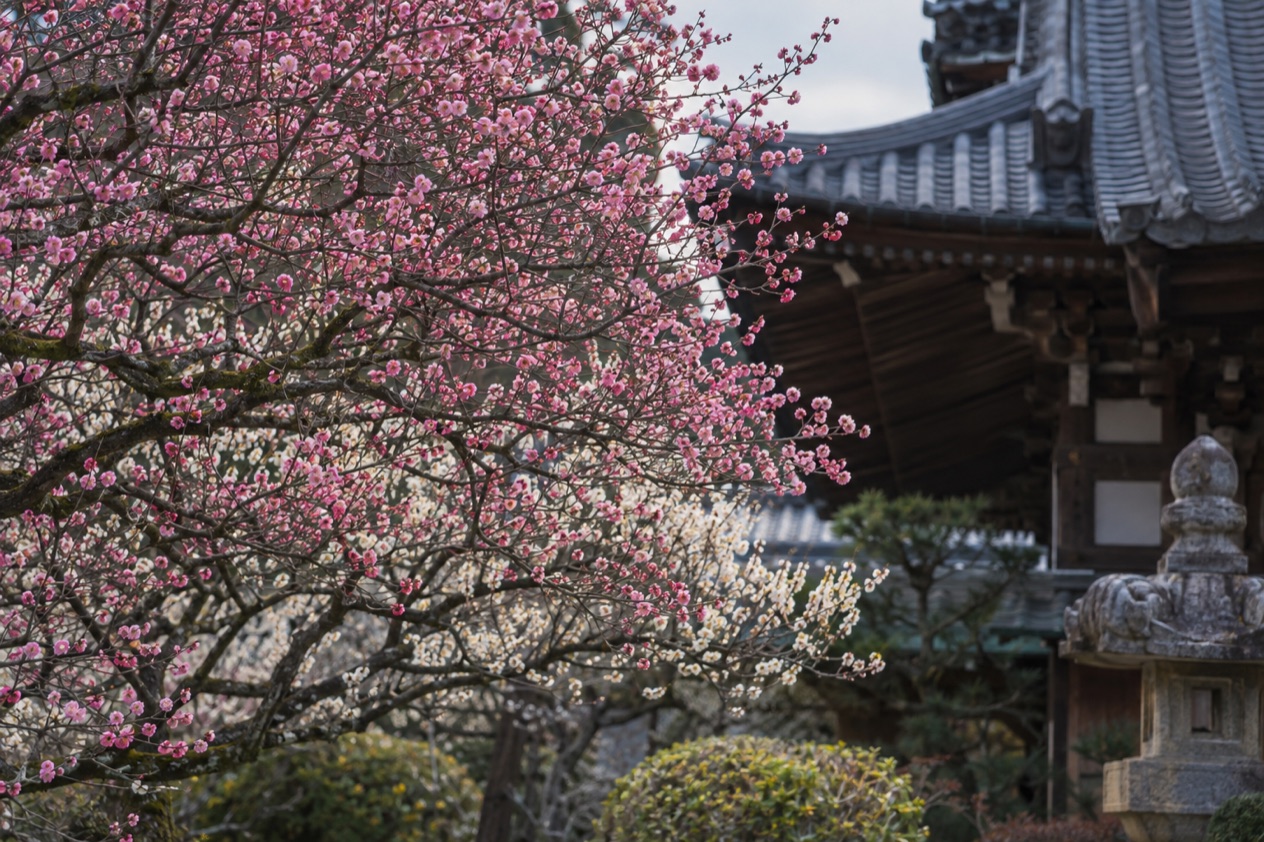
The plum blossom opens in the depths of winter, a good while before the cherry trees, and its flowering usually ends by the close of February. The tree behind it is Prunus mume, called ume in Japanese, and across East Asia it typically flowers from January until late February. In practice that means a season measured in weeks that sit squarely in the cold months, when a coat, gloves and a scarf are part of the outing.
Because the flowering stretches across several weeks, the trees do not all open at once. Early buds, half-open branches and full flowering can all be on view in the same garden, and a cold spell can hold the buds back while a mild one brings them on. From one winter to the next the timing shifts a little, so it pays to think of the season as a window rather than a single date.
The plum year at a glance
| Stage | Timing |
|---|---|
| Blossom | January until late February |
| Plums harvested for umeboshi | Late May or early June |
| Fruit ripens, with the rainy season called plum rain | June and July |
| Salted plums weighed down with a heavy stone | Until late August |
The flowers are only the first chapter. The tree keeps working through the year, and the Japanese calendar of food follows it closely. The fruit ripens as the East Asian rainy season arrives, which is why that season is known as meiyu, or plum rain. The name tells you how closely the tree is tied to the weather of the year.
After the flowers: umeboshi and umeshu
If you are in Japan in winter, the flowers are what you come for, but the fruit explains why the tree is so beloved. Plums for umeboshi, the salty, sour pickled plums that sit in the middle of a rice ball or beside a bowl of rice at breakfast, are picked while still firm and just turning yellow. They are layered with a great deal of salt and weighed down with a heavy stone, then dried in the sun on bamboo mats for several days.
Umeshu is the sweeter side of the story. Green plums are steeped in shochu, a clear Japanese liquor, and the result is a smooth, sweet drink that you can order in many kinds of bars and restaurants, on the rocks or mixed with soda. Neither the pickles nor the liqueur are made in February, but both are the reason you will see orchards and old trees treated with such affection when the blossom comes.
What the tree looks like
Prunus mume can grow to a height of about 13 to 33 feet, so some trees are small enough to lean over and smell and others are proper trees that fill a corner of a garden. The branches are dark and gnarled, and the flowers sit directly along them in clusters, white, pale pink or deeper rose depending on the variety. The blossoms are small, but because the branches are bare they stand out sharply, and the scent often reaches you before the sight does.
Where can you see it?
You see plum blossom in the places where Japanese people have long planted ume: gardens, temple and shrine grounds, parks and orchards. It is a tree of the garden more than of the avenue, which shapes the way you look for it. Rather than a single famous viewpoint, think of a quiet walk through grounds where a few old trees stand among stone lanterns and gravel paths.
Gardens, shrines and temples
Japanese tradition holds that the ume works as a protective charm against evil. That is why it was planted in the northeast of the garden, the direction from which evil is believed to come. Knowing this changes how you look at a garden: the plum in the corner is there on purpose, and finding it is part of reading the layout.
Temple and shrine grounds, with their stone paths, wooden halls and small ponds, suit the flowers well. A branch of blossom over a roof tile or a stone lantern is the kind of image you will want to photograph.
Many visitors treat the visit as a slow stroll that includes a stop for tea or a sweet, and the plum is the reason to go out in the cold. Opening hours and admission differ from site to site, so look them up for the specific garden you choose.
Orchards and parks
Beyond the formal gardens, ume are planted in groves and orchards grown for their fruit, and in parks where rows of trees turn a hillside white and pink. The same trees that give you blossom in winter give the harvest in late spring, so a grove is a place where you see the whole cycle on one site. Walking among the rows, you notice how different the trees look from the neat, pruned ones in a temple courtyard: more open, more wild in outline, and heavy with flowers.
There is no need to chase a single destination. Whichever city you are in, ask where the local plum garden or grove is, and you will usually be directed to a park, a shrine or a hillside that the people living nearby visit every winter. These are often more modest than the spring cherry spots, which suits a visit built around a walk and a warm drink rather than a spectacle.
Plum viewing as a custom
The custom of looking at plum blossoms has its own name, umemi, which means plum-viewing. It is a quiet pastime compared with a hanami picnic.
People stop under a tree, notice the scent, take a few photographs and move on, and the pleasure lies in small details: the shape of a branch, the shade of a petal, the way a flower holds a little frost. Treat the visit as a short winter pause, not a day with a fixed program.
How does it differ from cherry blossom?
The plum blossom comes first, in winter, and the cherry blossom comes after, as the one that marks the arrival of spring. Sakura is one of Japan’s most iconic symbols and the most famous flower in the country, and it is described as a harbinger of spring. The ume belongs to the cold months, so the two do not overlap in the way their reputations might suggest.
Timing and mood
With plum, you are visiting in the cold, in a coat, and the flowers are one of the few bright things in a bare landscape. With cherry, you are visiting at the turn of the seasons, and the blossom is the event that the whole country watches. The plum trip is the smaller, quieter version: fewer flowers on each tree, a more intimate scale and a pace that suits a garden walk.
This difference also affects how you plan. Plum blossom does not carry the sense of a national countdown that sakura does, so the experience is less about being in the right city on the right day and more about picking a garden and enjoying what is open. If you hope to see both on one trip, they belong to different times of the year, and one visit will not cover them.
The look, the scent and the tree
Plum flowers sit tight against dark, twisting branches, in white, pink and deeper reds. The scent is a big part of the experience, sweet and clear in cold air, and it is something photographs never capture. Cherry blossoms hang in large, soft masses and are known more for their look than for their fragrance, so the two flowers ask you to use different senses.
The tree also earns its place by what it produces. The plum gives fruit for umeboshi and umeshu, which is why it appears on the table as well as in the garden. Cherry is the flower you look at, and plum is a flower you look at and later taste.
Other flowers on the Japanese calendar
Once the plum is finished, the flower calendar moves on. In Toyota, in Aichi Prefecture, peach trees signal the arrival of spring, with a long stretch of weeping peach trees in white, red and pink. Tulips follow, with a sea of them at Grinpa amusement park against Mount Fuji, and Tonami Tulip Park in Toyama holds millions of bulbs in varied colors.
Blue nemophila at Hitachi Seaside Park is praised by CNN in spring, and the wisteria tunnels at Kawachi Fujien Wisteria Garden stretch for over 100 meters in purple, blue and white. Hydrangeas take over in early summer, with Hasedera Temple in Kanagawa one of the prime spots, and Hokkaido brings sunflowers and lavender, the latter at its peak in July at Tomita Farm.
Cosmos fields in Toyama carry the story into October. Plum is simply the opening act of that long sequence.
Good to know before you go
A plum blossom visit happens in winter, so dress for cold mornings and for time spent standing outdoors among bare branches. The season is one of walks, hot drinks and slow looking, and it pairs naturally with a meal that includes umeboshi or a glass of umeshu. Gardens and temples set their own hours and admission, so look up the one you plan to visit before you head out, and remember that the flowers can open a little earlier or later from one winter to the next.
Sources
- Japan National Tourism Organization, flowers by season: cherry blossom, plum, wisteria, hydrangea, where and when (https://www.japan.travel/en/see-and-do/flowers/), checked October 11, 2026
- Wikipedia, Prunus mume (https://en.wikipedia.org/wiki/Prunus_mume), checked October 11, 2026
To plan your stay
- Japan Rainy Season (Tsuyu): Dates, Regions and How to Plan Your Trip
- Seasons in Japan: Blossoms, Fall Color, Snow Festivals and Summer Matsuri
- Typhoon Season in Japan: When It Hits, Which Regions Take the Brunt and How the Warning Alerts Work
- Autumn Leaves Dates by City: Usual Maple Dates, 2025 Results and How Much They Shift