
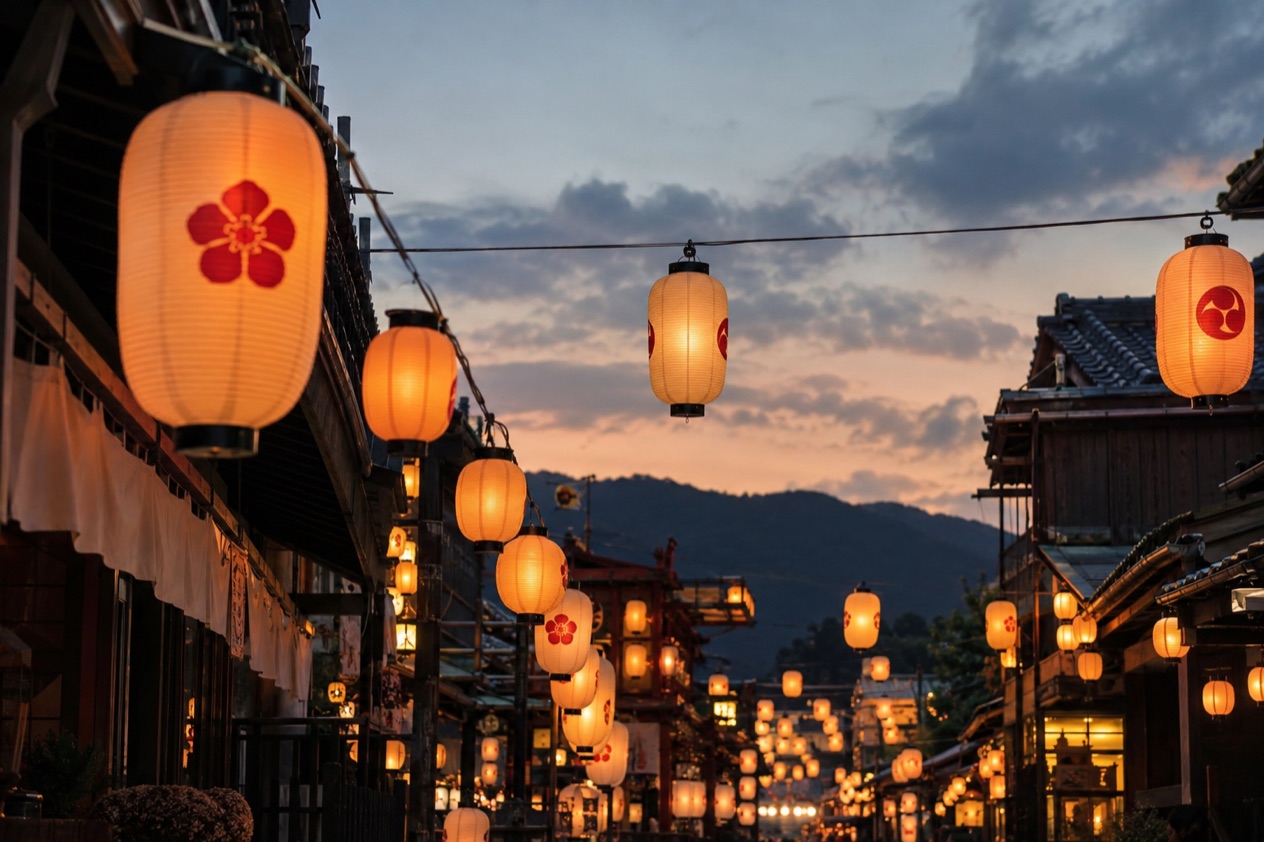
On a summer evening in mid-August, the sound of taiko drums drifts across a neighborhood square, and people in light cotton robes step slowly in a circle around a wooden tower strung with lanterns. Nearby, a family is sweeping a gravestone and setting out flowers. This is Obon, the season when Japan remembers its ancestors, and it shapes both the festivals you may stumble into and the rhythm of the towns you pass through.
What is Obon?
Obon is a Japanese Buddhist custom to honor the spirits of one’s ancestors, and it brings people back to the places their families come from. Relatives gather at the family home, visit the graves, and clean them. The mood is a mix of remembrance and reunion, closer to a family homecoming than to a spectacle staged for visitors.
The festival lasts for three days, and the idea behind it is that the souls of the departed return to their families for a short stay. Households welcome them, and at the end they are sent back. Much of what a traveler sees, from the dancing to the fires on the hills, belongs to one of those two moments: the welcome or the farewell.
The Bon dance
The typical Bon dance has people lining up in a circle around a high wooden scaffold called a yagura. The yagura is usually the bandstand, where musicians and singers play while the ring of dancers moves around it. The steps are simple repeating patterns, and the circle is open, so neighbors, grandparents and children all end up in the same ring.
Because Obon falls in the heat of summer, participants traditionally wear yukata, a kind of light cotton kimono. In the evening you see them on the street before you see the dance itself: families walking toward a shrine ground or a park, fans tucked into belts, wooden sandals clacking on the pavement. If you are watching, standing at the edge of the circle and following the movements of the dancers is a pleasant way to take part without needing to know the choreography.
Sending the spirits back
On the third day of the festivities, souls are sent back with fires called okuribi, which means sending fire. In some places this is a small fire lit at a doorway or a graveside. On a larger scale it becomes the burning of a giant character on a mountainside, and small lanterns are floated down a river, each carrying a wish or a name.
These farewells are the images most often associated with Obon, and they are quiet in spirit even when people gather to watch. The flames and the drifting lanterns are the end of the visit, not a show for its own sake, and that is a good frame of mind for anyone standing on the riverbank.
Local traditions worth knowing
Obon looks different from one region to the next, and several local versions have become destinations in their own right. Kyoto lights Gozan no Okuribi, a bonfire lit during the Obon festival. Hokkaido is known for the folk song Soran Bushi during Obon. Gujo in Gifu Prefecture is famous for all-night dancing, and Tokushima in Shikoku is very famous for its Awa Odori dance.
| Tradition | Place |
|---|---|
| Gozan no Okuribi (bonfire) | Kyoto |
| Soran Bushi (folk song) | Hokkaido |
| Gujo Odori (all-night dancing) | Gujo, Gifu Prefecture |
| Awa Odori (dance) | Tokushima, Shikoku |
Each of these has its own character. A bonfire on a mountainside is a watching event, while Gujo and Tokushima are about moving with the crowd.
When is it?
Obon takes place in mid-August, and it is a traditional family holiday during which people return to their hometowns. The festival itself lasts for three days, with the welcome of the spirits at the start and the okuribi fires on the final day. Local celebrations in some towns stretch their dancing and events around those days, so you may find a festival on an evening just before or after the core of the holiday.
Not a public holiday, but a holiday in practice
Obon days are not listed as public holidays in Japan, but it is customary for people to be given leave. That is why the season feels like a national break even though the calendar does not mark it in red. Compare that with Golden Week in late April and early May, whose days are fixed national holidays: Showa Day on April 29 opens it, Constitution Memorial Day on May 3 and Greenery Day on May 4 follow, and Children’s Day on May 5 closes it.
The practical result is that Obon is defined by custom more than by law. Some workplaces give time off and others handle it differently, so the experience in a given town depends on who lives and works there.
Why the date matters for planning
Mid-August is summer in Japan, and the festivals are built around that: yukata, outdoor dancing, lanterns on the water and fires lit after dark. Planning a trip around Obon means planning for a hot, outdoor season, and the best moments tend to come in the evening when the dances and farewells begin.
Dates of individual festivals vary by town, and the exact days are set locally, so a trip aimed at one specific event should be built around that event’s own announcement. What the season gives you in general is a window of days in the middle of the month when the whole country is thinking about family, graves and the departed.
Obon outside Japan
You do not have to fly to Japan to see a Bon dance. The Japanese Botanical Garden in St. Louis, Missouri has hosted an Obon festival over Labor Day weekend every year since 1977. It follows the American calendar rather than the Japanese one, but it carries the same ingredients of music, dancing and remembrance, and it is a reminder that Obon travels with Japanese communities.
How does it affect travel?
Obon changes travel mainly because so people head for their family hometowns, and because a customary break from work gives the season the feel of a national vacation. The country keeps running, but the people on the move and the places they head for are different from an ordinary week.
Cities and the daily routine
In urban areas, shops are generally open from 10:00 a.m. to 8:00 p.m. every day, and many convenience stores such as 7-Eleven, FamilyMart and Lawson stay open 24 hours a day, even on national holidays. That gives you a dependable base for snacks, drinks and basic errands whatever the season. Because Obon leave is customary rather than official, some smaller businesses may keep their own schedule, so a favorite restaurant may follow a family’s break rather than the posted hours.
Offices open from 9:00 a.m. to 5:00 p.m. on weekdays and close on weekends, and the weekday pattern of trains follows from that. Most trains run from about 5:00 a.m. to midnight. On weekdays the morning rush runs from about 7:30 a.m. to 9:00 a.m., when trains on major lines can be extremely crowded, and the evening rush from 5:30 p.m. to 7:00 p.m. During Obon, when many workers are away on leave, the workday pattern in a big city may be looser than usual, but the hours above are the framework to plan around.
Hometown travel and the countryside
The movement of people is the heart of Obon travel. Families head to ancestral places, which are often smaller towns and rural areas, and those same places hold the local dances and farewell fires. In rural areas, shops often close earlier, sometimes as early as 6:00 p.m., so evening plans in a small town should leave room for dinner before the dancing begins.
If you travel to a festival town, expect that the town itself is the event. Kyoto’s bonfire, the dancing at Gujo and the Awa Odori in Tokushima draw people who come for them, and the same holds for smaller circles around a yagura in a village park. Arrive with the idea that you are joining a community occasion, and that evenings are when the season comes alive.
Temples, shrines and graves
Shrines and temples in Japan are generally open all year and often accessible from early morning until late afternoon, so they remain places you can visit during Obon. Since the season is about honoring ancestors, temples may be busier with local families visiting graves, and a visitor is a guest in what is first of all a family occasion.
Walking through a temple cemetery or past a family tending a grave is part of the atmosphere, and the respectful approach is the usual one: keep your voice low, keep your camera away from people at their ancestors’ graves, and let the family have its moment. The cleaning of graves is a quiet task, and the flowers and incense you see are signs of it.
Compared with New Year and Golden Week
Japan has other seasons that move the whole country. During the New Year period, from late December to early January, many shops close for several days. During Golden Week, from late April to early May, you can expect heavy crowds and full transportation across Japan. Obon sits between those in spirit: a family holiday that sends people home, with local festivals as its public face.
The difference for a traveler is in the details. New Year is about closures, Golden Week is about crowds on the move, and Obon is about hometowns and evening festivals. Thinking of it that way helps you choose what to do: seek out a dance, a bonfire or a lantern farewell, and let the rest of the day follow the ordinary rhythm of the place you are in.
Good to know before you go
Mid-August is the heat of the summer, which is why the dances are held in the evening and why yukata are the traditional dress. Bring lightweight clothing and plan for outdoor time after dark. Obon is a family and remembrance season, so treat festivals as community events: join the edge of a dance circle when you are welcome, watch the lantern farewells from a respectful distance, and keep a gentle tone around graves and temples.
Sources
- Japan National Tourism Organization, shop and attraction hours, national holidays (https://www.japan.travel/en/plan/business-hours-and-holidays/), checked October 11, 2026
- Wikipedia, Obon (https://en.wikipedia.org/wiki/Obon), checked October 11, 2026
- Wikipedia, Public holidays in Japan (https://en.wikipedia.org/wiki/Public_holidays_in_Japan), checked October 11, 2026
To plan your stay
- Japan Rainy Season (Tsuyu): Dates, Regions and How to Plan Your Trip
- Seasons in Japan: Blossoms, Fall Color, Snow Festivals and Summer Matsuri
- Typhoon Season in Japan: When It Hits, Which Regions Take the Brunt and How the Warning Alerts Work
- Autumn Leaves Dates by City: Usual Maple Dates, 2025 Results and How Much They Shift