
In July the slopes of Niseko are covered in green instead of snow, and the volcanic ridge above the villages stands out against a sky that stays light well into the evening. Fields of potatoes and corn fill the valley floor, and the ski lifts that dominate the winter postcards hang still above the grass. It is a different Niseko from the one visitors know, a mountain district in summer dress, and this is how it looks for a traveler arriving in July.
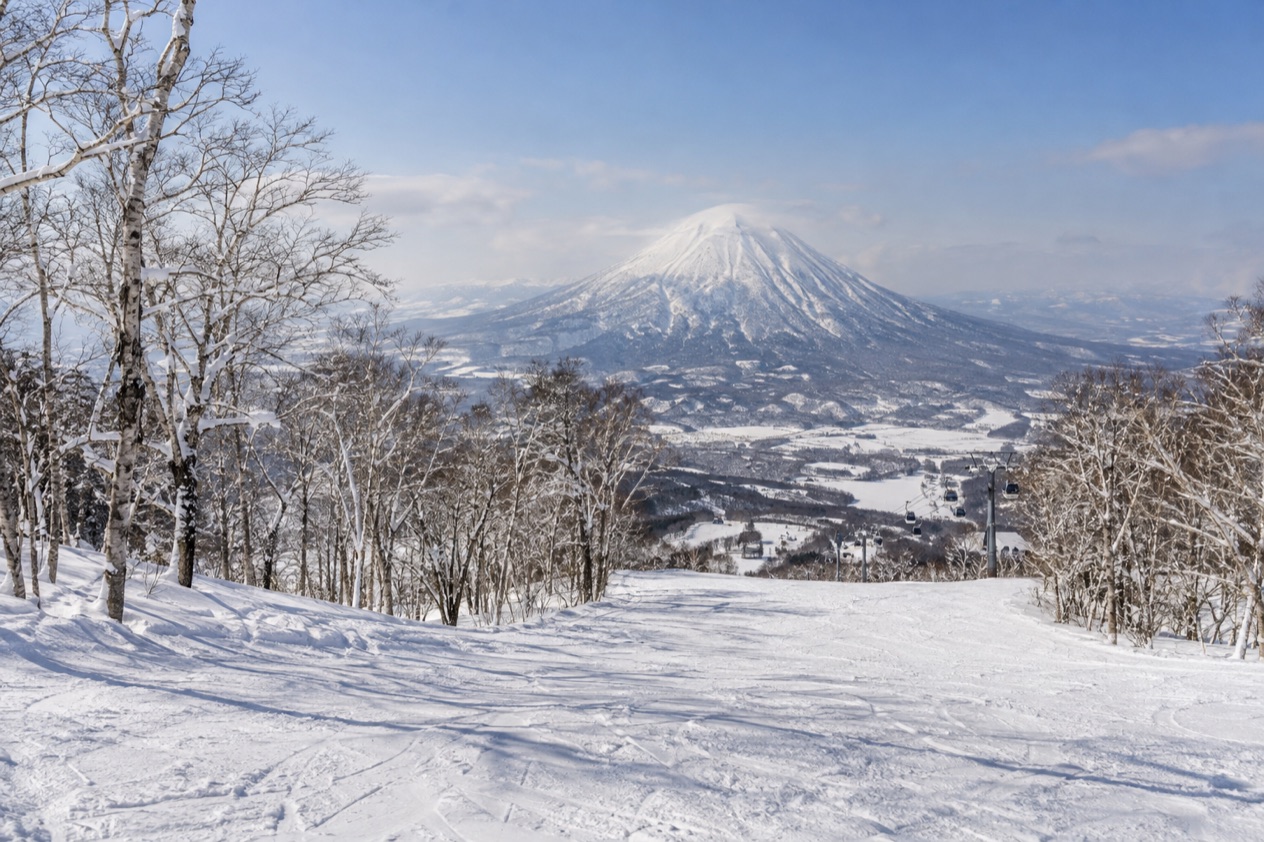
What is the weather like in Niseko in July?
July in Niseko is mild to warm, with comfortable afternoons, cooler nights and a fair amount of cloud and rain, a clear step up in warmth from June.
| Month | Average high (°F) | Average low (°F) | Precipitation (in) | Days with 1 mm or more of precipitation | Hours of sunshine | Daylight on the 15th |
|---|---|---|---|---|---|---|
| June | 69.6 | 52.3 | 2.36 | 8.0 | 170 | 15 h 19 min |
| July | 75.9 | 61.0 | 4.03 | 8.6 | 144 | 15 h 04 min |
| August | 77.7 | 62.1 | 6.03 | 9.9 | 150 | 13 h 59 min |
What this means on the ground is a month of layers rather than extremes. A T-shirt works for walking in the valley, but evenings call for a light sweater or a thin jacket, and anyone heading up toward the ridge should expect it to feel cooler than in the villages. The air is humid, around 83 percent at Kutchan, so a damp, close feeling is part of a July day, and rain gear belongs in the daypack.
Rain is a little heavier than in June but spread over roughly the same number of days, so the month is more a matter of passing wet spells than of washed-out weeks. A waterproof shell is more useful than an umbrella on trails and village lanes. Sunshine runs lower than in June, which makes for soft, often cloud-filtered light over the fields.
Daylight is generous, with the sun staying up past the hour when dinner is usually served, which leaves a long evening for a walk after the meal. Days are already a little shorter than in mid-June, a trend that continues into August.
What to do in Niseko in July
July is the green season, and the pleasure of Niseko in this month is the landscape itself: a mountain range of volcanic peaks, farmland below, and a region of Hokkaido with no shortage of fresh produce. Niseko is known as Japan’s most famous ski area, with powder snow and a welcoming atmosphere that draws many foreign visitors, but in July none of that is on offer and the place has to be enjoyed for what remains once the snow is gone.
Much of the mountain range lies within the Niseko-Shakotan-Otaru Kaigan Quasi-National Park, so the scenery around the resorts is largely protected land. Walking among the green slopes, the birch and the open fields is the natural way to spend a July day here, with the peaks of the Niseko volcanic group as a backdrop in clear weather.
Four resorts, one mountain
Niseko United describes itself as one mountain with four resorts, and in July the four are four different bases for exploring. Annupuri lies on the eastern part of the volcanic group, Niseko Village and Grand Hirafu hold the main clusters of lodgings and restaurants, and Hanazono is the fourth. Each has its own character, and wandering from one to another gives a sense of how the district is laid out.
Grand Hirafu is where you would start for cafés, bakeries and dinner options after a day outdoors. Annupuri suits those who want to stay near the mountain and its quieter feel. With the lifts silent in the green season, the buildings and the open slopes tell the story of the winter that defines the place, and that contrast is part of the charm of a July visit.
The taste of Hokkaido in summer
Hokkaido is known across Japan for its produce, and July tables here lean on corn, potatoes, tomatoes and melon, along with dairy such as fresh milk, soft-serve ice cream and cheese. A bowl of soup curry, a Sapporo specialty with a spiced broth and big pieces of vegetables, is a satisfying answer to a cool, damp evening. Grilled lamb, called jingisukan, is another dish of the island.
Cafés and bakeries in the resort villages turn local ingredients into pastries and sandwiches, while izakaya, the casual Japanese pubs, pair small plates with beer or sake. The mild July evening, with daylight still lingering, suits a slow meal. Fruit from Hokkaido farms often turns up in desserts and drinks during these warm weeks.
Onsen and slow evenings
Hokkaido’s volcanic geology means hot springs are part of the region’s life, and an onsen soak is a natural way to end a day of walking in damp or cool weather. The ritual is the same as elsewhere in Japan: wash first, then soak, and leave the towel out of the water. After a bath, the evening is for a light meal and an early night in the cool mountain air.
Staying in a ryokan, the traditional inn with tatami floors and a meal served in the room or dining hall, adds another layer to the visit, though the choice of lodging depends on what you find in the resort villages.
Day trips take in the wider Niseko Tourism Zone, which spans the municipalities of Kutchan, Niseko and Rankoshi. It is about a three-hour drive from Sapporo, which makes a stay of a few nights more sensible than a rushed visit, and the rhythm of the place rewards staying put.
A two-day itinerary for Niseko in July
Day 1. Start with a slow breakfast in Grand Hirafu, where bakeries and cafés give the village its morning rhythm. Spend the late morning walking among the slopes and fields around the village, looking up at the ridge of the volcanic group. Lunch can be a bowl of soup curry or a plate built around Hokkaido vegetables.
In the afternoon move on to Niseko Village, the second cluster of lodgings, and stroll through its grounds and the surrounding greenery. Daylight lasts past 8 p.m. in the evening, so there is room for a long walk before dinner. Dinner at an izakaya brings grilled meats, vegetables and cold beer, and an onsen soak closes the evening.
Day 2. Head to Annupuri on the eastern side for a morning among the green slopes at the foot of the peak, within the quasi-national park. Hanazono, the fourth resort, fills the afternoon, with its own cafés and open terrain. For a last meal choose lamb, corn or a dairy dessert. If rain sets in, the day turns to cafés, a long lunch and an onsen, which suits a damp afternoon well.
Is Niseko busy in July?
Niseko’s fame rests on its winter powder snow, and July belongs to a different, greener side of the place, so the winter picture of crowded lifts does not carry over to this month. The district is best understood as a mountain resort area in its off-season rhythm, where the pace is set by walks, meals and soaks rather than by a lift line.
The resort villages remain open for visitors, and the four areas, Annupuri, Niseko Village, Grand Hirafu and Hanazono, are all available to explore. For rooms and tables, the details vary from one property to another, so what matters is choosing a base that suits the way you want to spend the days.
The green season gives the mountains a different mood. Instead of the white of winter, the ridge is dark green, the fields below are cultivated, and the villages feel more like a countryside retreat than a ski town. For a traveler, that means a slower, more local experience, built around the landscape and the table.
What to pack for Niseko in July
Pack for mild days, cooler nights and passing rain, with clothing that works in layers and shoes that handle damp ground.
- A waterproof shell, because rain showers come on several days of the month.
- A light sweater or fleece for evenings, which cool down noticeably.
- Comfortable walking shoes that can handle wet grass and trails.
- T-shirts and light trousers for the warmer afternoons in the valley.
- A small daypack to carry layers between the villages and the slopes.
- A swimsuit or small towel for onsen visits, according to the bath you choose.
Good to know before you go
July is wetter than June in Niseko, with humid air and a gray spell now and then, so a flexible plan with indoor options like cafés and onsen is useful. Niseko sits in southwestern Hokkaido, in a region where the climate is humid continental, and the green season is short, which is part of what makes July here distinctive. The area is spread across several resort villages, so deciding on a base early helps shape each day.
Niseko in July vs June and August
Moving earlier to June brings cooler days and lighter rain, with more sunshine and the longest daylight of the three months. The air is crisper, the evenings need a warmer layer, and the landscape is fresh green. It suits travelers who prefer walking in cooler air over warm afternoons.
Moving later to August brings the warmest days of the three and the heaviest rain, with daylight already noticeably shorter. The mountains are at full summer green, and the evenings are the mildest of the three months. It suits those who like warmth and do not mind a wetter month.
July sits between the two, with warmer days than June and a rain pattern lighter than August. Choose June for coolness and long days, August for warmth, and July for a balance of both.
Is July a good time to visit Niseko?
Yes, for travelers who want mountain scenery, Hokkaido food and onsen evenings rather than skiing. July suits walkers, food lovers and anyone happy to pace the day around a long meal and a hot bath, but it is not the month for powder snow, and anyone who comes to Niseko for the slopes should choose winter instead.
On arrival, settle into your chosen resort village and take a first walk to see how the four areas sit against the ridge. After that, let the weather guide the day: walks and views when the sky is clear, cafés and onsen when the rain comes in. What is special about July in Niseko is seeing a famous winter mountain in its green season, with the ridge dark against the sky and the fields full of vegetables, and a long light evening over the villages.
Sources
- Japan Meteorological Agency (JMA), Normal values 1991-2020, monthly (https://www.data.jma.go.jp/stats/etrn/view/nml_sfc_ym.php?prec_no=16&block_no=47433), station Kutchan, elevation 176 m, checked October 11, 2026
- Computed from the date and the latitude of the place (sunrise equation, solar elevation -0.833 degrees), October 11, 2026
- Japan National Tourism Organization, weather and seasons in Japan (https://www.japan.travel/en/plan/weather/), checked October 11, 2026
- Wikipedia, Climate of Japan (https://en.wikipedia.org/wiki/Climate_of_Japan), checked October 11, 2026
- Japan National Tourism Organization, summer in Japan (https://www.japan.travel/en/guide/summer-guide/), checked October 11, 2026
- Japan National Tourism Organization, festivals and events (https://www.japan.travel/en/see-and-do/festivals-and-events/), checked October 11, 2026
- Wikipedia, Hanabi (https://en.wikipedia.org/wiki/Hanabi), checked October 11, 2026
- Wikipedia, Gion Matsuri (https://en.wikipedia.org/wiki/Gion_Matsuri), checked October 11, 2026
- Japan National Tourism Organization, Mount Fuji guide (https://www.japan.travel/en/fuji-guide/), checked October 11, 2026
- Official website for Mt. Fuji climbing, about the climb (https://www.fujisan-climb.jp/en/about/), checked October 11, 2026
- Wikipedia, Tanabata (https://en.wikipedia.org/wiki/Tanabata), checked October 11, 2026
- Japan National Tourism Organization, Niseko (https://www.japan.travel/en/destinations/hokkaido/hokkaido/niseko-and-nearby-ski-resorts/), checked October 11, 2026
- Niseko United, winter (https://www.niseko.ne.jp/en/winter/), checked October 11, 2026
- Wikipedia, Niseko (https://en.wikipedia.org/wiki/Niseko), checked October 11, 2026
- Wikivoyage, Niseko (https://en.wikivoyage.org/wiki/Niseko), checked October 11, 2026