
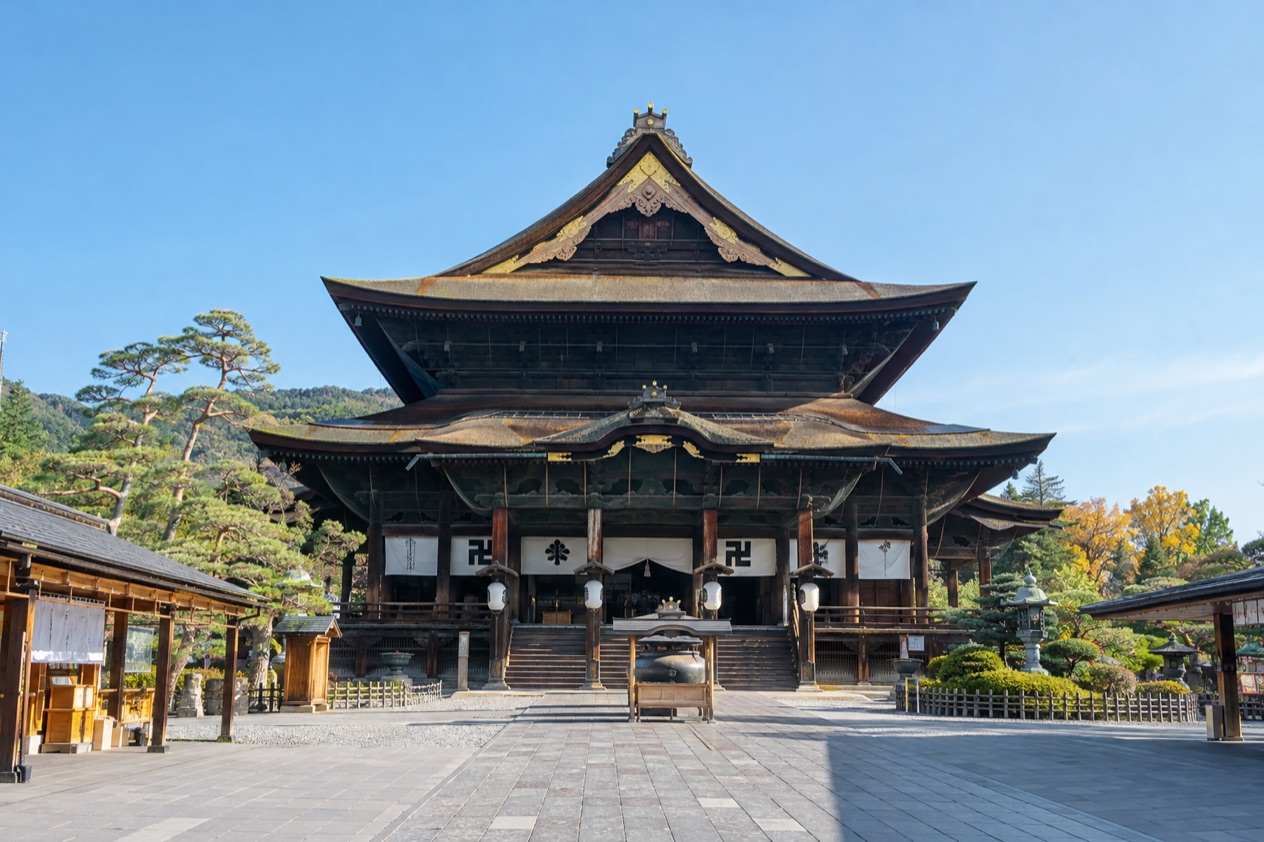
Smoke drifts from the big incense burner in front of the Main Hall, and people lean into it, fanning it over their shoulders, their knees, whatever part of them could use some luck. Nearby, a worn wooden figure has been rubbed smooth by generations of hands. Zenko-ji is a working temple in the city of Nagano, a place where you do things with your body rather than just look, and it suits travelers who like their sightseeing to come with rituals.
Is visiting Zenko-ji worth it?
Yes, if you want a temple where the visit is something you take part in, and it suits curious travelers, families who like a hands-on stop, and anyone building a trip around Nagano city. Zenko-ji is a Buddhist temple of the 7th century, and the Main Hall holds a National Treasure designation. What you feel on the grounds is less a museum hush than a place in daily use, with people stopping at each station of the compound in turn.
What sets it apart from other temples you may be visiting on a Japan trip is its unusual religious character. Zenko-ji belongs to both the Tendai and Jodoshu schools of Mahayana Buddhism, so it is not tied to a single sect, and the temple’s central image is a hidden Buddha, a hibutsu, that is never shown to the public.
That absence shapes everything. Instead of gazing at a famous statue, you encounter a series of touchable, smellable, even pitch-dark experiences: smoke on your skin, a statue you rub, a corridor where you grope for a metal key on the wall.
The temple also gives you a reason to take Nagano seriously as a stop rather than a place you pass through. The city is the capital of Nagano Prefecture and its northernmost transportation hub, and it hosted the Winter Olympic Games in 1998.
Many of the arenas from those Games, such as the M-Wave speedskating arena and the Aqua-Wing arena, remain open, so a day in town can pair old devotion with a bit of sports history. Zenko-ji is the cultural anchor of that day.
If your tastes run to quiet gardens and tea rooms, the mood here is different: it is active and a little tactile, a temple where the practice is visible. If you like understanding why a place matters to the people who come, it repays your attention.
What to see at Zenko-ji
The compound unfolds as a sequence of buildings and rituals, and the pleasure is in moving from one to the next without hurrying. Each stop has its own gesture attached, and watching other visitors repeat them is half the guide.
The Main Hall and the hidden Buddha
The Main Hall stands at the northern end of the compound and is considered a National Treasure of Japan. It is the heart of the temple and the home of the hibutsu, the hidden Buddha, a statue that is not shown to the public. Its secrecy is the point: the faith here rests on the presence of an image no one sees, which gives the building a charge that a displayed statue would not.
Look at how people behave in front of the hall. They pause, bow, and offer a short prayer, and the broad roof and deep interior invite you to take your time. Because the central image is hidden, there is no obvious focal point to photograph, so the experience is more about atmosphere and observation.
Maedachi Honzon and the Gokaicho ceremony
A replica of the hidden Buddha, called the Maedachi Honzon, is shown publicly once every six years in spring during a ceremony called Gokaicho. The most recent display ran from the beginning of April to the end of June, 2022. In that period, the temple draws pilgrims who come specifically for the chance to be near the replica.
If your trip falls in an ordinary year, you will not see it, but knowing the story deepens the visit. The sixth-year rhythm explains why the temple has such a sense of ritual calendar, and why people talk about the display with anticipation long beforehand.
The Binzuru statue and the incense burner
Binzuru is a physician said to be a follower of the Buddha, and visitors touch his statue to cure their ailments. The logic is simple and human: you rub the part of the statue that matches the part of you that hurts. Over time the figure has been worn smooth, and that smoothness is a record of countless requests for good health.
In front of the Main Hall, the incense burner works in a similar spirit. Visitors rub smoke from it onto their bodies for good health and fortune, wafting it toward the places they would like to protect. The scent of the incense follows you for a while after you step away, a small souvenir that costs nothing.
The dark corridor beneath the inner chamber
Beneath the inner prayer chamber runs a completely dark corridor. Worshippers walk through it trying to touch a metal key hanging on the wall, and touching it is said to bring enlightenment. With no light at all, you rely on your hand against the wall and on the people around you.
It is the most memorable moment of the visit for many people because it strips away sight in a place that is otherwise so visual. When you emerge, the daylight feels sharper. Go in expecting a ritual, not a thrill, and take it slowly.
The Kyozo and the Sanmon Gate
The Kyozo is a sutra repository, built in 1759, and its octagonal sutra holder can be rotated by visitors to gain enlightenment. The gesture is like turning a prayer wheel: a single push of the holder stands in for reading the scriptures it contains. It is a good place to watch how a ritual makes text physical.
The Sanmon Gate had a reconstruction that began on October 1, 2002, and was scheduled to end on December 31, 2007. As a gate, it frames the way into the temple precinct and gives the arrival a sense of threshold. Pause beneath it before heading to the main buildings.
When to visit Zenko-ji
The date that changes the most is the spring of a Gokaicho year, when the Maedachi Honzon replica is displayed publicly. It happens once every six years, and the last display ran from the beginning of April to the end of June, 2022. If your trip lines up with another such spring, it is the single strongest reason to schedule around the temple.
In an ordinary year, the temple’s character is the same in any month, because the rituals do not depend on a season. What changes is the setting around it.
Nagano sits at an altitude of 1,219 feet, the highest prefectural capital in Japan, so the city has real seasons, with a feel of winter sports in the cold months and greener walking in the warm ones. Dress for the weather of the day you choose, and plan the visit as one stop in a longer day.
Because the rituals involve touching, smelling and even walking in darkness, a day when you are not rushed makes a difference. Visiting when you have time to pause at each station, watch others, and repeat the gestures yourself gives you more than trying to squeeze the temple between two trains.
If you are building a trip around the winter sports side of Nagano, the temple makes a natural cultural counterweight to days spent outdoors. If you come for the temple first, the Olympic arenas still open in the city are an extra reason to stay a little longer. Either way, the temple itself rewards the visit regardless of month.
Tips for your visit
Think of Zenko-ji as a circuit of small experiences, and leave room to do each one properly. Rubbing incense smoke on your shoulder, touching the Binzuru statue, turning the sutra holder and feeling your way along the dark corridor each take only a moment, but together they make the visit feel complete rather than a quick glance at a building.
- Start at the Main Hall, then work through the Binzuru statue, the incense burner, the Kyozo and the dark corridor in whatever order the crowd of the moment allows.
- Take the dark corridor slowly, with one hand on the wall, and keep a moment of patience for people ahead of you.
- Leave room in the day for the rest of Nagano, including the Olympic arenas that remain open, such as the M-Wave and the Aqua-Wing.
- Wear shoes that are easy to take off and put on, since temple halls are places where footwear often comes off.
Getting to Nagano is straightforward on the rail network. From Tokyo, Nagano city is 1 hour 20 minutes away without stopping on the Hokuriku Shinkansen. From Osaka or Kyoto, you take the high-speed train to Nagoya and then the JR Wide View Shinano express train to reach Nagano.
With children, the touchable rituals are what tend to hold attention: rubbing the statue, rotating the sutra holder, waving smoke over a shoulder. Explain beforehand what each gesture means and the visit becomes a kind of treasure hunt through the compound. For anyone with limited mobility, plan around the layout of the buildings and the corridor, which depends on stepping and feeling your way in the dark.
Pair the temple with a wander through the city center, where Nagano’s role as a transportation hub gives it a practical, lived-in feel. A stop for local food after the temple rounds out the day, and the Olympic sites offer a second theme if you want one.
Good to know before you go
Zenko-ji is an active place of worship, so the rituals are done in the spirit of the people around you: unhurried, respectful, and with a quiet voice near the halls. Carry a little cash in coins for offerings, keep your phone away while you walk through the dark corridor, and bring a light layer, since the weather in Nagano follows the season. The temple’s story, from the hidden Buddha to the six-year display, is easiest to enjoy when you take the visit one gesture at a time.
Sources
- Wikipedia, Zenkō-ji (https://en.wikipedia.org/wiki/Zenk%C5%8D-ji), checked October 11, 2026
- Japan National Tourism Organization, Nagano (https://www.japan.travel/en/destinations/hokuriku-shinetsu/nagano/nagano-and-around/), checked October 11, 2026
- Wikipedia, Nagano (city) (https://en.wikipedia.org/wiki/Nagano_(city)), checked October 11, 2026
- Wikivoyage, Nagano (https://en.wikivoyage.org/wiki/Nagano), checked October 11, 2026
To plan your stay
- Best Time to Visit Japan: Cherry Blossoms, Autumn Colors, Weather and Festivals
- Where to Stay in Japan: Ryokan, Temple Stays, Capsule Hotels and the Best Cities to Base In
- Sending Luggage from the Airport in Japan: Hands-Free Travel, Hotel Delivery and Coin Lockers
- Know Before You Go to Japan: Entry, Money, Etiquette and Getting Around