
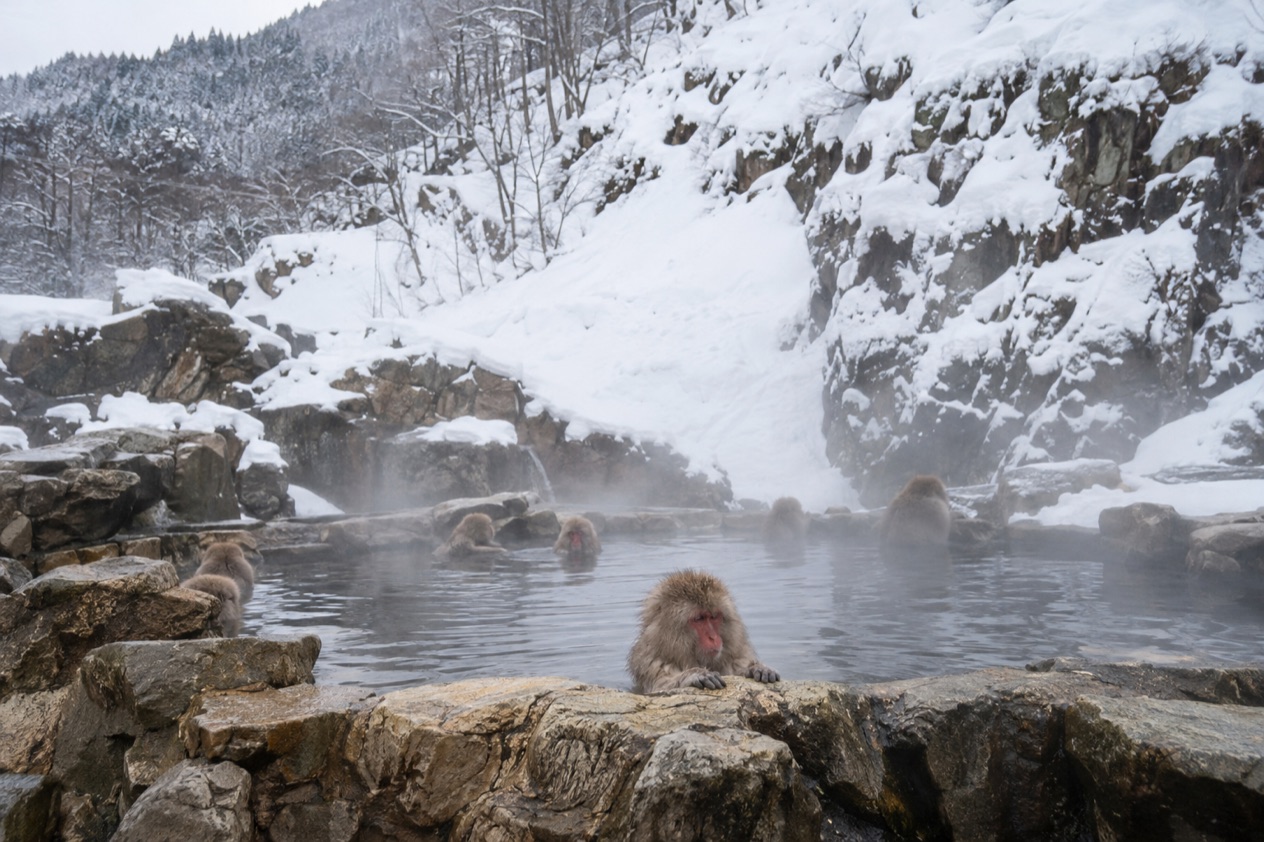
The walk begins among trees, with the sound of the Yokoyu River in the valley and steam drifting up from cracks in the ground. Then the first macaque appears on the path, unbothered, and a few turns later dozens more are sitting around a steaming pool with their red faces and thick gray fur. Jigokudani Monkey Park, in Yamanouchi in Nagano Prefecture, is a visit built around watching wild Japanese macaques in the one place where they treat a hot spring as their own.
Is visiting Jigokudani Monkey Park worth it?
Yes, for anyone who likes watching animals go about their lives at close range, and especially for travelers who are already in the Nagano area and want an outing with a story behind it. The park is built around one scene, wild macaques sitting in the warm water of an onsen (a Japanese hot spring), and that scene is the reason people travel to this valley from Tokyo, a journey of about three and a half hours.
What sets it apart from other wildlife stops is how you arrive. The park can be reached only by a narrow footpath through the forest, about 1.2 miles long, and that walk keeps the place uncrowded even though it is relatively well known.
You do not step off a bus into a gift shop. You walk in, the way the monkeys do when they come down from the cliffs, and the forest sets the mood before the first animal does.
It also differs from a zoo or a petting park because the macaques are wild. They live in the surrounding valley, come to the hot springs on their own and go back to the forest in the evenings.
The park attendants feed them, which is why hundreds of macaques gather here in any season. Visitors first met the place on screen, since the park became famous after appearing in the documentary Baraka. The real thing is quieter and more humorous than a film suggests.
It is a good fit for photographers, families with children old enough to enjoy a walk in the woods, and people curious about Japan outside its big cities. The visit is the path, the pool and the macaques, and it is the focus of those things that makes it memorable.
What to see at Jigokudani Monkey Park
The forest footpath
The footpath is the first thing you see and the part of the visit that most shapes the day. It runs for about 1.2 miles through forest, narrow enough that you walk with the trees close on both sides. Along the way you hear the valley before you see it, with running water below and the occasional rustle in the branches.
The park lies within Joshinetsu Kogen National Park, which locals call Shigakogen, and the path gives you a sense of that larger landscape. Look up and along the slopes as you walk. Macaques do not wait only at the pool, and you may meet one on the path or spot another sitting on a rock above you.
The hot spring pool and its macaques
At the end of the path the macaques come into view around the onsen. The monkeys descend from the steep cliffs and the forest to sit in the warm water, and the scene is the one on the posters, a row of gray heads in rising steam. Hundreds of animals use the area, so there is rarely a moment with nothing to watch.
Spend time on the small things. Watch how the adults groom each other at the edge of the water, how the young chase one another across the rocks, and how a macaque will settle into the pool with an expression of complete contentment. The animals are used to people and carry on with their day, which is what makes the watching so rewarding.
The cliffs and steam of Hell’s Valley
Jigokudani means Hell’s Valley, a name that comes from the steam and boiling water bubbling out of small crevices in the ground. Steep cliffs rise around the valley, and the forests above them are cold and hostile in winter. Look at the ground near the pool and you will see exactly why the early residents chose such a name.
The contrast is the point. In a landscape that looks harsh, the warm water is the one comfortable place, and the macaques know it. That is why a stretch of ground that sounds forbidding has become the soft center of the visit, with animals lounging in a spot named for hell.
How the macaques came here
The macaques’ presence here has a history. Japanese macaques once lived in nearby mountains such as Shiga Kogen, but in the 1950s the development of ski resorts and the clearing of forest pushed them out of their habitat. They came down toward human settlements and became pests.
The hot spring valley turned out to offer them a place to stay. Today they live around it, and the park attendants feed them.
It is worth keeping that in mind while you watch, because the scene is both wild behavior and the result of a long relationship between people and animals in this valley. Japanese macaques live farther north than any other monkey, and the Shimokita Peninsula, about 310 miles from here, marks the northern limit of their range.
Hours, tickets and rules
The park is reached only on foot, by the narrow footpath through the forest, and once you arrive the monkeys are there in every season. That is the core of the practical picture, and it shapes the day more than any schedule does.
Because attendants feed the macaques, they stay in the area of the hot springs all year, and a visit in any season lets you observe hundreds of them. You do not need to time a trip around a sighting season the way you would for migrating animals or flowers. The monkeys return to the security of the forest in the evenings, so the scene at the pool belongs to the daytime hours of your visit.
The footpath also sets the pace. Everyone, whatever the season, reaches the monkeys the same way, on their own feet along the narrow trail. That is part of why the park stays uncrowded even though it is well known, and why the walk in and the walk out are part of the visit rather than a chore before it.
The park is a place for watching, not for joining in. The macaques are wild animals that have come down from the cliffs and the forest, and the experience is about observing them from the path and the edges of the pool as they carry on with their day. Their hot spring is theirs, and you are a guest in their valley.
When to visit Jigokudani Monkey Park
Any time of year works, because the macaques are in the hot spring area in every season and a visit at any time will let you see hundreds of them. That is unusual for a wildlife destination, and it means the choice of month is about the kind of scene you want rather than about whether the animals will show up.
Winter is the season that made the park famous. The valley is cold, snow covers the cliffs and the forest, and the contrast between the frozen landscape and the steaming pool is at the heart of the pictures people take home.
The monkeys that give the park its English nickname, snow monkeys, are the ones you watch sitting in the warm water while the cold surrounds them. If that image is why you are coming, winter is the season it belongs to.
In the other seasons the setting changes while the monkeys stay. Without snow, the forest on the footpath is green or turns with the year, the ground near the pool is bare and the steam is still visible rising from the crevices that gave Hell’s Valley its name. The macaques still come down to the water, and the walk is a different kind of walk, through trees rather than through a white landscape.
Think about the time of day too, in the sense that the monkeys return to the forest in the evenings. The scene you came for is a daytime one, so plan the walk in so that you reach the pool well before the day closes in.
Tips for your visit
Wear shoes that suit a forest footpath, because the way in is about 1.2 miles along a narrow trail and the same distance back. Pack for the season, since the valley is cold and hostile in winter, with steep cliffs around it and steam rising from the ground. Bring a camera, because the macaques are the subject and they sit close.
Plan the trip around the distance. From Tokyo the park is about three and a half hours away, so it works as a full outing rather than a quick stop.
The Nagano side of the trip is where the rail network helps, since Nagano city is the northernmost transportation hub of the prefecture and is 1 hour 20 minutes from Tokyo on the Hokuriku Shinkansen without stopping. Travelers coming from Osaka or Kyoto take the high-speed train to Nagoya and then the JR Wide View Shinano express to Nagano.
Nagano city is also the natural place to pair with the monkeys, and it gives the day a second subject. Zenko-ji, a Buddhist temple established at its present location in Nagano in 642 AD and listed as a National Treasure, is a very different kind of visit from the macaques, and the contrast between the two makes for a rounded trip.
The city hosted the 1998 Winter Olympic Games, and facilities such as the M-Wave speedskating arena and the Aqua-Wing arena remain open. Nagano also sits at an altitude of 1,219 feet, the highest of any prefectural capital in Japan.
For families, the walk and the animals are the draw. Children who enjoy watching animals will find a lot to follow, from the grooming at the edge of the pool to the young macaques chasing each other over the rocks. The footpath is narrow, and the forest is the setting for all of it, so the day suits those who like to be outdoors.
Good to know before you go
The macaques are wild animals, and the habit of watching them from the path and the edges of the pool is the one that fits the place. The valley is cold in winter, with steep cliffs and steam from the ground, so dress for the season and for a walk through forest. Typhoon season and the rainy season can shape a trip to the Nagano area, so keep an eye on the forecast when you plan.
Sources
- Wikipedia, Jigokudani Monkey Park (https://en.wikipedia.org/wiki/Jigokudani_Monkey_Park), checked October 11, 2026
- Japan National Tourism Organization, Nagano (https://www.japan.travel/en/destinations/hokuriku-shinetsu/nagano/nagano-and-around/), checked October 11, 2026
- Wikipedia, Nagano (city) (https://en.wikipedia.org/wiki/Nagano_(city)), checked October 11, 2026
- Wikivoyage, Nagano (https://en.wikivoyage.org/wiki/Nagano), checked October 11, 2026
To plan your stay
- Best Time to Visit Japan: Cherry Blossoms, Autumn Colors, Weather and Festivals
- Where to Stay in Japan: Ryokan, Temple Stays, Capsule Hotels and the Best Cities to Base In
- Sending Luggage from the Airport in Japan: Hands-Free Travel, Hotel Delivery and Coin Lockers
- Know Before You Go to Japan: Entry, Money, Etiquette and Getting Around