
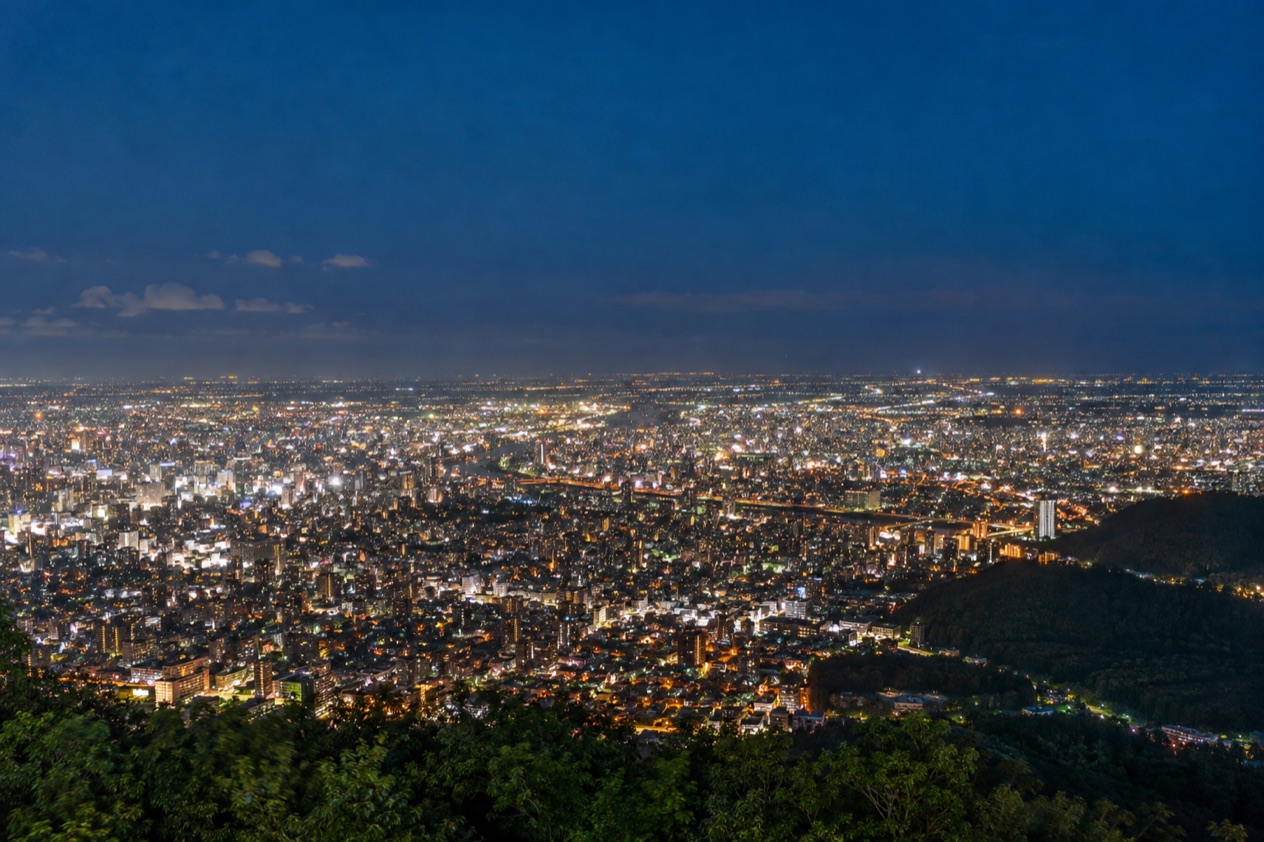
Dusk settles over Sapporo, and from the summit of Mount Moiwa the grid of streets below slowly turns into a field of small lights, with the dark outline of Hokkaido’s hills behind it. The air smells of cold stone and pine, and you hear voices in several languages as people lean on the railings. Mount Moiwa is the city’s own hill, a place Sapporo residents and visitors both climb to look back at the town, and it suits anyone who wants an evening outing that needs no long journey.
Is visiting Mount Moiwa worth it?
Yes, if you like cities best when you can see all of them at once, and it suits couples, first-time visitors to Sapporo, photographers and anyone with an evening free after a day of sightseeing.
What sets Moiwa apart from other lookouts is how close it sits to the center. The mountain is a resort for Sapporo citizens and tourists alike, so you are not leaving the city for a remote peak, you are rising above it.
Sapporo is a wide, orderly city laid out on a grid, and that layout is exactly what reads so clearly from above: long straight avenues, the green band of the central park, and the glow of the downtown towers. A harbor-side overlook or a high-rise observation deck can show you a similar skyline, but here you stand on an actual mountain, with trees around you and the night air on your face.
The mountain also changes with the calendar. In winter it becomes a ski resort, so the same hill that offers a lit-up view in autumn is covered in snow a few months later. That makes Moiwa a place you can place in almost any trip to Hokkaido, whether you are in town for the snow, for the beer and lamb barbecue the city is known for, or simply passing through on the way to the island’s wilder corners.
Think of it as the closing chapter of a Sapporo day: dinner before or after, a few quiet minutes looking at the lights, and a return to the hotel with the shape of the city finally clear in your mind.
What to see at Mount Moiwa
The mountain rises to 1,742 feet, high enough that the city lies flat and legible beneath you. The visit has a few distinct parts: the ride up, the viewpoint, the sky overhead and, in the cold months, the slopes.
The view over Sapporo
The main event is the panorama of the city. Once darkness falls, Sapporo spreads out as a carpet of white, amber and orange points, with the busiest districts glowing brightest and the dark patches of parks and the river cutting through them. Beyond the last streets, the land rolls away into hills and, on a clear night, the faint line of the horizon.
Take time to read the view rather than just photograph it. The long avenues show how the city was planned, and you can trace the route you walked earlier in the day. Bring a jacket for standing still at the railing, because lingering is the whole point of the visit.
The ropeway
A ropeway passes through Mount Moiwa, and for people the ascent is part of the pleasure. Rising above the trees, you watch the city shrink and the lights begin to appear, so the view builds gradually instead of arriving all at once at the top.
If you ride up in the last light of day, the sky and the town change together, and the descent gives you a second, different look at the same scene. It is a good moment to keep a camera ready, though glass and motion do not always make for sharp photos.
The observatory and the night sky
An observatory stands on Mount Moiwa, which fits the mountain’s role as a place for looking: down at the city in one direction and up at the sky in the other. It gives the summit a second reason to exist after dark, beyond the lights of the town.
Clear nights can bring a scatter of stars above the glow of the streets, though cloud often hides them, so treat the sky as a bonus rather than a promise. Looking up after you have spent time looking down gives the evening a pleasing symmetry.
The mountain in winter
From the cold months onward, Mount Moiwa operates as a ski resort. The slopes sit within the city’s reach, which is part of why Sapporo is known as a winter sports town, and the city hosted the first Winter Olympic Games in Asia in 1972.
In snow season the night view takes on a different mood, with white ground, glowing windows and a hush over the streets. If you are in Sapporo for the February snow festival, the mountain offers a wider, calmer counterpoint to the crowds and sculptures downtown.
How to get to Mount Moiwa
Mount Moiwa lies about 3 miles southwest of the center of Sapporo, so you start from the city itself and head up the hill rather than traveling out to a distant region. From Sapporo Station the mountain is 4 miles to the southwest. That puts it within the city’s own sphere, a destination you can build into an ordinary day around the downtown hotels, the department stores and the station area where visitors arrive.
By ropeway
The ropeway is the route that defines a Moiwa visit. It carries you up the mountain, and the climb itself is part of the experience, with the lights of the lower city sliding away beneath you as you rise.
Think of the ropeway as the main part of your plan rather than an extra. Allow yourself to arrive with some daylight left if you want to see the city change from day to night, and to enjoy the way the view grows as you go higher.
By road
A motorway passes through Mount Moiwa, so the mountain is reachable by road as well as by ropeway. This is useful to know if you are traveling by car, since the summit area is tied into the road network instead of standing apart from it.
Whichever way you go up, work out your return before you settle in at the railing. A night view tends to hold people longer than they planned, and it helps to know how you will get back to your hotel when you are ready to leave.
When to visit Mount Moiwa
Pick a season by what you want to see, and pick the evening by the sky.
| Month | Avg. high (°F) | Avg. low (°F) | Precipitation (in) | Days with precipitation |
|---|---|---|---|---|
| January | 31.3 | 20.5 | 4.27 | 18.3 |
| April | 53.1 | 38.1 | 2.15 | 9.6 |
| July | 77.7 | 64.2 | 3.57 | 7.7 |
| October | 61.5 | 46.4 | 4.33 | 11.6 |
October brings crisp evenings and a good chance of a clear sky, with only a trace of snow in the city. Autumn air is often sharp enough to make the lights look brighter, and a warm layer makes the difference between a quick glance and a long, enjoyable stay. Rain does fall on a fair share of days, so a gray evening is possible and worth planning around.
July gives the mildest evenings of the four months shown, with warm highs and the fewest days of rain. It is the season when you can stand outside for a long time without feeling the cold, and the view is the same grid of lights seen in shirtsleeves. Humidity rises in summer, so the air can feel softer and heavier than in autumn.
April is a month of change, still cold at night with a little snow in the city, and the days begin to lengthen. January is the deep-winter version of the visit: freezing temperatures, snow on most days and a mountain that doubles as a ski resort. The city glows against the white, but dress as you would for a long time outdoors in Hokkaido winter.
The Sapporo Snow Festival, held every February, is the special date to remember. If your trip falls then, a Moiwa evening pairs well with a day among the ice and snow sculptures in town, giving you the wide view after the close-up one.
Tips for your visit
Dress for the summit, not for the street. A scarf is easy to carry and useful when you stand still at a railing for a while.
Bring a camera or phone, and consider a small tripod if you are keen on night photography. Lights look best when held steady, and the grid of the city rewards a patient shot. Do not forget to put the camera down for a few minutes and simply look.
What to combine it with
A Moiwa evening fits neatly after a day in town. The Sapporo Beer Museum and its pub, the Sapporo Beer Garden, serve a beer and lamb barbecue, which makes a hearty dinner before or after you go up. Hokkaido is also known for its gourmet food, so you may find that a meal and a view together make a full evening.
If you are building a longer Hokkaido trip, the mountain pairs well with other outings on the island. Otaru Canal, with its glowing gas lamps and stone warehouses, offers another evening scene of a very different kind, while the craft shops of Ningle Terrace in Furano’s forests give a quieter daytime contrast.
Families and pacing
The ropeway ride and the view make a good shared experience for a family, because the city seen from above is something children tend to enjoy pointing out. Dress young travelers warmly, since standing still on a summit is colder than walking the streets.
Plan the outing as a relaxed evening rather than a packed schedule. Leave time to arrive without rushing, to linger at the view and to return at your own pace. Because the mountain sits so close to the center, it fits easily around a hotel stay in Sapporo.
Good to know before you go
Sapporo has a real winter, so the mountain in the cold months means snow, ice and short days, and boots with a good grip matter more than style. Autumn and spring bring rain and sleet on some days, so a waterproof layer is worth carrying, and a clear evening can turn cloudy without much warning. Keep some yen in your pocket for the small things that come up on an evening out, and take the usual habits you would use after dark in any city: stay with your group, mind your footing on wet or icy ground and keep an eye on the time for your return.
Sources
- Wikipedia, Mount Moiwa (https://en.wikipedia.org/wiki/Mount_Moiwa), checked October 11, 2026
- Japan National Tourism Organization, Sapporo (https://www.japan.travel/en/destinations/hokkaido/hokkaido/sapporo-and-around/), checked October 11, 2026
- Hokkaido Love, the official Hokkaido tourism site (https://www.visit-hokkaido.jp/en/), checked October 11, 2026
- Hokkaido Love, what to see and do (https://www.visit-hokkaido.jp/en/spot/), checked October 11, 2026
- Japan Meteorological Agency (JMA), Normal values 1991-2020, monthly (https://www.data.jma.go.jp/stats/etrn/view/nml_sfc_ym.php?prec_no=14&block_no=47412), station Sapporo, elevation 17 m, checked October 11, 2026
To plan your stay
- Best Time to Visit Japan: Cherry Blossoms, Autumn Colors, Weather and Festivals
- Where to Stay in Japan: Ryokan, Temple Stays, Capsule Hotels and the Best Cities to Base In
- Sending Luggage from the Airport in Japan: Hands-Free Travel, Hotel Delivery and Coin Lockers
- Know Before You Go to Japan: Entry, Money, Etiquette and Getting Around