
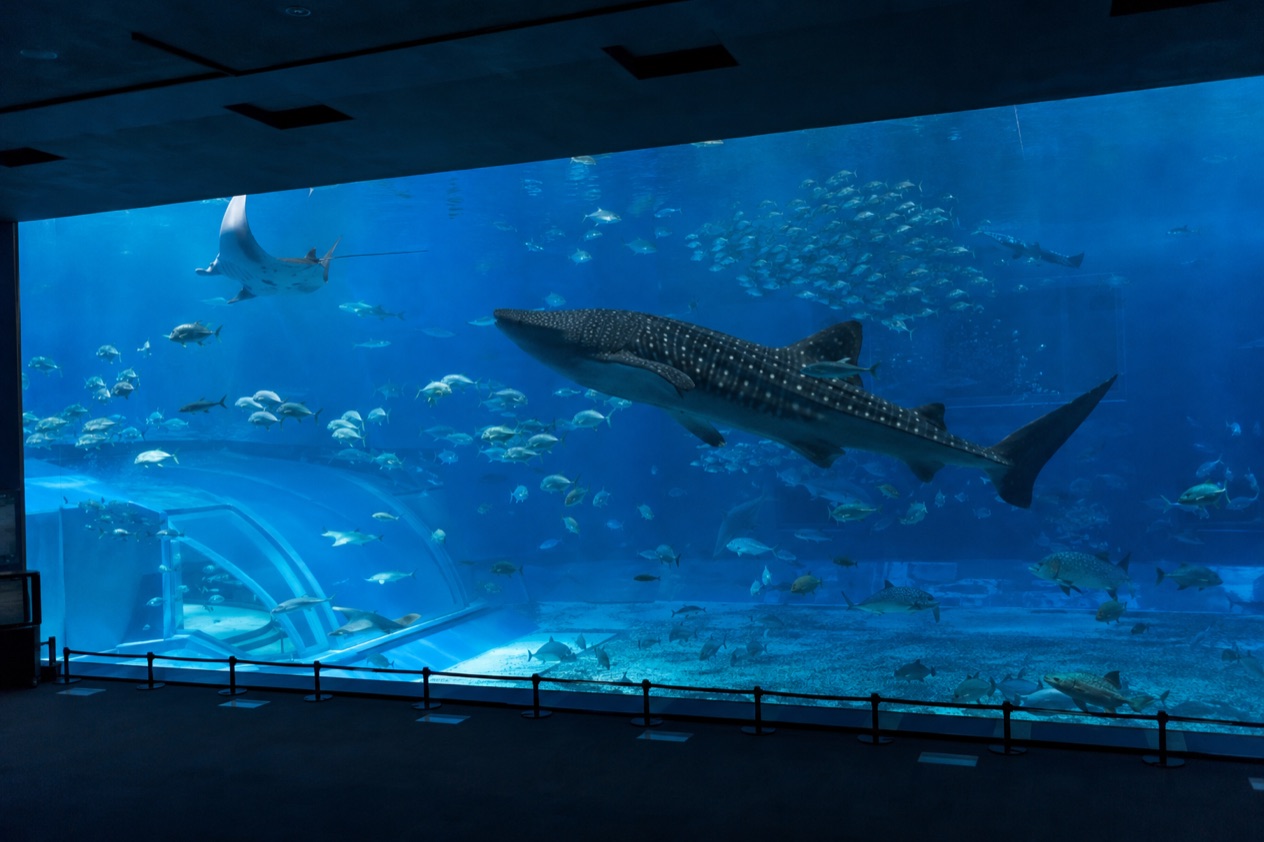
The first thing you meet at the Churaumi Aquarium is a wall of blue: a huge acrylic panel with the shadow of a whale shark sliding slowly across it, and a hush that falls over everyone standing in front of it. Outside, children crowd the rail of the sea turtle pool and the theater where the dolphins perform.
Is visiting the Churaumi Aquarium worth it?
Yes, for almost anyone who likes the ocean, and especially for families and travelers who want one big rainy-day or hot-day activity on Okinawa Island. The aquarium is built around the sea as Okinawa knows it, from the coral reefs near the surface to the dark water of the deep, and the exhibits follow that logic floor by floor.
What sets it apart from other aquariums is that the main attraction is an enormous single tank holding whale sharks and manta rays, seen through one of the largest acrylic panels ever fitted to a tank. Many aquariums show fish in rows of windows. Here you stand before one great body of water and watch the animals pass in their own time.
Part of the visit is also outdoors and free. The sea turtle pool, the manatee pool and the dolphin show are open to the public without a ticket to the main building, so even a short stop gives you something.
The aquarium has also made news for its breeding work, including a world first with Bigeye Pacific Opah, a baby bottlenose dolphin that visitors can watch swimming beside its mother, and a new female Japanese Sawshark that has arrived in an effort to breed the species. It feels like a working marine research center as well as a place to look at fish.
What to see at the Churaumi Aquarium
Kuroshio Sea tank
The Kuroshio Sea tank is the heart of the aquarium, on the 2nd floor, and it is where whale sharks and manta rays glide past. The main tank is 35 meters (115 ft) long, 27 meters (89 ft) wide and 10 meters (33 ft) deep. Its acrylic window measures 27 by 74 feet and is 2 feet thick, which is why the view feels like looking into open water rather than into a box.
Take a seat and let the scene settle. Whale sharks turn slowly at the far end, manta rays flap past like underwater birds, and smaller schools of fish fill the gaps. Watching for a while rewards you more than a quick photo, because the animals change places constantly.
Coral Sea and Deep Sea tanks
The Coral Sea tank on the 3rd floor shows a large selection of coral reef, the living architecture that gives Okinawa its colors. Look for the shapes of the coral first, then the small fish moving between the branches. It is a gentler, brighter counterpart to the big blue room downstairs.
On the 1st floor, the Deep Sea tank recreates Okinawa’s deep sea, a darker world of odd shapes and pale animals. The mood changes here, quieter and more mysterious, and it is the part of the visit that shows how much of the sea around the island lies beyond the reef.
Outdoor pools and the dolphin show
Outside the main building, the sea turtle pool and the manatee pool are free and open to the public, and they are easy places to linger while the kids look over the edge. Nearby, the Dolphin Show Stadium, called the Okichan Theater, offers a free show where viewers can touch the animals and watch the performance.
The Dolphin Lagoon is a dolphin contact facility that houses several species of dolphin. Together with the outdoor creatures, it makes the grounds a pleasant second half to the day, in the open air and the Okinawan sun.
Hours, tickets and rules
The aquarium opens in the morning and stays open into the evening, with the last entry an hour before closing. The turtle pool, the manatee pool and the dolphin show are free, which makes them an easy way to taste the place even when time is short.
| Site | Open |
|---|---|
| Okinawa Churaumi Aquarium (main building) | 08:30 to 18:30, last admission 17:30 |
| Sea turtle pool | Open to the public |
| Manatee pool | Open to the public |
| Dolphin Show Stadium (Okichan Theater) | Open to the public |
One rule worth knowing: the aquarium cautions visitors about an increase in bite-wound injuries from white-banded triggerfish during their breeding season.
When to visit the Churaumi Aquarium
The aquarium opens at 8:30 in the morning, which is the natural time to arrive if you want to start your day with the big tank. Outside, the Okinawan sun can be strong, so the outdoor pools and the dolphin show suit best when you have the stamina for them, and the indoor floors offer a cool break from the heat.
Month by month, the weather around Naha gives a sense of the island’s mood. January brings highs in the upper 60s with rain on about ten days, a mild month where the indoor galleries do most of the work.
April warms to the mid-70s, with about the same number of wet days and a bit more sun. July is the hot one, highs near 90 and a lot of sunshine, so you will want shade and water between visits to the outdoor areas. October stays warm, in the low 80s, with rain on fewer days.
| Month | Average high (°F) | Average low (°F) | Rain days | Sunshine (hours) |
|---|---|---|---|---|
| January | 67.6 | 58.8 | 10.2 | 93 |
| April | 75.7 | 66.4 | 10.3 | 121 |
| July | 89.4 | 80.6 | 9.4 | 227 |
| October | 82.6 | 74.3 | 8.8 | 163 |
In summer, the aquarium offers a special night event called Churaumi Night Aquarium, a different way to see the tanks after dark. Because the main building is indoors, a wet day does not spoil the visit, though the outdoor pools and the show are best enjoyed when the sky is clear.
Tips for your visit
Plan to spend a good part of the day. The grounds cover 19,000 square meters (200,000 sq ft) and the building holds 77 tanks, so rushing through wastes the best bits. A sensible route runs from the Kuroshio Sea tank through the Coral Sea and Deep Sea floors, then out to the pools and the dolphin theater.
Bring a hat and sunscreen for the outdoor part, comfortable shoes, and something light to wear indoors, where the rooms are cooler than the air outside. Families will find the free pools and the dolphin show useful for breaking up the visit, and the open grounds give small children room to move.
The aquarium sits on Okinawa Island, whose gateway is Naha Airport, and the beaches of the island, among them Emerald Beach, Okuma Beach and Manza Beach, are natural companions for a day out on the coast. Keep an eye on the triggerfish caution mentioned above if you step into the water anywhere nearby, and take the news from the tanks, the baby dolphin and the breeding programs, as a reason to look closely at each pool.
Good to know before you go
The aquarium opened on 1 November 2002 and has been a cornerstone of Okinawa’s coast ever since. Naha, the island’s largest city and home to its only rail network, the Okinawa Urban Monorail (Yui Rail), is the usual base for the wider island, and the airport there serves flights from dozens of cities across Japan, including low-cost carriers. The rainy months bring heavier showers, and typhoon season can affect the island, so keep a flexible plan if you travel in the warmer months.
Sources
- Okinawa Churaumi Aquarium (https://churaumi.okinawa/en/), checked October 11, 2026
- Japan National Tourism Organization, Okinawa (https://www.japan.travel/en/destinations/okinawa/okinawa/naha-and-the-main-island/), checked October 11, 2026
- Wikipedia, Okinawa Island (https://en.wikipedia.org/wiki/Okinawa_Island), checked October 11, 2026
- Japan Meteorological Agency (JMA), Normal values 1991-2020, monthly (https://www.data.jma.go.jp/stats/etrn/view/nml_sfc_ym.php?prec_no=91&block_no=47936), station Naha, elevation 28 m, checked October 11, 2026
To plan your stay
- Best Time to Visit Japan: Cherry Blossoms, Autumn Colors, Weather and Festivals
- Where to Stay in Japan: Ryokan, Temple Stays, Capsule Hotels and the Best Cities to Base In
- Sending Luggage from the Airport in Japan: Hands-Free Travel, Hotel Delivery and Coin Lockers
- Know Before You Go to Japan: Entry, Money, Etiquette and Getting Around