
MONTEGO BAY · IS IT SAFE? · THE STRIP, THE WATER, THE RIDE HOME
Most of what goes wrong here is a transaction rather than a crime. Visitors come home describing much the same short list: someone selling hard on the sand, a phone that left a bar table, a dark stretch of coast road they wish they had not driven themselves. The national picture, advisory level and named zones included, is kept current on our Jamaica safety page, and none of those zones sit in this city’s resort corridor. The local questions are narrower and more useful: which streets, which water, which ride.
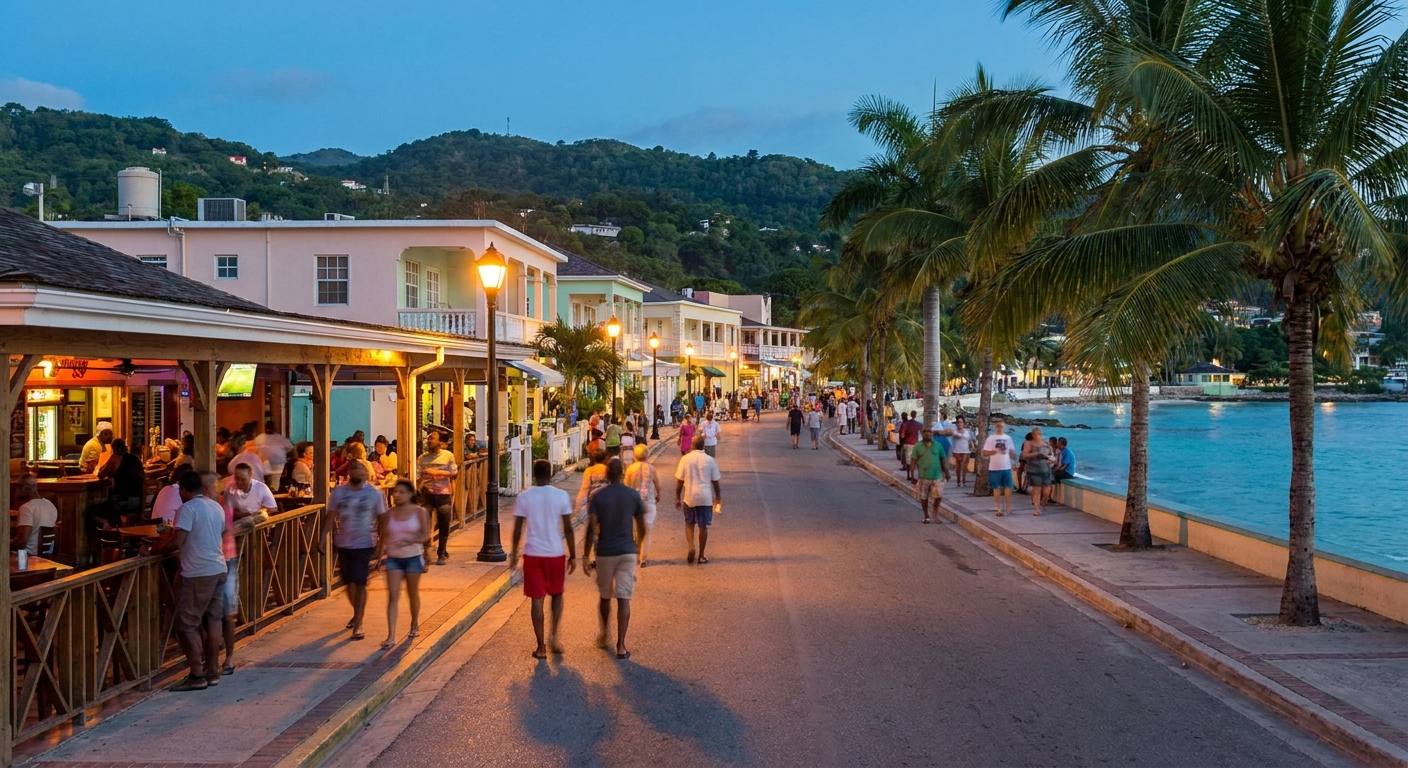
SAFETY IN MONTEGO BAY · WHAT VISITORS REPORT
The three things that actually cost visitors here are persistent selling, unattended-bag theft and the unlit coast road after dinner, and each answers to a habit that costs nothing.
GLOUCESTER AVENUE WALKABLE WHEN LIT AND BUSY · NIGHT MOVES BY LICENSED RIDE · EMERGENCY 119
Go for: an evening on the lit stretch of Gloucester Avenue, a morning swim inside the reef at Doctor’s Cave, and a taxi the front desk called for you.
Think twice before: leaving a bag on the sand while you swim, taking a rented scooter onto the coast highway, or walking east toward the resort belt once the streetlights thin out.
Advisory level, named zones and emergency numbers: the national safety page · full sources at the end of this guide
On this page
- What goes wrong in Montego BayVending, opportunist theft, night roads
- Is the Hip Strip safe, and what about the rest of the city?Gloucester Avenue, Ironshore and downtown
- Swimming, traffic, scooters, drinkingThe physical risks in and around town
- The ganja offers on the beachThe law, the pitch and the answer
- Montego Bay at nightTaxis, the strip and the ride back
- Emergency numbers in Montego Bay119, 110 and reporting a theft
Is Montego Bay safe? What goes wrong and where
Category one is selling. On the public sand, along Gloucester Avenue and outside the craft market, vendors work the same visitors repeatedly: braids, aloe, wood carvings, boat trips, taxis, ganja. Nothing about it is threatening. It is simply relentless in a way an American beach town is not, and the friction comes from travelers who negotiate out of politeness and then feel trapped in a conversation they never wanted.
Category two is opportunist theft, and it concentrates where attention lapses: a towel with a phone on it while everyone is in the water, a bag hooked over a bar stool, a wallet in a back pocket in a crowd. Category three is the road after dark, which is a driving problem rather than a crime problem and gets its own treatment in our guide to driving in Jamaica.
We have no city-level crime statistics of our own and will not pretend otherwise, so the table below reports situations rather than probabilities. Read it as a list of moments where visitors lose something, and the small adjustment that closes each one.
| The situation | What tends to happen | What prevents it |
|---|---|---|
| A lounger on public sand | A vendor returns every few minutes with a new offer | One clear, friendly refusal, then no further negotiation |
| Everyone swims at once at Doctor’s Cave or Cornwall Beach | The bag on the towel is unattended for twenty minutes | Swim in shifts, or leave the wallet and passport in the room safe |
| Gloucester Avenue late | Repeat approaches, taxi touts, ganja offers | Stay on the lit, populated stretch and take a taxi past its ends |
| Dinner in town, bed in the eastern resort belt | An unlit coast road, potholes and pedestrians walking in it | Book the return ride before you sit down to eat |
| Cash from a machine on the strip | You count a thick wad of notes in the open | Withdraw inside a bank or hotel lobby and split the cash between pockets |
| A scooter rented on the spot | Island traffic, loose gravel and no experience of either | Ride as a passenger with a licensed operator, or leave the two wheels alone |
Which areas of Montego Bay are safe: the resort corridor vs the working city
Visitor Montego Bay is a thin coastal band. It starts at the airport, runs along Gloucester Avenue with its bars, patty windows and duty-free counters, then continues east through the Ironshore and Rose Hall hotel belt. Hillside guesthouses sit above it. That band is patrolled, lit and busy, and the geography of it is drawn out on the city guide.
Behind it is a working Jamaican city of about a hundred thousand people: downtown around Sam Sharpe Square, the transport centre, the markets, and residential districts climbing the hills. By day, downtown is ordinary and interesting, and plenty of visitors walk it. At night the calculation changes, less because of any single district than because street lighting is patchy, there is nothing on those blocks a traveler needs after dark, and a stranger on foot draws attention anywhere in the world.
Two practical notes. Repairs since Hurricane Melissa have advanced unevenly along this coast, so sidewalks and lighting are not consistent from one block to the next, and the recovery tracker reports the picture by region. And the front desk answers the only question that matters on any given evening: ask whether to walk there or ride, and you get a straight local answer.
Montego Bay safety risks: sea currents, roads without sidewalks, scooters and rum
The water in front of the city is unusually forgiving because a reef sits offshore and flattens it, which is exactly why Doctor’s Cave has been a swimming beach for a century. West of town, at the river mouths and on the open stretches, that shelter ends. Swim where other people are swimming, ask staff about the day’s current before you go out past your depth, and treat an empty beach as information rather than luck.
On land, the hazard is mundane. Long sections of the coast road have no continuous sidewalk, traffic moves on the left, and pedestrians share the shoulder with taxis. Walk facing oncoming traffic, wear something pale after sunset, and cross at junctions rather than between parked vans. Rented scooters and quads put a first-time rider into that same mix, which is the least appealing place to learn.
Alcohol quietly amplifies all of it, particularly on an all-inclusive plan where nobody hands you a bill to slow you down. Sun, rum and a swim is the combination that fills clinic afternoons in every resort town on the island. The rule that has always worked: no swimming after drinking, and no unfamiliar road on foot after midnight.
Is ganja legal in Jamaica? Beach and Hip Strip offers and the law
You will be offered it, on the sand, on the strip, in the taxi queue, sometimes three times in a block. The legal position, which covers decriminalized small amounts and the licensed dispensaries that operate under it, is written out on the national safety page. What is local here is the volume of the pitch and how visitors get tangled in it.
A stranger’s sale is unregulated, illegal, and gives the seller a hold over you the moment money changes hands, which is the mechanism behind the classic beach shakedown. Declining works better when it is short: one warm no, no explanation, no counter-offer, no reopening the subject when the same seller comes back an hour later. Explaining that you already have some, or accepting anything as a gift, keeps the conversation alive.
One more thing worth saying plainly: none of it travels. Whatever is legal on the sand at Montego Bay is a customs matter at the airport and a federal matter on landing in the United States, and a suitcase is a bad place to test either.
Montego Bay at night: the strip, taxis and the ride back
The lit, populated section of Gloucester Avenue is the one piece of urban Jamaica most visitors walk after dark, and it is a normal night out: bars, music, patties, tourists, police presence, taxi drivers calling from the curb. The walk ends where the crowd and the lighting end. That boundary moves by season and by night, so it is judged on the spot rather than on a map.
For the ride, licensed operators over flagged-down route taxis is the island-wide rule and the getting-around guide explains the difference in plates and pricing. In practice: have the bar or the front desk call, agree the fare before you get in, and if you are sleeping out at Ironshore or Rose Hall, arrange the return before dinner rather than after the second round. Resort shuttles cover the same ground on a fixed schedule.
Self-driving deserves a separate line. Coming back along an unlit highway with unmarked repairs, pedestrians on the shoulder and oncoming high beams is the hardest driving on a Jamaica trip, and it is the one visitors most often regret taking on themselves. Travelers basing further west or east face the same evening arithmetic, which the Negril safety page and the Ocho Rios one each work through for their own roads.
Emergency numbers and what to do if something is stolen
119 reaches the police and 110 the fire brigade and ambulance, island-wide, and both are listed with their sourcing on the national safety page, along with the tourist-area police program and consular services in Kingston. Save them in your phone on the transfer in, not from a hotel lobby at two in the morning.
After a theft, the sequence that matters to your insurer is a police report with a reference number, so ask reception which station handles reports for your part of the coast and go in person the same day. Cancel cards immediately, keep a photo of your passport data page in your email, and note that a hotel’s own incident form is not a substitute for the police document. We are not going to invent a timeline for how long any of this takes, because it varies by station and by season.
The last word
Give the vendor on the sand a clean answer the first morning and he will remember you for the rest of the week, sometimes as the person he sells a patty to instead. That single exchange, handled well, removes most of what visitors describe as the stressful part of Montego Bay. The rest of it is the same discipline you would use in Miami: the safe for the passport, the taxi past midnight, the swim in shifts.
The risk sits on the coast road at ten at night, unlit, with someone walking a bicycle on the shoulder and the resort gate still four miles off. Book that ride before dinner and Montego Bay hands back an easy trip: reef-flat water inside the city limits, a strip you can walk to and from, and an airport close enough that the last morning is still a beach morning.
Sources & data for this guide
- Emergency numbers 119 (police) and 110 (fire and ambulance), advisory level and the current list of named zones · compiled on our Jamaica safety page from US State Department and Jamaican official information · checked Sep 6, 2026
- Ganja decriminalization for small amounts and licensed dispensaries · Jamaican law as publicly documented, summarized on the national safety page · checked Sep 6, 2026
- Post-Melissa street and infrastructure conditions on this coast, reported by region · the recovery tracker, verified monthly
- No city-level crime statistics were used: the situations table and the neighborhood characterizations are editorial judgment from ground reporting and hotel-staff briefings, not measured probabilities
- Licensed operator versus route taxi practice and night-driving conditions · getting around and driving in Jamaica · checked Sep 6, 2026