
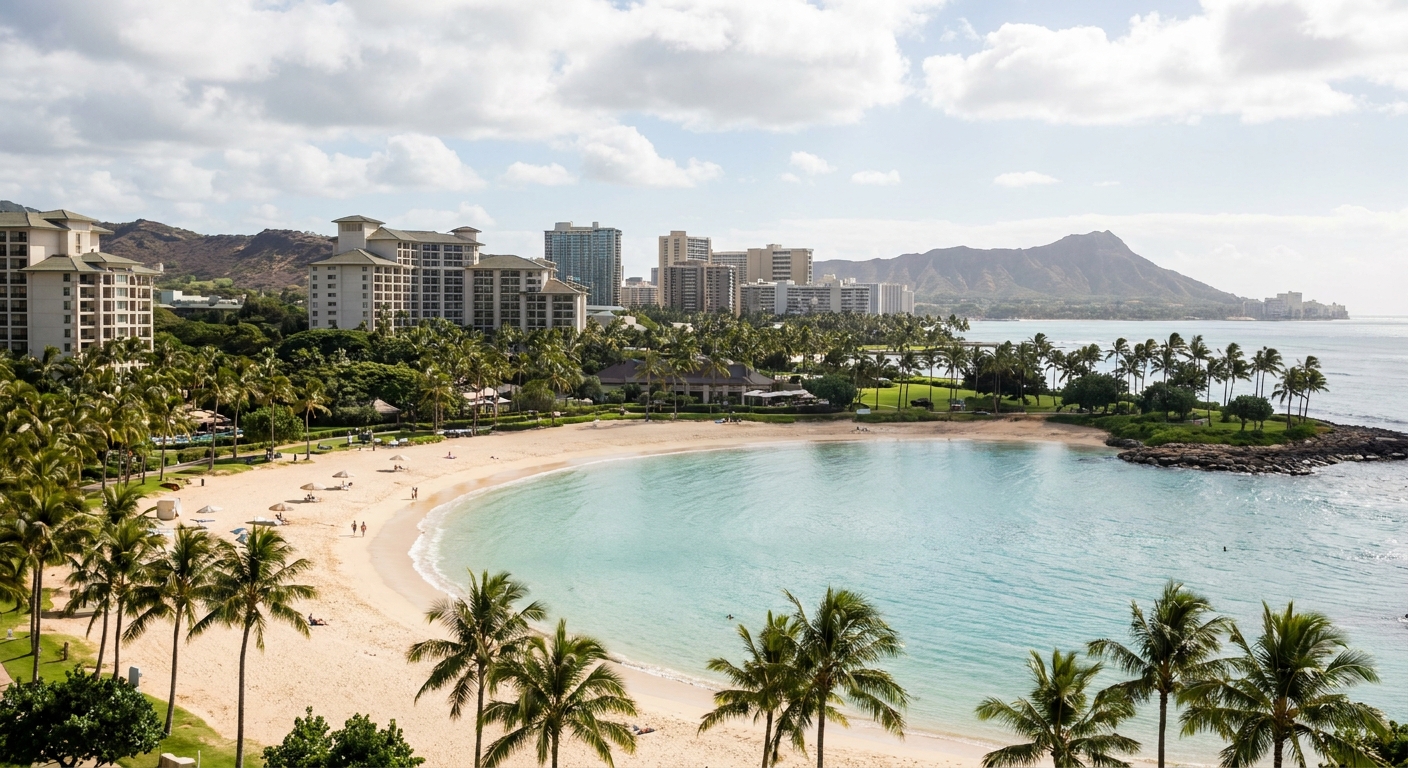
On a July morning at Ko Olina, the first joggers pass along the seaside path before the sun clears the Waianae ridge, and the lagoon is already glassy and warm. Winter brings a gentler pace, with cooler evenings and a lively holiday crowd, while summer is hot, dry and full of families. Ko Olina sits on the dry leeward corner of Oahu, so sun is the rule in nearly every month. It is a resort built around four sheltered lagoons, and the question is mostly which kind of vacation you want from them.
When is the best time to visit Ko Olina?
The best months are April, May, September and October for most travelers, with June through August the pick for pure beach time and the winter months for those who like a cooler, livelier season.
For the beach and the water, summer and early fall are hard to beat. Rain nearly disappears from June through September, the air is hot, and the sea is at its warmest by October. The lagoons are protected by rock breakwaters, so their water stays calmer than the open coast beyond, whatever the season.
For sightseeing, spring and fall are comfortable: warm enough for the water, but with less of the midsummer heat when you head for Pearl Harbor or a day around Honolulu. Winter suits those who want to do more on land, with cooler mornings and evenings that feel good for walking the lagoon paths after dinner.
Families should know that March is spring break season, and the lagoons, pools and restaurants get loud and busy. Summer is also family territory, but the mood is relaxed rather than crowded. Couples and travelers looking for quiet usually do best in late April, May, September and October.
Ko Olina weather by month
Ko Olina is warm every month, and the main change is between a hotter, drier summer and a slightly cooler, wetter winter.
| Month | Average high (°F) | Average low (°F) | Rain (in) | Rain days | Sea (°F) |
|---|---|---|---|---|---|
| January | 80.9 | 64.7 | 1.36 | 2.8 | 77.6 |
| February | 80.9 | 65.1 | 1.79 | 2.5 | 76.3 |
| March | 81.6 | 66.0 | 1.95 | 2.4 | 76.4 |
| April | 83.6 | 67.7 | 0.63 | 1.3 | 77.1 |
| May | 84.9 | 69.0 | 0.97 | 1.8 | 77.8 |
| June | 87.3 | 71.3 | 0.27 | 0.6 | 78.7 |
| July | 88.0 | 72.5 | 0.29 | 0.8 | 79.6 |
| August | 89.1 | 73.1 | 0.62 | 1.1 | 80.2 |
| September | 88.9 | 72.4 | 0.67 | 1.4 | 81.0 |
| October | 87.3 | 71.7 | 1.30 | 1.7 | 81.1 |
| November | 84.1 | 69.4 | 1.77 | 2.5 | 79.5 |
| December | 82.1 | 66.9 | 2.29 | 2.8 | 78.4 |
Even the wettest months here count only a few rainy days, usually short passing showers that clear quickly, sometimes with a cold front moving through in winter. Summer is nearly rain-free and noticeably hotter, with afternoons that call for shade and a long swim. Because the leeward corner is the island’s driest resort coast, overcast days seldom linger.
When is Ko Olina cheapest and least crowded?
The quietest stretches are late April through May, and September through mid-November, when school is in session on the mainland and the resort settles into an easy rhythm.
The busiest weeks are Christmas and New Year, the March spring break wave, Easter week, and the summer family weeks from June through August. Long holiday weekends such as Presidents Day, Memorial Day and Labor Day also fill rooms. At those times the lagoon beaches have towels staked out early, and the public parking at the lagoons fills quickly.
In the calm shoulder months, rooms are easier to find, restaurants have open tables at dinner, and you can usually find a patch of sand on the lagoon shore without planning around it. Holiday weeks bring peak-season rates, so flexible dates make a visible difference.
Which months should you avoid in Ko Olina?
No month is a bad one here, but a few carry caveats: the hurricane season, the hottest weeks of late summer, and the most crowded holiday weeks.
The Central Pacific hurricane season runs from June 1 to November 30. Hawaii is rarely hit, and Ko Olina’s dry corner sees little of the weather that reaches other coasts, but it is still the window in which a tropical system can interfere with plans, so flexible bookings make sense then.
August and September are the hottest months, and midday can feel intense on the sand. The wettest stretch is December through March, though that still means only a few short showers a month. During winter, the large surf mostly reaches the north shores, well away from the lagoons, yet the open coast beyond the breakwaters may turn rougher then, so check the day’s surf and currents and read the posted warnings before entering the water, and swim where a lifeguard is on duty.
When can you swim in Ko Olina?
You can swim in the lagoons all year, because the sea stays warm in every month.
Water is coolest in February and March, when many people still find it comfortable for a long swim, and it warms steadily through summer to a peak in September and October. By fall it feels like bathwater, which suits snorkeling and paddling with children.
Because the breakwaters shield the lagoons, the water there stays calmer than along the exposed leeward coast, but daily shifts still happen, so before entering, look over the posted warnings and check that day’s surf and currents, and swim near a lifeguard only at spots where one is on duty. Beyond the rocks, the open ocean can be livelier in winter, so keep your swimming inside the lagoon unless you know the water.
Festivals and events in Ko Olina through the year
Winter holidays and the whale months
Christmas and New Year bring decorated lobbies, holiday music by the pools and a festive crowd that books far ahead. Many families gather over the holiday stretch, and the beach evenings are mild enough for dinner outside and walks along the lagoon paths.
Winter is also when humpbacks are in Hawaiian waters, and you can often spot spouts and tail slaps from the shoreline or from a boat out of the nearby harbor. Whales are protected, so keep a respectful distance of at least 100 yards on the water.
The Honolulu Marathon in December draws runners and spectators to the city, about 45 minutes away, and some stay at Ko Olina for the calmer setting. Late winter then leads into the spring break rush in March.
Spring and summer celebrations
Lei Day on May 1 is a gentle celebration across Oahu, with lei making, hula and music at parks and resorts. At Ko Olina you will often see lei greetings and hula shows in the evening, a nice reason to be here in early May when crowds are light.
Kamehameha Day on June 11 honors the king who united the islands, with parades and floral lei draped over statues in Honolulu. It is a short drive from the resort and easy to pair with a day in town.
Summer evenings are made for the luau and for sunset on the lagoon shore, when families linger on the sand until the sky turns orange. This is the season for long beach days and late dinners outside.
Fall: quiet weeks and the Ironman buzz
October is calm at the resort, with the warmest sea of the year and a relaxed crowd. Elsewhere in the state, the Ironman World Championship in Kona on the Big Island takes over the news, though it does not change the mood on Oahu.
November marks the start of the wetter, cooler half of the year and the return of big surf on the north shores, a great day trip for watching the waves from the sand. Back at the lagoons, the pace stays easy until the holiday crowds arrive in December.
Sources
- NOAA NCEI, monthly normals 1991-2020, station USW00022551, checked September 8, 2026
- Open-Meteo Marine API, average 2015-2024, checked September 8, 2026
- sunrise-sunset.org, sunrise and sunset calculated for the 15th of the month, checked September 8, 2026
- Ko Olina Resort, Lagoons (koolina.com/destination/lagoons), checked September 25, 2026
- Ko Olina Resort, press release « City and Ko Olina Partner To Launch New Public Access Plan for Lagoons », October 15, 2020, checked September 25, 2026
- Hawaii Tourism Authority, Go Hawaii, itineraire « 4 Days in Waikiki and 3 Days on the Leeward Coast » ; HVCB, map Driving Times from Waikiki (2010), checked September 25, 2026
- NOAA NCEI, normals 1991-2020, stations USW00022551 (Kalaeloa) and USC00519397 (Waikiki), via PLAN-HAWAII.md §1, checked September 24, 2026
- NOAA, Hawaiian Islands Humpback Whale National Marine Sanctuary, Responsible Recreation, checked September 25, 2026
- Hawaii Department of Taxation, Announcement 2025-03 ; City and County of Honolulu, OTAT FAQ, checked September 25, 2026
- NWS Honolulu / Central Pacific Hurricane Center, « 2026 Central Pacific Hurricane Season Outlook », weather.gov/hfo/hurricaneOutlook2026, checked September 24, 2026