
FLORIDA · PEACOCK SPRINGS · MARCH
Wes Skiles Peacock Springs sits in the flat pine-and-oak country north of the Suwannee, and March is the month the drive there stops being a winter drive. Afternoons average 74.9°F. Nights still fall to 49.6°F, and two of them, in an average March, reach freezing. A March day here swings better than 25 degrees between the hour before sunrise and mid-afternoon.
The clock change also lands in March, so by mid-month there are twelve full hours of daylight and the sun is still up at 7:41 pm local time. What we could not verify is everything under the surface: no entrance fee, no opening hours and no water temperature for the vents came back confirmed, and we would rather say so than guess three numbers.
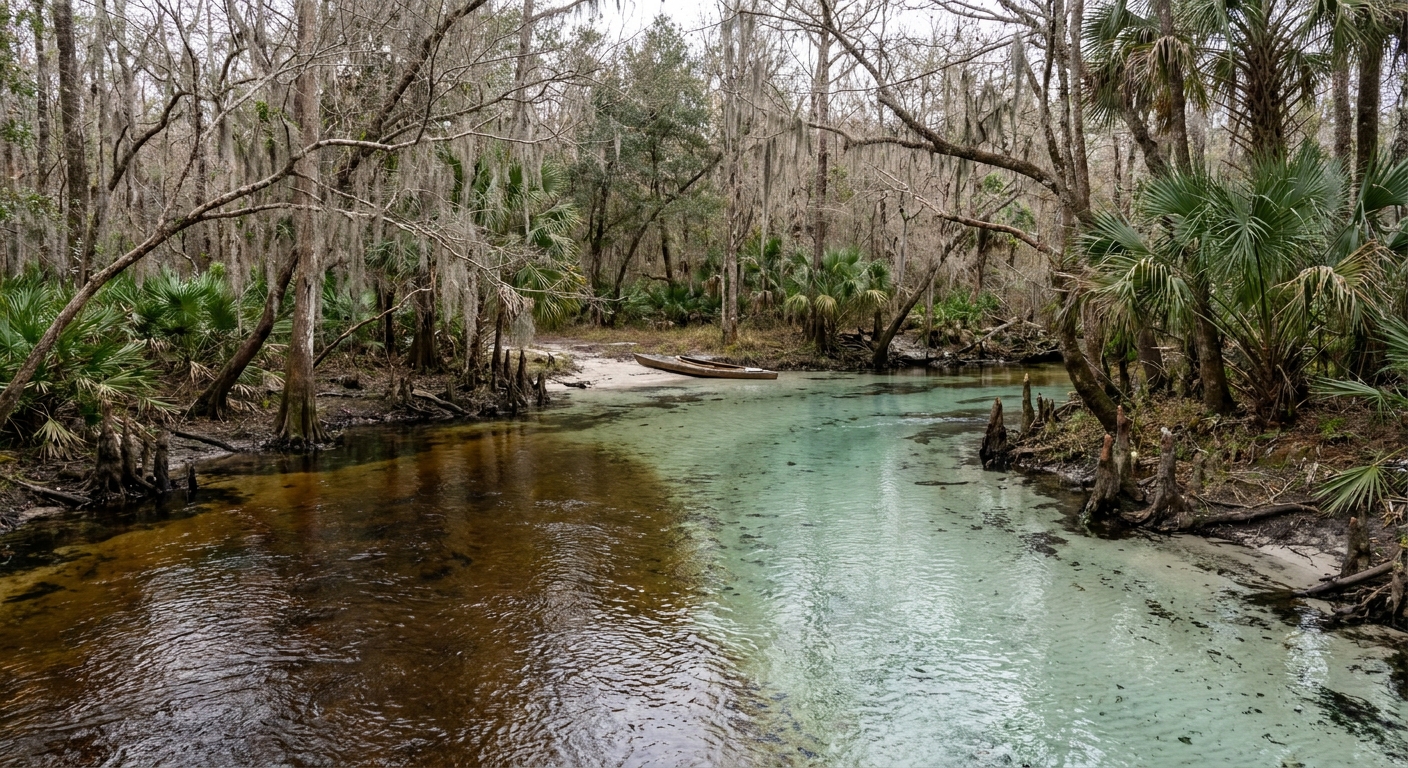
THE MONTH AT A GLANCE · PEACOCK SPRINGS
March hands you the warmest afternoons of the late dry season and a 7:41 pm sunset, at the cost of two nights at or below freezing and Florida’s busiest school-break weeks on the same roads.
AVG HIGH 74.9°F · AVG LOW 49.6°F · 4.6 WET DAYS · 2 FREEZING NIGHTS
Go for: dry-season afternoons at 74.9°F, twelve usable hours of light, rain on fewer than five days, and the last month before April’s 80.1°F middays.
Think twice before: committing to a tent, since two March nights in an average year reach 32°F or below at the nearest official station.
Normals: NOAA NCEI 1991-2020, station USW00012833 at Cross City · Daylight: sunrise-sunset.org · full sources at the end
On this page
- March weather at Peacock Springs74.9°F highs, 3.53 inches, 4.6 wet days
- How cold the mornings get49.6°F lows and two freezing nights
- Crowds and prices in MarchSpring break statewide, and the figures we could not read
- Things to do around the springs in MarchThe park, Troy Spring and the Suwannee reach
- A two-day plan for March lightFrom the 7:39 am sunrise to the 7:41 pm sunset
- March, February or April?How the three months compare, degree by degree
- Is March a good month to go?Who it suits, and when April is the better call
Every figure here is measured at Cross City, at the NOAA station that also serves Troy Spring on the same reach of the Suwannee. It is the closest official thermometer we could read, and it records the air, never the water in the sinks. Where we had nothing to read, we say so instead of filling the gap.
Wes Skiles Peacock Springs weather in March: average highs, lows and rain days
| March normal at Cross City | Figure |
|---|---|
| Average high | 74.9°F |
| Average low | 49.6°F |
| Total precipitation | 3.53 in |
| Days with 0.10 in or more | 4.6 |
| Days with 1 in or more | 0.6 |
| Nights at 32°F or below | 2.0 |
| Daylight on March 15 | 12 h 02 min |
The normals here are NOAA NCEI’s 1991-2020 set, read at station USW00012833 at Cross City. They give March an average high of 74.9°F, an average low of 49.6°F and 3.53 inches of rain across the month. This is a station record, not a gridded reanalysis, so it is a real thermometer in a real place, just not the one you are swimming in.
An average of 4.6 days collect at least a tenth of an inch, so measurable rain shows up roughly one day in seven. The heavy version is rarer: 0.6 day reaches a full inch, or one real soaking in about three Marches out of five. Late dry season rain here tends to arrive with a passing front rather than the stacked afternoon storms Florida runs from June onward.
Between the 49.6°F night and the 74.9°F afternoon sits a swing of 25.3 degrees, and it happens most days rather than occasionally. Pack for two climates in one bag: a fleece or a real jacket for anything before 9 am, short sleeves for the middle of the day, and a dry change of clothes kept in the car. Cotton that got wet at dawn is still damp at dusk in March air.
On March 15 the sun rises at 7:39 am and sets at 7:41 pm local time, 12 hours and 02 minutes apart, per sunrise-sunset.org (the raw times are 11:39 and 23:41 UTC, converted to Eastern Daylight Time). Daylight saving has already started by mid-month, so the light is loaded into the evening. You can still be outdoors at 7 pm and be on the road before full dark.
How warm is Wes Skiles Peacock Springs in March?
Warm is an afternoon condition in March, not a daily one. The 74.9°F average high belongs to the middle of the day and holds for a few hours. The 49.6°F average low belongs to the hour before sunrise. Both are thirty-year normals, so half the Marches in the 1991-2020 record ran warmer and half cooler, and any single day can sit well outside the pair.
In practice you leave the car in a jacket and finish the day in a t-shirt. Fifty degrees with damp river air moving through it reads colder than fifty degrees dry, and anyone standing still on a dock or at a parking area feels it first. By two in the afternoon the same clothes are too much. The one item worth its space is a towel plus a dry layer nobody has sat on.
Two nights in an average March fall to 32°F or below at the Cross City station. That is frost on a windshield and a genuinely cold night under thin nylon.
How busy is Wes Skiles Peacock Springs in March? Crowds, prices and the demand peak
We found no occupancy series and no monthly room-rate series for this corner of North Florida, so we crown no month expensive and no month cheap. What is a matter of calendar rather than pricing: March is spring break across the state, and our Florida orientation flags it as the loudest, priciest stretch of the year for beach towns and parks alike. A quiet inland spring is not Panama City Beach, but the interstates and the rental fleet are shared.
No booking lead-time data came back for the park, so we give no number of weeks. The two variables you control are your dates and your bed. Midweek days carry exactly the same 74.9°F afternoon as Saturdays, which is the cheapest adjustment available to anyone with a flexible calendar. Regions and budget tiers live in our where-to-stay guide and what a Florida trip costs.
We could not verify the county lodging-tax rate that applies to overnight stays near the park, so we give no percentage and none should be read into our totals. The same goes for the park’s own entrance fee. Our know-before-you-go page handles the general Florida layer of taxes, tolls and rental extras.
There is one line where spending more visibly changes a March day, and it is warmth after dark. Everything before 10 am happens near 49.6°F, and two nights in the month reach freezing. A heated room instead of a tent buys back the whole morning: you start the day dry, warm and roughly two hours earlier than someone packing a frozen rainfly.
Things to do in Wes Skiles Peacock Springs in March
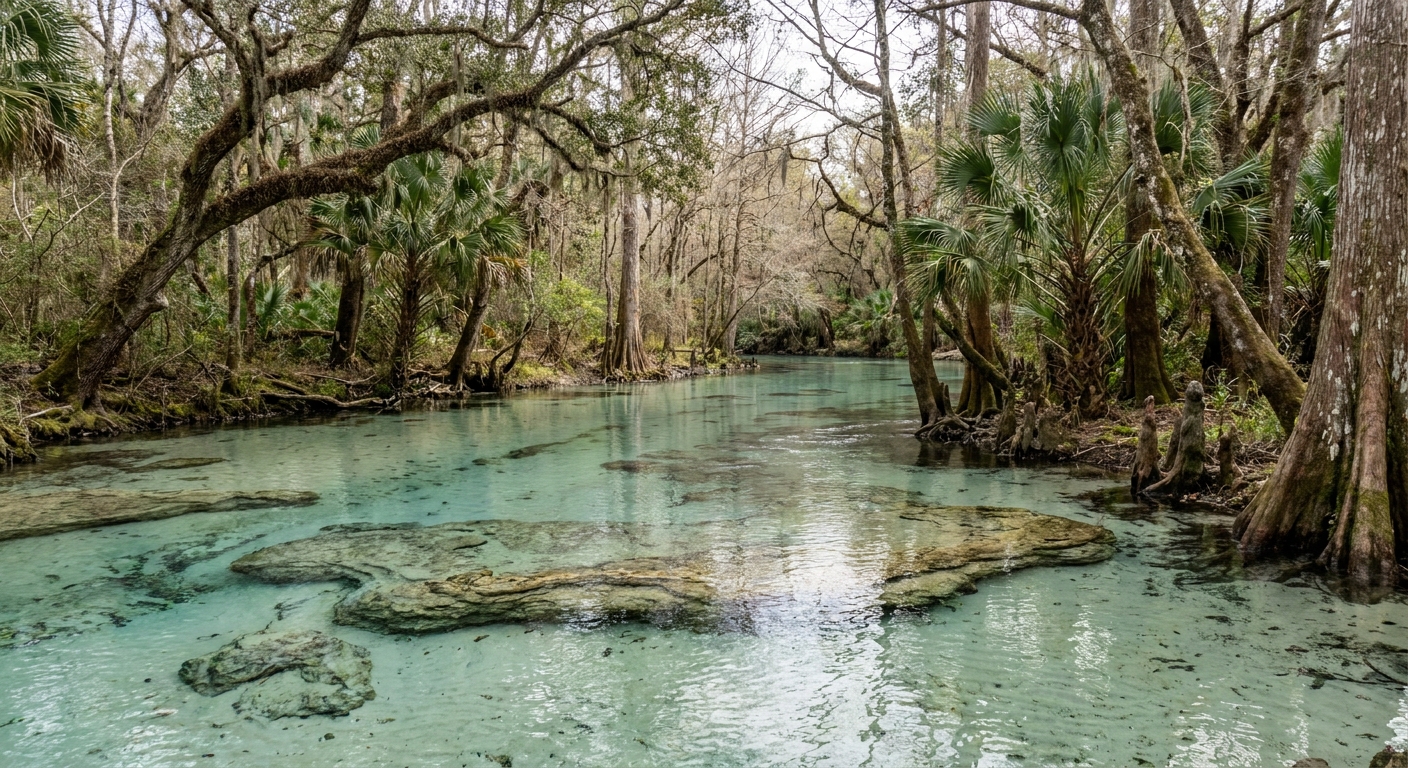
March is the month you can spend a full day outdoors here without negotiating with the weather. Afternoons average 74.9°F, measurable rain falls on 4.6 days out of thirty-one, and the light runs to 7:41 pm. February hands you the same water under a 69.6°F ceiling. June hands you heat and the start of the wet season. The mild afternoon stacked on twelve hours of daylight is the specific thing March holds.
Wes Skiles Peacock Springs State Park is the destination, and we will not attach figures to it that we have not read: its entrance fee, its hours and the temperature of its vents all came back unverified, so check the park operator before you drive. Troy Spring sits on the same reach of the Suwannee and shares the Cross City weather station, which is how one set of normals covers both. Wider options are in our Florida things-to-do guide.
A Florida spring run barely shifts temperature across the year. The air above it moves 25.3 degrees in a single March day, and 10.5 degrees between the February and April averages. That gap is what a month actually buys you: the same water feels welcoming at 8 am and brisk at 3 pm, with nothing changed but the air on your skin when you climb out.
Since we could not verify what the park charges, we cannot tell you what inside it is free. What costs nothing in March is the light: 12 hours and 02 minutes on the 15th, with the last of it at 7:41 pm, and no reason to be back at the car by five.
Wes Skiles Peacock Springs in March: a two-day itinerary
Day one runs on March light. Sunrise is 7:39 am into air near 49.6°F, so give the first hours to the drive and the coffee: gear sorted at 9, first entry between 10 and 11 once the air has come up off its low, lunch out of a cooler around 1, the second session inside the 74.9°F window from 2 to 4, and everything packed by 6 as the temperature slides back. Sunset at 7:41 pm still leaves an hour of usable light for the road.
Day two is where the 4.6 wet days get decided. If the morning is grey, invert the order: drive first, take the water in the afternoon, keep the session short. If a front parks over the whole day, North Florida’s indoor answer is a town with a roof over its history, and our St. Augustine guide lays that day out. Getting between the two is covered in the Florida driving guide.
Wes Skiles Peacock Springs in March vs February and April
| Normal, 1991-2020 | February | March | April |
|---|---|---|---|
| Average high | 69.6°F | 74.9°F | 80.1°F |
| Average low | 45.2°F | 49.6°F | 55.0°F |
| Precipitation | 2.96 in | 3.53 in | 2.90 in |
| Days with 0.10 in or more | 4.8 | 4.6 | 4.1 |
February runs 5.3 degrees cooler by day, 69.6°F against 74.9°F, and 4.4 degrees cooler by night. April runs 5.2 degrees warmer by day and 5.4 warmer by night, at 80.1°F and 55.0°F. Rain inverts that neat ladder: March is the wettest of the three at 3.53 inches, against 2.96 in February and 2.90 in April, despite counting fewer days at a tenth of an inch than February. No water temperature was verifiable for any of the three, so we give none.
Shift four weeks earlier and you save nothing on rain frequency, 4.8 wet days against 4.6, while losing 5.3 degrees off every afternoon. Shift four weeks later and April gives 80.1°F days, 55.0°F nights you can sleep through outdoors, and the driest month of the three at 2.90 inches. What April takes away is the cool morning: the air is already at 55.0°F before sunrise, so the change of season you feel climbing out of the water is gone.
Is March a good time to visit Wes Skiles Peacock Springs?
Yes for anyone building a day around water and daylight: 74.9°F afternoons, twelve hours of light and rain on fewer than five days of the month is close to the best combination the dry season offers here. No for cold sleepers in unheated tents, no for anyone who needs an empty highway during Florida’s busiest school-break weeks, and no for anyone who wants a firm price forecast, because we have none to give.
If the answer lands on no, the fix is April rather than February. April is 5.2 degrees warmer by day, 5.4 warmer by night, and the driest of the three at 2.90 inches. February is colder on every measure we hold and no better on wet-day count, at 4.8 days against March’s 4.6. The full twelve-month view sits in our best-time-to-visit page.
No other month puts a 74.9°F afternoon on top of a 49.6°F morning with twelve hours of daylight between them, and that daily 25-degree climb is the signature of March here.
The last word
Settle where you sleep before anything else, because those two freezing nights land on somebody, and a heated room turns the coldest hour of a March day into a non-event. The rest of the month is generous: warm by lunch, light until 7:41 pm, dry on twenty-six days out of thirty-one. One last piece of arithmetic worth carrying north: the 3.53 inches arrive across 4.6 wet days, about 0.77 inch each time it rains, against 0.62 in February. March rains no more often, it rains harder. Bring the dry bag you would have skipped four weeks earlier.
Sources & data for this guide
- March normals: average high 74.9°F, average low 49.6°F, 3.53 inches · NOAA NCEI monthly normals 1991-2020, station USW00012833 at Cross City · checked Sep 24, 2026
- Wet days (4.6 at 0.10 inch or more, 0.6 at 1 inch or more) and 2.0 nights at 32°F or below · NOAA NCEI 1991-2020, same station · checked Sep 24, 2026
- February (69.6°F / 45.2°F / 2.96 in / 4.8 days) and April (80.1°F / 55.0°F / 2.90 in / 4.1 days) · NOAA NCEI 1991-2020, same station · checked Sep 24, 2026
- Sunrise 11:39 UTC and sunset 23:41 UTC on March 15, converted to Eastern Daylight Time, 12 h 02 min of daylight · sunrise-sunset.org · checked Sep 24, 2026
- Editorial caveat: the station sits at Cross City, not at the spring, and it also serves Troy Spring on the same reach of the Suwannee. Read the figures as local air, never as water.
- We could not verify the park’s entrance fee, its opening hours, a water temperature for its vents, or the county lodging-tax rate. Confirm all four with the park operator before you drive.
To plan your stay
- Best Time to Visit Wes Skiles Peacock Springs: Weather, Rain and the Quiet Months
- Wes Skiles Peacock Springs in February: Highs of 69.6°F, 4.8 Wet Days and Four Freezing Nights
- Wes Skiles Peacock Springs in April: Weather, Rain Days and How It Compares With March and May
- Wes Skiles Peacock Springs in January: Weather, Rain Days, Frost Nights and Daylight