
FLORIDA · WES SKILES PEACOCK SPRINGS · SUWANNEE COUNTY
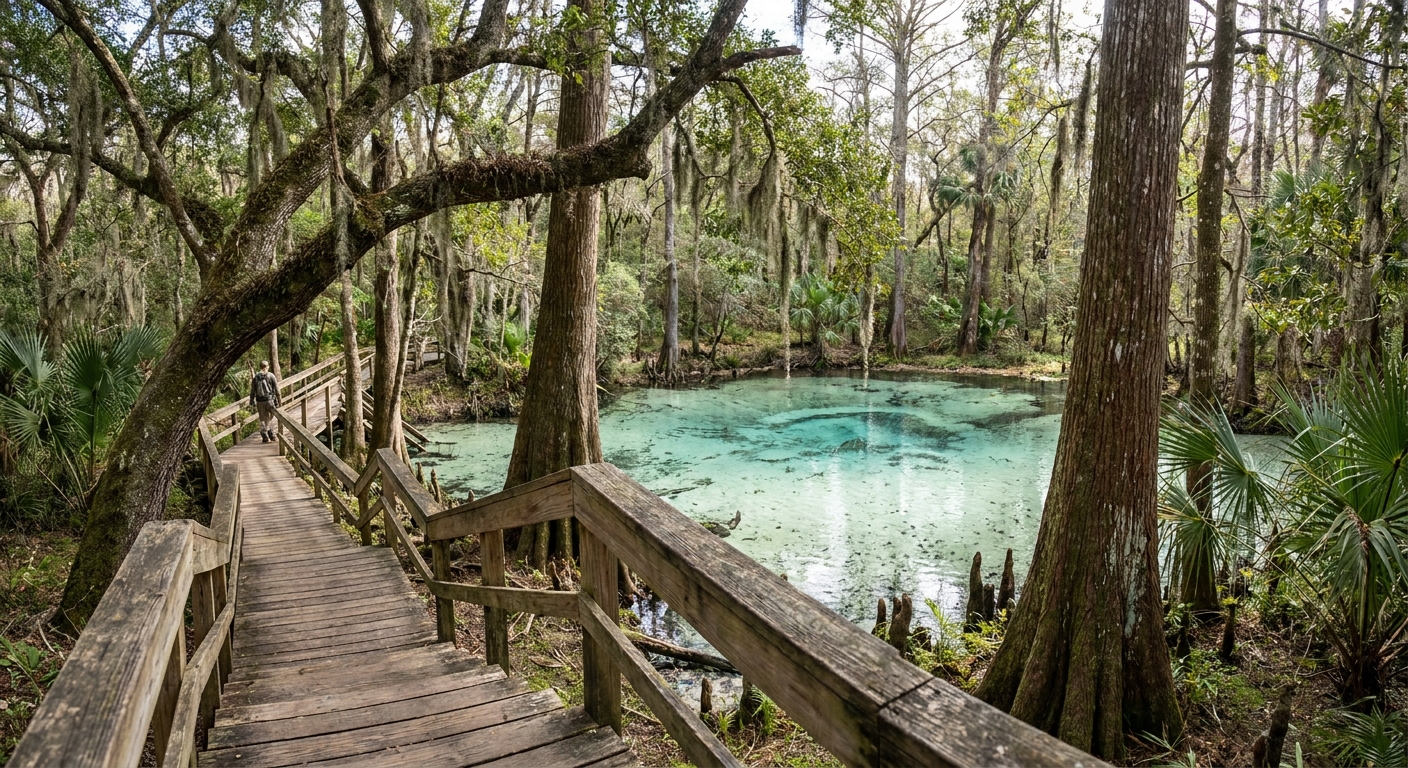
Wes Skiles Peacock Springs is a patch of north Florida hardwood with holes in the floor. Peacock I, Orange Grove Sink and the karst windows between them link up underground, and most people who make the drive arrive with tanks in the trunk. The rest come to swim in cool water while the parking lot bakes. Above the water line, the year here splits along one line: rainfall.
That split is sharper than the temperature curve, and it decides more about a weekend than the thermometer does. Dry ground means carrying gear without wading to the truck. A wet month means an afternoon spent under the tailgate. The twelve rows below sort the year, and the sections after them answer the four questions people actually arrive with.
THE YEAR AT A GLANCE · WES SKILES PEACOCK SPRINGS
Go in October: 82.2°F afternoons, 2.23 inches of rain and 3.7 wet days make it the month that pairs warm air with dry ground.
BEST MONTH: OCTOBER · HARDEST ABOVE WATER: AUGUST · NORMALS FROM CROSS CITY, 1991–2020
Go for: October and early November weekends, when afternoons hold 82.2°F and 74.4°F and rain falls on 3.7 and 3.4 days respectively.
Think twice before: booking a June to August trip around anything above the water line: 7.00 to 8.10 inches of rain a month, and nights that sit near 73°F.
Normals: NOAA NCEI 1991–2020, Cross City · Daylight: sunrise-sunset.org · full sources at the end
On this page
- Highs, lows and rainfall for all twelve monthsThe Cross City normals table
- One month to bookOctober, at 82.2°F and 2.23 inches
- How hot summer getsJuly at 90.1°F, nights near 73°F
- The quietest weeks by the calendarJanuary and February weekdays
- The month to move if you canAugust, 8.10 inches of rain
- Is spring or fall the better shoulder?How April and November compare
The park sits near Luraville in Suwannee County, roughly an hour’s drive west of Gainesville and a little over two hours from Jacksonville (est.). Most visits are a day trip or a two-night weekend run out of Live Oak, Branford or High Springs, which keeps flying simple: Gainesville or Jacksonville, then a rental car (how Florida’s airports stack up). Pick the month and you have mostly picked whether the ground you carry tanks across is dry.
Wes Skiles Peacock Springs weather month by month: highs, lows and rainfall
| Month | Avg high | Avg low | Rain | Days ≥ 0.10 in |
|---|---|---|---|---|
| January | 65.9°F | 41.8°F | 3.38 in | 5.7 |
| February | 69.6°F | 45.2°F | 2.96 in | 4.8 |
| March | 74.9°F | 49.6°F | 3.53 in | 4.6 |
| April | 80.1°F | 55.0°F | 2.90 in | 4.1 |
| May | 86.7°F | 62.7°F | 2.74 in | 4.7 |
| June | 89.5°F | 70.6°F | 7.00 in | 9.1 |
| July | 90.1°F | 72.5°F | 7.77 in | 11.6 |
| August | 89.9°F | 72.9°F | 8.10 in | 11.5 |
| September | 88.0°F | 69.8°F | 5.82 in | 7.6 |
| October | 82.2°F | 59.9°F | 2.23 in | 3.7 |
| November | 74.4°F | 49.2°F | 2.10 in | 3.4 |
| December | 68.2°F | 44.4°F | 2.95 in | 4.6 |
Two blocks, not twelve steps. From October through May, no month carries more than 3.53 inches of rain. From June through September, none carries less than 5.82. Temperature moves on a gentler curve: 65.9°F in January to 90.1°F in July, a spread of 24.2°F across the year, with seven months averaging 80°F or better in the afternoon.
The switch happens twice. Between May and June, rainfall goes from 2.74 inches to 7.00 and days at 0.10 inch or more climb from 4.7 to 9.1. It runs backward between September and October, when the total drops from 5.82 inches to 2.23, wet days fall from 7.6 to 3.7, and average lows shed 9.9°F, from 69.8 to 59.9. Those two four-week stretches do nearly all the work.
August takes the wettest ground of the twelve months, 8.10 inches of it, spread over 11.5 days at 0.10 inch or more and 2.4 days of an inch or more. July logs a hair more wet days, 11.6, on slightly less water, 7.77 inches. For a diver below the ceiling, none of that registers. For anyone gearing up, eating lunch or snorkeling the sink at midday, it is the pair of months that rewrites the plan.
Every figure here comes from NOAA’s 1991-2020 normals for station USW00012833 at Cross City, the same station that serves Troy Spring on the same reach of the Suwannee. The park keeps no long-run weather record of its own, so treat these numbers as the shape of the local year rather than a reading at the sink rim. A monthly mean also flattens the day: January’s average high of 65.9°F sits in the same month as its 8.5 freezing nights.
When is the best time to visit Wes Skiles Peacock Springs?
October, and it is not close. Average high 82.2°F, average low 59.9°F, 2.23 inches of rain across 3.7 days at 0.10 inch or more, and 11 hours 29 minutes of daylight on the 15th. Warm enough to stand around between dives without shivering in a damp suit, dry enough that a two-day trip rarely loses an afternoon to weather, and past the summer downpours by a full month.
November looks like the obvious rival because it is drier, 2.10 inches over 3.4 days. For that saving of 0.13 inch you hand back 7.8°F in the afternoon, 10.7°F at night, two average nights at or below freezing, and 48 minutes of daylight, since November 15 gets 10 hours 41 minutes against October’s 11 hours 29. April is the spring answer at 80.1°F, though it carries 2.90 inches of rain, a third more than October.
The wider Florida calendar behind these numbers, the dry season and the hurricane months that overlap this park’s wettest stretch, is laid out in our state timing guide. If the spring is one stop in a longer loop through north Florida, the road-trip guide handles the driving order, and the parks guide covers what else fits on the same tank of gas.
How hot does Wes Skiles Peacock Springs get in summer?
June, July and August average 89.5°F, 90.1°F and 89.9°F in the afternoon, and the nights give almost nothing back. Average lows of 70.6, 72.5 and 72.9°F mean that dawn in August starts warmer than an April afternoon ends. Daylight peaks at 14 hours 07 minutes on June 15, so there is plenty of time to do the work, and plenty of heat to do it in while hauling steel across a sand lot.
What the record we read does not carry is the part everyone asks about. There is no humidity series, no dew point and no heat index in these normals, and no measured water temperature for the spring itself, so we are not going to publish a figure for any of them. Florida spring water runs cool and steady all year, which means the gap between air and water is widest in July and narrowest in January, when the afternoon averages 65.9°F.
When is Wes Skiles Peacock Springs quietest?
By the calendar rather than by any price list: weekdays between the start of December and the week before spring break, with a second lull in late September once the school year is running again. Summer weekends and the March break weeks are the busy end. We hold no visitor counts and no rate series for this corner of Suwannee County, so read that as a calendar pattern and nothing more.
Winter weekdays give you the water without the queue for the stairs and a short walk from the lot to the sink. Cold air also flatters spring water: the climb out in January, with the afternoon at 65.9°F, is a far easier five minutes than the same climb in August’s 89.9°F. And the ground holds up, since December’s 2.95 inches and February’s 2.96 land in the driest half of the year.
The cost is light and cold. January 15 gets 10 hours 28 minutes of daylight, second shortest of the twelve behind December’s 10 hours 16, so two dives and a drive home use the whole box. January also averages 8.5 nights at or below freezing, the most of any month, ahead of December’s 6.2 and February’s 4.1. Its 3.38 inches over 5.7 wet days make it the soggiest month outside summer except March, at 3.53.
Which month should you avoid in Wes Skiles Peacock Springs?
August, for anyone whose day includes time above the water. It brings 8.10 inches of rain, the most of the twelve months, on 11.5 days at 0.10 inch or more and 2.4 days of an inch or more, and its nights average 72.9°F, the warmest of the year. Divers underground notice none of it. Families swimming the sink, photographers with cases open and anyone changing out of a wetsuit in the lot notice all of it.
Two figures soften the verdict. With 2.4 inch-plus days inside 11.5 wet days, most of that rain arrives as showers rather than all-day gray, and August 15 still delivers 13 hours 15 minutes of daylight, so a washed-out hour at two o’clock leaves a long evening intact. The summer water is also the friendliest of the year for long, lazy surface intervals.
Is the shoulder season worth it in Wes Skiles Peacock Springs?
The shoulders here are April and May on one side, October and November on the other. April averages 80.1°F by day and 55.0°F at night against July’s 90.1 and 72.5: 10.0°F cooler in the afternoon, 17.5°F cooler before dawn, on 2.90 inches of rain instead of 7.77. October runs warmer than April at 82.2°F with less rain still, 2.23 inches.
Dry ground is the real gain. April logs 4.1 days at 0.10 inch or more and October 3.7, against July’s 11.6, so the odds of a lost afternoon roughly divide by three. Freezing nights are effectively gone by April, at 0.1 on average, and May stays generous with light: 13 hours 43 minutes on the 15th, only 24 minutes short of the June peak, on the year’s second-lowest rainfall total of 2.74 inches.
You give up daylight, mostly. April 15 runs 12 hours 58 minutes, 69 minutes short of June 15, and October 15 runs 11 hours 29 minutes, 2 hours 38 minutes short of it, which shortens a two-dive day with a drive on each end. March is the shoulder month to treat with care: 3.53 inches of rain, the most outside summer, and 2.0 nights at or below freezing.
Take the fall shoulder if the trip is about the water and the gear, from mid-October into the first half of November, when afternoons still reach 82.2°F and 74.4°F on 3.7 and 3.4 wet days. Take the spring shoulder if the trip is about long days with children at the sink, which points at May and its 13 hours 43 minutes of light. Summer stays workable for certified divers who accept that lunch happens in the truck.
The last word
Book the third week of October, drive in on a Friday and give yourself the Saturday and Sunday: 82.2°F afternoons, 2.23 inches spread across a whole month, and a lot that stays firm under a loaded cart. If winter is the only window you have, aim at February rather than January, since its 4.1 average freezing nights are roughly half of January’s 8.5 and its afternoons run 3.7°F warmer at 69.6°F, with 43 more minutes of daylight on the 15th. Then check the forecast the morning you leave, because a thirty-year average has never once canceled a dive.
Sources & data for this guide
- Monthly normals for highs, lows, precipitation, wet days and freezing nights · NOAA NCEI 1991-2020, station USW00012833 (Cross City, Florida) · checked Sep 12, 2026
- Daylight length and sunrise/sunset times for the 15th of each month · sunrise-sunset.org · checked Sep 12, 2026
- Scope caveat · the park keeps no long-run weather station; Cross City is the same station used for Troy Spring on the same reach of the Suwannee · checked Sep 12, 2026
- We found no visitor-count series, no lodging rate series and no measured water-temperature record for this spring, so none is published here.
- Drive times from Gainesville and Jacksonville are editorial estimates. Park hours, access rules and diving requirements change: check with the park before you drive.