
FLORIDA · JANUARY · WES SKILES PEACOCK SPRINGS
You have already chosen Wes Skiles Peacock Springs, the north Florida state park best known for its underwater cave system. The open question is the calendar. January brings frosty dawns, mild afternoons fit for a long walk in the woods, and sunsets before six, so the month decides your layers and the timing of any swim more than it decides whether to go.
For a winter trip, plan around two facts: frost is common enough to pack for, and rain falls on roughly one day in five. If warmer afternoons matter most to you, our February guide runs the same station four weeks later.
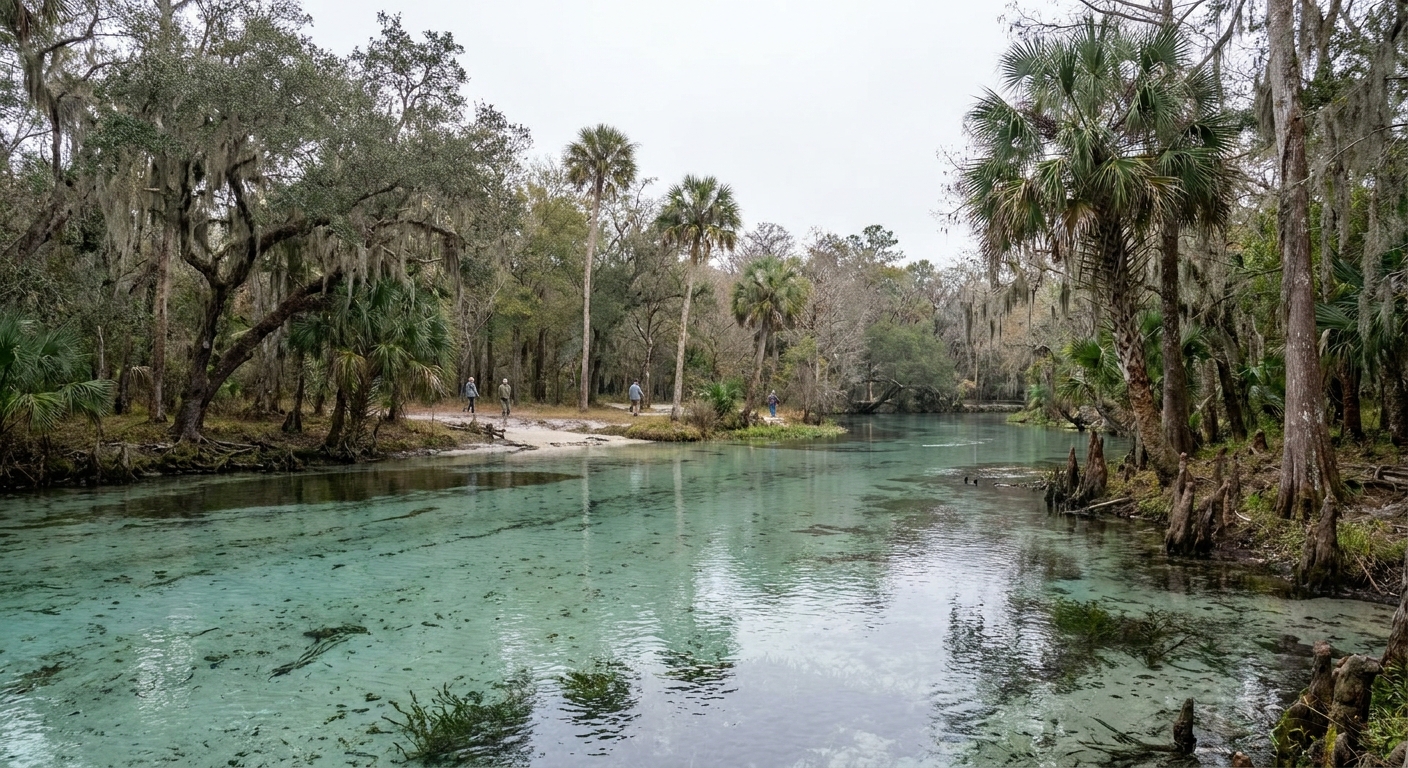
JANUARY AT A GLANCE · WES SKILES PEACOCK SPRINGS
January suits walkers and divers who can handle a near-freezing start, with mild afternoons and a sunset at 5:55 pm to plan the day around.
COOLEST OF DEC–FEB · 8.5 FROST NIGHTS · SUNSET 5:55 PM ON JAN 15
Go for: midday walks without summer heat, cave diving in cool air, and the chance to see the park in its winter light.
Think twice before: planning a warm-air swim day. The average morning sits at 41.8°F, and getting out of the water into that air is a shock.
Climate: NOAA NCEI, Cross City station · Daylight: sunrise-sunset.org · full sources at the end
On this page
- Wes Skiles Peacock Springs weather in JanuaryHighs of 65.9°F, lows of 41.8°F, 5.7 rain days
- How cold does it get at night in January?8.5 nights at 32°F or below, and what to wear
- Crowds and prices in JanuaryBooking, lodging tax and the one cost worth raising
- Things to do at Peacock Springs in JanuaryPeacock Spring, Orange Grove Sink and Troy Spring nearby
- A one-day plan for JanuarySunrise at 7:27 am, sunset at 5:55 pm
- January vs December and FebruaryJanuary runs 2.3°F cooler than December and 3.7°F cooler than February
- Is January a good time to visit?Yes for walkers and divers, no for warm-weather swimmers
Most visitors treat the park as a day trip from a base elsewhere in north Florida. Our where-to-stay guide covers the bases, our flights guide sorts the airports, and getting around Florida explains why you will want a car for this corner of the state.
Wes Skiles Peacock Springs weather in January: average highs, lows and rain days
| January at Cross City (NOAA, 1991–2020) | Normal |
|---|---|
| Average high | 65.9°F (18.8°C) |
| Average low | 41.8°F (5.4°C) |
| Precipitation | 3.38 in |
| Days with 0.10 in or more | 5.7 |
| Days with 1 in or more | 0.8 |
| Nights at 32°F or below | 8.5 |
| Daylight on January 15 | 10 h 28 min · 7:27 am to 5:55 pm EST |
NOAA’s National Centers for Environmental Information set the January normal at 65.9°F for the afternoon high and 41.8°F for the overnight low, averaged over 1991 to 2020 at the Cross City station, USW00012833. These come from a physical thermometer at an official station, and that station stands on the same reach of the Suwannee as Troy Spring, away from the park itself. Read the normals below as the January of that stretch of river country. The month totals 3.38 inches of precipitation.
Those 3.38 inches arrive on 5.7 days that clear a tenth of an inch, about one day in five. On a two-day weekend, the odds favor at least one dry day, so keep the plan flexible and move the swim or the long walk to whichever day stays clear.
From dawn to mid-afternoon the thermometer climbs about 24°F, enough to take you from a winter jacket at the car to long sleeves by lunch. Pack in layers you can peel off: a warm midlayer, a windproof shell, a hat and gloves for the first hours, and a full change of dry clothes for anyone who plans to get wet.
On January 15 the sun rises at 7:27 am and sets at 5:55 pm Eastern time, for 10 hours 28 minutes of light. Under tree cover the light fades before the official sunset, so aim to be back at the car around 5:30 pm.
How warm is Wes Skiles Peacock Springs in January?
An average January afternoon peaks at 65.9°F (18.8°C) and the night bottoms out at 41.8°F (5.4°C), a gap of 24.1°F. We could not verify a water temperature for the springs from our sources, so we quote none. The air is what swings, and those two numbers set the day.
A 9 am start calls for the insulated jacket, gloves and a warm hat. By early afternoon a fleece or a long-sleeved shirt is usually enough for walking, and the jacket can wait in the car until the light starts to go.
Frost is a regular visitor. NOAA counts 8.5 nights in an average January that fall to 32°F or below, a little more than one night in four. Expect ice on the windshield before sunrise, and if you camp anywhere in the region, bring a sleeping bag rated below freezing.
How busy is Wes Skiles Peacock Springs in January? Crowds and prices
January falls inside Florida’s dry season, as our Florida orientation lays out, though at Cross City it is the wettest of the three winter months at 3.38 inches. We found no occupancy series or monthly room rates for lodging near the park, so we call no month cheap or expensive.
Without a price series, we cannot tell you how many weeks ahead to book. Choose refundable rates where you can, and since we could not verify whether the park limits entries on busy days, check with Florida State Parks before you drive out.
We could not verify the lodging-tax rate that applies near the park, so we give no percentage. Ask for the total price with taxes and fees when you book.
If one line of the budget deserves more money in January, make it warm sleep: a heated room or cabin instead of a tent on a frost night. Divers should budget for gear that keeps them warm between dives on a cold morning. Our Florida trip-cost guide covers the rest of the budget.
Things to do in Wes Skiles Peacock Springs in January
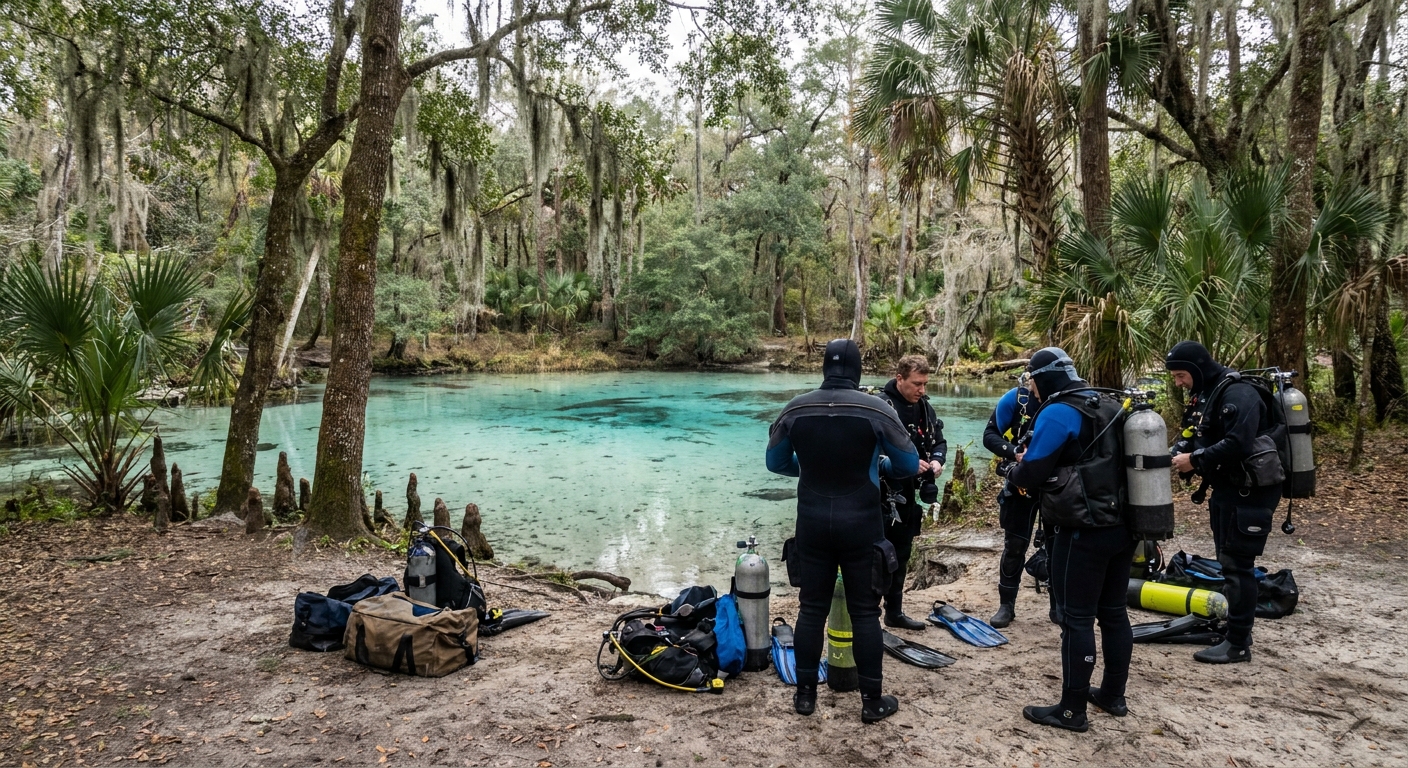
January makes midday the best time to be outdoors. With afternoons averaging 65.9°F, you can walk the woods around the sinks at noon without summer heat. Cave divers get cool air for hauling tanks, and water that holds steady through the year will feel mild against a 41.8°F morning.
The park centers on Peacock Spring and Orange Grove Sink, and Troy Spring sits on the same reach of the Suwannee, close enough to share its weather station. We could not verify the park’s entry fee, opening hours or parking capacity from our sources, so we list none. Florida State Parks publishes current figures, and they change.
The spring does not follow the calendar, but the air around it does. In January the air moves 24.1°F between dawn and afternoon, so a swim at 10 am means stepping out into much colder air than a swim at 2 pm. Keep towels and a warm layer at the water’s edge.
We could not verify any free-entry day at the park in January, so we promise none. For more free outdoor time across the state, our Florida things-to-do guide lists options by region.
Wes Skiles Peacock Springs day trip in January
The sun is up at 7:27 am, but the first hours are the coldest of the day, so use them for the drive and aim to reach the park when its posted hours allow. We could not verify the opening time. A good plan is to walk from around 10 am as the air warms, eat lunch at noon, and keep the jacket in the car rather than in your pack.
Between 1 pm and 3 pm, the warmest part of the day, is the time to swim or dive. Be dry and dressed by 4:30 pm, before the light drops toward the 5:55 pm sunset. If it rains, and it does on 5.7 days in an average January, or a cold front brings a near-freezing morning, move the water plans to the next dry afternoon and walk only once the rain has passed.
Wes Skiles Peacock Springs in January vs December and February
| NOAA normals, Cross City | December | January | February |
|---|---|---|---|
| Average high | 68.2°F | 65.9°F | 69.6°F |
| Average low | 44.4°F | 41.8°F | 45.2°F |
| Precipitation | 2.95 in | 3.38 in | 2.96 in |
| Days with 0.10 in or more | 4.6 | 5.7 | 4.8 |
January is the coolest and wettest of the three months. Its average high of 65.9°F sits 2.3°F below December and 3.7°F below February, and its low of 41.8°F runs 2.6°F and 3.4°F colder. It collects about 0.4 inch more precipitation than either neighbor, and gets 1.1 more rain days than December and 0.9 more than February.
Moving to February gets you 3.7°F more warmth in the afternoon, nearly one fewer rain day and later sunsets. Moving back to December gets you 2.3°F more warmth and the driest month of the three, with 4.6 rain days. We found no price data for any of the three months, so we cannot say what the shift costs or saves.
Is January a good time to visit Wes Skiles Peacock Springs?
Yes, for walkers, photographers and certified cave divers who are happy to start the day in a heavy jacket. No, for families counting on a warm swim, since an average morning at 41.8°F makes getting out of the water hard work for children.
If January feels too cold, pick February. Its 69.6°F high and 45.2°F low are the warmest of the three winter months, and it still has only 4.8 rain days. Our February guide plans the day around them, and the Florida best-time guide covers the whole year.
January gives the coolest middle of the day of the three winter months, and it suits anyone who wants to walk the woods at noon.
The last word
Choose January if a frosty start and a mild afternoon sound like a fair trade, and plan the swim for the hours after lunch. At Cross City, rain of an inch or more falls on just 0.8 day in an average January, so a storm that wipes out the whole trip is rare. Pack for the cold morning, keep a dry towel by the water, and watch the 5:55 pm sunset from the car park.
Sources & data for this guide
- January, December and February normals (highs, lows, precipitation, rain days, frost nights) · NOAA NCEI monthly normals 1991–2020, station USW00012833, Cross City · checked Sep 24, 2026
- Station scope · the Cross City thermometer serves this reach of the Suwannee, Troy Spring included, and does not sit inside the park · checked Sep 24, 2026
- Daylight, sunrise and sunset on January 15 · sunrise-sunset.org, 12:27 and 22:55 UTC converted to Eastern Standard Time (UTC-5) · checked Sep 24, 2026
- We could not verify the park’s entry fee, hours, parking capacity, spring water temperature, lodging tax or any January event, so we give none · check Florida State Parks before you go.
To plan your stay
- Best Time to Visit Wes Skiles Peacock Springs: Weather, Rain and the Quiet Months
- Wes Skiles Peacock Springs in February: Highs of 69.6°F, 4.8 Wet Days and Four Freezing Nights
- Wes Skiles Peacock Springs in December: Weather, Frost Nights, Daylight and How It Compares
- Wes Skiles Peacock Springs in March: Weather, Freezing Nights and a Two-Day Plan