
FLORIDA · JULY · WES SKILES PEACOCK SPRINGS
The sun comes up at 6:40 am in mid-July near Wes Skiles Peacock Springs and stays up until 8:35 pm. Across the month, the official station at Cross City averages a 90.1°F afternoon. For a diver or a swimmer, that makes July a month of long, hot days, and the best hours come early.
You have already picked the park. The open question is the date. July gives you nearly fourteen hours of light and warm nights. In return it takes away dry afternoons: rain falls on about three days in eight. If a shift of four weeks suits you better, June and August have their own guides. To plan the trip in, start with our Florida flights guide.
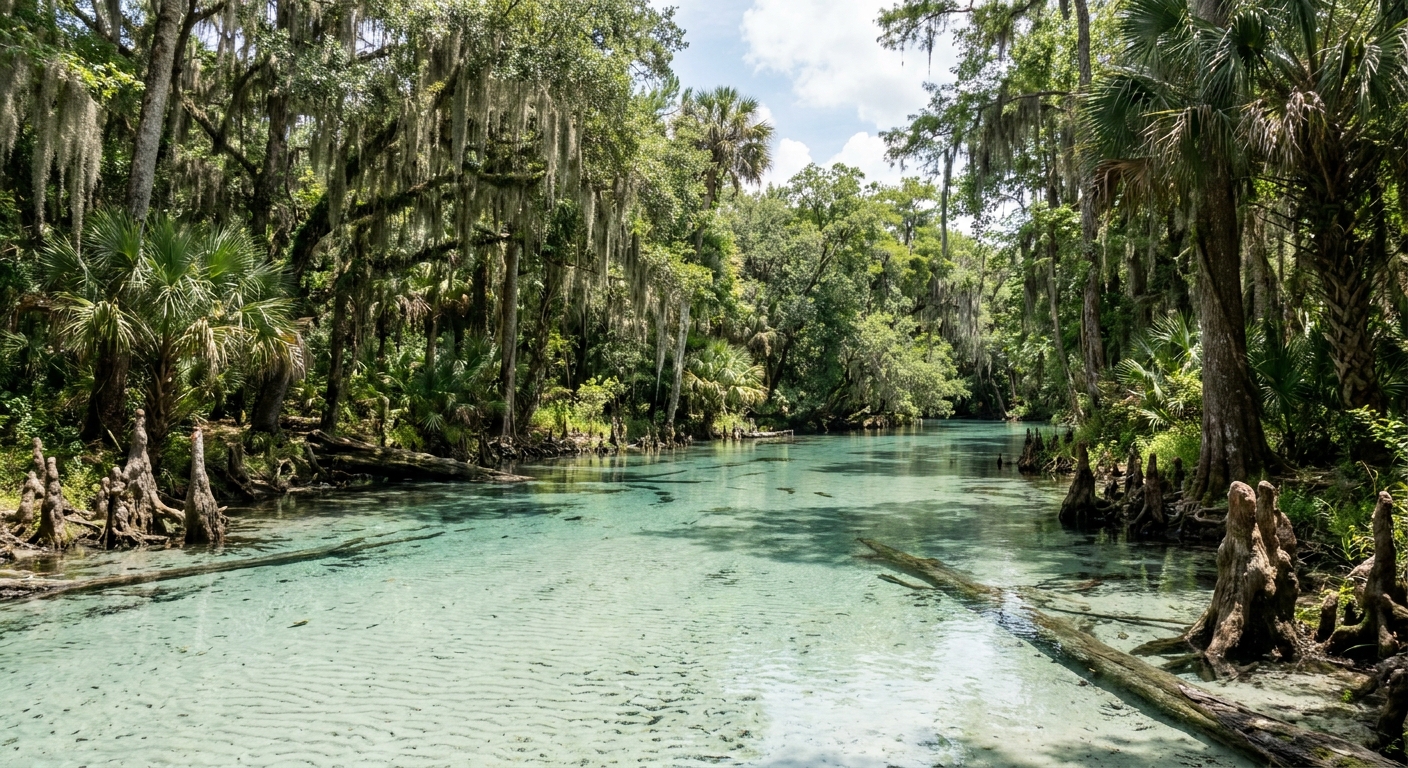
JULY AT A GLANCE · WES SKILES PEACOCK SPRINGS
July suits divers and swimmers who start at the 6:40 am sunrise and leave the water before the afternoon storms. Expect 90.1°F highs and rain on about three days in eight at the nearest official station.
HIGH 90.1°F · 11.6 RAIN DAYS · SUNSET 8:35 PM EDT
Go for: dawn dives and swims, close to fourteen hours of daylight, and warm nights that need no extra layer.
Think twice before: planning long midday hours in the open. The afternoon heat and the wet-season storms shape every July day.
Climate: NOAA NCEI 1991-2020, Cross City station · Light: sunrise-sunset.org · full sources at the end
On this page
- July weather at Peacock Springs90.1°F highs, 72.5°F lows and 11.6 rain days
- How hot does it get in July?A 17.6°F swing from dawn to afternoon
- Crowds and prices in JulySummer season, hurricane-season booking and lodging tax
- Things to do in JulyCave dives, spring swims and Troy Spring on the same river
- A July day trip to the parkSunrise at 6:40 am, out before the storms
- July vs June and AugustHow the three months compare on heat and rain
- Is July a good time to go?Yes for early starters, June for everyone else
For the drive into north-central Florida, see our getting-around guide. Heat and lightning precautions live in the Florida safety guide. If the springs are one stop on a longer loop, the Florida road trip sets out the route.
Wes Skiles Peacock Springs weather in July: average highs, lows and rain days
| July normal, Cross City station | Value |
|---|---|
| Average high | 90.1°F (32.3°C) |
| Average low | 72.5°F (22.5°C) |
| Precipitation | 7.77 in |
| Days with 0.10 in or more | 11.6 |
| Days with 1 in or more | 2.5 |
| Daylight on July 15 | 13 h 56 min |
| Sunrise and sunset, July 15 | 6:40 am · 8:35 pm EDT |
Every figure here comes from NOAA’s National Centers for Environmental Information: the 1991-2020 monthly normals for station USW00012833 at Cross City. It is an official station with a real thermometer, not a reanalysis grid cell. It also serves Troy Spring on the same reach of the Suwannee. It does not stand at the park, and we found no gauge at the spring itself. Read the normals below as the July of this stretch of river: an average high of 90.1°F (32.3°C), an average low of 72.5°F (22.5°C) and 7.77 inches of rain.
In an average July, 11.6 days log at least 0.10 inch of rain at Cross City. That is about three days in every eight. Only 2.5 days bring an inch or more, so a true downpour lands about one day in twelve. The station counts totals, not hours, so it cannot tell you when the rain falls. Across Florida’s wet season the storms tend to build in the afternoon, as our Florida orientation explains. A July plan therefore puts the water first and leaves the back half of the day open.
From a 72.5°F dawn to a 90.1°F afternoon, the average swing is 17.6°F. You need no sweater at either end. Sun and rain decide the packing instead: a light rain shell for the wet days, a hat, sunscreen, plenty of drinking water for the drive, and a dry bag for your phone and keys at the spring. After a swim, a dry change of clothes matters more than a warm one.
On July 15 the park gets about 13 hours 56 minutes of daylight. Sunrise is at 6:40 am and sunset at 8:35 pm Eastern Daylight Time, converted from sunrise-sunset.org’s 10:40 and 00:35 UTC. The sky starts to dim in the half hour before sunset (est.). Plan any late swim or photo of the basin to finish by then.
How warm is Wes Skiles Peacock Springs in July?
Averaged over July, the warmest part of the day reaches 90.1°F at the Cross City station and the coolest drops to 72.5°F. The gap is 17.6°F, about 9.8°C. Both are means across 1991-2020, so some afternoons run hotter and some dawns cooler than either number.
Mornings in the low 70s mean shorts and a T-shirt at the car. As the afternoon climbs toward 90°F, you will want shade, a hat and a way back into the water or the air conditioning. Spring water is a separate reading. We could not verify a water temperature for Peacock Spring or Orange Grove Sink, so we give none. Coastal sea-temperature tables usually average daily maxima, a little warmer than a 24-hour mean, and none of them measures a spring.
We found no count of freezing nights in the July normals we read. With an average low of 72.5°F, frost is not a July concern. Pack for heat and rain alone.
How busy is Wes Skiles Peacock Springs in July? Crowds and prices
July falls in Florida’s summer and wet season, during school vacations. We found no occupancy series or monthly room rates for lodging around the park. We therefore rank no month as cheap or expensive and quote no nightly price. For a statewide budget, start with our Florida trip-cost guide.
Without booking data, we give no fixed lead time. One calendar fact still shapes the reservation: July sits inside the Atlantic hurricane season, June 1 to November 30. A refundable room or campsite is the safer booking. Check the tropical forecast in the week before you drive or fly.
We could not verify the lodging-tax rate for rooms near the park, so we give no percentage. When you book, ask for the total with taxes, and compare that figure across properties.
If you spend more anywhere in July, spend it on an air-conditioned bed close to the park. With sunrise at 6:40 am and afternoons averaging 90.1°F, a short drive to the gate puts you in the water during the cool first hours. It also gives you a cold room to retreat to when the afternoon storms arrive. Our where-to-stay guide covers the options by region.
Things to do in Wes Skiles Peacock Springs in July
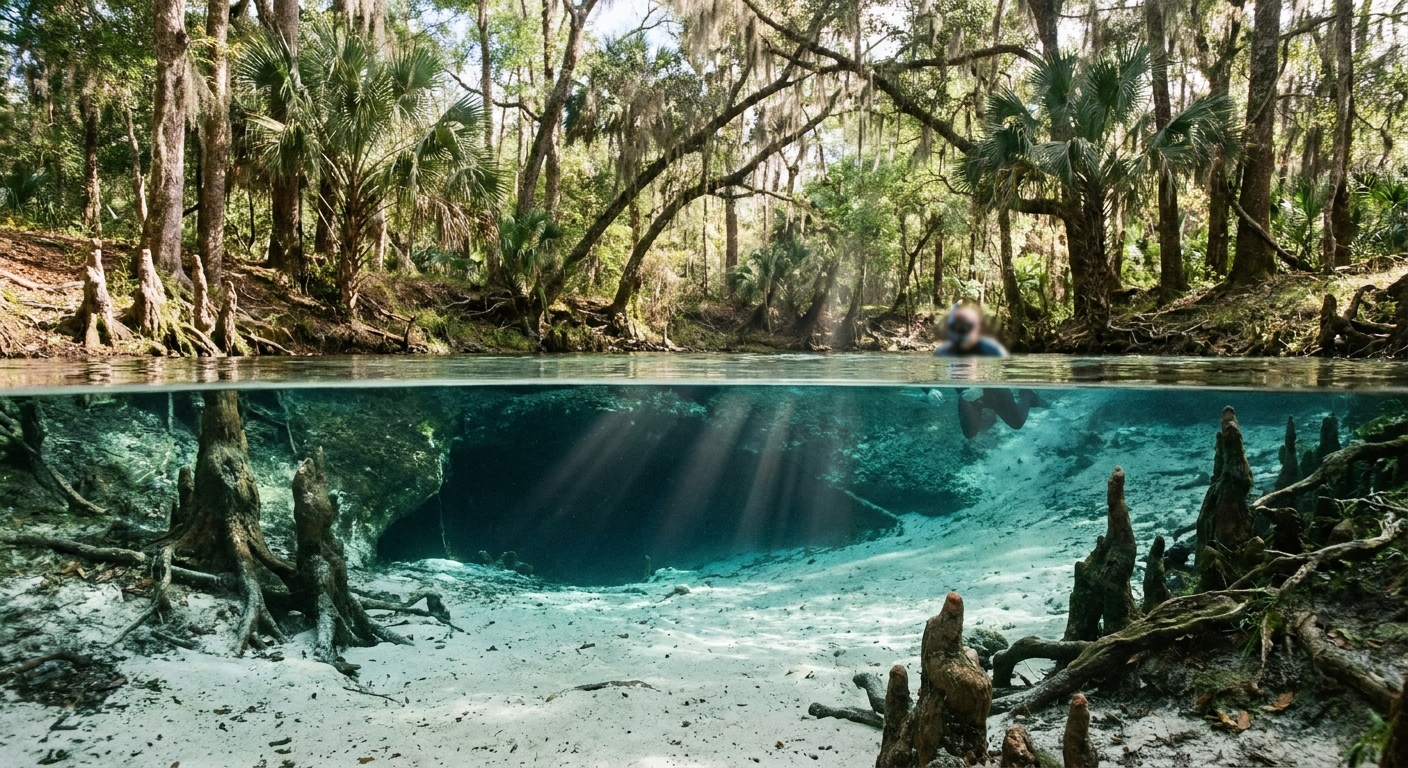
July gives nearly fourteen hours of daylight, 13 hours 56 minutes on the 15th. The air is warm enough that a wet swimmer dries off at the car without a jacket. Surface intervals between dives, a picnic between swims and the drive back all fit into daylight that lasts until 8:35 pm.
Wes Skiles Peacock Springs State Park is best known for cave diving. Its named features include Peacock Spring and Orange Grove Sink. Troy Spring sits on the same reach of the Suwannee and shares the Cross City thermometer. We could not verify the entry fee, gate hours, parking capacity or water temperature at any of the three. We therefore print no figure and no rule on who may swim or dive where. Confirm current fees and access rules with Florida State Parks before you drive.
Florida spring water holds close to one temperature all year. The air above it moves with the calendar. In July that air averages 90.1°F by afternoon, so the jump from air to water is largest in the afternoon. Divers suiting up are better off in the morning, before the parking lot heats up.
We found no free-entry day or confirmed fee waiver for the park in July, so we list none. The long evening light costs nothing, though. A sunset at 8:35 pm leaves daylight for the drive back after a late swim.
Wes Skiles Peacock Springs day trip in July
Sunrise is at 6:40 am. Leave your room early enough to reach the gate as it opens. We could not verify the opening time, so check it the day before. Aim to be in the water within the first hour. By about 11 am, get out, rinse off and eat in the shade. The 90.1°F average high builds through the day, and the parking lot is hottest by early afternoon. We could not confirm parking capacity either, which is one more reason to arrive at opening.
Afternoon is the storm window of the wet season. With 11.6 rain days in an average July, expect rain on about three of every eight days. At the first thunder, leave the water and open ground and wait in the car or back at your room, following the lightning advice in our Florida safety guide. If the storm clears early, daylight lasts until 8:35 pm for a second session. On a day without storms, the evening suits a walk around the basins as the air cools toward the 72.5°F overnight low.
Wes Skiles Peacock Springs in July vs June and August
| Cross City normal | June | July | August |
|---|---|---|---|
| Average high | 89.5°F | 90.1°F | 89.9°F |
| Average low | 70.6°F | 72.5°F | 72.9°F |
| Precipitation | 7.00 in | 7.77 in | 8.10 in |
| Days with 0.10 in or more | 9.1 | 11.6 | 11.5 |
On the same NOAA station and the same 1991-2020 period, July’s 90.1°F high sits 0.6°F above June’s and 0.2°F above August’s. Nights move more. June’s 70.6°F low is 1.9°F cooler than July’s 72.5°F, and August’s 72.9°F is 0.4°F warmer. June is the drier month, with 7.00 inches and 9.1 rain days, 0.77 inch less and 2.5 fewer days than July. August adds 0.33 inch for 8.10 in total, but it logs 11.5 rain days, 0.1 fewer than July.
Move four weeks earlier to June and you gain about two and a half extra dry days and slightly cooler dawns. The afternoons stay just as hot. Move four weeks later to August and you get the warmest nights of the three and a little more rain. All three months fall inside hurricane season, so refundable bookings apply to each. See Peacock Springs in June and Peacock Springs in August for the full picture.
Is July a good time to visit Wes Skiles Peacock Springs?
Yes, for certified cave divers and for swimmers who start at dawn. July gives 13 hours 56 minutes of light and 72.5°F nights that need no extra gear. It is a poorer choice if you want long midday hours in the open or hate losing an afternoon to storms. The heat averages 90.1°F and rain falls on about three days in eight.
If July is not for you, look at June. It has 9.1 rain days against 11.6, 7.00 inches of rain against 7.77, and lows of 70.6°F, with an average high of 89.5°F, just 0.6°F cooler. The details are in our June guide, and the statewide calendar is in the best time to visit Florida.
Of the three summer months, July has the highest average afternoon at 90.1°F and the most rain days at 11.6, so it is the month where a dawn start matters most.
The last word
Book a bed close to the gate and set the alarm for the 6:40 am sunrise. In July, the useful hours are the ones before the afternoon heat and storms. The park is named for Wes Skiles, the cave diver and filmmaker who explored these north Florida springs. Confirm the gate time with Florida State Parks the night before, and be there when it opens.
Sources & data for this guide
- July normals (high 90.1°F, low 72.5°F, 7.77 in, 11.6 days at 0.10 in+, 2.5 days at 1 in+) · NOAA NCEI monthly normals 1991-2020, station USW00012833, Cross City · checked Sep 24, 2026
- The Cross City station also serves Troy Spring on the same reach of the Suwannee. It is not at the park, and we found no gauge at the spring · NOAA NCEI · checked Sep 24, 2026
- June and August normals · NOAA NCEI monthly normals 1991-2020, same station and period · checked Sep 24, 2026
- Daylight and sunrise/sunset for July 15 (10:40 and 00:35 UTC, shown here in EDT) · sunrise-sunset.org · checked Sep 24, 2026
- Hurricane season dates · see our Florida orientation, sourced to NOAA National Hurricane Center
- What we could not verify: park entry fee, gate hours, parking capacity, spring water temperature, lodging-tax rate, room rates and any July events. Check with Florida State Parks and your lodging before you go.
To plan your stay
- Best Time to Visit Wes Skiles Peacock Springs: Weather, Rain and the Quiet Months
- Wes Skiles Peacock Springs in June: Weather, Rain Days, Crowds and May vs July
- Wes Skiles Peacock Springs in August: Weather, Rain Days, Daylight and How It Compares to July and September
- Wes Skiles Peacock Springs in May: Weather, Rain Days, Daylight and April vs June