
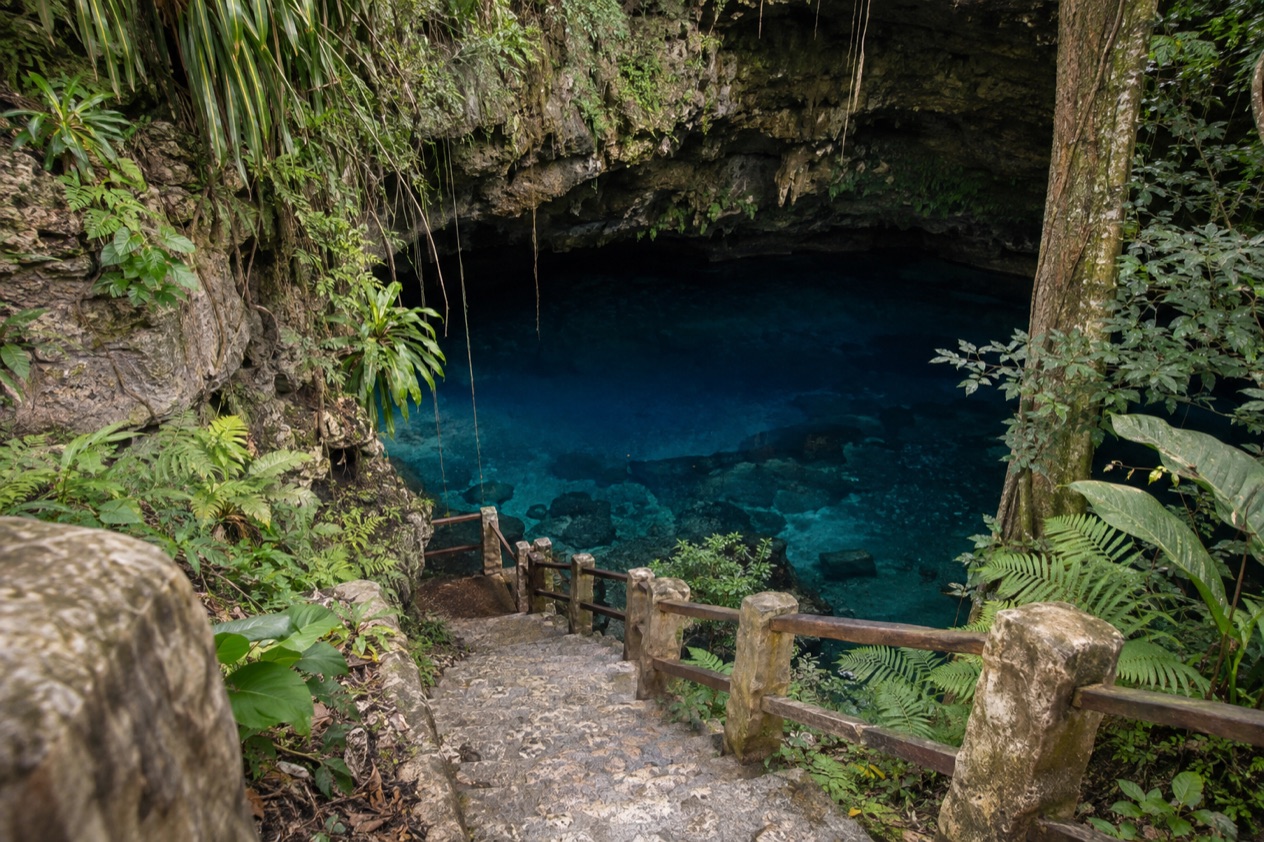
The road drops into a green fold of the Maya Mountains, and the first thing you meet is the cool breath coming out of a cave mouth hung with ferns and roots. Beyond it a turquoise pool sits at the bottom of a sunken bowl of jungle, its color almost unreal against the leaves. St. Herman’s Blue Hole National Park is a day of caves, forest trails and a swim, set along the Hummingbird Highway in the Cayo District.
Is visiting St. Herman’s Cave and Blue Hole National Park worth it?
Yes, if you like your adventure with a mix of cave, forest and water, and you want it without a long expedition.
What sets it apart from other nature stops nearby is how much sits in one park. It holds two cave systems, St. Herman’s and Crystal Cave, plus the Blue Hole itself, in a forest of 575 acres where ocelots, jaguars, tapirs and many bat species have been spotted.
The caves were used by the Maya during the Classic Period, so the underground world here carries real history, not only dripping stone. Many places offer a cave or a swimming hole, but few put both in the same forest, with picnic areas and changing rooms at the ends of the trails.
The setting adds to it. The park lies on a forested ridge in the foothills of the Maya Mountains, between the valleys of the Sibun River and its tributary, the Caves Branch.
What to see at St. Herman’s Cave and Blue Hole National Park
St. Herman’s Cave
The cave is the heart of the park. Without a guide, you can walk 200 yards into the entrance, enough to feel the temperature drop, hear the echo of your own steps and watch daylight shrink behind you. Look up for the cave’s formations and for bats, which are among the many species recorded in the park.
Go beyond that point and you need a guide, who can take you through the whole cave to see speleothems (the stalactites, stalagmites and other mineral formations) and Maya artifacts. Archaeologists have found artifacts and sacrificial sites showing the Maya used the cave during the Classic Period, so the dark passages were once a ceremonial space.
Cave tubing back to the entrance
After a guided tour through St. Herman’s Cave, visitors can float back to the cave entrance on an inner tube. It turns the return trip into part of the fun: you drift along the water in the half-light, with the cave walls sliding past and the sound of the stream around you. It suits people who like a bit of play in their sightseeing, and it pairs well with the walk-in at the entrance, since you arrive back at the place where the daylight begins.
The Blue Hole
The Blue Hole is a jungle pool at the bottom of a cenote, a depression about 100 feet deep and 300 feet across, with the pool itself about 25 feet deep. Its vivid color gives the park its name. Seen from the rim, with the forest walls rising around it, it looks like a bowl of colored glass set in the trees.
It is described as a cool and refreshing place for an afternoon swim. The second entrance area has changing rooms, restrooms and a picnic area, so you can arrive, dip and sit in the shade before heading back along the trails.
Crystal Cave (Mountain Cow Cave)
Crystal Cave, also called Mountain Cow Cave, is the park’s second cave system. It is visited on a guided exploration into huge caverns adorned with crystalline formations, the reason for its name. Like St. Herman’s, it was used by the Maya in the Classic Period. It suits visitors who want more than the first cave and are happy to follow a guide into the deeper chambers, where the formations sparkle under a headlamp.
Hours, tickets and rules
The park opens in the morning and closes in the late afternoon, so you can combine a cave visit and a swim in one day. Entrance is charged per day, with a lower rate for Belizeans than for non-nationals.
| Site | Open | Admission |
|---|---|---|
| St. Herman’s Blue Hole National Park | 8:00am to 4:30pm | BZD 2 per day for Belizeans, BZD 8 per day for non-nationals |
Visitors can walk 200 yards into St. Herman’s Cave without a guide. Traversing the cave completely, and exploring Mountain Cow Cave, are done with a guide. The Blue Hole is described as a place for an afternoon swim. The park is the responsibility of the Belize Forest Department and is managed by the Belize Audubon Society.
How to get to St. Herman’s Cave and Blue Hole National Park
The park sits just off the Hummingbird Highway in the Cayo District, 12 miles southeast of Belmopan, on the right side of the road when you are heading southeast. Belmopan, the nearest base, is a small capital built after Hurricane Hattie in 1961, with a National Assembly Building designed to resemble a Pre-Columbian Maya temple.
Belmopan has a domestic airstrip, Hector Silva Airstrip, in the northwest of the city. The closest scheduled flights come into Belize City, home to Philip S. W. Goldson International Airport, the country’s only international airport. Belize City lies 50 miles inland-wise from Belmopan, about 49 miles by the figure given for the airport.
Once at the park, there are two entrance areas, each with parking. The St. Herman’s Cave entrance has a picnic area, visitor center, gift shop, restrooms and trail heads. The second entrance gives access to the Blue Hole, with a picnic area, restrooms, changing rooms and other trails.
When to visit St. Herman’s Cave and Blue Hole National Park
The park keeps daytime hours, so plan around the opening in the morning and the closing in the late afternoon. A cave walk and a guided tour fit well in the first half of the day, leaving the pool for later, which matches how the Blue Hole is described as an afternoon swim.
Belmopan’s temperatures hold fairly steady through the year, between the low 70s and low 80s Fahrenheit, so the heat does not change much from month to month. What changes is the rain. The area has a lengthy wet season running from May through January, which means green forest and full streams for much of the year.
The Atlantic hurricane season runs from June 1 to November 30, so trips in those months overlap with it. Outside the wet season, in the months after January, the forest is drier underfoot.
Tips for your visit
Bring a swimsuit and a towel for the Blue Hole, since the second entrance has changing rooms. If you plan to tube back through St. Herman’s Cave, pack clothes you are happy to get wet. The picnic areas at both entrances make it easy to bring lunch and eat between the cave and the pool.
Think of the visit as two parts. The cave entrance area has the visitor center and gift shop, and the trail heads start there. The Blue Hole entrance is the place for the swim. Choose a guide if you want to see the speleothems and Maya artifacts inside St. Herman’s, or the crystal formations of Mountain Cow Cave.
Keep your eyes open on the trails. Ocelot, jaguarundi, jaguar, tapir, peccary, tamandua, paca, coatimundi, kinkajou and deer have all been spotted in the park, though seeing one is a matter of luck. Bats are the most likely sight in the caves.
Good to know before you go
The U.S. State Department rates Belize Level 2, “Exercise increased caution”, because of crime, and says the south side of Belize City has historically had the highest concentration of violent crime.
The entrance fee is charged per day, so a visit that includes both caves and the pool is covered by one day’s entry. Guides for the caves are hired at the park. The Belize dollar is the currency behind the fees listed for the park.
Sources
- Belize Audubon Society, St. Herman's Blue Hole National Park (https://belizeaudubon.org/shbh/), checked October 11, 2026
- Wikipedia, St. Herman's Blue Hole National Park (https://en.wikipedia.org/wiki/Blue_Hole_National_Park), checked October 11, 2026
- Wikipedia, Belmopan (https://en.wikipedia.org/wiki/Belmopan), checked October 11, 2026
- U.S. Department of State, Belize Travel Advisory, Level 2, March 11, 2026 (https://travel.state.gov/), checked October 11, 2026
- NOAA National Hurricane Center, Climatology (https://www.nhc.noaa.gov/climo/), checked October 11, 2026