
The water changes color before the boat slows down. Turquoise flats give way to a ring of pale reef, and inside it sits a disc of deep indigo, so dark it looks like a hole cut in the sea.
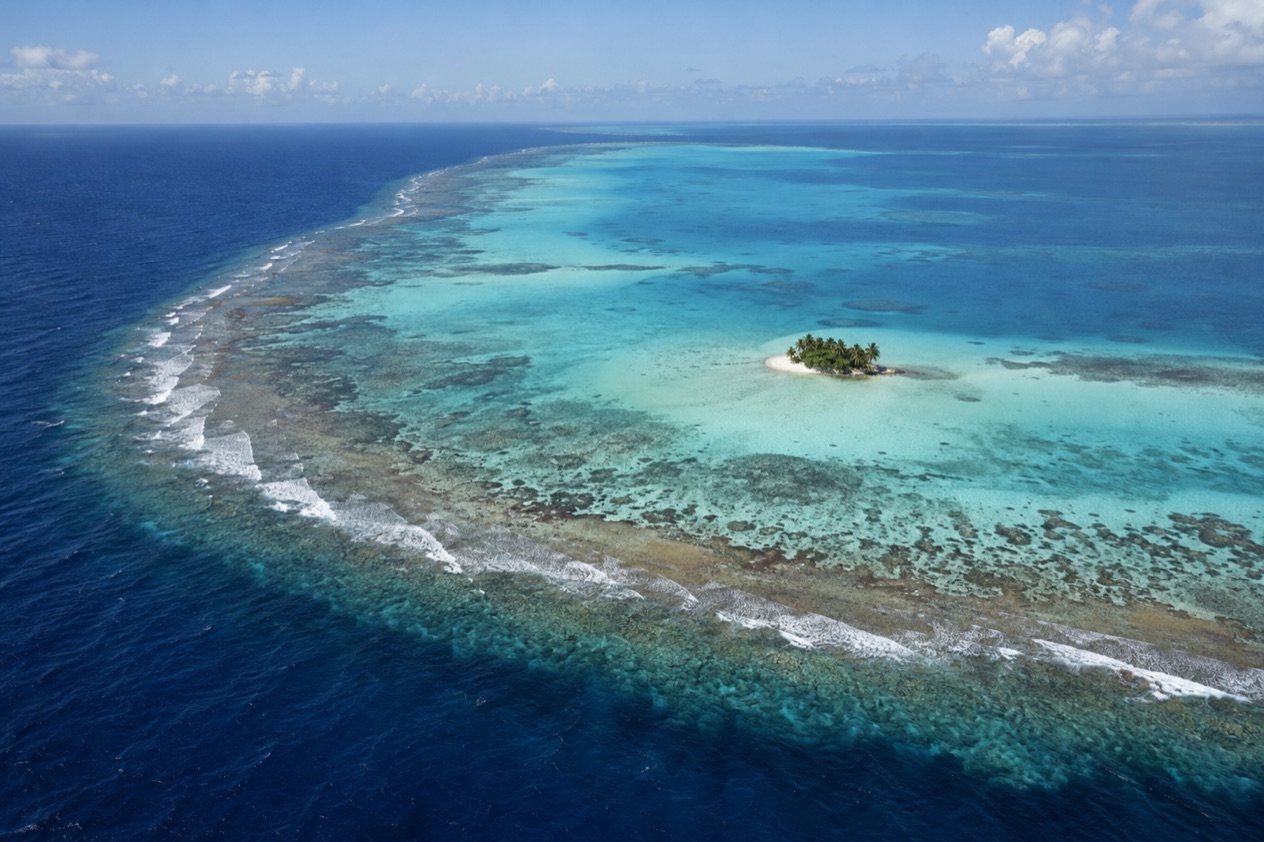
Overhead, white seabirds circle a tiny island of palms and sand. Lighthouse Reef is a remote Belizean atoll for divers, birdwatchers and anyone who wants to see the Great Blue Hole and Half Moon Caye with open ocean on every side.
Where is Lighthouse Reef and what is it like?
Lighthouse Reef is an atoll in the Caribbean Sea, about 50 miles southeast of Belize City, and it is the outermost of Belize’s three offshore atolls. It is a ring of reef around a shallow sandy lagoon, with a few small cayes on the rim and almost nothing else.
There are no towns, no streets and no shopping here. What you find instead is water, coral and sky, plus a handful of resorts and the protected shores of Half Moon Caye.
The atoll runs about 22 miles from north to south. It is roughly 5 miles wide, and the lagoon it encloses is a shallow sandy basin covering around 46 square miles. The Great Blue Hole sits near the center of that lagoon, while Half Moon Caye lies at the southeast corner. Because the atoll is a ring, the reef edge faces open sea on one side and calm lagoon on the other, which is why dive sites here are described as walls, caves and aquariums rather than as a single reef.
The reef itself has a reputation to match the scenery. Lighthouse Reef is considered one of the best developed and healthiest reefs in the Caribbean, and it belongs to the Belize Barrier Reef Reserve System, a UNESCO World Heritage Site. That is the reason divers cross open water to reach it, and the reason the atoll feels so different from the busy cayes closer to the mainland.
The pace here is set by boats and by the sun. Days begin with an engine starting at a dock and end with the light going gold over the lagoon. If you want nightlife, restaurants to wander between or a beach town with shops, this is the wrong atoll.
If you want a place where the main event is the sea itself, and where a small island can be a bird sanctuary, it is the right one. Divers will feel at home immediately, and so will people who simply like to watch seabirds and reef-edge water from a boat deck.
What is there to do in Lighthouse Reef?
The big reasons to come are the Great Blue Hole, Half Moon Caye and the dive sites along the atoll’s walls.
The Great Blue Hole
The Great Blue Hole is a circular marine sinkhole near the center of the atoll, 1,043 feet across. It drops 407 feet deep, and from a boat or from the air it reads as a perfect dark circle ringed by pale reef. The Blue Hole Natural Monument, designated in 1996, includes no land and has no visitor facilities other than mooring buoys for dive boats, so the experience is entirely about being on the water above it.
Diving the sinkhole is the primary focus of the monument. Stalactites found inside show that it formed in stages, the oldest about 153,000 years ago, when the cave was dry land.
A submarine expedition in December 2018 found a layer of hydrogen sulfide at about 300 feet, and below it the water is dark, anoxic and devoid of life. That is why the Hole is a place to look and wonder as much as a place to dive. Private charters can stretch their time at the Blue Hole for photography, and private departures between 10am and 2pm are suggested for the best viewing, when the sun is high enough to light the deep blue.
Half Moon Caye and its birds
Half Moon Caye is a sliver of sand and trees at the southeast corner of the atoll, only half a mile long. It carries a long list of firsts.
Belize’s oldest site of wildlife protection began here as a bird sanctuary in 1924 to protect red-footed boobies. In 1981 the Half Moon Caye Natural Monument became the first nature reserve under the National Park Systems Act and the first marine protected area in Central America.
The birds are the draw. The caye supports possibly the only viable breeding colony of white-phase red-footed boobies in the western Caribbean, and you see them in the trees as you come ashore. The western half of the island also holds a rare surviving atoll forest of siricote, a tree with bright orange flowers. Bring binoculars if you have them, and look up.
| Site | Open | Admission |
|---|---|---|
| Half Moon Caye Natural Monument | 8:00am to 4:30pm | BZD 20 per day for non-nationals, BZD 2.50 per day for Belizean nationals |
Dive sites along the atoll’s walls
Beyond the Hole, the atoll holds a string of named dive sites. Half Moon Caye Wall, Long Caye Aquarium, Silver Caves, Tres Cocos and West Point are the ones that come up most in descriptions of Lighthouse Reef, and the names hint at what they offer: a wall, a crowded reef garden, caves and open reef edge. Together they are the reason the reef is called healthy and well developed.
Visitors to the Blue Hole generally include both the Hole and Half Moon Caye in the same itinerary, so a tour often pairs the sinkhole with a stop on the sand and a look at the birds. A stay at a resort on the atoll gives the chance to see more of these sites in one trip.
How many days do you need in Lighthouse Reef?
A single day is enough to see the headline sights, and a few days on the atoll let you go deeper. The day trip is the simplest way in.
A tour from the mainland or a nearby caye reaches the Great Blue Hole and Half Moon Caye in one outing, since visitors to the Blue Hole generally include both in their itineraries. For many people that is the whole visit, and it is a complete one.
With a few nights on the atoll, the shape of the trip changes. Resorts within Lighthouse Reef are named among the places tours depart from, which means the atoll has its own base for exploring.
From there you can spend time at the walls and caves named earlier, return to a site you enjoyed, and see the Blue Hole at the hour you choose rather than the hour of a scheduled boat. Mornings and evenings on a remote ring of reef are quiet in a way no day trip can match.
If you have more time still, build the rest of your Belize vacation around the starting points. San Pedro, Caye Caulker, Hopkins and Placencia are all named as departure points for Half Moon Caye tours, so you can pair Lighthouse Reef with whichever of those you like. Turneffe Atoll, with its own resorts, is another reef destination you can add to the same trip.
The one thing worth deciding early is whether you want the sinkhole alone or the full atoll. A trip aimed at the Hole is about the sinkhole and perhaps a stop on the caye. A longer stay is about the walls, the reef and the birds, and it rewards people who like to repeat a dive site or simply sit on a dock watching the lagoon change color.
Where to stay in Lighthouse Reef
The choice is between sleeping on the atoll itself and staying on the mainland or a nearby caye and visiting by boat. The atoll has resorts of its own, and tours depart from resorts within Lighthouse Reef as well as from Turneffe. Staying there puts you beside the lagoon and the dive sites, with nothing between you and the water. It suits divers and nature lovers who want the atoll to be the whole trip.
The other approach is to base yourself where the tours start. San Pedro, Caye Caulker, Hopkins and Placencia are all named as places where Half Moon Caye tours depart, and Belize City is a departure point for Great Blue Hole tours. Each of these has its own character, from an island town to a coastal village, so you can choose the one that fits the rest of your Belize plans and treat Lighthouse Reef as a long outing from it.
There are no neighborhoods on the atoll to compare, only the resort setting and the bare shores of the cayes. Half Moon Caye is a protected natural monument rather than a place with lodging, and the Blue Hole Natural Monument has no land at all, so the places you visit are separate from the places you sleep.
Think about what you want from the evenings. On the atoll, the evenings belong to the sea and the sky. In a mainland or caye base, they belong to the town you chose. Either way, the days at the reef are the reason you came, and the accommodation is simply the starting point.
How do you get to Lighthouse Reef and get around?
You reach Lighthouse Reef by boat, and the most common way is with a tour operator. Tours to Half Moon Caye leave from San Pedro, Caye Caulker, Hopkins, Placencia and from resorts within the Turneffe and Lighthouse Reef atolls.
Great Blue Hole tours also leave from Belize City. The atoll sits about 43 miles from the mainland coast at its nearest, so the trip is a real crossing of open water, which is why it is organized as a tour.
Departure times vary by operator and starting point. One Great Blue Hole tour leaves Belize City at 8:30am. From Caye Caulker it leaves at 8:45am on Sunday, Monday, Wednesday and Friday. From San Pedro it leaves at 9:00am on the same four days. A different operator lists a scheduled Great Blue Hole tour at 1PM from San Pedro, Caye Caulker or Belize City Municipal.
Private tours are another option. Private Great Blue Hole charters from all stations can depart between 10am and 2pm, the window suggested for best viewing, and they can extend their time at the Blue Hole for photography. If you stay at a resort on the atoll, the resort itself is the base for getting around.
Once you are there, you get around by boat. The Blue Hole Natural Monument includes no land, and its mooring buoys are for dive boats, so you reach it from the water. Half Moon Caye is a small island, only half a mile long, where you step ashore from the boat. The sites on the atoll, from the Hole to the walls and caves, are all places you reach by water.
When is the best time to visit Lighthouse Reef?
The months from December through May are a good choice, because they fall outside the official Atlantic hurricane season, which runs from June 1 to November 30. A reef trip depends on boats reaching open water, so the calendar matters more here than it does for a town visit. Those six months give you the widest margin on that count.
The air itself is warm in every season. In Belize City, January highs reach the low 80s, with about ten days of measurable rain. July is hotter, with highs near 90, and about twelve rain days.
The light is the other factor. Private Blue Hole tours that leave between 10am and 2pm are suggested for the best viewing, which tells you the sinkhole looks its best with the sun high. That holds in any month.
No festival is tied to the atoll, so the season is chosen for the sea and the sky rather than for a date on the calendar. Choose a time of year that suits your tolerance for the hurricane season, then choose a tour hour that suits the light.
Good to know before you go
The U.S. State Department rates Belize Level 2, “Exercise increased caution”, because of crime, and says the south side of Belize City has historically had the highest concentration of violent crime.
Prices at the Half Moon Caye Natural Monument are quoted in Belize dollars, so keep that in mind when you read the entrance fee. The atoll has no towns, and the Blue Hole Natural Monument has no visitor facilities other than mooring buoys, so your tour or resort is your link to everything else. The Atlantic hurricane season runs from June 1 to November 30, and a boat trip to an atoll in open water is a good reason to plan around it.
Sources
- Wikipedia, Lighthouse Reef (https://en.wikipedia.org/wiki/Lighthouse_Reef), checked October 11, 2026
- Wikipedia, Great Blue Hole (https://en.wikipedia.org/wiki/Great_Blue_Hole), checked October 11, 2026
- Wikipedia, Half Moon Caye (https://en.wikipedia.org/wiki/Half_Moon_Caye), checked October 11, 2026
- Belize Audubon Society, Half Moon Caye Natural Monument (https://belizeaudubon.org/hmcnm/), checked October 11, 2026
- Belize Audubon Society, Blue Hole Natural Monument (https://belizeaudubon.org/bhnm/), checked October 11, 2026
- Tropic Air, Great Blue Hole tour (https://www.tropicair.com/tropic-air-tours/the-great-blue-hole-tour/), checked October 11, 2026
- Maya Island Air, Great Blue Hole tour (https://www.mayaislandair.com/the-great-blue-hole-tour/), checked October 11, 2026
- Wikipedia, Climate of Belize (https://en.wikipedia.org/wiki/Climate_of_Belize), checked October 11, 2026
- NOAA NCEI, GHCN-Daily station BHM00078583 (Philip S. W. Goldson International Airport, Belize City), normals 1991-2020 computed from the daily record (https://www.ncei.noaa.gov/access/services/data/v1?dataset=daily-summaries&stations=BHM00078583), checked October 11, 2026
- U.S. Department of State, Belize Travel Advisory, Level 2, March 11, 2026 (https://travel.state.gov/), checked October 11, 2026
- NOAA National Hurricane Center, Climatology (https://www.nhc.noaa.gov/climo/), checked October 11, 2026