
A tortilla puffs on a comal, a pot of coconut-scented rice and beans steams beside it, and someone sets a small bottle of pepper sauce on the table without being asked. Belizean cooking comes from many kitchens at once, Kriol, Maya, Garifuna, Mestizo, East Indian and Mennonite, and you taste that mix from the cayes to the villages inland. Any time you arrive, a plate like this is waiting.
What is Belizean food?
Belizean food is the cooking of a country with several cultures at once: Kriol, Maya, Garifuna, Mestizo, East Indian and Mennonite traditions all sit on the same table. Corn, beans, rice, cassava, plantain, coconut and fish turn up again and again, prepared in ways that change from one community to the next. A single day of eating can take you from a Maya tamale to a Kriol stew to a Garifuna fish soup.
The cooking is homey rather than fussy. Dishes are built on starches and slow-cooked sauces, and heat arrives separately, in a bottle or a small bowl, so you decide how much. In rural areas meals may be simpler than in the cities, which usually means fewer dishes on the plate and more attention on a few good ones.
Breakfast: fry jacks, tortillas and beans
Breakfast often comes as bread, flour tortillas or fry jacks, many of them homemade, served with cheeses, refried beans and eggs in whatever style you like. Fry jacks are puffy pieces of fried dough that you can tear and fill, and they are a morning habit that has made it onto the menus of lodges and island resorts alike. Coffee or tea goes alongside, and some tables also offer cereal with milk.
Johnny cakes, a Belizean bread, show up on breakfast plates too. At Thatch Caye Resort, a private island resort, the morning spread includes eggs, bacon, sausage, Belizean fried jacks, toast and Johnny cakes, and that gives you a good picture of how a classic Belizean breakfast looks when it is dressed up a little.
The midday meal
Midday meals run from lighter plates to full dinners. The lighter side includes rice and beans, tamales, panades, escabeche, chimole, stew chicken and garnaches. Panades and garnaches are fried and crisp, often eaten as a snack or small meal. Escabeche is an onion-heavy soup, and chimole is a dark, spiced stew.
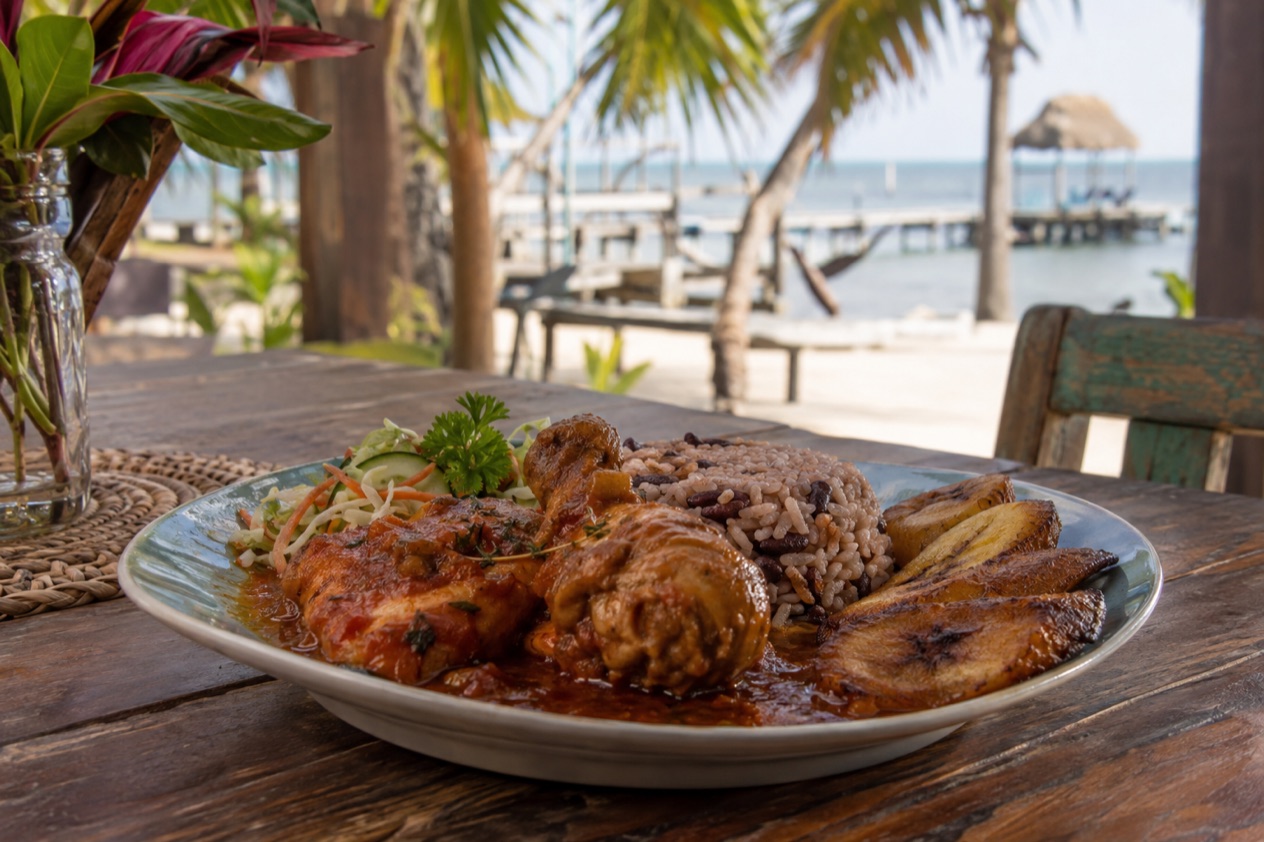
The heartier version is a dinner plate of rice and beans with meat and a salad or coleslaw. It is the plate you will meet again and again, and it is worth ordering at least once just to see how each cook handles the coconut, the seasoning and the stew on top.
The communities behind the plate
Maya cooking centers on corn. Tortillas cooked on a comal wrap meat and beans, and tamales are corn dough, often filled, wrapped in a corn husk and steamed. The most famous Maya dish is caldo, a broth-based meal. Kriol cooking brings the bile up, Garifuna cooking brings cassava bread and fish soups, and every one of these traditions has found its way into everyday Belizean meals.
Coconut ties much of it together. Every part of the coconut has a use in Belize: the husk for crafts and for starting a barbecue fire, the water as a refreshing drink or a mixer, and the grated meat for milk that gives Kriol bread and bun their distinctive taste.
What should you try in Belize?
Start with rice and beans, then work through the bile up, bammy, hudut and the Maya tamale, with a sweet corn dukunu to finish. Each of these belongs to a particular community, so ordering them is also a small lesson in who lives in Belize.
Bile up, the Kriol dish
The bile up (also written boil up) is considered the cultural dish of the Belizean Kriols. It combines boiled eggs, fish or pig tail with ground foods such as cassava, green plantains, yams and sweet potatoes, and it comes with a tomato sauce. It is a plate of root vegetables and protein, built to fill you up, and it is the dish to ask about when you want something that tastes of home cooking rather than of a menu.
Kriol bread and bun, flavored with coconut milk, are the sweeter side of the same kitchen. Together they show how the coconut runs through the cooking.
Bammy and the Garifuna table
Bammy is a small fried cassava cake inherited from the Garifuna. Cassava is grated, rinsed, dried, salted and pressed into flat cakes about 4 inches across and half an inch thick, then lightly fried, dipped in coconut milk and fried again. It is usually served as a starchy side with breakfast or with fish, or eaten alone as a snack.
Hudut is the Garifuna fish dish, in two main types. One is made with coconut milk and mashed half-ripe plantain. The other skips the coconut milk and is closest to a spicy fish soup. Bos a pepa, a pepper sauce made from the hot habanero or the milder jalapeño, is sometimes added. The Kriol fish seré is similar, so if you see it on a menu, you know roughly what to expect.
Tamales, caldo and sweet corn
Maya tamales are corn dough, often with a filling, wrapped in a corn husk and steamed. They turn up at midday alongside other staples, and they are an easy way to taste the Maya side of Belizean cooking. Caldo, the most famous Maya dish, is the broth-style meal to look for when you want something warm.
For something sweet, look for dukunu, a sweetened starch, usually cornmeal but sometimes sweet corn, wrapped and boiled in foil or a banana leaf. Cahn sham is ground or powdered sweetened parched corn, a simpler treat from the same corn tradition.
Seafood from the cayes
Lobster and conch are the seafood most tied to the cayes. Caye Caulker became home to lobster fisheries in the early 20th century, and Turneffe Atoll Marine Reserve is an important nursery ground for Queen conch, Caribbean spiny lobster and many reef fishes. The closed season for lobster runs from March 1 to June 30 across all of Belize, so lobster is a dish for the other months of the year.
Eagle Landing, at the southeast tip of Lighthouse Reef Atoll, shows what lives beneath those tables: abundant reef fish, Queen conch and stingrays in a shallow dive. In the Bacalar Chico Marine Reserve, fishing in the General Use Zones is restricted to residents fishing for subsistence, and lobster and conch are excluded.
What do people drink?
Belizeans drink Belikin beer, coconut water, coffee and tea, and the cocktails of the island bars. Belikin is the national beer, and it is the one most likely to be in your hand at a beach bar, a barbecue or a dance.
Belikin, the local beer
Belikin was founded in 1969 and is made by the Belize Brewing Company, with its headquarters in Ladyville, in the Belize District. Several varieties exist, including Belikin Beer, Belikin Stout and seasonal brews, so there is more than one bottle to try. Michael H.M. Bowen is President and CEO, and Nolan Michael is the Brew Master.
A cold Belikin goes naturally with fry jacks at breakfast, no, with stew chicken and rice and beans at lunch, and with fried snacks in the evening. The stout is a different kind of drink, darker and slower, for after dinner.
Coconut water and coffee
Coconut water is a refreshing drink on its own, and it is also used as a mixer with alcoholic drinks. It is the drink of a hot afternoon, sold in a coconut that is opened in front of you. Coffee and tea come with breakfast, and at Thatch Caye Resort self-serve coffee is out from 6:30 a.m., before breakfast begins.
Island bars and resort cocktails
On the cayes, drinking is part of the evening routine. Danny’s Tree Bar at Matachica Resort and Spa on Ambergris Caye serves cocktails, and the resort’s Mambo Bistro serves breakfast, lunch and dinner. At Thatch Caye Resort the Island Package includes unlimited local alcoholic and non-alcoholic beverages along with three chef-prepared meals daily and snacks.
Happy Hour at Thatch Caye Resort runs from 4:00 to 7:00 p.m. at Starfish Bar, just before dinner at 7:00 p.m. in The Grove. The resort has no fixed menus, so every dish is inspired by what is fresh and in season, using ingredients from Muy’Ono Farms.
Good to know before you go
The U.S. State Department rates Belize Level 2, “Exercise increased caution”, because of crime, and says the south side of Belize City has historically had the highest concentration of violent crime.
Food in Belize follows the seasons of the sea. The lobster closed season ends on June 30, and the Atlantic hurricane season runs from June 1 to November 30, so plan a trip with both in mind. Visitors with dietary needs will find that Thatch Caye Resort caters to most of them when guests say so while booking, and vegetarian dinner options are available on request there.
Sources
- Wikipedia, Belizean cuisine (https://en.wikipedia.org/wiki/Belizean_cuisine), checked October 11, 2026
- Wikipedia, Belikin (https://en.wikipedia.org/wiki/Belikin), checked October 11, 2026
- Wikipedia, Culture of Belize (https://en.wikipedia.org/wiki/Culture_of_Belize), checked October 11, 2026
- Matachica Resort and Spa, home (https://www.matachica.com/), checked October 11, 2026
- Thatch Caye Resort, dining (https://www.thatchcaye.com/dining), checked October 11, 2026
- San Pedro Belize Express Water Taxi, Caye Caulker (https://belizewatertaxi.com/destinations/caye-caulker/), checked October 11, 2026
- Belize Audubon Society, Half Moon Caye Natural Monument (https://belizeaudubon.org/hmcnm/), checked October 11, 2026
- Belize Fisheries Department, Bacalar Chico Marine Reserve (https://fisheries.gov.bz/bcmr/), checked October 11, 2026
- Belize Fisheries Department, Turneffe Atoll Marine Reserve (https://fisheries.gov.bz/tamr/), checked October 11, 2026
- Belize Fisheries Department, Regulations (https://fisheries.gov.bz/regulations/), checked October 11, 2026
- U.S. Department of State, Belize Travel Advisory, Level 2, March 11, 2026 (https://travel.state.gov/), checked October 11, 2026
- NOAA National Hurricane Center, Climatology (https://www.nhc.noaa.gov/climo/), checked October 11, 2026