
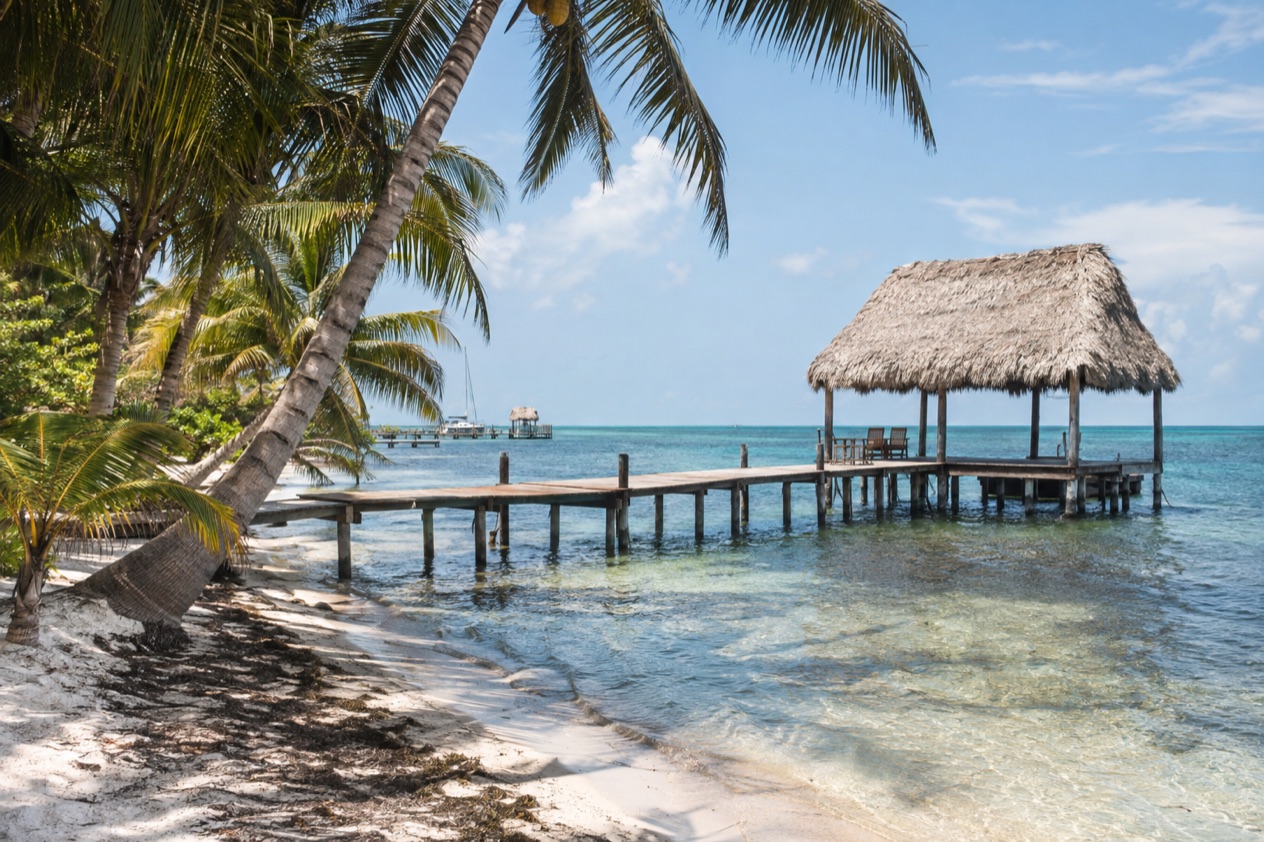
The small plane drops toward a strip of green with a turquoise edge, and then you are on Ambergris Caye, where the first thing you notice is how quickly the pace slows. In San Pedro, the town at the southern end of the island, the streets are sandy, the sea sits right at the end of every lane and conversation drifts between English and Spanish. A few practical things make the arrival smoother, from the paperwork to the money to the way people move around the island.
What should you know before visiting Ambergris Caye and San Pedro?
Four things matter most: your entry papers, the Belize dollar and its fixed rate, how you move between the airport, the town and the other cayes, and the fact that serious medical care is not close by. Everything else on the island is easy to settle once those are in hand.
What surprises first-time visitors is often the shape of the place. Ambergris Caye is the largest of several hundred cayes in the northernmost waters of Belize, a long, thin island, and San Pedro sits on its southern part. The Belize Barrier Reef, the second largest in the world, runs just offshore, which is why the island is built around the water: snorkel boats, dive shops and reef trips shape the daily rhythm far more than any road or sight on land.
The second surprise is the language. English is the official language of Belize, so menus, signs and conversations are in English, yet you will hear Spanish and Creole around you, and Belize is a country where several tongues sit side by side. Many travelers arrive expecting a Spanish-speaking Caribbean island and find something quite different, with its own accent, food and humor.
The island is also administered as part of the Belize District, even though the closest point on the mainland belongs to the Corozal District. It feels like its own small world, and it helps to think of it that way: you plan around the island, the reef and the sea.
Entry, fees and paperwork
U.S. citizens entering Belize need a U.S. passport valid for the length of their stay, and no Belizean visa is required for a visit of under 30 days. Travelers must also show proof of an onward or return ticket and sufficient funds to cover the whole stay. Belize does not require special immunizations for visitors.
Visitors are usually given a 30-day stay. To remain longer, you get your passport re-stamped at a local immigration office and pay an extra fee for each additional month, up to a maximum of six months. The Visitor’s Permit Extension adds 30 days, provided you do not work or engage in business without consent, and the Immigration Office nearest you can tell you whether you qualify.
Children traveling without both parents are asked by immigration officials for proof of consent and identification from the parent who is not traveling, along with the children’s birth certificates. If you come in by land, the fee differs depending on whether you stay less or more than 24 hours.
On the way out through Philip S. W. Goldson International Airport, two charges apply, listed here with the airport’s overnight parking fee.
| Fee | Amount | Who pays |
|---|---|---|
| Passenger Service Fee | US$53.50 | Passengers departing from Philip S. W. Goldson International Airport |
| Protected Areas Conservation Trust (PACT) Fee | US$20.00 | Passengers departing from Philip S. W. Goldson International Airport |
| Overnight parking | US$9.00 | Anyone leaving a vehicle overnight at the airport |
| Visitor’s Permit Extension | BZ$200.00 | Visitors extending their stay by 30 days |
Departing passengers are expected at the airport at least 3 hours before the scheduled flight.
Money and cards
The currency is the Belize dollar, and its official value is pegged at BZ$2 to US$1. That fixed rate makes the math simple: halve a Belize dollar price and you have the U.S. figure. Keep in mind that a price may be quoted in either currency, so it is worth knowing which one is meant before you agree to it.
The Central Bank of Belize, which stands behind the currency, was established on January 1, 1982. Fees set by the Belizean government, such as the Visitor’s Permit Extension at BZ$200.00, are stated in Belize dollars, while the airport charges on departure are in U.S. dollars.
Getting around
Most visitors reach San Pedro from the mainland by air, and a flight from Belize City to Ambergris Caye takes about 20 minutes. The island itself is about 25 miles long and about a mile wide, so everything is arranged along a narrow north to south line, with San Pedro at its southern part.
Beyond the town, the sea is the main road. Hol Chan Marine Reserve lies 4 miles south of San Pedro, and it is also close to Caye Caulker. Shark Ray Alley and Bacalar Chico are other protected areas tied to San Pedro, and reaching them means going out on the water.
If you plan to drive on the mainland, road conditions in Belize range from two-lane paved roads to dirt or gravel tracks. Driving at night is strongly discouraged, and roadside assistance is frequently unavailable. Valid U.S. or international driver’s permits are accepted only for three months after initial entry.
Health and the sun
Medical care is the practical point to take seriously. Emergency services in Belize are usually unavailable or significantly delayed, and serious injuries or illnesses normally require evacuation to another country. Advanced treatment is scarce even in Belize City and Belmopan, and in rural and remote areas even basic care can be hard to find. Evacuation insurance is worth having in mind when you plan.
On vaccines, Hepatitis A is recommended for unvaccinated travelers one year old or older, and infants 6 to 11 months old should also be vaccinated. Hepatitis B is recommended for unvaccinated travelers younger than 60, while those 60 and older may get vaccinated. Typhoid vaccine is recommended if you might visit rural areas with poor sanitation, spend a month or more, or visit friends or relatives.
On a narrow island with a reef-edged sea, the sun is strong from morning until evening, and the water and white sand reflect it back. Long days on a boat or a beach call for hats, shade and sunscreen reapplied often.
Local customs and etiquette
Belizeans greet each other warmly, and a friendly “good morning” or “good afternoon” when you enter a shop, a restaurant or a guesthouse is the normal courtesy. Conversations tend to be unhurried, and a little patience at a counter or a table goes a long way on island time.
San Pedro is a beach town, and swimwear belongs on the sand and the boat. Walking through town, a shirt and shorts or a light dress are the norm, and a cover-up is appreciated when you step into a church or a family-run restaurant. Meals follow a relaxed rhythm, with breakfast of fry jacks or johnnycakes, a big lunch of rice and beans with stewed chicken or fresh fish, and dinner that stretches into the evening.
Belize is a mix of Creole, Maya, Garifuna, Mestizo and Mennonite communities, and the Spanish you hear in San Pedro lives alongside English and Creole. Curiosity is welcome, and asking people about the food or the music is a good way into a conversation.
There are no legal restrictions on consensual same-sex relations in Belize, though there continues to be significant hostile sentiment towards people based on real or perceived sexual orientation. The Immigration Act prohibits “homosexual” persons from entering Belize, but immigration authorities have not enforced that law.
Good to know before you go
The U.S. State Department rates Belize Level 2, “Exercise increased caution”, because of crime, and says the south side of Belize City has historically had the highest concentration of violent crime.
The Atlantic hurricane season runs from June 1 to November 30, and an average season brings 14 named storms, 7 hurricanes and 3 major hurricanes. Keep your passport, onward ticket and proof of funds together, since immigration will ask for them. If you buy souvenirs, remember that counterfeit and pirated goods can bring fines or confiscation when you bring them back to the United States.
Sources
- U.S. Department of State, Belize Travel Information, Entry and exit requirements (https://travel.state.gov/), checked October 11, 2026
- U.S. Department of State, Belize Travel Information, Health (https://travel.state.gov/), checked October 11, 2026
- U.S. Department of State, Belize Travel Information, Traveling and transportation (https://travel.state.gov/), checked October 11, 2026
- U.S. Department of State, Belize Travel Information, Local laws and special circumstances (https://travel.state.gov/), checked October 11, 2026
- U.S. Centers for Disease Control and Prevention, Belize traveler view (https://wwwnc.cdc.gov/travel/destinations/traveler/none/belize), checked October 11, 2026
- Wikipedia, Belize dollar (https://en.wikipedia.org/wiki/Belize_dollar), checked October 11, 2026
- Wikipedia, Languages of Belize (https://en.wikipedia.org/wiki/Languages_of_Belize), checked October 11, 2026
- Philip S. W. Goldson International Airport (Belize), FAQ (https://www.pgiabelize.com/about-us/faq/), checked October 11, 2026
- Belize Immigration Department, Visitor's permit (https://immigration.gov.bz/permits/visitors-permit/), checked October 11, 2026
- Tropic Air, Belize immigration and visas (https://www.tropicair.com/belize-immigration-visas/), checked October 11, 2026
- Maya Island Air, Belize visa requirements (https://www.mayaislandair.com/belize-visa-requirements/), checked October 11, 2026
- NOAA National Hurricane Center, Climatology (https://www.nhc.noaa.gov/climo/), checked October 11, 2026
- Wikipedia, Ambergris Caye (https://en.wikipedia.org/wiki/Ambergris_Caye), checked October 11, 2026
- Wikipedia, San Pedro Town (https://en.wikipedia.org/wiki/San_Pedro_Town), checked October 11, 2026
- Wikivoyage, Ambergris Caye (https://en.wikivoyage.org/wiki/Ambergris_Caye), checked October 11, 2026
- Wikivoyage, San Pedro (Belize) (https://en.wikivoyage.org/wiki/San_Pedro_(Belize)), checked October 11, 2026
- Wikipedia, Hol Chan Marine Reserve (https://en.wikipedia.org/wiki/Hol_Chan_Marine_Reserve), checked October 11, 2026
- Belize Fisheries Department, Hol Chan Marine Reserve (https://fisheries.gov.bz/hcmr/), checked October 11, 2026
- U.S. Department of State, Belize Travel Advisory, Level 2, March 11, 2026 (https://travel.state.gov/), checked October 11, 2026
To plan your stay
- Best Time to Visit Ambergris Caye and San Pedro: Dry Months, Sea Temperatures, Hurricane Season and Festivals
- Things to Do in Ambergris Caye and San Pedro: Reef Snorkeling, Hol Chan, Bacalar Chico and Island Dining
- Where to Stay in Ambergris Caye and San Pedro: Beach Resorts, Town Stays and a Private Island
- Ambergris Caye and San Pedro from Belize City: Water Taxi, Flight and Getting There