
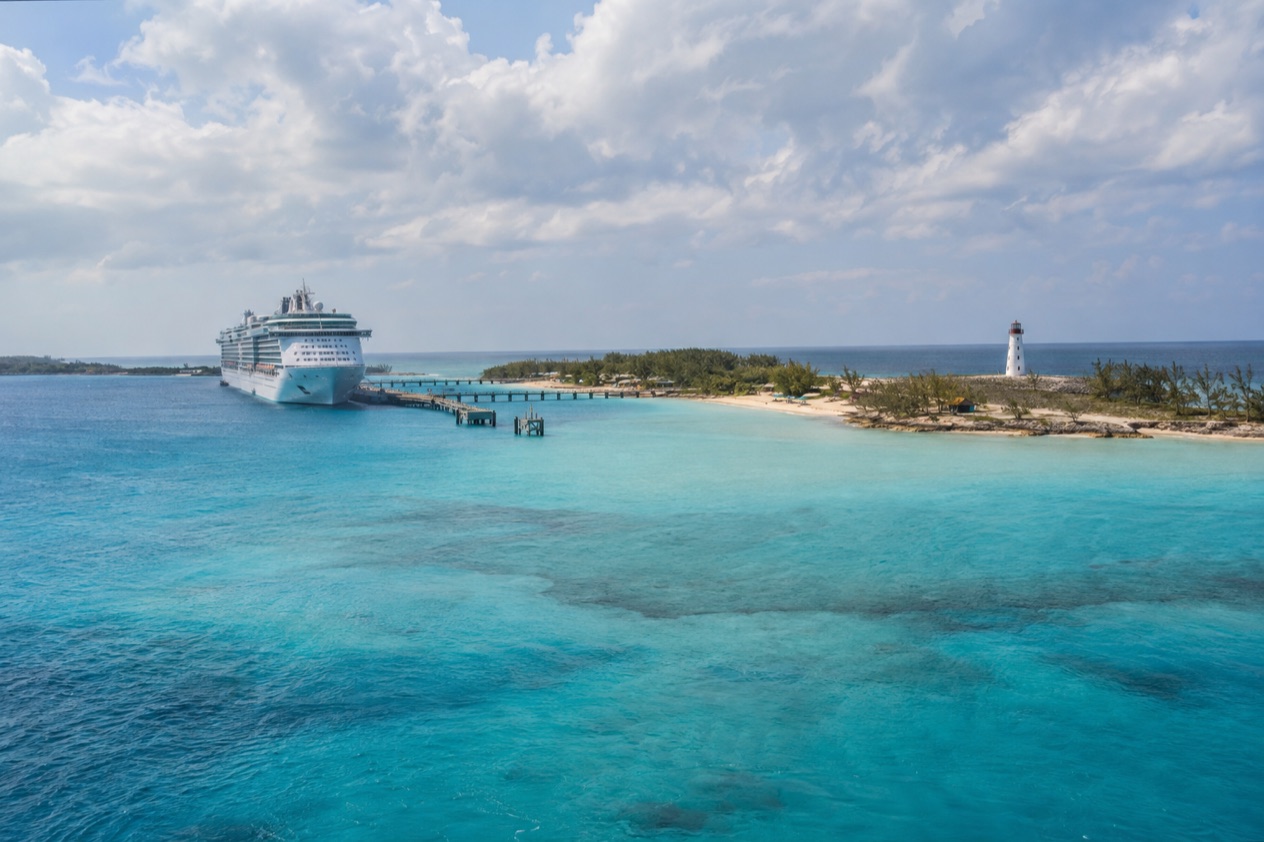
On a sea day, when the ship’s pool deck is full and the itinerary card promises a stop at a private island, the questions start: what is Ocean Cay, who sails there, and what is there to do once the gangway comes down? Ocean Cay MSC Marine Reserve is a small island in the Bahamas that MSC Cruises has turned from an industrial site into a beach stop of its own, with a lighthouse, a ring of named beaches and a conservation name to live up to.
What is Ocean Cay MSC Marine Reserve?
Ocean Cay MSC Marine Reserve is a private island in the Bahamas, redeveloped for MSC Cruises on a piece of land that was once a mining site. It sits in the district of Bimini, and it is a very different place from the busy ports of Nassau or Freeport.
Nobody lives here in the way they do on Bimini proper. The island exists as a destination, and everything on it has been planned around that purpose.
| Detail | Ocean Cay |
|---|---|
| District | Bimini, Bahamas |
| Distance south of Bimini proper | 20 miles |
| Size of the island | 0.16 square miles |
| Lease with the Bahamian government | 100 years |
| Planned redevelopment spending | $200 million |
From mining site to cruise destination
The island’s earlier life was industrial, and the change of scenery is the heart of its story. The restoration involved removing all of the abandoned mining facilities and infrastructure, so what you walk on now is a cleared and reshaped cay rather than a place with an old quarry at its edge. That history explains the word Reserve in the name, which signals that the company wants the island to be seen as a place being repaired as much as a place being visited.
For a traveler, the practical effect is a landscape that feels designed. Beaches have names, areas have purposes, and the low profile of the island means the sky and the horizon do a lot of the work. Think of it as a small, tidy stretch of sand and sea set out in open water, with no town behind it.
A lease signed with the Bahamian government
The arrangement dates to 2015, when Pierfrancesco Vago, executive chairman of MSC Cruises, signed an agreement with the Bahamian government to redevelop Ocean Cay into a resort for the line. The long term of the lease tells you this is not a pop-up stop. It is a place the company expects to shape and keep for generations, which is why the redevelopment reached into the ground itself and not just the shoreline.
Because the island is so small, almost everything you see was placed there on purpose. That gives it a calm, uncluttered look from the ship, where the lighthouse and the long low line of beach are the first things to stand out against the water.
Where it sits in the Bahamas
The Bahamas is an archipelago, and Ocean Cay belongs to the Bimini district, not to Nassau or any other island group you may have read about. Anything you have heard about New Providence, Paradise Island or Grand Bahama belongs to those places and not here. Ocean Cay stands on its own, a separate speck of land in the Atlantic with its own rhythm, set by the ships that come to it.
Which cruise lines go to Ocean Cay MSC Marine Reserve?
MSC Cruises is the line behind Ocean Cay MSC Marine Reserve, which was redeveloped as its private island. The name says it plainly: the island carries the line’s initials, and the lease, the investment and the restoration all trace back to the same company. If you are weighing cruises, this is an MSC stop, and it is shaped by what MSC has built there.
Why the island carries one line’s name
A private island in the cruise world is a place a company holds for its own guests, and Ocean Cay follows that model. MSC Cruises signed the long lease, planned to spend $200 million on the redevelopment, and then gave the island its own identity as a marine reserve. That is a lot of commitment for a piece of land this small, and it explains why the island has the feel of a finished product rather than a port that grew up by accident.
What this means in practice is a stop with one voice. The signage, the layout and the sense of how the day is meant to flow come from a single planner, which can make the place feel coherent and easy to read as you step off the ship.
What a private island means for your day
On a private island the shore is part of the cruise experience instead of a separate excursion into a town. There is no street market to wander into, no local taxi stand, no old quarter with a church on the square. The trade-off is simple. You give up the texture of a real Bahamian settlement, and you get a stretch of sand and water arranged for people who want to spend the day outdoors.
If you want Bahamian life, with its fish fries, Junkanoo music and conch salad stands, you find it on the inhabited islands such as New Providence. Ocean Cay is a different kind of stop, and it is best enjoyed for what it is: a beach day in open water, with a lighthouse as its landmark.
Other lines and other private islands
Other cruise lines have their own island stops in the Bahamas, each tied to its own owner, and none of them should be confused with this one. Ocean Cay is MSC’s, in the Bimini district. When you read about a beach club or a private cay elsewhere in the archipelago, treat it as a separate place with its own story, its own layout and its own operator.
What can you do at Ocean Cay MSC Marine Reserve?
You can spend the day on the beaches, visit the lighthouse and enjoy the setting of a restored island. The island’s strength is its variety of shoreline, with eight beaches, each with its own character and position around the cay. For a stop that is mostly about sun, sand and sea air, that choice of spots is the main appeal.
The beaches
Ocean Cay has eight beaches, including Lighthouse Bay, North Beach, South Beach and Bimini Beach, along with areas near the lagoon and a beach reserved for employees. The names alone suggest how the island is laid out, with different faces turned toward different parts of the horizon. Lighthouse Bay takes its name from the tower that gives the island its silhouette, while Bimini Beach nods to the district the cay belongs to.
Sea conditions change from day to day and from one stretch of shore to another. That is a detail of how the island is run, and it is worth knowing when you pick where to settle for the day. The employee beach is not part of the visitor circuit, so it stays out of your plans.
The lighthouse
The lighthouse is open to visitors on the island, and it is the island’s signature. LED lights are integrated throughout the structure for visual light shows, so the tower is as much a piece of staging as a piece of navigation. Seen from the beach, it gives the flat horizon a vertical anchor, and it is the picture most people take home from the stop.
It suits anyone who likes a landmark to aim for and a view that makes the scale of the island clear. If you only plan one thing beyond lying on the sand, this is it. Pair it with a slow walk along Lighthouse Bay, so that the tower and the shoreline that carries its name are part of the same outing.
A restored island to look around
Part of the experience is simply taking in a place that was cleared of its mining past. The abandoned facilities are gone, and what remains is open ground, sea and sky. Walking from one beach toward another, you notice how little stands between you and the water, and how the island’s size lets you feel its edges.
The marine reserve in the name is a promise about care for the surrounding sea. Treat the place the way the name suggests, carrying your own things back to the ship and leaving the shoreline as you found it, and you will be in the spirit of the island.
What do you need to know before you go ashore?
Before you go ashore, know which travel document you carry, how the day on a small private island works, and that the hurricane season shapes the calendar. The first point matters even for a stop where you never leave the cruise’s own island, because documents are tied to the whole voyage and not to a single beach.
Travel documents on a cruise
Travelers heading to the Bahamas on a cruise may use another Western Hemisphere Travel Initiative compliant document, such as a U.S. passport card. That is the rule for the sea voyage, and it differs from the rule for flying. The U.S. State Department nonetheless strongly recommends a passport, in case an unforeseen emergency requires disembarking and returning by air.
The air rule is stricter. U.S. citizens entering the United States by air must present a valid U.S. passport, a Trusted Traveler Program card (NEXUS, SENTRI or FAST), a U.S. military identification card when traveling on official orders, or a U.S. Merchant Mariner document when traveling in conjunction with official maritime business. Children must present their own passport when traveling by air, and the Indian or tribal card cannot be used for air travel.
Beaches
Sea conditions change from day to day and from one stretch of shore to another, so the beach hours matter more than the beach you pick. The beach reserved for employees is off the visitor map. For the rest, the choice between Lighthouse Bay, North Beach, South Beach, Bimini Beach and the areas near the lagoon comes down to the view you want and the spot that suits your group.
The sea itself is open Atlantic water, and conditions change with weather. Sea conditions change from day to day and from one stretch of shore to another, so treat the water with the respect any ocean deserves.
A small island, a full day
With so little land, distances on the island are small and everything feels close. That makes it easy to plan a loose day: a morning on one beach, a visit to the lighthouse, and an afternoon on another shoreline before heading back toward the ship. Nothing here asks for an early start or a long route, only a sense of where the ship’s departure falls and a habit of keeping an eye on the time.
Since the island is run by one company for its own guests, the ship remains your base. Whatever you bring ashore, bring it with the idea of returning with it, and keep in mind that the shore is part of the cruise and shares its rhythm.
Good to know before you go
The U.S. State Department rates the Bahamas Level 2, “Exercise increased caution”, and says most crime occurs in Nassau on New Providence and in Freeport on Grand Bahama.
The Atlantic hurricane season runs from June 1 to November 30, and cruise stops at a low island like this one sit squarely inside that calendar for much of the year. A change of weather can reshape a day at sea, so travelers who sail in those months should expect the plan to shift if conditions require it.
Ocean Cay is part of the Bimini district, far from the busy centers of Nassau and Freeport, so the island itself feels remote and quiet. Carry what you need for a day on the sand, keep your travel document with you for the voyage, and let the ship’s schedule guide the hours, since sea conditions change from day to day and from one stretch of shore to another.
Sources
- Wikipedia, Ocean Cay (https://en.wikipedia.org/wiki/Ocean_Cay), checked October 10, 2026
- U.S. Department of State, The Bahamas Travel Information, Entry and exit requirements (https://travel.state.gov/), checked October 10, 2026
- U.S. Customs and Border Protection, Western Hemisphere Travel Initiative (https://www.cbp.gov/travel/us-citizens/western-hemisphere-travel-initiative), checked October 10, 2026
- U.S. Department of State, The Bahamas Travel Advisory, Level 2 (https://travel.state.gov/), checked October 10, 2026
- NOAA National Hurricane Center, Climatology (https://www.nhc.noaa.gov/climo/), checked October 10, 2026
To plan your stay
- Best Time for a Bahamas Cruise: Weather by Month, Hurricane Season and Sea Temperatures
- Bahamas Cruise Ports: Nassau, Freeport, Private Islands and Which Stop Suits You
- Freeport Cruise Port: Celebration Key, Port Lucaya and Getting Around Grand Bahama
- Bahamas Cruise from Baltimore: Carnival, Royal Caribbean, Ports and Boarding Documents