
A low, damp breath rolls across the water, and every head on the boat turns at once. Then a dark back rises, a fin slides past, and a broad tail lifts and slips under the surface, leaving a smooth patch of ripples behind.
That is the moment people come to Alaska’s coastal waters for. Humpback whales and orcas feed here, and the waters around Juneau, Icy Strait and Glacier Bay are where many travelers go to look for them.
Where can you see whales in Alaska?
You can look for whales from several corners of the state, but the best-documented starting points are Juneau, Icy Strait Point, Glacier Bay and the waters reached from Anchorage. Each offers a different kind of day, from a harbor departure to a long cruise through a national park. Humpbacks are the whales most visitors hope to see, and orcas turn up in many of the same waters.
Alaska is huge, and the whales are wild animals that go where the food goes. Treat every outing as a chance rather than a promise. The pleasure of the day is also in the other animals and the scenery around you.
Juneau and Auke Bay
Juneau is the place where whale watching feels most woven into the town. Boats go out from Auke Bay Harbor, and the city’s wildlife viewing tours are built around whales, bears, seals, eagles and mountain goats.
A group of humpbacks has even been observed bubble-net fishing near Juneau. In that technique the whales circle a school of fish, blow a curtain of bubbles to corral it, then surge up through the middle with mouths open. You may be lucky enough to watch something like it, though no one can schedule it.
Wildlife tours around Juneau can also bring you close to Dall’s porpoises, sea lions, harbor seals and sea otters. Between sightings, the boat is a good place to scan the shoreline for bald eagles. On the town side, Juneau pairs the water with Mendenhall Glacier and a small, walkable historic district, so a gray or rainy day can be given to museums and galleries instead.
Icy Strait Point
Whale watching is offered off Icy Strait Point, which is how many cruise travelers meet their first Alaska whale. The scene is a working boat on open water, binoculars passed along the rail, and a hush whenever someone calls out a blow. Hearing the exhale before you see the animal is part of the memory.
If you arrive with a cruise itinerary that includes this stop, treat the whale outing as one pleasure among several. The water and the forested shoreline are worth watching even when the whales stay below. Keep your camera ready but your eyes up, since the best views come at the surface and are over quickly.
Glacier Bay National Park
Visitors to Glacier Bay can see puffins, bears, whales and eagles, and most people experience the park from a boat. That might be a cruise ship, a tour vessel, a charter or a private kayak. It is a place where the whales share the stage with tidewater cliffs of ice and a very large quiet.
Bartlett Cove is the only developed area in the park. It has a lodge, a visitor center with exhibits, trails, a public dock, kayak rentals and a walk-in campground. For travelers who want more than a day on a vessel, the park also offers wilderness camping, hiking, backpacking, kayaking, rafting and mountaineering. Birdwatchers have plenty to do as well, with 274 species sighted in the park.
Anchorage and the day cruise
Anchorage is better known for moose wandering the city edges, but its wildlife offerings include day cruises for whales, puffins and otters, along with flights to see bears fishing. Seward, easily reached from Anchorage, adds the Alaska SeaLife Center, the state’s only public aquarium, for a rainy hour or two.
Orcas in Alaska waters
Orcas live in all oceans and most seas, including the waters off Alaska, and the coast from California to Alaska is a major place where they are studied. Transient orcas are seen near Unimak Island in the eastern Aleutians, and transient pods have been sighted from southern Alaska to central California. These are the mammal-hunting orcas, and they have been observed preying on moose swimming between islands off the northwest coast.
Alaskan orcas have also learned to steal fish from longlines, overcoming several techniques meant to stop them. It is a reminder of how clever these animals are. On a boat trip, an orca sighting is a bonus rather than the plan.
When is whale season?
In Juneau, visitors are likely to see bears, bald eagles or humpback whales, especially from April through November. It does not describe every other port, so treat it as the Juneau season rather than a rule for the whole state.
Why the whales come north
Humpbacks migrate between feeding areas toward the poles and breeding areas near the equator. Alaska’s cold, rich waters are on the feeding side of that journey. The whales are here to eat, which is why you see them lunging, diving deep and surfacing with a loud breath, rather than lounging.
Regional estimates put the North Pacific population at around 21,000 humpbacks. Only a slice of them is in any one bay at a time, so even in a good season a day on the water has the quality of a search. The reward is that when a whale does show itself, it feels earned.
What a humpback looks like up close
An adult humpback runs from 46 to 56 feet in length, about the span of a city bus or longer. Seen from a boat, most of that is hidden. You mostly get a rounded back, a small dorsal fin, and then the tail flukes lifting high as the whale begins a deep dive.
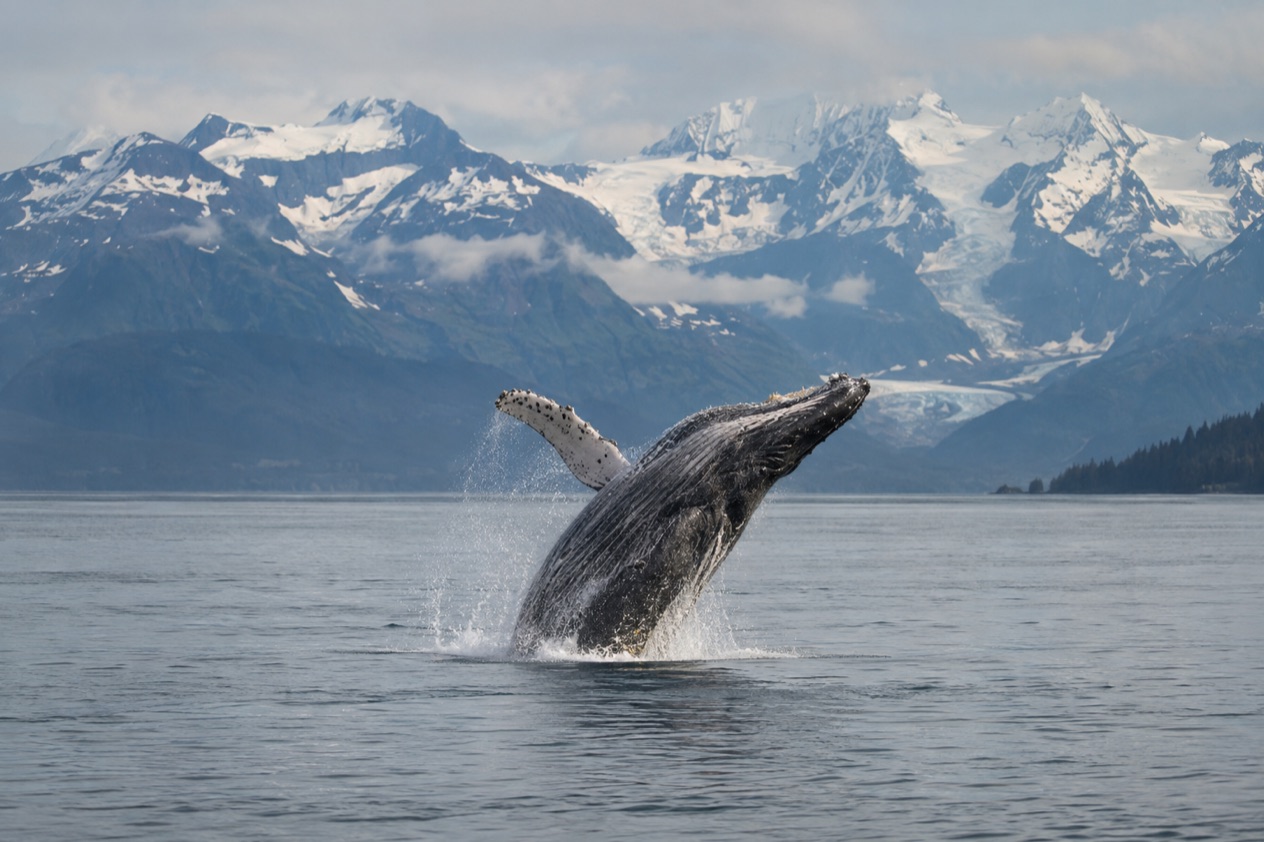
Humpbacks are known for breaching and other surface behaviors, which is why they are favorites with whale watchers. A breach, when a whale throws much of its body out of the water, is the dramatic one. Slapping a fin or tail on the surface is more common and just as loud. Keep your attention on the water between blows, because the show can begin with no warning.
Song, bubbles and other behavior
Male humpbacks produce complex songs that typically last from 4 to 33 minutes. The songs travel underwater, so you will rarely hear them from a deck, but they are part of what makes these animals so compelling. Some boats carry equipment that lets passengers listen, though only an operator can tell you that.
Bubble-net feeding is the behavior that Juneau travelers talk about most. A ring of bubbles rises, a head or two emerges, and the water seems to boil. Seeing it is a chance, never a certainty, and it is all the more memorable for that.
What else shares the season
The same months bring bears, bald eagles, harbor seals, sea lions and sea otters to the viewing list around Juneau. Mountain goats and Sitka blacktail deer appear on the tours as well. A day that misses the whales can still end with a seal hauled out on a rock or an eagle perched above the water.
For travelers visiting in autumn, Juneau’s April through November window means the season still runs into the month of this writing. Some travelers pair a boat day with a small plane or helicopter landing on a glacier, where hiking or dog-sledding is on offer. Weather decides the flying, so keep the plans loose.
How do the tours work?
Most whale watching in Alaska is done from a boat, with a naturalist or ranger helping you read the water, and rules that keep the vessel from crowding the animals. The shape of the outing depends on where you board. In Juneau you leave from Auke Bay Harbor, while at Icy Strait Point the outing is part of a cruise stop.
On the water
Regulations for whale watching vessels restrict how close boats can approach the whales. That is why the best views often come when a whale chooses to surface near the boat, not when the captain chases it. It also explains the patience of a good trip: engines slow, voices drop, and everyone watches the surface.
Humpbacks are large and the animals often look closer than they are. A pair of binoculars is a useful companion. Watch for blows, which tell you where a whale will surface next, and for gulls or other birds gathering over feeding fish.
Cruise ships and park rangers in Glacier Bay
Park rangers at Glacier Bay provide regular guided activities and board cruise ships and tour vessels to present information and answer questions. If you are on one of those vessels, the ranger on deck is a resource you can use. Ask what the whales are doing and what else is moving in the water.
Because most people see the park from a boat, the experience tends to be unhurried. You glide past rock walls and ice, and the day is shaped as much by the landscape as by the whales. The visitor center and exhibits at Bartlett Cove help put what you saw into context.
From the air and from town
Flightseeing from communities near Glacier Bay gives an amazing aerial perspective, weather permitting. From above, the scale of the bays and glaciers becomes clear in a way a deck cannot match. Clouds can keep planes on the ground, so a flight is something to pencil in loosely.
In Juneau, boat outings sit alongside the rest of the town. The historic district is small and walkable, with several sights, and the city’s calendar of annual events adds options. Rotating museum galleries give you somewhere to go if the weather turns, and the wildlife tours can take you toward seals, porpoises and sea otters even when the whales are elusive.
Good to know before you go
Whales are wild animals and the rules about how close boats may get exist for their sake, so a captain’s choices on the day are part of the experience. Weather can limit flights, and a clear schedule leaves room for a second try. Pack patience, binoculars and the willingness to enjoy eagles, seals and mountains while you wait for the next blow.
Sources
- Wikipedia, Humpback whale (https://en.wikipedia.org/wiki/Humpback_whale), checked October 11, 2026
- Wikipedia, Orca (https://en.wikipedia.org/wiki/Orca), checked October 11, 2026
- Travel Juneau, things to do (https://www.traveljuneau.com/things-to-do/), checked October 11, 2026
- Visit Seward, things to do (https://www.seward.com/things-to-do), checked October 11, 2026
- Homer, things to do (https://www.homeralaska.org/things-to-do/), checked October 11, 2026
- National Park Service, Glacier Bay National Park & Preserve, plan your visit: things2do (https://www.nps.gov/glba/planyourvisit/things2do.htm), checked October 11, 2026
- Royal Caribbean, Alaska cruises (https://www.royalcaribbean.com/cruise-destinations/alaska-cruises), checked October 11, 2026
- Visit Anchorage, wildlife viewing (https://www.anchorage.net/outdoors/wildlife-viewing/), checked October 11, 2026