
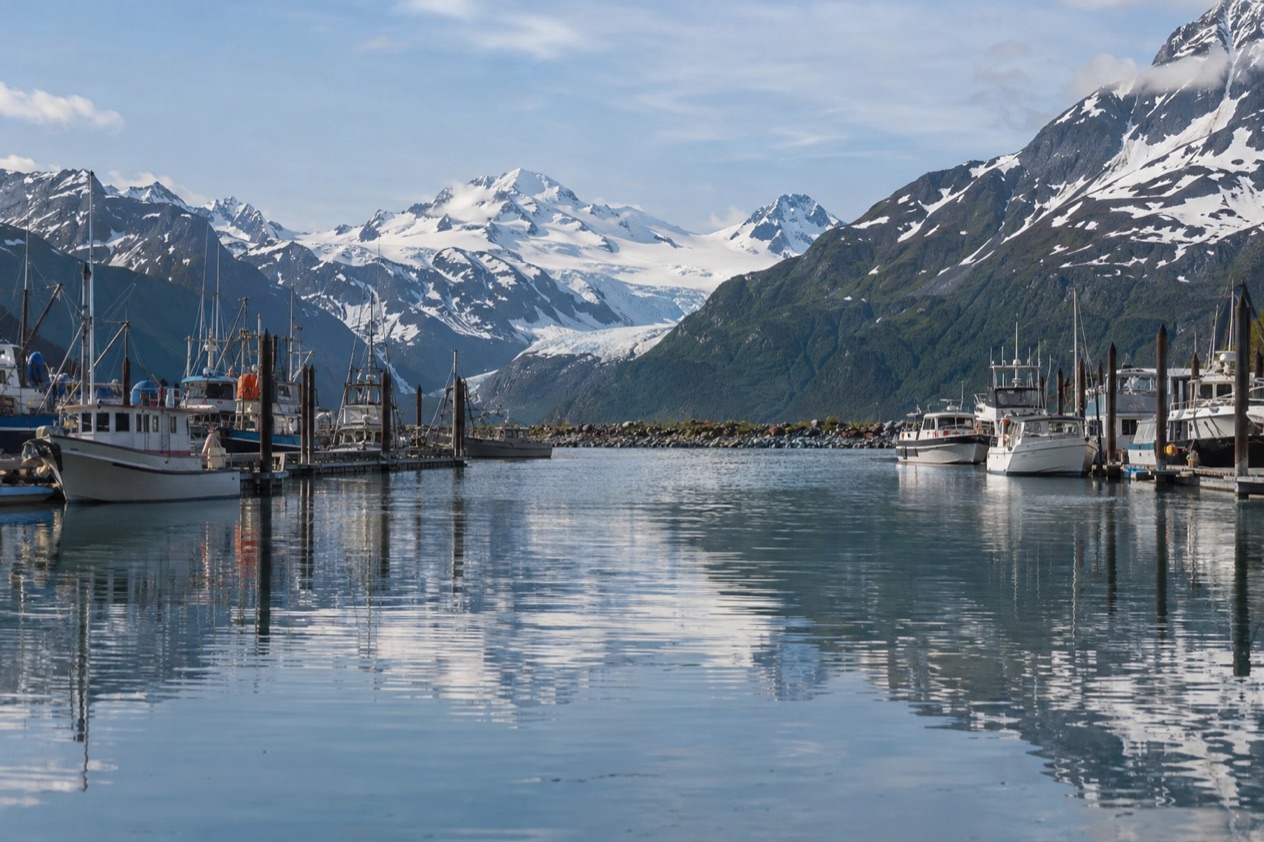
Snow in Valdez falls in thick, quiet curtains that bury parked trucks overnight, while the harbor below stays dark and open against white mountains. In summer the same fjord is bright until late in the evening and the slopes turn green right down to the water. Valdez sits at the head of a fjord on Prince William Sound, and each season gives it a different character for visitors.
When is the best time to visit Valdez?
June and July are the best months for travelers: the days are long, the air is at its mildest, and rain falls on fewer days than in late summer. For sightseeing, that is when you can drive the Richardson Highway, stop at a glacier and still have hours of light left for dinner.
For wildlife and the mountains, May and the first half of August are worth a look too. May brings long light and the last of the snow, with mornings that can still feel like winter.
Early August keeps the long days but starts to turn wetter, and by September the rain comes more often than not. Animals along the shore and in the water are always a chance, never a promise, and a gray day with low clouds hides the peaks that make the fjord so striking.
The quiet seasons have their own pull. Winter is for people who want snow in a place famous for it, since Valdez is known as the snowiest city in the United States, with more than 300 inches in an average year.
Daylight is short and the town is small, so winter suits travelers who like cozy rooms, long dinners and a landscape buried in white. Early spring, when days lengthen quickly and snow still lies deep, works for the same crowd.
Families will find June and July the easiest months to fill with outdoor time, simply because the daylight lasts so long and the temperatures stay cool rather than cold. Winter works for families who want to play in deep snow and dress for it. The Richardson Highway is the only road in, so the drive itself is part of the trip in any season.
Valdez weather by month
Valdez has cool summers and winters that hover near the freezing mark, which is why so much of the precipitation falls as snow.
| Month | Average high (°F) | Average low (°F) | Precipitation (in) | Days with precipitation | Daylight on the 15th |
|---|---|---|---|---|---|
| January | 28.7 | 19.1 | 6.56 | 11.4 | 6 h 21 min |
| February | 31.9 | 21.4 | 5.92 | 10.5 | 8 h 58 min |
| March | 36.7 | 23.0 | 4.10 | 8.8 | 11 h 38 min |
| April | 46.4 | 31.9 | 3.37 | 8.2 | 14 h 36 min |
| May | 55.6 | 39.8 | 3.02 | 8.0 | 17 h 21 min |
| June | 62.5 | 46.3 | 2.44 | 6.4 | 19 h 15 min |
| July | 64.1 | 49.1 | 3.87 | 10.1 | 18 h 31 min |
| August | 62.0 | 46.9 | 7.00 | 12.3 | 15 h 57 min |
| September | 55.0 | 41.6 | 9.76 | 16.0 | 13 h 03 min |
| October | 44.9 | 34.1 | 7.98 | 14.0 | 10 h 13 min |
| November | 33.9 | 24.9 | 6.14 | 10.3 | 7 h 23 min |
| December | 30.7 | 21.8 | 7.74 | 12.4 | 5 h 34 min |
The year runs in two halves. Spring is the driest stretch, and June is the driest month of all, with the fewest wet days. From August through October the rain turns heavy, and September has some precipitation on more than half its days. Pack a real rain jacket for those months, because the showers can settle in and the peaks vanish behind cloud.
From November on, the same wet pattern arrives as snow. December is the snowiest month in the table, at 70.5 inches, and January is close behind. Winter highs sit right around freezing, so the cold is damp and snowy rather than the deep freeze of the Interior.
Light changes the day more than temperature does. Spring and fall swing quickly, with each week adding or losing a large slice of daylight. Plan outdoor stops for the middle of the day in the shoulder months.
What is there to do in Valdez in each season?
The long days of summer
Summer is when the Richardson Highway shows what it is. Along it sits Worthington Glacier, at milepost 28.7, a National Natural Landmark since 1968 that covers thousands of acres of ice. Stopping to look at it is one of the simplest ways to feel the scale of the Chugach country.
In town, the harbor is the center of things. Valdez is the northernmost ice-free port in North America, and it is also where the Trans-Alaska Pipeline System ends, so the waterfront has the look of a working place rather than a resort. Evenings are long enough for a walk along the water after dinner, with the mountains still lit around the fjord. Birds and sea life are chances along the shore, never guarantees.
Fall, when the rain sets in
Fall in Valdez is damp, and the wettest weeks come early in the season. September and October are for travelers who accept gray skies in exchange for emptier roads and a shifting landscape, with fresh snow dusting the high ground first. Good rain gear matters more than any plan.
The drive is the main event, because the same highway looks different every week as the light shortens. The long evenings of summer fade quickly, and by October the day has far less daylight to work with. Fall suits people who like moody scenery and a quiet town, and who are happy to spend hours indoors when the weather turns.
Winter and the spring thaw
Winter in Valdez means snow, and a great deal of it. From November to March the town sits under deep drifts, days are short, and the harbor stays open while the mountains turn white. It is a season for staying close to the town, watching the weather and enjoying the contrast between snow and dark water.
Spring arrives unevenly. By April the days have grown long but snow still lies on the ground, and in May the town starts to thaw while the mountains stay white well above it. It is a time for travelers who want the shoulder-season quiet and do not mind mud and mixed weather. The drive from Anchorage takes 6 to 7 hours in good conditions, so a day of snow can change the plan.
When is Valdez cheapest and least crowded?
The quietest months are the ones when snow is deep and days are short, from late fall through early spring. In those months the town is calm, with few visitors and a slow pace, and rooms and tables are likely easier to find than in the bright weeks of early summer. A traveler who comes then is mostly sharing the place with the people who live there.
The weeks around the longest days are the ones people picture when they plan a trip, so that is when the town feels busiest. Valdez is a destination at the end of a single road rather than a stop on the way somewhere else, which means the visitors who come are ones who made the trip on purpose. A day trip to a glacier or a long evening walk is easy to enjoy at any time.
The shoulder months of May and September sit between the two extremes. May brings long light and thinner company, while September brings the heaviest rain of the year with a quiet feel. Both reward flexible travelers, and a town this small never feels like a crowd.
Which months should you avoid in Valdez?
No month rules Valdez out, but September and October bring the most rain, and December has the shortest days and the deepest snow. If you want clear views of the mountains and the glacier, those are the months to plan around, or to accept as part of the trip.
The long daylight runs from spring into summer, with May, June and July giving the most hours outdoors. The aurora is a different calendar. In Fairbanks, at the other end of the Richardson Highway, the viewing season runs roughly from August 21 to April 21, and the sky is not dark enough between April 22 and August 20. Those dates belong to Fairbanks, and Valdez has its own mountains, clouds and snowfall to contend with.
In the snowy months the Richardson Highway matters more than anything. The drive from Tok takes about 4.5 hours, and the whole route can feel longer in winter weather.
Winter is not a bad choice, just a different one. Days are short and the weather rules the schedule, so winter suits travelers who enjoy snow for its own sake. If your plan depends on long outdoor days, steer toward early summer.
Festivals and events in Valdez through the year
Summer holidays and long light
The Fourth of July falls in the warmest stretch of the year, when the days are long and the evenings stay bright. It is the kind of date that fits Valdez well, because the weather is best and the light does not fade until very late.
Summer is also when nature keeps its own calendar. Wildlife along the shore, the fjord and the road is a chance, never a promise, and the light that makes the mountains glow in the evening is part of the draw. Travelers who come in June and July often find the days themselves are the event.
Fall and winter holidays
Halloween on October 31 comes when the rain is heavy and the evenings are already dark, which suits the holiday. Thanksgiving and Christmas follow in the snowy months, and Christmas on December 25 in a town this snowy has an obvious charm, with lights glowing against drifts. These are small-town holidays, quiet and close, with weather as the backdrop.
In Fairbanks it runs roughly from August 21 to April 21, and activity tends to be stronger around the equinoxes than at midwinter or midsummer.
Spring light and the thaw
The equinox in March marks the point when day and night are balanced, and from there the light builds quickly toward the long days of summer. It is a season of change that rewards travelers who like to watch a place wake up.
The thaw is gradual, with snow retreating from the town while the mountains stay white. For anyone who likes to see a landscape in transition, from deep winter toward green, spring in Valdez offers it in a few short weeks.
Sources
- NOAA NCEI, U.S. Climate Normals 1991-2020, monthly (https://www.ncei.noaa.gov/access/services/data/v1?dataset=normals-monthly-1991-2020&stations=USW00026442), station Valdez Wso, elevation 95 feet, checked October 11, 2026
- Computed from the date and the latitude of the place (sunrise equation, solar elevation -0.833 degrees), October 11, 2026
- Alaska.org, dest valdez (https://www.alaska.org/destination/valdez), checked October 11, 2026
- Wikivoyage, Valdez (https://en.wikivoyage.org/wiki/Valdez), checked October 11, 2026
- Wikipedia, Valdez, Alaska (https://en.wikipedia.org/wiki/Valdez,_Alaska), checked October 11, 2026
- Wikipedia, Worthington Glacier (https://en.wikipedia.org/wiki/Worthington_Glacier), checked October 11, 2026
- Wikipedia, Richardson Highway (https://en.wikipedia.org/wiki/Richardson_Highway), checked October 11, 2026
- Wikipedia, Prince William Sound (https://en.wikipedia.org/wiki/Prince_William_Sound), checked October 11, 2026
- Wikipedia, Whittier, Alaska (https://en.wikipedia.org/wiki/Whittier,_Alaska), checked October 11, 2026
- Wikipedia, Copper River Highway (https://en.wikipedia.org/wiki/Copper_River_Highway), checked October 11, 2026
- Wikipedia, Climate of Alaska (https://en.wikipedia.org/wiki/Climate_of_Alaska), checked October 11, 2026
- University of Alaska Fairbanks Geophysical Institute, Aurora forecast (https://www.gi.alaska.edu/monitors/aurora-forecast), checked October 11, 2026
To plan your stay
- Things to Do in Valdez: Glaciers, Thompson Pass, Prince William Sound and Local Seafood
- Where to Stay in Valdez: Town Center, Richardson Highway, Glacier Lake and How to Choose
- Valdez from Anchorage: the Richardson Highway, Thompson Pass and Worthington Glacier
- Valdez in January: Snow, Short Days and the Road to Worthington Glacier