
In August, the harbor at Valdez smells of salt, diesel and wet rope, and the mountains around the head of the fjord wear low clouds like scarves. Evenings stretch on, so a walk along the water after dinner still happens in daylight. The town is the largest port on Prince William Sound, and August suits travelers who want a working Alaska waterfront, a glacier beside a highway and long days to fit both in.
What is the weather like in Valdez in August?
August in Valdez is cool, damp and bright for long hours, with mild afternoons, chilly nights and showers that come more often than in July.
| Month | Average high (°F) | Average low (°F) | Precipitation (in) | Days with precipitation | Daylight on the 15th |
|---|---|---|---|---|---|
| July | 64.1 | 49.1 | 3.87 | 10.1 | 18 h 31 min |
| August | 62.0 | 46.9 | 7.00 | 12.3 | 15 h 57 min |
| September | 55.0 | 41.6 | 9.76 | 16.0 | 13 h 03 min |
Afternoons sit in the low 60s, which is comfortable for walking the waterfront in a light jacket but too cool for shirtsleeves. Mornings and evenings drop into the mid-40s, so a warm layer under a shell is the normal outfit from breakfast to dinner. No snow falls in the town this month.
Rain is the thing to plan around. August is noticeably wetter than July here, and showers turn up on a bit more than one day in three. Some are brief and others settle in as a gray, drizzly day, so a waterproof jacket earns its place in the daypack. The mountains can vanish behind cloud, then reappear within an hour.
The light is generous without being endless. Days are long enough that dinner and an evening stroll need no flashlight, yet the daylight has shortened a good deal since July, and the sky now has a softer, lower feel at the end of the day. Early evening is a good time for photographs of the harbor and the peaks when the clouds lift.
What to do in Valdez in August
August in Valdez is about being outdoors in long daylight, at the water’s edge and along the road that climbs out of town. The town is the largest port on Prince William Sound, and it sits at the southern terminus of the Trans-Alaska Pipeline System, so the harbor has the feel of a place where people work as well as visit. Walking the docks, watching boats come and go and looking up at the steep, cloud-wrapped mountains is the simplest and most satisfying start.
Showers are part of the month, so the best days are built around flexibility. When the clouds lift, you head for the highway and the glacier. When the drizzle settles in, you linger in the harbor area, take a long lunch and wait for a break. The mood in town is unhurried, with people in rain jackets and boots rather than resort clothes.
The harbor and Prince William Sound
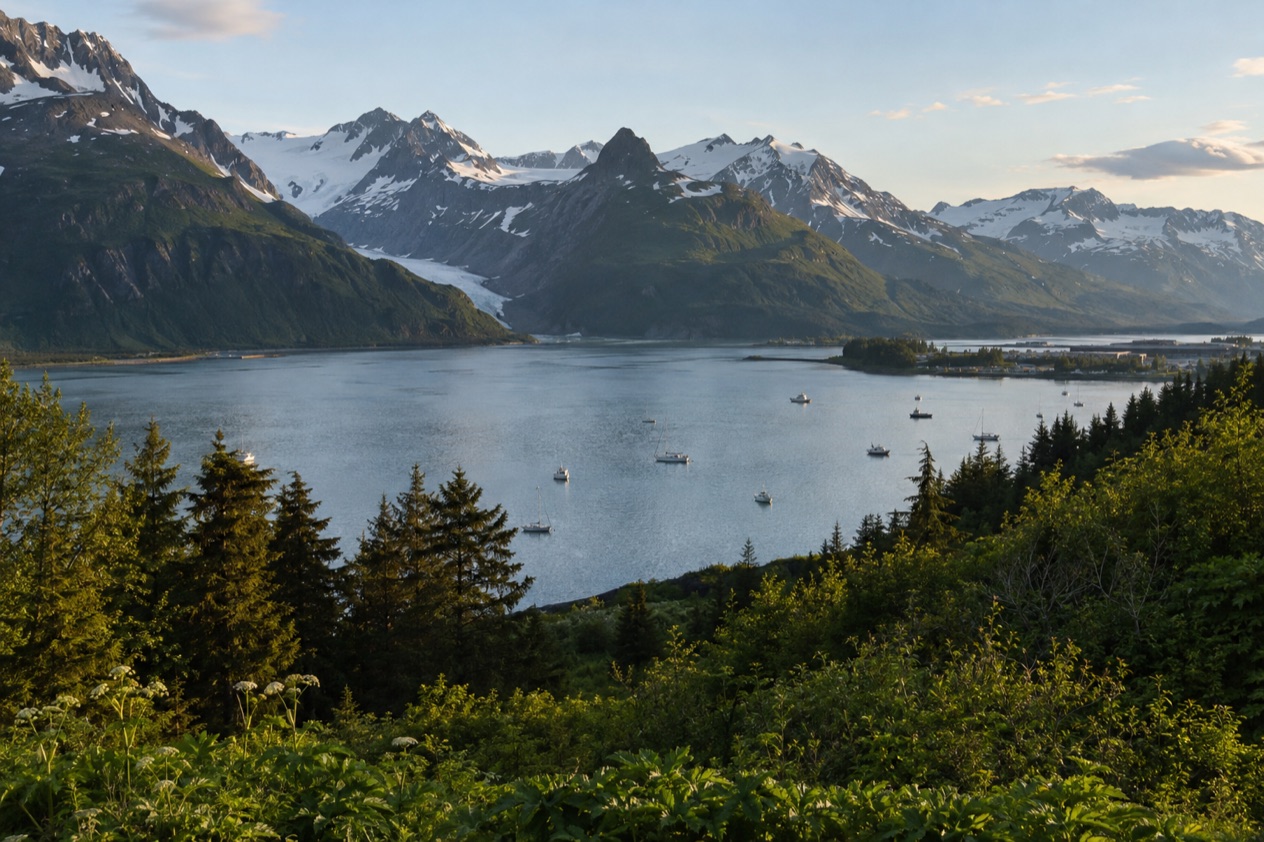
The harbor is the heart of Valdez. Fishing boats and pleasure craft crowd the docks, gulls wheel over the pilings, and the water is the dark green-gray of a glacial fjord.
Prince William Sound lies beyond, a maze of waterways ringed by mountains, and its other settlements include Cordova, Whittier and the Alaska Native villages of Chenega and Tatitlek. From the shore you read the geography of the place at a glance, with the town at the end of the water and the Chugach peaks rising behind it.
Spend time here at the start and the end of the day, when the light is low and the working boats are most active. A bench by the water with a hot drink and a rain shell is a perfectly good way to spend an hour. It is also the place to see how Valdez fits the sound, which is the reason the town exists.
Wildlife on the water is a chance, not a promise. Sea birds are common around any harbor, and you may spot other animals, but treat anything beyond the gulls as a bonus rather than a plan.
Worthington Glacier on the Richardson Highway
Worthington Glacier lies beside the Richardson Highway at milepost 28.7, east of Valdez. It covers a large stretch of mountainside, and it was listed as a National Natural Landmark in 1968. Ice, rock and meltwater sit together in one view, and the glacier’s pale blue and gray tones look best when the clouds are high and the light is even.
The road that brings you here is a story in itself. The Richardson Highway was the first major road built in Alaska, and it connects Valdez to Fairbanks. Driving out of town on it gives you the feel of leaving the coast and climbing into bigger country, with the mountains pressing close on both sides.
Go on a morning when the cloud base looks high, since a low gray ceiling hides much of the glacier and the peaks above it. Bring the same layers you wear in town, plus a hat, because the air near the ice can feel cooler than the waterfront.
Following the Richardson Highway
Even if you never reach Fairbanks, the highway is worth treating as an outing in its own right. It is marked as Alaska Route 4 from Valdez to Delta Junction, and the whole road runs 368 miles. A drive along its first stretch is a good way to see how quickly the landscape changes from fjord to mountain valley.
Pull-offs let you stop for photographs when the clouds break. Mountain streams, wet rock faces and patches of green hillside give August its character here, with the damp air keeping everything vivid. Because the month is wetter than July, have a plan for a rainy hour, such as a late lunch in town, and then try the road again when the sky improves.
The long daylight helps. You can head out after breakfast, stop where the views are good and still be back at the harbor with light left for a stroll.
Food in a port town like this leans toward seafood, and a plate of fish after a damp, windy day is exactly the right reward. Look for harbor-side cafés and small restaurants where the menu follows the catch, and finish with something hot.
A two-day itinerary for Valdez in August
Day 1 belongs to the town and the water. Start with a slow breakfast, then walk the harbor while the boats are active and the morning light is soft.
Midday suits a seafood lunch in a harbor-side café, followed by an unhurried afternoon along the waterfront, where the mountains at the end of the fjord fill the view. If rain moves in, stay put with a long coffee and watch it sweep across the water.
In the evening, with daylight still long, return to the docks for a last stroll. The air cools quickly, so a warm layer under a shell keeps the walk pleasant. Dinner in a small restaurant in town ends the day without any rush.
Day 2 is for the highway. Leave after breakfast on the Richardson Highway and head for Worthington Glacier, ideally on a morning when the cloud looks high. Spend the late morning at the ice, then stop at pull-offs on the way back for photographs of the valley and streams.
Return to Valdez for a late lunch, then use the afternoon as a flexible buffer. If the weather has turned, a long meal and a quiet hour indoors fit the day perfectly. If it clears, finish with one more walk along the water in the evening light.
Is Valdez busy in August?
August is still a summer month in Valdez, with long days that keep the harbor and the highway in motion, though the daylight is already shrinking from July’s peak.
The pace of the town follows the season. Boats come and go, the road to the glacier is open to travelers, and people spend as much of the day outside as the weather allows. In a damp stretch the streets quiet down, and when the sun appears the waterfront fills again with people walking, fishing and photographing the peaks.
The cruise lines that run Alaska itineraries, such as Princess, Holland America Line and Norwegian, use other departure ports and ports of call, and Whittier, also on Prince William Sound, is one of the departure points for Holland America. Plan Valdez as its own stop, with its own rhythm of harbor, road and mountains.
What to pack for Valdez in August
Pack for cool air, frequent showers and long hours outdoors, with layers you can add or remove as the cloud comes and goes.
- A waterproof jacket with a hood, because showers arrive on a good share of days.
- Warm layers such as a fleece or light insulated vest for chilly mornings and evenings in the mid-40s.
- Waterproof shoes or boots for wet docks, damp ground and the glacier stop.
- A hat and light gloves for the cooler air near the ice.
- A sleep mask, since evenings stay light well into the night hours.
- A small daypack cover to keep your camera and snacks dry during a shower.
Good to know before you go
Valdez is the port at the end of the Richardson Highway, which runs to Fairbanks, so the road is the main link to the rest of the state. In August the daylight is long but shrinking, which gives you a generous window each day for the harbor and the glacier stop. Keep the day flexible around the weather, because a gray, drizzly morning can turn into a brighter afternoon.
If you are thinking about the aurora, the season in Fairbanks begins roughly on August 21, and in Anchorage the lights can be seen from the middle of August. Those figures belong to those cities and not to Valdez, but they show that the dark sky is returning across Alaska as the month closes.
Valdez in August vs July and September
Moving the trip four weeks earlier brings a drier, warmer and much lighter Valdez. July has noticeably less rain, evenings that stay bright far longer and slightly warmer afternoons, which makes it easier to count on a clear view of the glacier and the peaks. If you want the best odds of dry hours on the highway, July has the edge.
Moving four weeks later changes the character of the month. September is cooler, wetter on more days and short on daylight compared with the summer peak, and a little snow can appear. The mountains and the road take on a moodier, more autumnal feel, and the aurora season in Fairbanks is already underway, so the dark sky is back for those who travel on to the Interior.
August sits between the two. Choose July if you put dryness and the longest evenings first, and September if you like cool, dramatic weather and do not mind getting wet. Stay with August if you want a middle path, with long enough days for a full outing and a taste of the season turning.
Is August a good time to visit Valdez?
Yes, August is a good time for travelers who enjoy a working harbor, mountain scenery and long days, and who are happy to carry rain gear and take the weather as it comes.
It suits people who like to build a day around the view, walking the docks, driving the Richardson Highway and standing in front of Worthington Glacier when the cloud lifts. It is less suited to anyone who needs reliably dry, warm weather or wants the very longest evenings, since July offers more of both.
On arrival, start at the harbor to get your bearings, then keep the first clear morning for the glacier. After that, let the sky decide, with the highway for bright spells and the waterfront and a warm meal for the gray ones. What marks August in Valdez is the balance of a fjord town in full summer rhythm, with daylight still generous and a first hint of autumn in the cooler, wetter air.
Sources
- NOAA NCEI, U.S. Climate Normals 1991-2020, monthly (https://www.ncei.noaa.gov/access/services/data/v1?dataset=normals-monthly-1991-2020&stations=USW00026442), station Valdez Wso, elevation 95 feet, checked October 11, 2026
- Computed from the date and the latitude of the place (sunrise equation, solar elevation -0.833 degrees), October 11, 2026
- Princess Cruises, Alaska cruises (https://www.princess.com/en-us/cruise-destinations/alaska-cruises), checked October 11, 2026
- Holland America Line, Alaska cruises (https://www.hollandamerica.com/en/us/cruise-destinations/alaska-cruises), checked October 11, 2026
- Norwegian Cruise Line, Alaska cruises (https://www.ncl.com/cruise-destinations/alaska-cruises), checked October 11, 2026
- Royal Caribbean, Alaska cruises (https://www.royalcaribbean.com/cruise-destinations/alaska-cruises), checked October 11, 2026
- National Park Service, Lake Clark National Park & Preserve, plan your visit: conditions (https://www.nps.gov/lacl/planyourvisit/conditions.htm), checked October 11, 2026
- National Park Service, Katmai National Park & Preserve, plan your visit (https://www.nps.gov/katm/planyourvisit/index.htm), checked October 11, 2026
- University of Alaska Fairbanks Geophysical Institute, Aurora forecast (https://www.gi.alaska.edu/monitors/aurora-forecast), checked October 11, 2026
- Wikivoyage, Northern lights (https://en.wikivoyage.org/wiki/Northern_lights), checked October 11, 2026
- Wikipedia, Aurora (https://en.wikipedia.org/wiki/Aurora), checked October 11, 2026
- Visit Anchorage, northern lights viewing (https://www.anchorage.net/winter/things-to-do/northern-lights-viewing/), checked October 11, 2026
- Wikipedia, Worthington Glacier (https://en.wikipedia.org/wiki/Worthington_Glacier), checked October 11, 2026
- Wikipedia, Richardson Highway (https://en.wikipedia.org/wiki/Richardson_Highway), checked October 11, 2026
- Wikipedia, Prince William Sound (https://en.wikipedia.org/wiki/Prince_William_Sound), checked October 11, 2026
- Wikipedia, Whittier, Alaska (https://en.wikipedia.org/wiki/Whittier,_Alaska), checked October 11, 2026
- Wikipedia, Copper River Highway (https://en.wikipedia.org/wiki/Copper_River_Highway), checked October 11, 2026
- Wikipedia, Climate of Alaska (https://en.wikipedia.org/wiki/Climate_of_Alaska), checked October 11, 2026
To plan your stay
- Things to Do in Valdez: Glaciers, Thompson Pass, Prince William Sound and Local Seafood
- Where to Stay in Valdez: Town Center, Richardson Highway, Glacier Lake and How to Choose
- Valdez from Anchorage: the Richardson Highway, Thompson Pass and Worthington Glacier
- Best Time to Visit Valdez: Weather by Month, Seasons and Festivals