
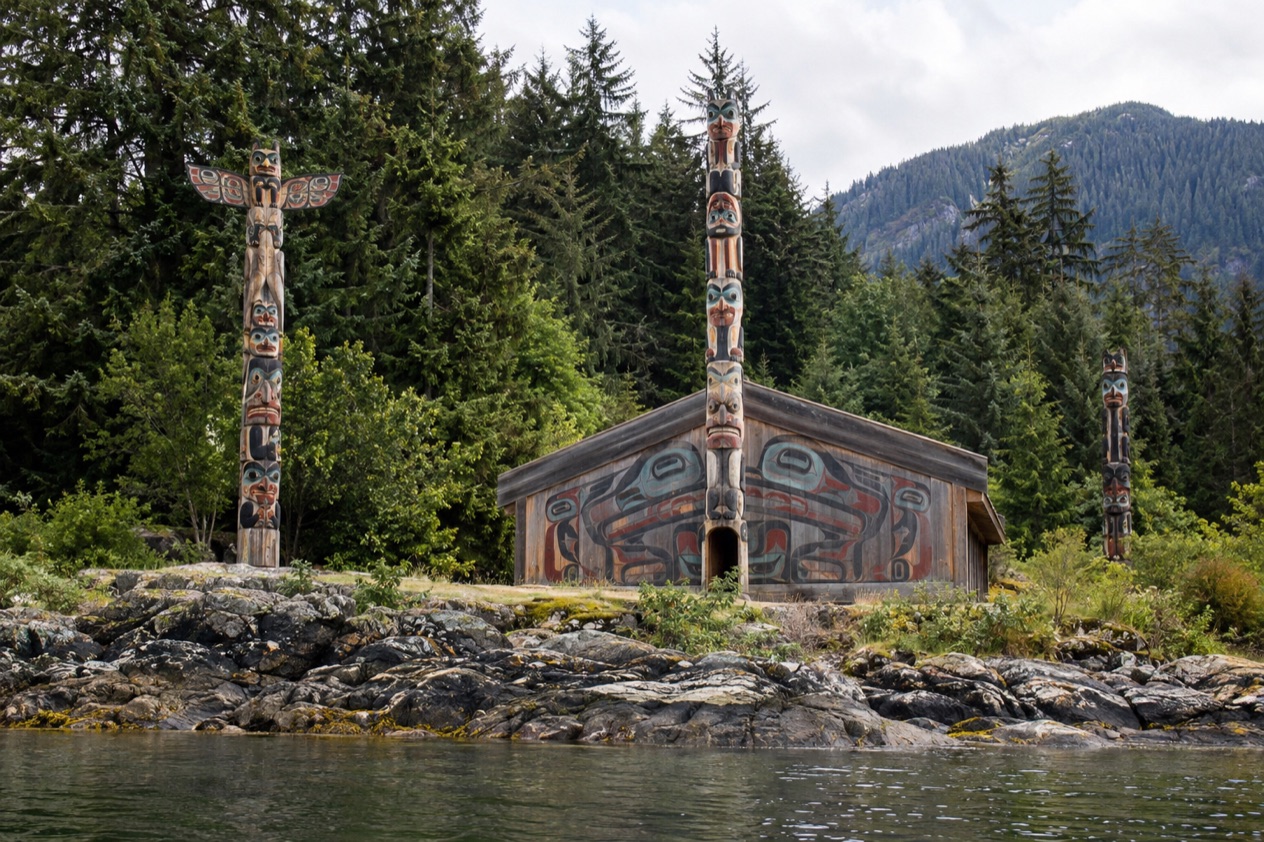
You step out of the car into tall, damp spruce and hemlock, and then the forest opens onto a lawn where carved poles stand in a line facing the water. Painted faces of raven, eagle, bear and whale look out from cedar trunks, and behind them a long wooden clan house waits at the edge of the bight. Totem Bight is a quiet, unhurried place north of Ketchikan, a visit built around looking closely at Tlingit, Haida and Tsimshian art.
Is visiting Totem Bight State Historical Park worth it?
Yes, if you want to see totem poles in a setting that feels like a place rather than a display, and it suits anyone curious about Native art, history and the Southeast Alaska rain forest. Ketchikan is home to the cultures of the Tlingit, Haida and Tsimshian people, and this park is where that heritage is laid out among the trees, with a replica chieftain’s house at its center.
What sets it apart from other totem sites near town is the shape of the visit. Ketchikan has the world’s largest collection of standing totem poles, spread across Saxman Totem Park, Totem Bight State Park, Potlatch Park and the Totem Heritage Center, and each of the four has its own character.
Totem Bight is the one that sits on a former Native campground known as Mud Village and Mud Bight Village, so the poles stand where people once camped beside the water. The grounds cover a good stretch of woodland, and the historic core was added to the National Register of Historic Places in 1970. You come away with a sense of how the poles, the house and the shoreline belong together, which a museum room cannot give you.
It is also an easy fit beside other Ketchikan plans. If you only have room for one totem stop and you like trees, water and quiet, this is a strong candidate.
What to see at Totem Bight State Historical Park
The totem poles
The collection holds 15 poles, most of them replicas of 19th-century poles, placed here by a Civilian Conservation Corps project. Walk slowly and look at the stacked figures from bottom to top. Totem poles record family crests, clan histories and stories, and the animals you see, such as raven, eagle, bear, wolf and killer whale, usually stand for lineages rather than decoration.
Notice the paint and the cut of the cedar, and how the same crest creature can look different from one pole to the next, because each carver brought a hand of his own. Stand back for the whole figure, then step close for the details of beaks, eyes and wings.
The replica chieftain’s house
The community house is the heart of the park. It is a replica of a traditional chieftain’s house, built by the Civilian Conservation Corps, and the carvings on it were executed by Charles Brown, a Tlingit of Saxman. The front of such a house is a statement of family and standing, with a painted façade and a carved entrance.
Look at how the big timbers fit together and how the house faces the water, the way a family’s home once announced itself to arriving canoes. Photographs of the front work best when you can see the poles beside it, so give yourself a moment to take in the whole composition before moving in close.
The setting: forest and the bight
The site is on the former Mud Village campground, and the setting is part of what you came for. Tall conifers frame the poles, moss covers what the rain touches, and the water at the edge of the grounds gives the clan house its reason for being where it is. On a gray, misty day the carvings take on a deeper color, and the place feels close to what a Southeast Alaska village might have looked like.
A picnic shelter in the park can be reserved, which makes it a spot for a group lunch beside the trees.
Hours, tickets and rules
The park is operated by the Alaska Department of Natural Resources, as a state historical park. The grounds are a mix of woodland and the historic site, with the totem poles and the clan house forming the main stop of any visit.
| Site | Operator | Historic status |
|---|---|---|
| Totem Bight State Historical Park | Alaska Department of Natural Resources | National Register of Historic Places, October 27, 1970 |
Specific opening hours and admission amounts are not given here, and no rule on climbing, swimming, drones or tripods is stated for this park. Treat the carvings as works of art to look at and photograph from the paths, and use the reserved picnic shelter only if you have booked it.
How to get to Totem Bight State Historical Park
Totem Bight is at Mile 10.5 of the North Tongass Highway, north of Ketchikan, in the Ketchikan Gateway Borough. Ketchikan sits in Southeast Alaska, in the Inside Passage, and the park is one of the places you reach from town along that highway.
Think of the trip as a run out of Ketchikan along the North Tongass Highway, watching the mile markers until you reach 10.5. Downtown Ketchikan is the base for almost everyone, and from there the park is the northern stop among the totem sites, while Saxman Totem Park is another of the four collections around town.
If you are building a day around Ketchikan, the same base also gives you access to the Tongass National Forest, wildlife and sightseeing tours, fishing charters and floatplane trips to Misty Fjords. The park slots in as the cultural stop among those outdoor choices.
When to visit Totem Bight State Historical Park
There is no single best hour, but the park rewards a slow pace, so plan for a time when you are not rushing to another appointment. Early or late light on the painted faces brings out the color, and a quieter moment lets you hear the forest around the clan house.
Southeast Alaska is a rain forest, and a damp or overcast day suits the place well. Wet cedar and moss look rich against the paint, and the mist over the bight adds to the mood. A bright day shows the carving detail more crisply, so either kind of weather gives you a different park.
No special festival or seasonal date is tied to the park in what we can say with confidence, so the choice of month comes down to your Ketchikan trip as a whole. Match the visit to the days you are already in town and let the weather set the mood.
Tips for your visit
Bring a rain jacket and shoes that handle wet ground, since the setting is forest and the poles stand outdoors. A camera helps, and so does patience: the figures reward a second look from a different angle.
Pair the park with the rest of Ketchikan’s totem story. Saxman Totem Park, Potlatch Park and the Totem Heritage Center each hold part of the world’s largest collection of standing totem poles, and seeing more than one lets you compare carving styles and settings.
If you are traveling with a group, the picnic shelter is available for reservation. Beyond that, pick a pace that lets everyone stop at the poles that catch their eye, and give the clan house a few unhurried minutes.
Good to know before you go
Totem Bight is a state historical park, so it is a place to be respectful of: the poles and the house are heritage as well as scenery. Look, photograph from the paths and leave everything as you find it. The setting is a damp forest beside the water, so dress for weather and keep daylight in mind when you plan the end of your afternoon.
Sources
- Wikipedia, Totem Bight State Historical Park (https://en.wikipedia.org/wiki/Totem_Bight_State_Historical_Park), checked October 11, 2026
- Visit Ketchikan, things to do (https://www.visit-ketchikan.com/things-to-do/), checked October 11, 2026
- Alaska State Parks, Southeast region (https://dnr.alaska.gov/parks/aspunits/southeast/seindex.htm), checked October 11, 2026
- Wikipedia, Ketchikan, Alaska (https://en.wikipedia.org/wiki/Ketchikan,_Alaska), checked October 11, 2026