
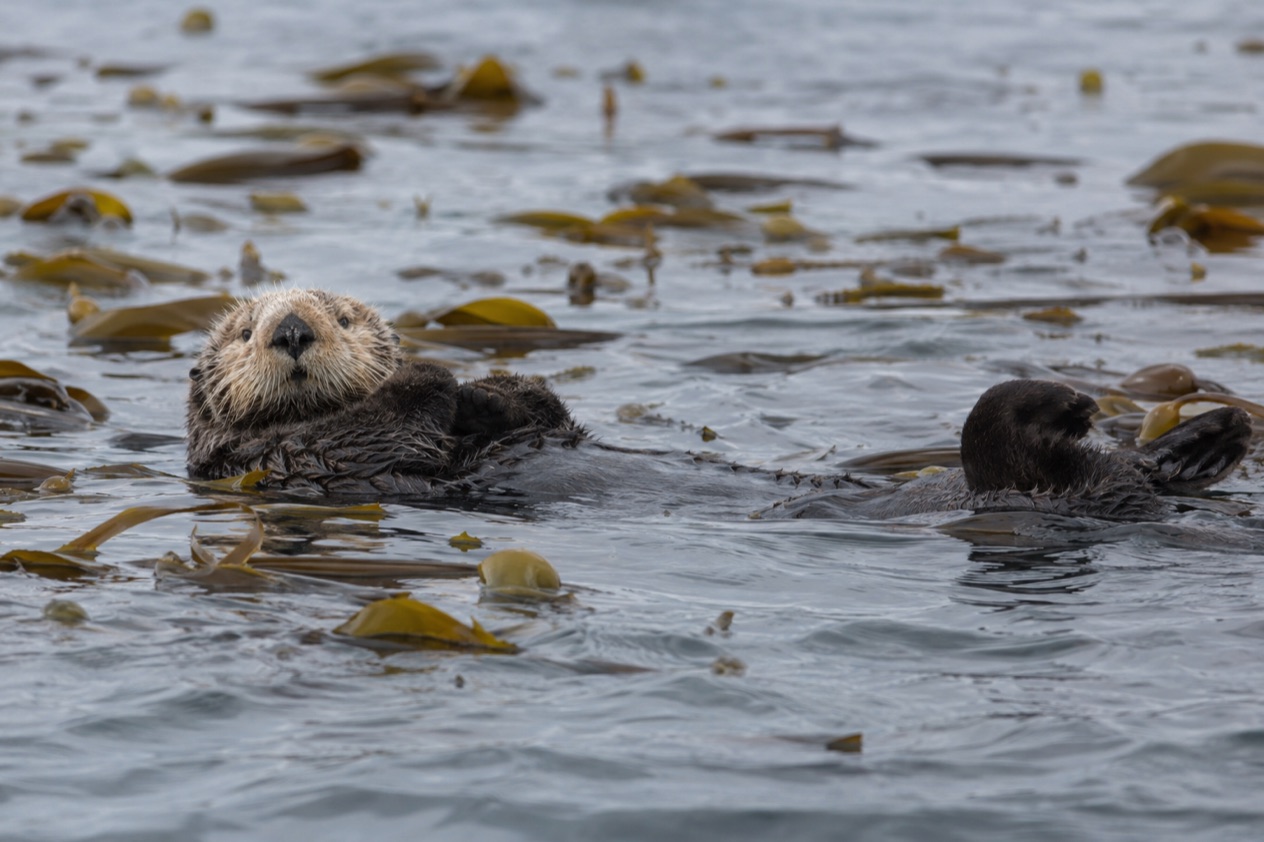
A sea otter floats on its back in a bed of kelp, a mussel balanced on its chest, tapping it against a stone with the patience of someone shelling peas on a porch. Around it the water is gray-green and cold, and the shoreline is all spruce and rock. Alaska holds a great share of the world’s sea otters, and meeting one from the deck of a boat is among the quietest pleasures of the coast, one that suits anyone who likes to watch wildlife slowly.
Where can you see sea otters in Alaska?
You look for sea otters along Alaska’s saltwater coast, from the deck of a boat, in sheltered bays and sounds where kelp and rocky shores give them food and a place to rest. They are animals of the shoreline and the shallows rather than the open ocean, so the trips that follow the edge of the land are the ones that give you a chance. Nothing is guaranteed, and that is part of the charm: one trip brings a single otter drifting past, another brings a whole group wrapped in kelp.
What you are looking for is easy to describe and sometimes hard to spot. A dark, rounded head on the surface, whiskers pale against wet fur, and often a pair of paws held up near the face. Otters ride low in the water and are easily mistaken at first for a floating log or a seal, which is why a pair of binoculars and a slow scan of the water pay off.
Prince William Sound
Prince William Sound is the place where the story of Alaska’s sea otters feels most present. Its otter population was severely affected by the Exxon Valdez oil spill in 1989, and the animals that live there today carry that history with them. For a traveler, the Sound is a landscape of sheltered water, forested islands and tidewater glaciers, and watching the surface for otters is one of the quiet things to do while the scenery slides by.
Knowing the history changes how you look at the water. An otter grooming its fur or resting in the kelp is not just a charming sight, it is part of a population that has been through a great deal. It suits travelers who like a bit of context with their wildlife, and who are content to spend an hour watching the same patch of water.
Glacier Bay National Park
Visitors experience Glacier Bay from a boat, whether a cruise ship, a tour vessel, a charter or a private kayak, and that is exactly the vantage point that suits marine mammal watching. The park is a place of tidewater ice and cold fjord water, and on any trip there you may find your eyes drawn to the surface between the icebergs and the shoreline, where sea life sometimes appears.
Park rangers regularly board cruise ships and tour vessels to present information and answer questions, so you can ask what to look for on the water. Bartlett Cove is the only developed area of the park, with a lodge, a visitor center, exhibits, trails, a public dock and kayak rentals.
It is a natural starting point if you want to learn about the bay before you head out on it. Flightseeing from nearby communities gives an aerial view of the same coast, weather permitting.
Seward and the Alaska SeaLife Center
The Alaska SeaLife Center sits on Railway Avenue in Seward and is a place to learn about the animals of the coast with dry feet. Its special experiences include a Marine Mammal Encounter, an Octopus Encounter and a Puffin Encounter, and its Wildlife Response Program rehabilitates marine mammals such as harbor seals and walruses. It is an easy way to understand how the cold Alaska waters support so much life before you go looking for it outdoors.
It is a good rainy-day idea for families and anyone who wants marine life explained by people who work with it.
When do you see them?
When do you see them? Otters spend their lives in the water, feeding, grooming and resting there, which means a boat trip can offer a glimpse of all three behaviors within a single hour. Patience is the real season for otter watching.
What a sighting looks like
The classic scene is an otter on its back, using its chest as a table. It dives for a clam or a sea urchin, comes up with the prey and a favorite stone, and cracks the shell open by pounding.
Between meals it grooms obsessively, rolling and rubbing its coat, because its dense fur is what keeps it warm in cold water. You may see a female with a pup resting on her belly, which is the picture that ends up on postcards.
Otters also sleep on the water, sometimes wrapped in kelp so they do not drift away, and groups of resting otters are called rafts. Seeing a raft drift quietly is a calm kind of wildlife moment, nothing like the dash of a whale breaching. Bring a pair of binoculars, a warm layer, and the willingness to keep looking at the same patch of water for a while.
A comeback that took decades
The reason sea otters can be seen along so many coasts today is a story of recovery. An international ban on hunting, conservation efforts and reintroduction programs have helped numbers rebound, and the sea otter is classified as an endangered species, which is a reminder of how fragile that recovery remains. Alaska played a central part, because it supplied animals to other coasts.
From 1969 to 1972, 89 sea otters were flown or shipped from Alaska to the west coast of Vancouver Island in British Columbia. In 1969 and 1970, 59 animals were moved from Amchitka Island to Washington and released near La Push and Point Grenville. An effort to move 95 otters to southern Oregon failed, which shows that returning an animal to a coast is never a simple matter.
Otters far from Alaska
California’s sea otters have their own history. Their historic population was estimated at 16,000 before the fur trade nearly wiped them out and they were assumed extinct. Today’s animals descend from a single colony of about 50 otters found near Bixby Creek Bridge in March 1938, and their range has gradually widened, now running from Pigeon Point in San Mateo County to Santa Barbara County.
In the late 1980s, about 140 southern sea otters were relocated to San Nicolas Island to create a reserve population. On December 19, 2012, the U.S. Fish and Wildlife Service declared its so-called no otter zone experiment a failure and chose to protect the otters recolonizing the coast south of Point Conception as a threatened species. Seeing an Alaska otter, you are looking at the population that helped restart others.
How do you watch them responsibly?
You watch them responsibly by letting the otter decide how the encounter goes, and by learning from the people who work in these waters. A sea otter that is resting, feeding or caring for a pup is using energy it needs, so the best sightings are the ones where the animal carries on as if you were not there. Quiet, patience and a good pair of binoculars do more than any amount of trying to get closer.
From the boat
Because visitors see Glacier Bay from a boat, the boat is where good habits matter. If an otter looks up, turns away or dives repeatedly, it is telling you something, and the kind response is to let it settle.
Kayakers get the closest sense of the water, and Bartlett Cove has kayak rentals. Paddling quietly lets you notice the small things: the click of a shell against a stone, the ripple of a dive. It is a way to watch for people who already enjoy being on the water, and who are happy to let the animals set the pace.
With rangers and naturalists
Park rangers at Glacier Bay provide regular guided activities and board cruise ships and tour vessels to present information and answer questions. Treat that as a free lesson. Ask what the animals are doing, what the water and the kelp mean for them, and what the park asks of visitors. A ranger can read a stretch of coast in a way that a first-time visitor cannot.
The park also lists area visitor services, a directory of businesses that provide lodging, transportation, tours and other help near the park. The mailing address is PO Box 140, Gustavus, AK 99826, and the phone number is 907 697-2230. Both are useful if you want to ask the park directly about conditions before your trip.
From a screen, and from the center
Not every trip has a boat in it, and not every day on the water brings an otter. The Alaska SeaLife Center in Seward gives you a different kind of watching, one that costs the wild animals nothing. Its Wildlife Response Program rehabilitates marine mammals, and its livestream of the Chiswell Island Steller Sea Lion Rookery lets you observe wildlife in its own setting from afar.
Visitors can purchase tickets, donate or become members through the center’s website, and the center is a 501(c)(3) nonprofit. Supporting research and rescue work is one more way to give something back to the animals you came to see, and it keeps the coast’s otters, seals and sea lions in your thoughts long after you leave.
Good to know before you go
Sea otters are wild animals, and the best days are the unplanned ones, so give yourself more than one chance on the water. Glacier Bay National Park also offers camping, hiking, kayaking and birdwatching, with 274 bird species sighted there, and Glacier Bay National Preserve allows hunting, trapping and commercial fishing, so the rules differ between the two areas. The Alaska SeaLife Center sells tickets through its website and has The Porthole Cafe for a break before or after your visit.
Sources
- Wikipedia, Sea otter (https://en.wikipedia.org/wiki/Sea_otter), checked October 11, 2026
- Alaska SeaLife Center, Seward (https://www.alaskasealife.org/), checked October 11, 2026
- National Park Service, Glacier Bay National Park & Preserve, plan your visit: things2do (https://www.nps.gov/glba/planyourvisit/things2do.htm), checked October 11, 2026