
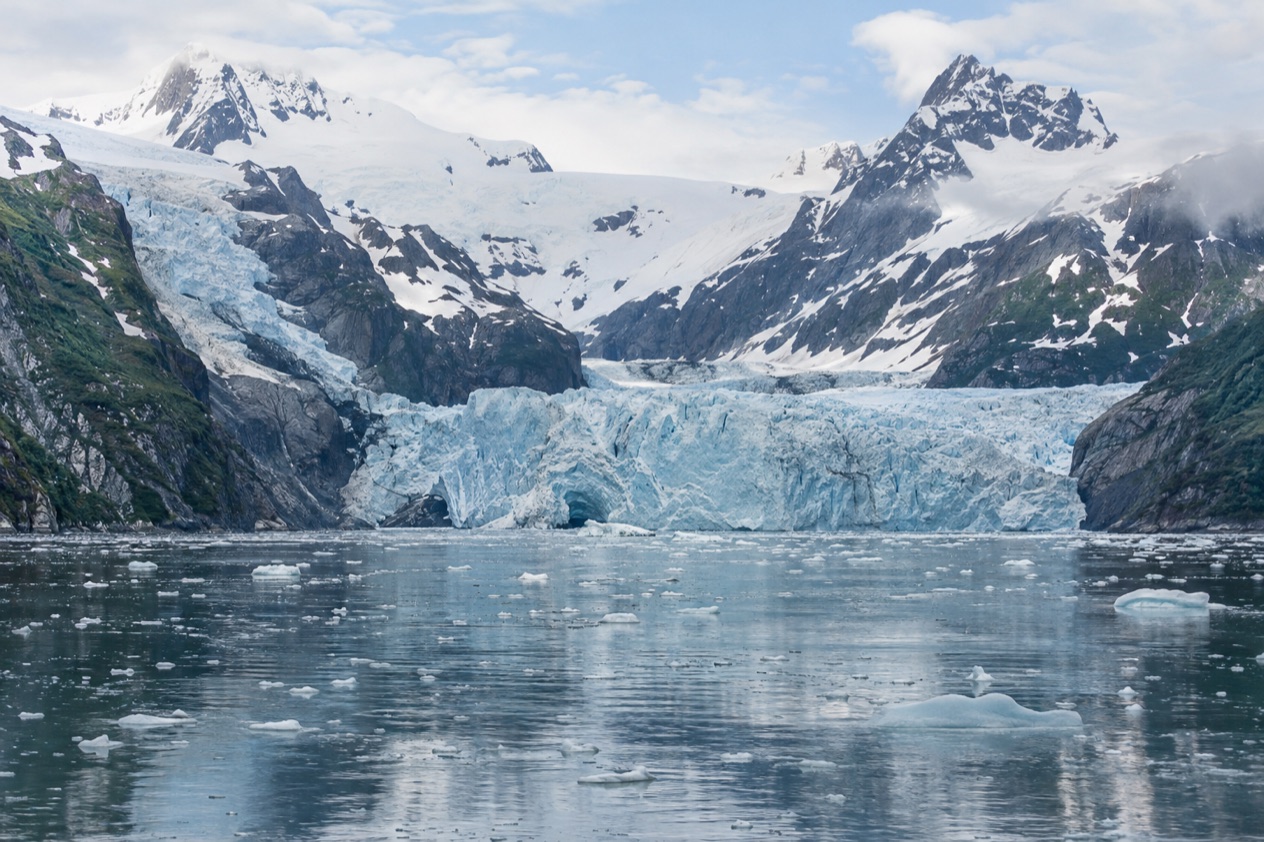
The ferry slides out of a harbor where fishing boats rock against their lines, and within minutes the mountains close in on both sides, wearing snow right down to the spruce. Gulls wheel over the wake, a slab of ice drifts past, and the air smells of salt and rain. Prince William Sound is a coast of fjords, tidewater glaciers and small harbor towns, and it suits travelers who would rather watch the water than hurry past it.
Where is Prince William Sound and what is it like?
Prince William Sound is a large, island-dotted inlet of the Gulf of Alaska on the east side of the Kenai Peninsula, ringed by the Chugach Mountains and wrapped by Chugach National Forest. Its towns sit at the edges of the water, and the biggest port is Valdez, the end of the line for the Trans-Alaska Pipeline System. Cordova, Whittier and the Alaska Native villages of Chenega and Tatitlek complete the short list of settlements.
The scale is what you notice first. The forest around the sound counts thousands of miles of shoreline, and a good part of the land above it is permanent ice.
Glaciers come down out of the mountains and meet the salt water, so a boat can sit in a bay with ice on one side and a rainforest of hemlock and spruce on the other. Compared with the roadside Alaska of the Kenai or the Richardson corridor, this is a place you experience mostly from the water.
The sound carries a layered history in its name. Captain James Cook entered it in 1778 and first called it Sandwich Sound after his patron, the Earl of Sandwich.
Later that same year it was renamed for the young Prince William Henry, the third son of George III, who was still a boy. Long before either name, the coast belonged to the Alaska Native peoples whose villages, among them Chenega and Tatitlek, still stand on its shores.
The pace of the towns
Each harbor has its own temperament. Valdez is the working port, with fishing boats, ferry traffic and a tourist trade built on marine life, glaciers, deep-sea fishing and heli skiing.
Cordova has no road to the rest of Alaska, which gives it the feel of an island town where plans are made around the ferry and the weather. Whittier is a handful of buildings at the head of a canal, with the mountains nearly in the front yard.
This is a quiet, weather-shaped region, and it rewards people who like gray mornings, fog lifting off the water and a hot drink in a harbor café. Travelers who need a lot of nightlife, big shops or fast schedules may find it slow. If a rainy day with a book beside a fishing harbor sounds good, you will probably love it.
What is there to do in Prince William Sound?
The big reasons to come are glaciers seen from the water, the towns themselves, the trails and wetlands of the national forest, and the festivals of Cordova. What sets the sound apart from its neighbors is that almost everything happens on the coast, in or around small harbors, rather than along a highway.
Glaciers and fjords by boat
College Fjord lies in the northern sector of the sound and holds five tidewater glaciers, five large valley glaciers and dozens of smaller ones. Most are named for East Coast colleges, with women’s colleges on the northwest side and men’s colleges on the southeast side. The names date from the Harriman Expedition of 1899, whose members included a Harvard and an Amherst professor.
Valdez and Whittier are both set up for sightseeing of marine life and glaciers, and in Whittier the Glacier Discovery Train connects with a glacier and wildlife cruise in the sound. On the water you may see sea otters, harbor seals, eagles or whales, though none of these is ever a promise. Bring layers, because the air beside a glacier is cold even when the town was mild.
Valdez: fishing, ice and snow
Valdez is an ice-free port all year, the northernmost one in North America. It also gets enormous snow, with an average of over 300 inches, enough that the Weather Channel and NOAA call it the snowiest city in the country. Deep-sea fishing is part of the draw, and heli skiing in the surrounding mountains is the winter side of the same landscape.
Between the harbor, the fish and the mountains, a day in Valdez is easy to fill by simply walking the waterfront and watching boats come in. The only road in is the Richardson Highway, which crosses Thompson Pass and Keystone Canyon, so the arrival itself is a good part of the experience.
Cordova: festivals, wetlands and an old ski lift
Cordova keeps a calendar worth planning around. The Copper River Delta Shorebird Festival, run by the chamber of commerce, takes place in early May, when millions of migrating shorebirds stop in the delta. The delta is part of the largest contiguous wetlands complex on North America’s Pacific coast, so the birds have a lot of room.
In February the Iceworm Festival brings a parade, a talent show, a royal crowning, an oyster shucking contest, a ping pong tournament and a survival suit race. Above town, the Mt. Eyak ski area runs a single chair lift and a rope tow, and it is the oldest working ski lift in North America.
Whittier and the forest trails
Whittier is known as the Town Under One Roof because almost all of its residents live in the Begich Towers Condominium. The city operates a seaplane dock, and it is a port for the Alaska Marine Highway. It is a gateway more than a long stay, but the odd architecture and the water at the end of the street make it worth a slow walk.
The forest around the sound has few roads but a large network of trails, over 500 miles of them designated. That makes it a landscape for walkers who want to trade the car for a boot path, and for anyone happy to look at mountains from a dock.
How many days do you need in Prince William Sound?
A long weekend is enough to taste one harbor town and one glacier outing, and a week lets you link two or three towns at the pace the ferries and the weather set. The sound is not a place to cram, because its charm is in the waiting, watching and unhurried looking.
With just a couple of days, pick one base. From Whittier the plan is simple: arrive, walk the harbor, and spend the main day on a glacier and wildlife cruise in the sound, which the Glacier Discovery Train from Anchorage connects to. From Valdez, you might spend a day on the water for marine life and glaciers, and another on the waterfront and the surrounding mountains.
With more time, Cordova becomes the natural next stop, since regular Alaska Marine Highway ferries link it to both Valdez and Whittier. Cordova has its harbor, its festivals when the calendar lines up and the Copper River Delta around it. Allow a day for the town itself and its trails, and another to follow the Copper River Highway out of town.
Day trips worth adding
The Copper River Highway begins at the ferry terminal in Cordova and runs 49.5 miles to the Million Dollar Bridge over the Miles Glacier. The first 12 miles are paved and the rest is gravel. Past mile 36 the road has been de facto abandoned since 2011, because erosion damaged the approach to Bridge 339, so go with that stretch in mind.
A cruise into College Fjord is the other classic outing, a way to spend a day among tidewater glaciers named for universities. If you have extra days, add a ride on the Glacier Discovery Train, which stops at places reachable only by train and offers day trip options for all ages and energy levels.
Where to stay in Prince William Sound
The main places to base yourself are Valdez, Cordova and Whittier, with the small villages of Chenega and Tatitlek as part of the wider picture. Each suits a different kind of trip, and all of them put you within sight of the water.
Valdez
Valdez is the largest port on the sound and the most obvious base for travelers who want marine life and glacier sightseeing, deep-sea fishing or winter heli skiing. It is linked by the Richardson Highway to the rest of the road network and is also a port of call for the Alaska Marine Highway, so you can arrive by road or by water.
It suits people who want a working harbor town with a mountain setting and a choice of ways to get out on the water. Anglers will find the town a natural fit, and so will those who like to combine a boat day with a drive along the highway.
Cordova
Cordova is the base for people who want a small town with a character of its own. With no road connecting it to other Alaskan communities, you reach it by plane or ferry, and that detail shapes the whole stay, from the unhurried pace to the sense of being slightly apart.
It is the right choice for birders, for anyone planning around the Shorebird Festival or the Iceworm Festival, for skiers curious about the old lift on Mt. Eyak and for travelers who want the Copper River Delta on their doorstep. Those short on time will find the ferry schedule the main limit.
Whittier and the villages
Whittier sits at the head of the Passage Canal, about 58 miles southeast of Anchorage, and most residents live in a single building. It is a convenient, atmospheric spot for travelers whose main aim is a cruise on the sound or a link with the Glacier Discovery Train. The setting is dramatic, though it is a small place, and it suits a short stay best.
Chenega and Tatitlek are Alaska Native villages on the sound. They are not tourist towns, and the Alaska Marine Highway only whistle-stops there when prior reservations are made. Treat them as communities you pass by with respect rather than as stops on a checklist.
How do you get to Prince William Sound and get around?
You reach the sound by road to Valdez or Whittier, by train to Whittier, or by Alaska Marine Highway ferry, and Cordova can also be reached by plane. Within the sound, boats and ferries do much of the work that roads do elsewhere.
By road and tunnel
Valdez has only one road access, the Richardson Highway, which crosses Thompson Pass and Keystone Canyon. The highway runs 368 miles and connects Valdez with Fairbanks, and it was the first major road built in Alaska. Its southern end is at the Alaska Marine Highway terminal in Valdez, so road and ferry meet on the same waterfront.
Whittier is reached through the Anton Anderson Memorial Tunnel, which links the Portage Glacier Highway and Whittier to the Seward Highway. Vehicles creep through at a reduced speed, and the passage takes about ten minutes. Pedestrians and bicycles may not use the tunnel except during the annual Walk to Whittier event, and the tolls are collected from eastbound vehicles.
By train and ferry
The Glacier Discovery Train runs from Anchorage to Girdwood, Whittier, Portage, Spencer and Grandview. It follows much of the Coastal Classic route, with an added turn off the main line to Whittier. It stops briefly at the resort town of Girdwood on the way, and at Whittier the train passes through a mountain tunnel and connects with a glacier and wildlife cruise.
The Alaska Marine Highway calls at Whittier and Valdez, and it provides the regular ferry service to Cordova from both. Tatitlek and Chenega Bay get whistle stops only if prior reservations are made.
Getting around once you are there
The harbor towns are compact enough to explore on foot, and the Forest Service roads in the national forest are few. The designated trails are where the long walks happen. Whittier also has a seaplane dock operated by the city, a reminder that in this part of Alaska the air and the water are as much a part of getting around as the road.
When is the best time to visit Prince William Sound?
Early May is a strong choice if birds are your reason, since the Copper River Delta Shorebird Festival is held in Cordova then, when millions of migrating shorebirds stop in the area. February suits winter travelers with a sense of fun, because the Cordova Iceworm Festival fills the town with a parade, an oyster shucking contest and a survival suit race.
The sound is wet in every season. Whittier gets an average of 197.31 inches of precipitation a year, and Valdez is the snowiest city in the country. Plan for rain gear, flexible days and a mood that is as happy in fog as in clear light, because clear days on a glacier coast are a bonus rather than a promise.
Valdez stays open to ships through the cold months because its port never freezes, and it is a winter base for heli skiing. Some services, such as glacier cruises, ferry calls and the roads, keep their own seasons, so match each plan to the dates its operator gives. Choose your month by what you want to see, whether birds, snow, festivals or ice.
Good to know before you go
The tunnel to Whittier charges a toll on eastbound vehicles, and the amounts below are the ones to expect. Vehicles owned by the Alaska Railroad, the Alaska DOT&PF, or emergency and law enforcement are exempt. Bring layers and rain gear for the damp, and remember that the Copper River Highway past mile 36 is not maintained.
| Fee | Amount | Who pays |
|---|---|---|
| Anton Anderson Memorial Tunnel toll | $13 | Eastbound regular vehicle or motorcycle |
| Anton Anderson Memorial Tunnel toll | $22 | Eastbound vehicle pulling a trailer |
| Anton Anderson Memorial Tunnel toll | $38 | Eastbound small bus or regular RV |
| Anton Anderson Memorial Tunnel toll | $137 | Eastbound large bus |
| Anton Anderson Memorial Tunnel toll | $330 per use | Eastbound oversize vehicle, 10 to 11 feet wide and 14 to 15 feet high |
| Anton Anderson Memorial Tunnel toll | $11 | State government agency or school district vehicle |
Sources
- Wikipedia, Prince William Sound (https://en.wikipedia.org/wiki/Prince_William_Sound), checked October 11, 2026
- Wikipedia, Whittier, Alaska (https://en.wikipedia.org/wiki/Whittier,_Alaska), checked October 11, 2026
- Wikipedia, Valdez, Alaska (https://en.wikipedia.org/wiki/Valdez,_Alaska), checked October 11, 2026
- Wikipedia, Cordova, Alaska (https://en.wikipedia.org/wiki/Cordova,_Alaska), checked October 11, 2026
- Wikipedia, College Fjord (https://en.wikipedia.org/wiki/College_Fjord), checked October 11, 2026
- Wikipedia, Copper River Highway (https://en.wikipedia.org/wiki/Copper_River_Highway), checked October 11, 2026
- Wikipedia, Whittier Tunnel (https://en.wikipedia.org/wiki/Whittier_Tunnel), checked October 11, 2026
- Alaska Railroad, Glacier Discovery (https://www.alaskarailroad.com/ride-a-train/our-trains/glacier-discovery), checked October 11, 2026
- Wikipedia, Richardson Highway (https://en.wikipedia.org/wiki/Richardson_Highway), checked October 11, 2026
- Wikipedia, Chugach National Forest (https://en.wikipedia.org/wiki/Chugach_National_Forest), checked October 11, 2026
- Wikipedia, Climate of Alaska (https://en.wikipedia.org/wiki/Climate_of_Alaska), checked October 11, 2026