
Around the summer solstice in Fairbanks, a baseball game starts in the evening and keeps going while the sky turns a soft, lingering twilight instead of dark. Players and fans have been doing this for generations, and nobody reaches for a flashlight. That is the midnight sun in everyday life: a few weeks when Alaska’s far north simply forgets to go dark, and when places a little farther south come close.
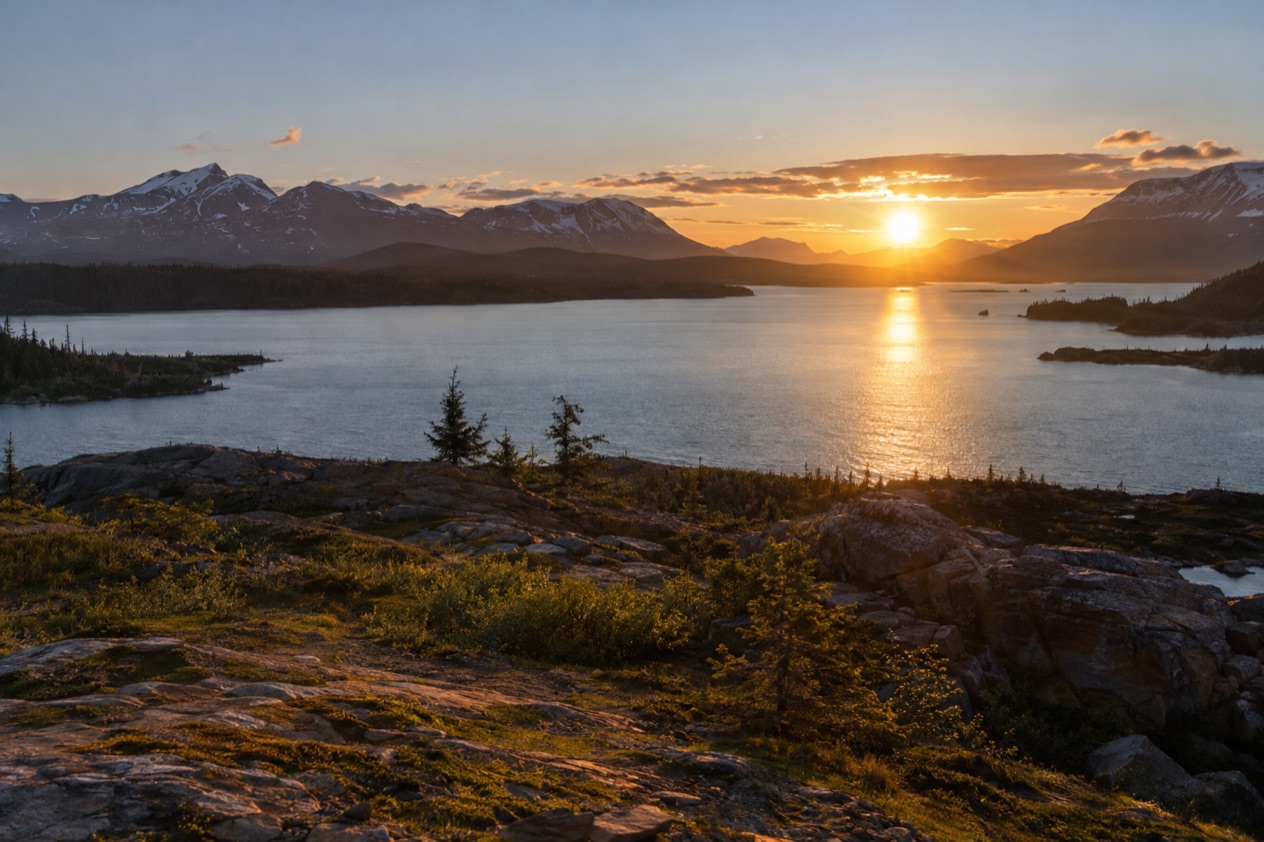
Where is the sun up all night in Alaska?
The sun stays up all night only in the part of Alaska that lies north of the Arctic Circle, and the biggest town there is Utqiagvik. Midnight sun is the stretch of summer when the sun remains visible at local midnight, and it happens at latitudes from roughly 65°44′ north all the way to the pole. Because Alaska reaches so far north, the phenomenon is real here, but it does not cover the whole state.
The Arctic Circle itself is marked by a sign along the Dalton Highway, which makes a natural pilgrimage for anyone who wants to stand on the line. Right on the circle, the sun does not set at the June solstice, and the same spot goes without a sunrise at the December solstice. The effect gets stronger the farther north you go, and atmospheric refraction can stretch the midnight sun a little outside the circle as well.
Utqiagvik, the true midnight sun town
Utqiagvik, formerly Barrow, is the largest U.S. settlement north of the Arctic Circle, with about 5,000 inhabitants. It sits at 71° north, roughly 1,300 miles from the North Pole, and it is reached through Wiley Post–Will Rogers Memorial Airport. Here polar day lasts 84 days, a long season of unbroken light that reshapes how people live and sleep.
Summer brings its own local events. Nalukataq, the Blanket Toss Celebration, begins in the third week of June and celebrates successful spring whale hunts. On July 4, Eskimo games such as the two-foot high kick and the ear pull are held, and winners go on to compete at the World Eskimo Indian Olympics. The Iñupiat Heritage Center, which displays traditional clothing, is a cultural stop in town. One practical detail for the evening: Utqiagvik has a damp law, so alcohol cannot be sold but may be imported, possessed and consumed.
Fairbanks, south of the circle but still bright
Fairbanks lies 196 miles by road south of the Arctic Circle (140 miles by air), so strictly speaking the sun does set there. But on the summer solstice it sets at 12:47 a.m., and what follows is a twilight rather than a real night. The city, with a population of 32,515, treats this as a civic celebration.
That is the setting for the Midnight Sun Game, a baseball competition contested since 1906 in the twilight around midnight on June 21. Fairbanks also calls its broader bright stretch the Midnight Sun Season, which runs from April 22 to August 20 each year. In summer, the Alaska Railroad operates tourist trains to and from Fairbanks, and the airport is open 24 hours a day.
Anchorage and the rest of the state
Anchorage is far south of the circle, yet visitors there can still hike mountain trails under the midnight sun, as the city’s visitor bureau puts it. The Anchorage Museum is open year-round, whether on a snowy winter day or during the summer midnight sun. Treat these places as very long evenings of light rather than a sun that never sets.
When does the midnight sun happen?
The midnight sun happens in summer, peaking around the June solstice, and the exact span depends on how far north you are. At the Arctic Circle, some part of the midnight sun is visible from approximately June 12 until July 1. Farther north the window widens, which is why Utqiagvik gets so many more days than the line itself.
At the pole, by comparison, the midnight sun lasts about six months, from approximately March 18 to September 24. Utqiagvik sits between those extremes, with polar day lasting 84 days. The same geometry runs in reverse in winter, and the dark season is a useful way to understand how the light works.
| Place | Light in summer | Dark in winter |
|---|---|---|
| Arctic Circle | Some midnight sun, about June 12 to July 1 | No sunrise at the December solstice |
| Utqiagvik | Polar day of 84 days | No daylight from about November 21 to January 21 |
| Fairbanks | Sunset at 12:47 a.m. on the summer solstice | Midnight Sun Season April 22 to August 20 |
The other side: polar night
Polar night is when the sun stays below the horizon for more than 24 hours, and it occurs only inside the polar circles. In Utqiagvik, the sun sets on November 18 and stays below the horizon until January 23, about 66 days. The days when there is no daylight at all run from about November 21 to January 21.
True polar night, with no astronomical twilight at all, is limited to latitudes above roughly 84°34′ north, so Utqiagvik gets a softer version. In places with polar twilight, the middle of the day is typically the brightest time. Even far south in Anchorage, December 15 brings only about 5 hours 34 minutes of daylight, which shows how much the seasons swing.
Which season suits what
If light is the goal, plan around the June solstice, when Fairbanks plays its Midnight Sun Game and Utqiagvik is in the middle of Nalukataq. For a broader bright stretch with trains running, the Midnight Sun Season in Fairbanks gives a long window from late April to August 20. Spring festivals fall earlier, with Piuraagiaqta held in Utqiagvik in mid-April and including outdoor activities.
Fairbanks is also a place where the aurora comes into play, as the northern lights are visible on average more than 200 days per year in the vicinity. That belongs to the dark half of the year rather than the bright one, so the two experiences are not usually combined in a single trip.
How does it affect your trip?
The midnight sun stretches your day, so evenings become usable time for hiking, sightseeing or a late baseball game. In Anchorage you can hike mountain trails under the midnight sun, and in Fairbanks the twilight around midnight on June 21 is bright enough to hold a ballgame. The light changes how you plan, because the clock no longer tells you when the day is ending.
Planning your days and your sleep
With so much light, it is easy to keep going well past a normal bedtime. A sensible habit is to decide on a stopping hour rather than waiting for dusk, since dusk may not come. Many travelers find that a sleep mask or blackout curtains help, though that is a habit rather than a rule.
Transport matches the long day. Fairbanks International Airport is open 24 hours a day, which suits late arrivals, and the Alaska Railroad runs tourist trains to and from Fairbanks in summer.
Outdoors under the light
Long light invites trail time, and that raises wildlife questions. Light does not change the need for that check.
When you want a break from the outdoors, the Anchorage Museum is open year-round, and in Utqiagvik the Iñupiat Heritage Center gives a cultural counterpoint to a day outside. These are good places to spend an hour when the weather turns, since the sky will not tell you what time it is.
What the sun does not change
Bright nights do not make Fairbanks warm all the time. July has a normal monthly mean temperature of 62.9 °F, which is pleasant for walking, while January sits at −8.3 °F, a reminder that Fairbanks is the coldest city in the United States among cities with at least 10,000 people. Summer light and winter cold sit in the same place.
Good to know before you go
Pick your place by the kind of light you want: Utqiagvik for a sun that truly does not set, Fairbanks for a bright twilight and a baseball game, Anchorage for long evenings on the trail. Remember that Utqiagvik is a damp town where alcohol cannot be sold, and that Denali wildlife closures can appear without warning on the map. Fairbanks airport never closes, which helps with the odd hours that midnight sun invites.
Sources
- Wikipedia, Midnight sun (https://en.wikipedia.org/wiki/Midnight_sun), checked October 11, 2026
- Wikipedia, Polar night (https://en.wikipedia.org/wiki/Polar_night), checked October 11, 2026
- Wikipedia, Utqiagvik, Alaska (https://en.wikipedia.org/wiki/Utqiagvik,_Alaska), checked October 11, 2026
- Wikipedia, Fairbanks, Alaska (https://en.wikipedia.org/wiki/Fairbanks,_Alaska), checked October 11, 2026
- Wikipedia, Arctic Circle (https://en.wikipedia.org/wiki/Arctic_Circle), checked October 11, 2026
- Fairbanks International Airport (https://www.dot.alaska.gov/faiiap/), checked October 11, 2026
- Denali Backcountry Lodge (https://www.denalibackcountrylodge.com/), checked October 11, 2026
- National Park Service, Denali National Park & Preserve, plan your visit: conditions (https://www.nps.gov/dena/planyourvisit/conditions.htm), checked October 11, 2026
- Anchorage Museum (https://www.anchoragemuseum.org/visit/), checked October 11, 2026
- Visit Anchorage, things to do (https://www.anchorage.net/things-to-do/), checked October 11, 2026
- Explore Fairbanks (https://www.explorefairbanks.com/), checked October 11, 2026
- Computed from the date and the latitude of the place (sunrise equation, solar elevation -0.833 degrees), October 11, 2026