
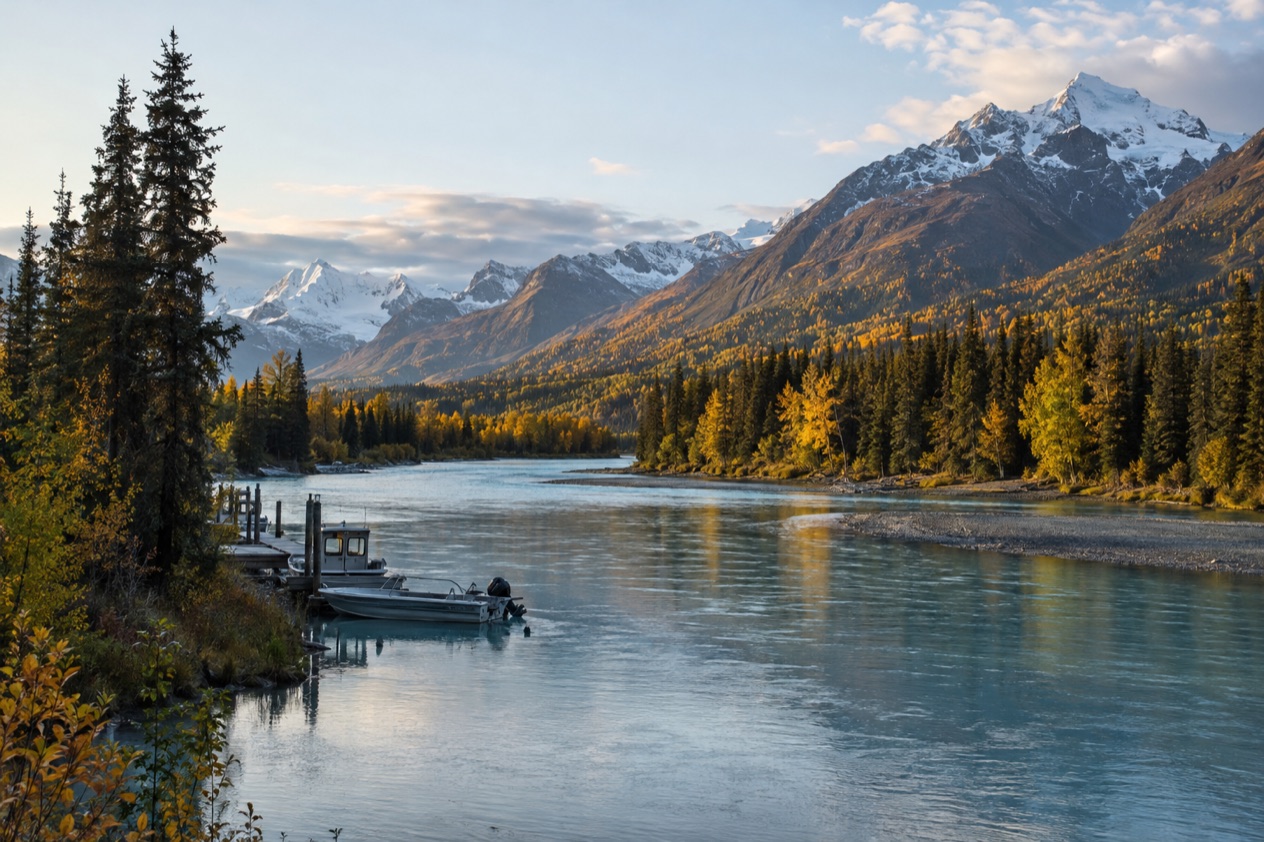
By September the fireweed along the roadsides has gone to fluff, birch and cottonwood leaves are turning yellow, and the Kenai River runs dark and quiet past the docks in Soldotna. Mornings smell of woodsmoke and wet spruce, and the light slants low across Cook Inlet in the evenings. It is a month of fall color, river walks and quieter streets in Kenai and Soldotna, for travelers who like their Alaska cool and unhurried.
What is the weather like in Kenai and Soldotna in September?
September is cool, damp and bright by turns, a clear step down from the mild days of August.
| Month | Average high (°F) | Average low (°F) | Precipitation (in) | Days with precipitation | Daylight on the 15th |
|---|---|---|---|---|---|
| August | 62.7 | 46.8 | 2.68 | 7.5 | 15 h 51 min |
| September | 55.7 | 39.8 | 3.57 | 9.0 | 13 h 01 min |
| October | 43.1 | 28.6 | 2.56 | 6.6 | 10 h 15 min |
Afternoons in the mid-50s are comfortable for walking if you wear layers, and the sun can feel warm when it breaks through. Mornings start in the upper 30s, so expect a crisp edge at breakfast, breath in the air at the river and frost on a clear night. A fleece under a waterproof shell handles nearly all of it.
September is the wettest of the three months here. Rain comes on about every third day, and it is often a steady gray drizzle rather than a violent downpour, the kind that settles over the river and the spruce for an afternoon and then lifts.
The light is still generous, with long enough days to fit in a full morning and a full afternoon, but evenings close in earlier each week. By dinnertime you want a jacket, and the low sun turns the birch leaves a bright gold. Cook Inlet is cold at any time of year, so it is a view to admire from the bluff, never a place for a swim.
What to do in Kenai and Soldotna in September
September here is about the river, the colors and the slower rhythm of a fishing town after the busiest weeks. The days suit walks along the water, a visit to the old church and a long lunch with a window. The towns work as a pair, Kenai near the mouth of the river and Soldotna a little way up it, and you can easily spend a day in each.
The Kenai River in Soldotna
The Kenai River is the center of life in Soldotna, and in fall it is a pleasure simply to walk beside it. Soldotna Creek Park is a good place to start, with grass, picnic tables and a riverside path where the cottonwoods turn yellow over the water. You may see anglers working the banks in waders, and the pace feels more reflective than in the crowded weeks of summer.
If you want to try fishing, the state’s Division of Sport Fish runs a Rod Loaner Program that rents fishing gear for free, and it also offers hatchery tours where you can see fish and learn how they are managed. Both are a good way to understand why this river matters so much to the town. Cold mornings are best spent with a thermos in hand and a hat pulled down.
Cooper Landing, at the meeting of the Kenai and Russian Rivers, is an outing for those who want more of the peninsula’s river country. It has become a popular summer tourist destination for its scenery and the salmon fishery of the two rivers, so in September it feels like the end of a season. Its Gold Rush past goes back to a miner named Joseph Cooper, who found gold there in 1884.
Old Kenai and the Cook Inlet bluff
Kenai is the older of the two towns, and its historic center rewards a slow stroll. The Holy Assumption of the Virgin Mary Russian Orthodox Church, with its blue onion domes, is a reminder that Russian traders and missionaries settled here long before Alaska became a state. Photographers like the way the domes stand out against yellow leaves and a gray fall sky.
From the bluff you look out over Cook Inlet, where the water changes from steel gray to silver as the clouds move. The wind can be sharp at the edge, so bring a hat. A walk along the shore near the river mouth is also where you may spot gulls, eagles and other birds working the tide line, though any wildlife sighting is a matter of luck.
Moose country and fall color
Moose are part of everyday life on the peninsula. The Alaskan moose is the largest moose race, and adult males can be almost six feet tall at the shoulder, carrying antlers that only males grow.
You may see one near a lake, a trail or a roadside meadow, and the fall light on their dark coats can make a striking picture. Treat any sighting as a chance, never a promise, and follow the guidance of the Alaska Department of Fish and Game.
Birch and willow glow in yellow and orange where the spruce forest opens up, and the muted fall palette is one of the reasons to come now. A walk on any trail around the towns is a good way to enjoy it, especially on a dry morning when the leaves are still wet with dew.
On gray, rainy days the towns have their own pleasures: a bowl of chowder or a plate of salmon at a riverside restaurant, a coffee at a local café, an hour in a small museum or visitor center. The food is hearty and built around local fish, and meals feel good after a cold morning outside. Evenings are for early dinners, quiet streets and the first woodsmoke of the season.
A two-day itinerary for Kenai and Soldotna in September
Day 1 belongs to Kenai and the inlet. Start with a coffee and a walk through the old town in the early morning, when the light is soft and the air is cold, and spend time at the Russian Orthodox church with its blue domes. Then follow the bluff to see the water of Cook Inlet and the mouth of the Kenai River, wearing a windproof layer.
At midday, eat at a casual café or diner in town, preferably something with fresh fish on the menu. The afternoon is for the shoreline and for a slow drive through the neighborhoods, watching for moose in the meadows and for the color of the birches. Keep an eye on the sky, because September rain can arrive by midafternoon.
If the weather turns, spend the afternoon in a museum or a warm restaurant with a view and wait out the shower.
Day 2 moves to Soldotna and the river. Begin at Soldotna Creek Park in the morning, when mist often hangs over the Kenai and the cottonwoods are lit by the low sun. Walk the riverside path, watch the anglers and, if you are curious, look into the free rod loans and hatchery tours offered by the state’s Division of Sport Fish.
Have lunch at one of the casual riverside spots, then spend the afternoon on a trail among birch and spruce, where fall color is at its brightest and moose may be grazing near the edge of the woods. If you have the energy, a drive to Cooper Landing, where the Kenai and Russian Rivers meet, makes a worthwhile outing.
A rainy day suits a long lunch, a browse through a local shop or a visit to a visitor center. Close the day with a hot dinner of local fish and a quiet evening, since the town settles early once the sun goes down.
Is Kenai and Soldotna busy in September?
No, September is a calmer month here than the height of summer, when the rivers and the fishing draw crowds to the peninsula. Cooper Landing, nearby on the same river system, is described as a popular summer tourist destination, and the summer rush fades as the days shorten.
In town, that shows up as quieter riverbanks, shorter waits at the café counter and a sense that locals have their streets back. The fishing season still draws anglers, and you will see them on the water, but the feeling is of a place winding down and enjoying the fall. Hours and services can shift at the end of the summer season, and the towns feel more like themselves than like a stop on a tourist circuit.
What to pack for Kenai and Soldotna in September
Think in layers and plan for damp. Mornings are cold, afternoons are cool, and rain comes about every third day.
- A waterproof jacket with a hood, because September is the wettest of the three months in the table.
- A warm fleece or wool midlayer for the cold mornings and the evenings.
- Waterproof shoes or boots for wet riverbanks and trails.
- A hat and light gloves for the wind on the bluff above Cook Inlet.
- Binoculars for birds on the shoreline and for moose at a distance.
- A small daypack to carry layers as the day warms and cools.
Good to know before you go
The main thing to plan around in September is the light. Daylight is still generous, but it is shrinking quickly, so start your outdoor plans in the morning and leave the evenings for dinner. Services that run in summer can change as the season ends, so confirm any specific tour or transport before building a day around it. A rain jacket matters more than any reservation.
Kenai and Soldotna in September vs August and October
Going four weeks earlier, in August, brings warmer afternoons, much longer days and the full energy of the summer season. The days are longer and drier, and the river has more of its summer bustle. The silver salmon run on the nearby Russian River comes in August, which is one reason fishing remains a draw in that month.
Going four weeks later, in October, brings a cold, short-day month. Highs sit in the low 40s, nights fall below freezing and the light fades much earlier. The leaves are mostly gone, the mood is quiet and the towns feel closed in for the long winter ahead. It suits travelers who like stark landscapes and have little interest in daytime activity.
September sits between the two. Choose August if you want long days and warmth, October if you want solitude and are ready for cold, and September if you want fall color, cool air and a slower pace without losing a full day of light.
Is September a good time to visit Kenai and Soldotna?
Yes, for travelers who like cool air, fall color and quiet river towns more than long warm days. September suits walkers, photographers, anglers who enjoy the season’s calm and anyone who prefers a gentle pace to a busy one.
It is a poorer fit for people who want warm weather, dry days or the full buzz of summer, since rain is frequent and mornings are cold. If you plan around a layered wardrobe and a flexible schedule, the damp days become part of the charm.
On arrival, start with a walk by the Kenai River in Soldotna or the bluff in Kenai to get your bearings and see the colors. What is special about September here is the feeling of a river town exhaling after summer, with gold leaves over dark water, a moose in a meadow if you are lucky and a hot bowl of chowder waiting at the end of a damp, bright day.
Sources
- NOAA NCEI, U.S. Climate Normals 1991-2020, monthly (https://www.ncei.noaa.gov/access/services/data/v1?dataset=normals-monthly-1991-2020&stations=USW00026523), station Kenai Muni Ap, elevation 91 feet, checked October 11, 2026
- Computed from the date and the latitude of the place (sunrise equation, solar elevation -0.833 degrees), October 11, 2026
- Wikipedia, Fat Bear Week (https://en.wikipedia.org/wiki/Fat_Bear_Week), checked October 11, 2026
- Wikipedia, Brooks Falls (https://en.wikipedia.org/wiki/Brooks_Falls), checked October 11, 2026
- National Park Service, Katmai National Park & Preserve, plan your visit: brooks camp (https://www.nps.gov/katm/planyourvisit/brooks-camp.htm), checked October 11, 2026
- Alaska Department of Fish and Game, Moose species profile (https://www.adfg.alaska.gov/index.cfm?adfg=moose.main), checked October 11, 2026
- Wikipedia, Moose (https://en.wikipedia.org/wiki/Moose), checked October 11, 2026
- Wikipedia, Russian River (Alaska) (https://en.wikipedia.org/wiki/Russian_River_(Alaska)), checked October 11, 2026
- Wikipedia, Cooper Landing, Alaska (https://en.wikipedia.org/wiki/Cooper_Landing,_Alaska), checked October 11, 2026
- Alaska.org, dest cooper landing (https://www.alaska.org/destination/cooper-landing), checked October 11, 2026
- Alaska Department of Fish and Game, Sport fisheries (https://www.adfg.alaska.gov/index.cfm?adfg=fishingsport.main), checked October 11, 2026
- Kenai Peninsula Borough (https://www.kpb.us/), checked October 11, 2026
- Wikipedia, Climate of Alaska (https://en.wikipedia.org/wiki/Climate_of_Alaska), checked October 11, 2026
To plan your stay
- Things to Do in Kenai and Soldotna: Kenai River Fishing, the Old Town Walking Tour and Day Trips
- Where to Stay in Kenai and Soldotna: Kenai River Access, Refuge Gateways and Area Comparison
- Kenai Fjords Cruise from Seward: Wildlife, Coastline and Getting There
- Kenai Fjords National Park: Exit Glacier, Harding Icefield, Boat Tours and Wildlife