
The boats nose out of Seward’s harbor past fishing skiffs and gulls, and Resurrection Bay opens up with mountains rising straight from the water. Before long the shoreline turns ragged, cut by steep rock walls that glaciers carved long ago. A Kenai Fjords cruise is a day on the water in the national park’s coastal wilderness, made for travelers who want to see Alaska’s wildlife and coast from a boat.
Is visiting Kenai Fjords cruises worth it?
Yes, for anyone who wants to see the part of Kenai Fjords that roads never reach, and it suits families, wildlife watchers and photographers alike. Most of the park lies beyond the one road to Exit Glacier, and the rest is reached by boat, airplane and hiking. A cruise is the way most visitors meet that wild shoreline.
What sets it apart from other outings around Seward is the sheer variety packed into one outing. The boat tours run by various companies are described as giving views of land and marine wildlife, from Steller sea lions and puffins to Dall’s porpoises, mountain goats and humpback and orca whales.
Exit Glacier, on land, shows you a single glacier up close. The SeaLife Center shows you animals behind glass. A cruise puts you on the open water where those same creatures live, with the cliffs and the weather around you.
It also fits the character of Seward itself, a town that calls itself the place where Alaska starts and that sits between mountains and the ocean. You step onto the boat in a working harbor town and step off having seen a coast shaped by ice.
Sightings of whales, bears or any other animal are chances, never promises, and that uncertainty is part of the appeal. Some days bring a pod of whales, others bring a quiet bay, a cliff crowded with seabirds and a sea lion hauled out on a rock.
What to see at Kenai Fjords cruises
The coast comes first, then the animals that live along it, and on land the glacier and icefield that feed the whole landscape.
Resurrection Bay and the fjord coast
The cruise begins in Resurrection Bay, where Seward sits at the head of the water. The town is the ancestral homeland of the Alutiiq, or Sugpiaq, people, and the bay has long been a route between the mountains and the open Gulf. From the deck the harbor shrinks quickly, and the green slopes give way to bare rock and steep ridgelines.
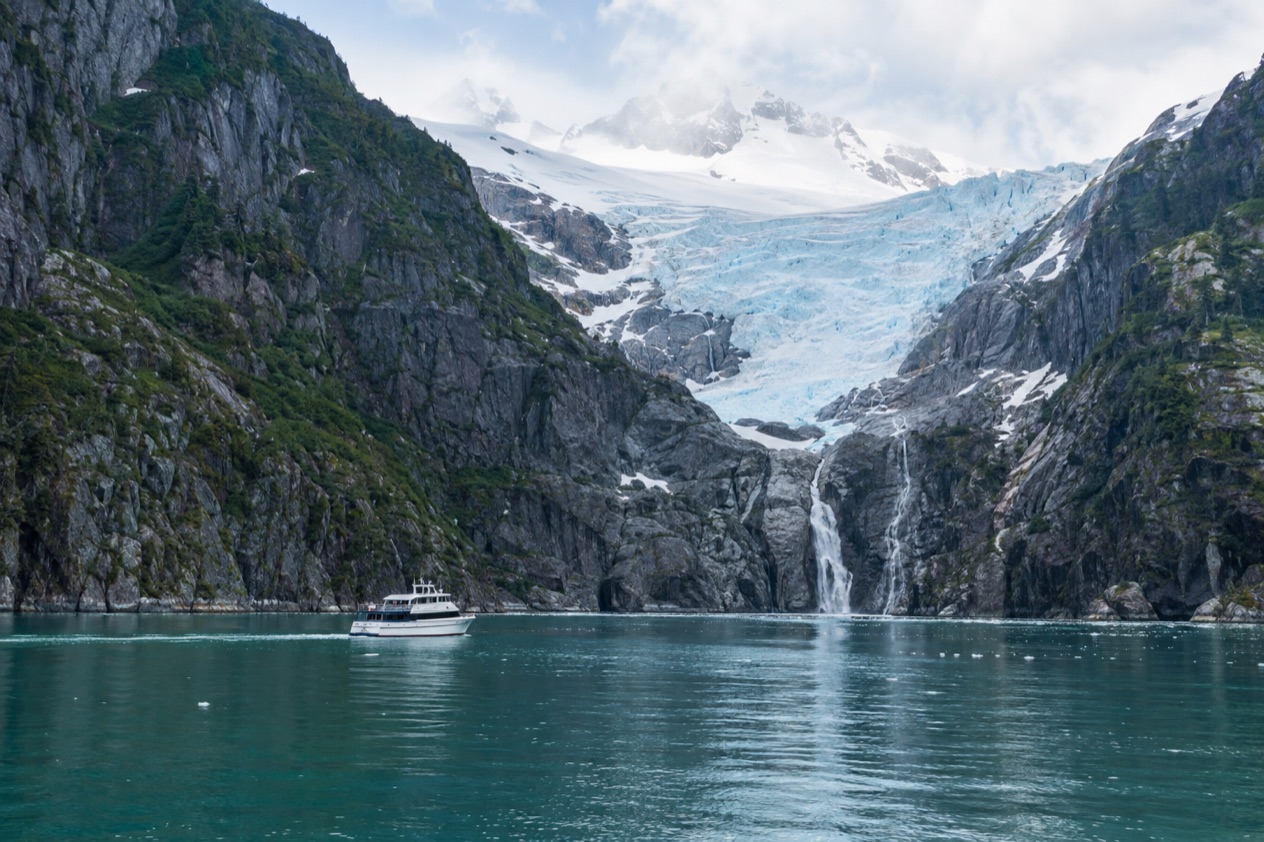
Farther out, the fjords themselves show how the land was made. Glaciers pushed down through valleys, scoured them deep, and the sea flooded in when the ice drew back. You see sheer walls, waterfalls dropping straight into salt water, and slopes of spruce and alder that climb until the rock takes over. Light changes constantly here, so the same cliff can look silver, green or nearly black within an hour.
Bring your eyes and a camera ready for wide scenes rather than details. The coast is the main attraction on days when animals keep their distance.
Wildlife along the shore and on the water
The park lists mountain goats, black bears and bald eagles among its wildlife, and the boat tours describe views of Steller sea lions, puffins, Dall’s porpoises, snowshoe hares, humpback whales and orcas too. Many of these animals live on or near the shoreline, so the boat’s route past cliffs and rocky points is where you may spot them.
Sea lions are often the easiest to find, heavy bodies sprawled on ledges and noisy from a distance. Puffins, with their bright bills, tend to sit on the water or whir low over it on rapid wingbeats.
Mountain goats look like pale specks on impossibly steep slopes, and a pair of binoculars turns them into animals. Whales are the great chance of the trip, a spout, a dark back, sometimes a tail lifting, and when one appears the whole boat goes quiet and moves to one rail.
None of this can be promised, and the best habit is to look at the water and the rock in turns. Wildlife in the park is wild, and the park reminds visitors to be prepared for encounters and for changing weather.
Exit Glacier and the Harding Icefield
Exit Glacier is the only part of Kenai Fjords National Park reachable by road, and it is the natural companion to a day on the water. A network of trails from the Exit Glacier Nature Center leads to the glacier and to the Harding Icefield Trail, which runs 7.4 miles. Visitors primarily reach the park either by this road, to a glacier that is retreating, or by water along the coast.
The icefield above is the source of everything you see from the boat. It receives 60 feet of snowfall a year, an amount that explains the scale of the ice that once filled these valleys. Seeing the icefield’s edge on land and the fjords from the sea makes the two halves of the park fit together, the reservoir and the carved channels it once fed.
Hours, tickets and rules
Boat tours into the park are run by various companies from Seward, so each one is a separate business with its own boat and its own tour. The park itself is a place of rules rather than turnstiles, and the ones that matter for a cruise day are about animals, pets and commercial use.
Pets are allowed only in select areas of Kenai Fjords National Park for the safety of all. In Seward, whether a dog can join an adventure varies throughout the trip, so a dog that is welcome on a town walk may not be welcome at the next stop. Permits are required in the park for special events, commercial activities and guiding, and for research, which is why tours and guided hikes are run by operators that hold them.
The park describes itself as remote, rugged and unpredictable, and asks visitors to be ready for wildlife encounters and changing weather. For Exit Glacier, the road’s status appears on the park’s Current Conditions and Alerts page, which also lists closures and conditions. Junior Ranger activities for kids and curious adults are offered by the park, a nice way to turn the day into something children can take home.
How to get to Kenai Fjords cruises
You get to a Kenai Fjords cruise by getting to Seward, the nearest large town to the park, which sits on Resurrection Bay immediately east of it. The boats leave from Seward’s harbor, and from there the park lies to the west.
From Anchorage, Seward is about 130 miles away at the southern end of the Seward Highway, and the visitor bureau calls the town easily accessible from Anchorage. The highway is the road link to the park, and Seward is the base for everything in it. Seward’s position is given as 60.1042° N, 149.4422° W, a useful point for anyone plotting the trip on a map.
Once you are in town, the park shows its two faces. By road you reach Exit Glacier through the Exit Glacier Nature Center, one of only three national parks in Alaska that can be reached by road. Everything else comes by boat, airplane or hiking, and the cruise is the boat option that starts straight from Seward’s waterfront.
The town makes a pleasant base before and after the boat. Its historic downtown and boat harbor hold one of the largest public mural collections, and coffee at Resurrect Art Cafe or a meal at The Cookery fits easily around a day on the water. Seward offers accommodations and activities year-round, so the town is ready for visitors well beyond a single outing.
When to visit Kenai Fjords cruises
The best time is a day when the weather lets you see the coast, and in Kenai Fjords the weather is the thing nobody controls. The park calls itself unpredictable and tells visitors to expect changing conditions, which on a boat means a bright start can turn gray and a gray morning can break open.
Seward’s weather is the guide the park uses for the area, so conditions in town are a fair sign of what the bay may offer. A mist on the water can soften the mountains for a while and then lift, and a cloudy sky tends to flatten the color of the ice and rock but leaves the animals just as present. Dress and plan for that variety rather than for one kind of day.
For wildlife, think in chances. Whales, sea lions, puffins and bears are part of the park, and any one trip may show some of them and not others. The park does not promise a sighting, and a day spent looking carefully is a good day whether or not a whale surfaces.
Seward is a town with something to do in more than one season. A winter visitation guide names winter as one of the best times to visit, and the town has a winter weekend experience, though a cruise is its own matter. Exit Glacier Road has its own status, shown on the park’s alerts page, so anyone pairing a boat day with the glacier should look at those conditions first.
Tips for your visit
Bring what a day of changing weather asks for, and bring binoculars and a camera. Beyond that, the most useful thing to carry is patience, since wildlife appears on its own schedule. The park describes the area as remote, rugged and unpredictable, and a day on the water is a day in that setting.
A cruise combines well with the rest of Seward. The Alaska SeaLife Center is the state’s only public aquarium and a family-friendly attraction, and it is a natural pairing for travelers who want to see the animals up close after seeing them in the wild. The Seward Community Library and Museum is another family highlight, and the town’s murals make a good walk around the harbor.
If you want the land side of the park, Exit Glacier and the trail network from the Nature Center sit alongside the cruise. The Harding Icefield Trail is the long hike that climbs toward the ice, and Seward Guided Hikes offers wilderness hiking. For a longer stay, the park has camping and cabins, public-use cabins and shelters along the coast and at the edge of the icefield, and the Kenai Peninsula has many more public-use cabins and wilderness lodging options.
Families will find the Junior Ranger program a good companion to the boat, and anglers will find Seward well known for sportfishing. Dogs are not welcome everywhere, since pets are allowed only in select areas, so plan for that when traveling with one. If you have time after the cruise, the rest of the Kenai Peninsula is open for exploring.
Good to know before you go
Kenai Fjords is a wild place and the park says so plainly: remote, rugged and unpredictable, with wildlife and changing weather. Treat the coast with respect and keep a flexible mind about what the day will show.
The park’s mailing address is PO Box 1727, Seward, AK 99664, and its Current Conditions and Alerts page carries news on closures and on the Exit Glacier Road. If your visit goes well you may leave with a photo to share, and Seward invites visitors to tag it #VisitSeward on Instagram.
Sources
- National Park Service, Kenai Fjords National Park, plan your visit (https://www.nps.gov/kefj/planyourvisit/index.htm), checked October 11, 2026
- Visit Seward, things to do (https://www.seward.com/things-to-do), checked October 11, 2026
- Wikipedia, Kenai Fjords National Park (https://en.wikipedia.org/wiki/Kenai_Fjords_National_Park), checked October 11, 2026
To plan your stay
- Best Time to Visit Kenai and Soldotna: Salmon Runs, Weather by Month and Seasonal Things to Do
- Where to Stay in Kenai and Soldotna: Kenai River Access, Refuge Gateways and Area Comparison
- Kenai and Soldotna in January: Winter Weather, Short Days and What to Do
- Kenai and Soldotna in February: Weather, Winter Daylight and Two Days on the Kenai River