
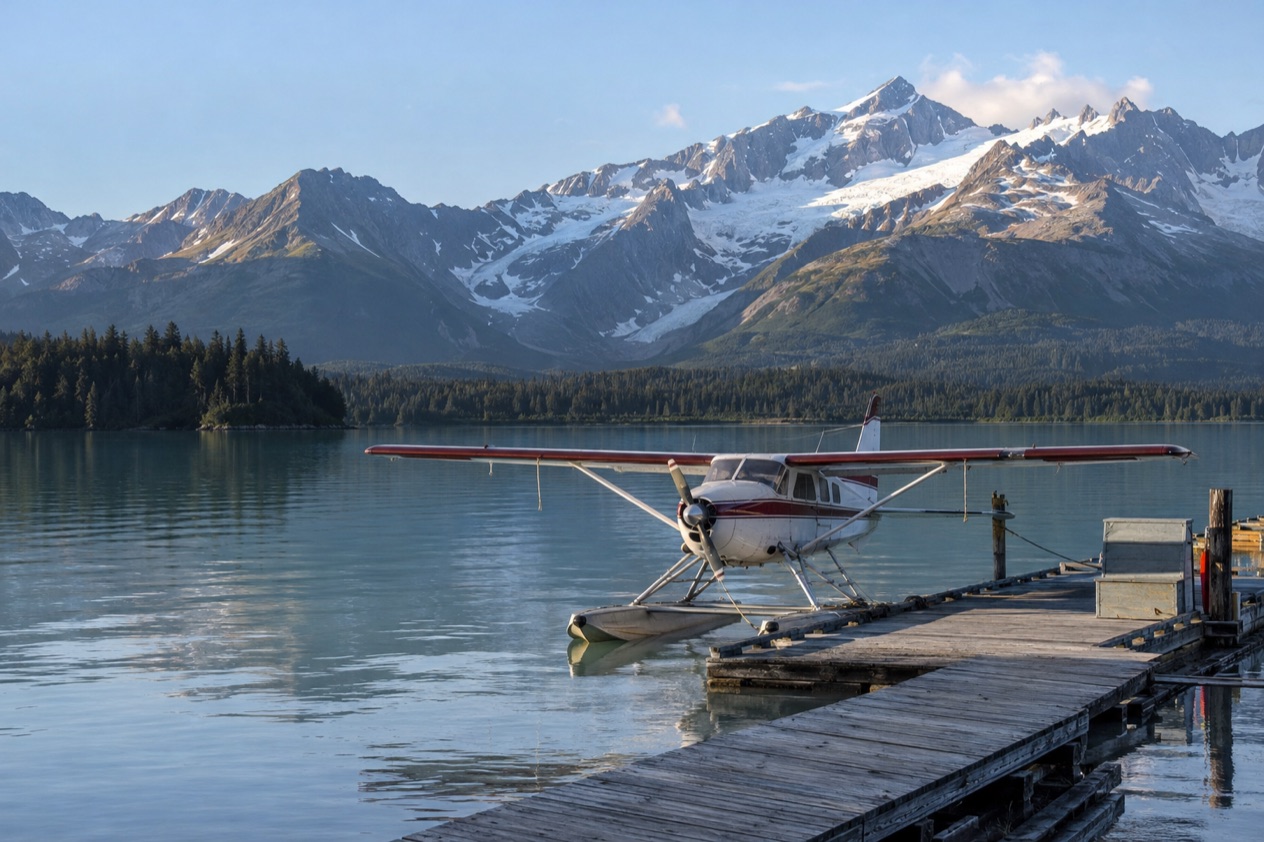
The floatplane drops onto a lake, the engine settles to a mutter, and the pilot steers toward a gravel bar where no road has ever arrived. You step onto a pontoon, rod in hand, and the first cast lands in water that sees far fewer anglers than any river along the highway.
What is fly-in fishing in Alaska?
Fly-in fishing means a small aircraft, usually on floats, carries you to water that has no road to it, and you fish there from the shore, a gravel bar or a boat. It rests on bush flying, which the history books define as flying in remote wilderness areas without prepared landing strips or runways. In Western Alaska, 82% of towns are not connected by roads, so the same planes that bring you to a lake also bring food, mail and medical care to villages.
The aircraft are built for the job. Bush planes carry tundra tires, floats or skis, which lets a pilot work from rough ground, open water, snow and ice. For an angler, floats are the ones that matter most, because lakes and wide rivers become the runway and the dock at once.
How the idea took off
Bush flying in Alaska has a clear starting point. Noel Wien made the first successful bush flight to Livengood on August 19, 1924, carrying supplies to a mining camp. The trip took under an hour, where the winter dog sled trail would have taken several days.
Passengers came later. In 1947, Celia M. Hunter worked as one of the first flight attendants on flights to Nome and Kotzebue, the first tourist trips made by flying in the Alaskan bush. Today’s fishing lodges descend from that idea, offering visitors a seat on a plane that was once strictly a working vehicle.
What a day feels like
A typical fly-in day has a shape. You board at a base, watch the road system fall away beneath the wing, and spend the flight with your face against the window. Lakes the color of pewter, braided rivers and mountain passes slide by, and the landing is often the most memorable minute of the trip.
Then the fishing slows everything down. Silence is the main thing you notice, along with the sound of moving water and the occasional bird overhead. Anglers who like company and a hot meal tend to pick a lodge. Those who prefer fewer people choose a day flight to a stretch of river and an evening back at a cabin or camp.
Who it suits
It suits anyone who wants to fish in country with no roads and is comfortable stepping in and out of a small plane. Experienced fly anglers will find plenty to chase, and so will people who have never held a rod. Alaska’s Rod Loaner Program rents fishing gear for free, a helpful detail if you are testing the sport before buying a full kit.
Nonfishers in the group are not left out. The same trips often pass through country with hiking, bird-watching and wildlife viewing, so a partner who does not fish can still fill the day.
Where do the lodges fly to?
They fly to water beyond the road system, and the best-documented example is Lake Clark National Park and Preserve in southwest Alaska, about 100 miles southwest of Anchorage. No roads lead there. The park can be reached only by boat or small aircraft, typically floatplanes, and the main air route through the mountains is Lake Clark Pass, at 1,050 feet elevation.
Lake Clark and Port Alsworth
Port Alsworth, on Lake Clark, is the main inhabited place in the park. It has a Park Service visitor center and privately operated lodges, so it works as a gateway for anglers who want a roof over their heads between flights. The park itself is remote and undeveloped, and the landscape reads that way, with turquoise lakes, tundra slopes and mountains behind them.
Visitors there can go kayaking, rafting, fishing, bird-watching, hiking and camping. That range is what makes a day on the water feel complete: you fish in the morning and walk a lakeshore in the afternoon. Backpacking over tundra slopes and past turquoise lakes is also possible for those who want to go further.
One landmark draws visitors off the water. Dick Proenneke’s historic cabin stands on upper Twin Lake in the park, and people can visit it. Standing outside a hand-built cabin on a quiet lake gives the trip a human scale that the fishing alone does not.
Silver Salmon Creek and Chinitna Bay
On the coastal side of Lake Clark, Silver Salmon Creek and Chinitna Bay are the places the National Park Service names for watching coastal Alaskan brown bears graze on sedges. You may see them there, though wildlife keeps its own schedule and no sighting can be promised. The scene is gentle in its own way, with bears feeding on grass at the edge of a bay rather than chasing fish.
Anglers who add a day here get a different kind of outing, one built around watching rather than casting. It pairs well with a fishing-focused stay at a lodge, since the coast and the lakes give two very different views of the same park.
Other waters and the fish they hold
Fly-in country stretches well beyond one park, and so does the fish. Rainbow trout are found throughout southwestern and southeast Alaska. Chinook range north to Kotzebue Sound, coho around the Bering Sea to mainland Alaska, and chum from Alaska down to California and also in the Yukon River. Pink salmon reach from northern California to the Mackenzie River in Canada, and sockeye cover a wide stretch of the eastern Pacific.
The Yukon River holds a record of its own, the longest freshwater migration of any salmon, over 1,900 miles from the Bering Sea to spawning grounds above Whitehorse. Alaska’s state fish is the Chinook, called king salmon for its size and flavor. All six Pacific salmon species are anadromous and die after spawning, which is why a river changes character as the fish move upstream.
Not every remote spot needs a plane for the last leg. The Tanana River drainage has six remote recreational public use cabins, a different kind of base for anglers who want a simple shelter near the water.
What should you know before you book?
Know what the trip is built around: a small aircraft, a remote destination and a fish you actually want to catch. Start with the fish. Chinook can be found on their spawning redds from September to December, and since salmon die after spawning, the season of the fish shapes the whole trip. A lodge that can tell you which species it expects, and where, gives you a better picture than a brochure photo.
Choosing an operator
Guided sport fishing operators in Alaska must register and report their activity through eLogbooks with the Division of Sport Fish. That requirement makes a useful question to ask: is the guide or lodge you are considering a registered operator? It is a simple filter before you send a deposit.
The state also offers the GoFishAK interactive maps, which help anglers discover sport fishing opportunities across Alaska. Use them to see what water exists near your destination, then decide whether you want a guided day or time on your own. Hatchery tours, available for visitors, are a good rainy-day addition that shows how fish are managed.
Weather and what it changes
Lake Clark gives a useful sense of the conditions. Cold air over water feels colder still when the plane lands and you wait on the shore.
| Lake Clark National Park | Temperature (°F) |
|---|---|
| Typical summer temperatures | 50 to 65 |
| Summer highs | Around 68 |
| Winter lows | Around 1 |
Weather also decides flights. Floatplanes land on water, and Lake Clark Pass is the main air route through the mountains between Anchorage and western Alaska, so conditions in the pass matter. A trip planned with some slack in the schedule handles that better than a tight itinerary.
Gear, rules and expectations
The Rod Loaner Program helps if you do not own a rod, and many anglers still bring their own favorite. Ask what the operator provides before you pack. On trips that include bear viewing, follow the rules posted by the National Park Service and the Alaska Department of Fish and Game, and listen to your guide on site.
Finally, expect a trip that runs on the plane’s schedule rather than yours. That is part of the charm. The reward is a lake or river that sits well beyond the road, where the main thing on your mind is the next cast.
Good to know before you go
Everything on a fly-in trip depends on a small aircraft, so keep your plans loose and leave room for weather. Lake Clark is not on the road system, which means getting in and out is part of the adventure and part of the planning.
Bring warm layers, because the air near the water stays cool even when the sun is out. Treat wildlife as a chance rather than a promise, and enjoy the quiet that comes with fishing far from any highway.
Sources
- Alaska Department of Fish and Game, Sport fisheries (https://www.adfg.alaska.gov/index.cfm?adfg=fishingsport.main), checked October 11, 2026
- Wikipedia, Bush flying (https://en.wikipedia.org/wiki/Bush_flying), checked October 11, 2026
- Wikipedia, King salmon (https://en.wikipedia.org/wiki/King_salmon), checked October 11, 2026
- Wikipedia, Pacific salmon (https://en.wikipedia.org/wiki/Pacific_salmon), checked October 11, 2026
- Wikipedia, Lake Clark National Park and Preserve (https://en.wikipedia.org/wiki/Lake_Clark_National_Park_and_Preserve), checked October 11, 2026
- National Park Service, Lake Clark National Park & Preserve, plan your visit (https://www.nps.gov/lacl/planyourvisit/index.htm), checked October 11, 2026