
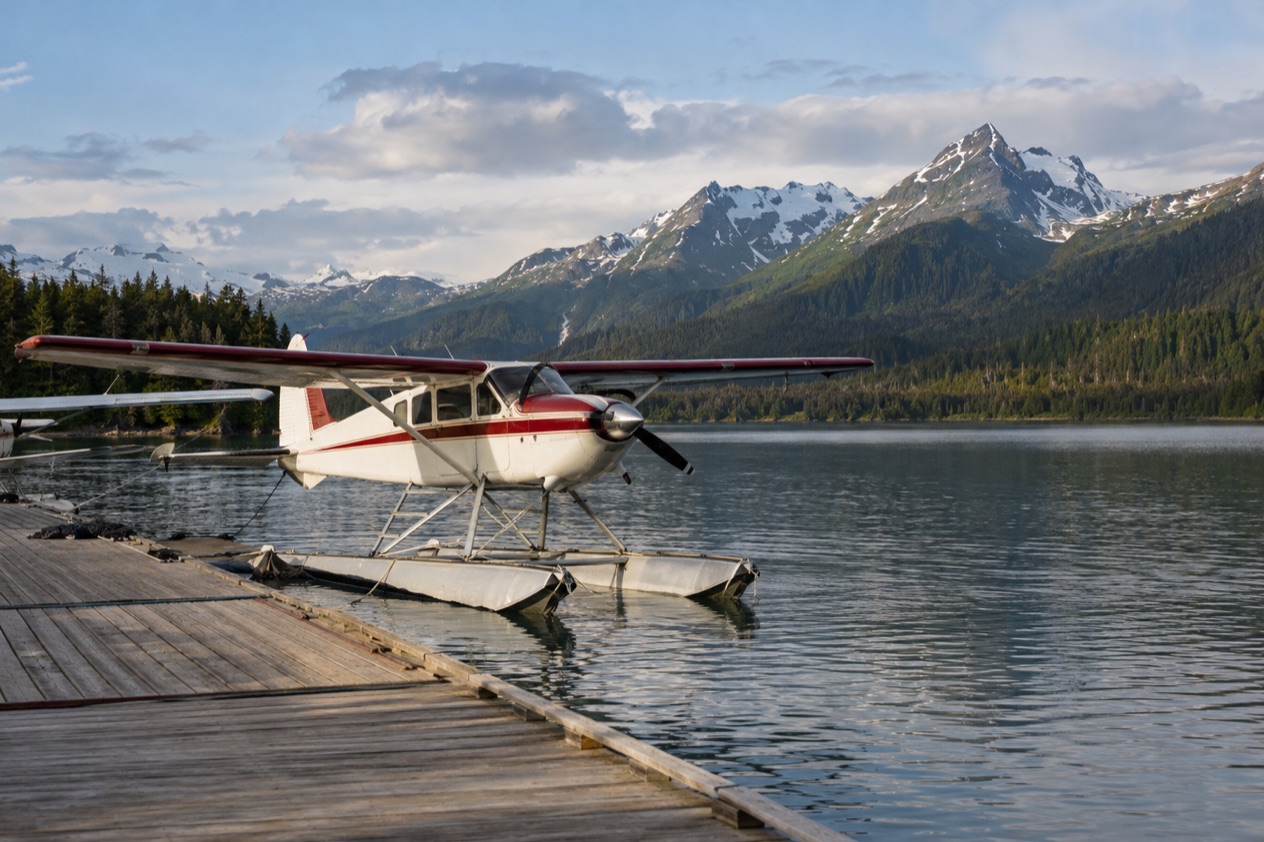
A floatplane idles at its dock with the engine ticking, the pilot loads the last bag, and the water ahead is the only runway. In Alaska this is not a stunt, it is how a great deal of the state gets from one place to another. A floatplane flight lands on lakes and coastal water where there is no airstrip, and for a traveler it opens up fjords, lake country and park lands that roads never reach.
What are floatplane flights in Alaska?
A floatplane flight is a trip in a small aircraft fitted with floats, so it takes off and lands on water instead of a runway. It belongs to a long Alaska tradition called bush flying, which means flying in remote wilderness areas without prepared landing strips. Bush planes carry tundra tires, floats or skis, depending on whether they need to set down on rough ground, open water, snow or ice.
The tradition is a working one before it is a sightseeing one. Noel Wien made the first successful bush flight to Livengood on August 19, 1924, and showed that a run to a mining camp could be done in under an hour, where a winter dog sled trail would take several days.
That summer he made 34 flights to supply the roughly 250 men at the camp. Today the same logic holds in Western Alaska, where 82% of towns are not connected by roads and bush flying brings in food, mail and medical care.
From mail runs to tourist trips
Bush flying began with freight and mail. In 1924, Eielson received a de Havilland 4 to make eight mail runs to McGrath, 280 miles away. Passengers came later: in 1947, Celia M. Hunter became one of the first flight attendants on flights to Nome and Kotzebue, which were the first tourist trips made by air in the Alaskan bush.
That heritage is still part of the experience. Alaska has about six times as many pilots per capita as the rest of the United States, and flying a small plane is a normal part of life rather than a novelty.
What a flight can involve
From Anchorage, flightseeing day trips and overnight adventures include bear viewing, fly-in fishing, hiking and glacier landings. Personalized tours or charters are offered by floatplane, fixed wing and helicopter, so the floatplane is one choice among several, and it is the one that lets you touch down on a lake or a quiet stretch of coast.
Wildlife is a chance on any of these trips, never a promise. You may see bears, and you may not, and a good pilot reads the water and the weather rather than guaranteeing a scene. What you can count on is the view from above: braided rivers, glacier-carved valleys and mountain walls that look different from every altitude.
Where can you take one?
You can take a floatplane from Anchorage, from Ketchikan and, for lake country, toward Lake Clark National Park and Preserve. Each starting point leads to a different kind of landscape, so the choice is really a choice of scenery.
Anchorage: Lake Hood and Merrill Field
Flightseeing tours depart from Anchorage year-round. Flights leave from Merrill Field and from Lake Hood, the world’s busiest floatplane base, or from nearby Girdwood. Watching the traffic at Lake Hood, with planes taxiing between docks and lifting off the water, is a small show in itself.
The mountains and parks within reach shape what the day looks like. Denali, North America’s tallest peak at 20,310 feet, lies to the northwest of Anchorage. Kenai Fjords National Park is due south on the Kenai Peninsula. The Chugach Range stretches 710 miles east from Anchorage toward Prince William Sound and Valdez, a long wall of peaks that fills the horizon on a clear day.
Ketchikan and Misty Fjords
Ketchikan sits in Southeast Alaska, in the Inside Passage, and visitors can take a floatplane to Misty Fjords from there. The monument is about 40 miles east of Ketchikan along the Inside Passage coast, in the extreme southeast of the state. Because of its remoteness, visitors arrive by boat or aircraft from Ketchikan or Juneau.
The landscape is the reason to go. Light-colored granite, about 50 to 70 million years old, has been sculpted by glaciers into deep U-shaped troughs. The fjord walls are near-vertical, often rising 2,000 to 3,000 feet above sea level and dropping 1,000 feet below it. From the air you see how sheer they are, and from a landing on the water you look up at them.
The monument covers 2,294,343 acres of the Tongass National Forest and is administered by the U.S. Forest Service. All but 151,832 acres are designated wilderness. It was proclaimed by President Jimmy Carter in December 1978 under the spelling Misty Fiords. Back in town, downtown Ketchikan is easy to walk, with historic buildings, galleries and shops, and the Tlingit, Haida and Tsimshian cultures are part of the place.
Lake Clark National Park and Preserve
Lake Clark is on the Alaska Peninsula in southwest Alaska, southwest of Anchorage and west of Homer. It is not on the road system, and access is primarily by small aircraft. That makes it a natural fit for a floatplane, since the park’s lakes are the landing places.
The park was established on December 2, 1980, by the Alaska National Interest Lands Conservation Act. Its field office is in Port Alsworth. Permits and reservations are required for the park, and internet and cellular access there is limited, so the stay tends to be a quiet one.
What should you know before you go?
The main things to know are where the flight starts, what kind of aircraft you want, and what the destination requires. Floatplanes are one of three options from Anchorage, alongside fixed wing and helicopter, so decide whether landing on water is what you are after.
Matching the flight to the place
Think about the setting first. Misty Fjords is a coastal wilderness reached from Ketchikan, where visitors can also join a wildlife or sightseeing tour, explore the Tongass National Forest or book a fishing charter. Anchorage offers the widest menu, from bear viewing and fly-in fishing to hiking and glacier landings, and the flights start year-round.
Lake Clark is the choice if you want a park with no road at all. Since access there is primarily by small aircraft, the flight is not an add-on but the way in. The park’s permit and reservation requirement belongs in your planning from the start.
Reading the water and the sky
Bush planes are built to operate from rough terrain, water, snow and ice, which is why the same aircraft can wear floats in one season and different gear in another. A floatplane depends on open water, and a flight is a matter of conditions on the day. Treat a sighting of any animal, or a clear view of a peak like Denali, as a bonus rather than a given.
Staying connected is another thing to plan around. At Lake Clark, internet and cellular access is limited, so settle messages and arrangements before you leave. The flight itself is the link to everything else: in a state where so many towns have no road, the small plane is the ordinary way to move, and the pilot knows the lakes, the weather and the landing spots far better than any map.
Good to know before you go
Flightseeing tours leave from Anchorage year-round, so the city is a flexible base, while Lake Clark asks for permits and reservations and offers only limited cell and internet service. Misty Fjords is the classic coastal outing from Ketchikan. Carry what you need for a day on the water, and let the pilot’s judgment on the weather decide the schedule.
Sources
- Wikipedia, Bush flying (https://en.wikipedia.org/wiki/Bush_flying), checked October 11, 2026
- National Park Service, Lake Clark National Park & Preserve, plan your visit: basicinfo (https://www.nps.gov/lacl/planyourvisit/basicinfo.htm), checked October 11, 2026
- Visit Anchorage, flightseeing (https://www.anchorage.net/things-to-do/flightseeing/), checked October 11, 2026
- Visit Ketchikan, things to do (https://www.visit-ketchikan.com/things-to-do/), checked October 11, 2026
- Wikipedia, Misty Fjords National Monument (https://en.wikipedia.org/wiki/Misty_Fjords_National_Monument), checked October 11, 2026