
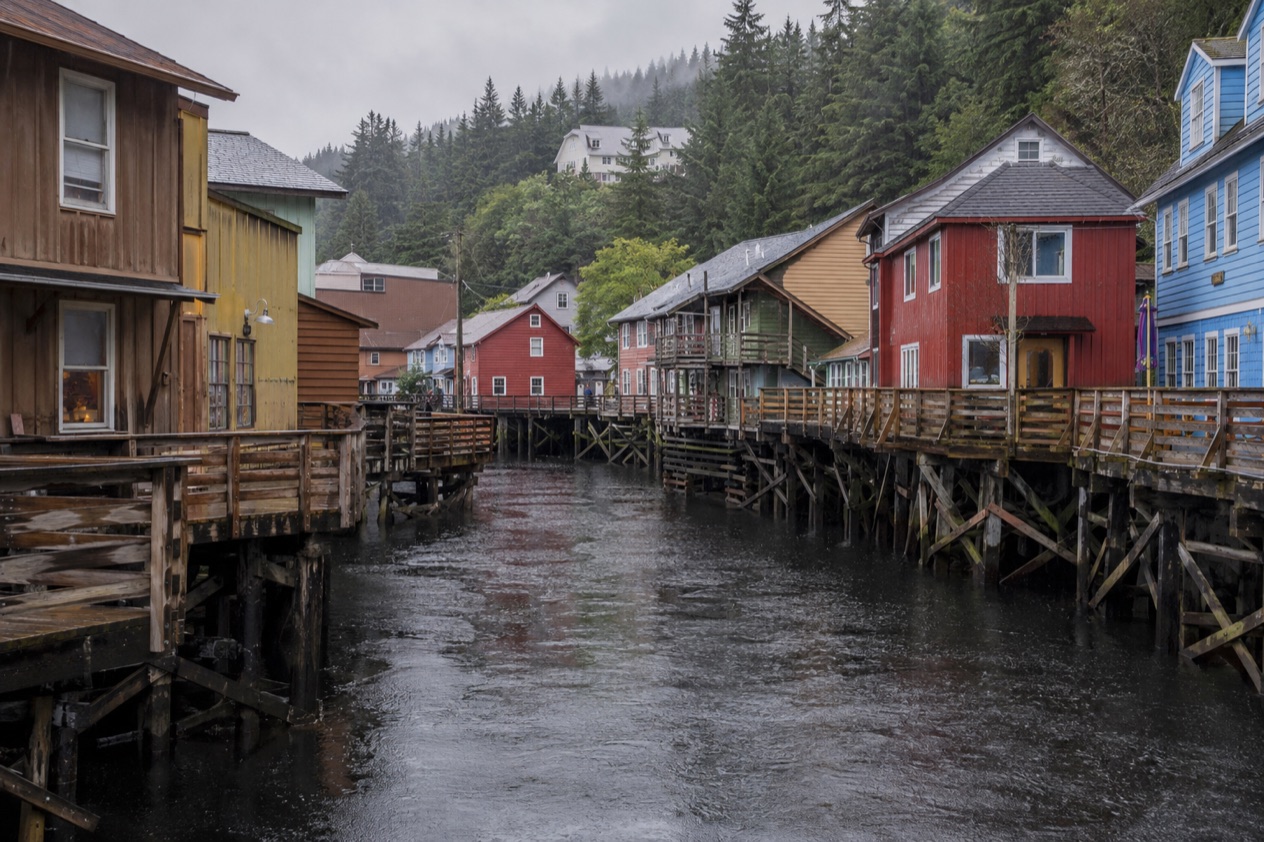
Creek Street is a row of weathered wooden buildings held up on pilings above Ketchikan Creek, with the water running beneath your feet and the planks creaking under every step. Painted facades, hanging signs and shop windows line the way, and the rain-dark wood gives the whole street the look of an old photograph. It is a stroll through the town’s wilder past, now filled with galleries, souvenir shops and quiet storefronts, in the heart of a historic downtown.
Is visiting Creek Street worth it?
Yes, if you like places with a story attached to every doorway, and it suits cruise passengers, history lovers, photographers and anyone who enjoys browsing for local art. Creek Street was once a raucous red-light district, and during prohibition a row of speakeasies. Today it is home to quieter establishments and keeps its historic charm.
What sets it apart from other Alaska waterfront strips is that it is not a modern promenade built for visitors. The buildings that recall the street’s past as a red-light district serving miners, fishermen and loggers are still here, standing along the creek rather than facing the harbor.
Elsewhere in Ketchikan you look at totem poles, boats and mountains. Here you look at the town’s human history, in the planks, windows and railings where it happened.
It also fits neatly into a larger outing, because downtown Ketchikan is easy to walk and full of historic buildings, galleries and shops. Creek Street is one stop in that walk, not a day on its own. It rewards a slow pace, a camera and an open mind about the rain, since Ketchikan is nicknamed the Rain Capital of Alaska.
What to see at Creek Street
The boardwalk above the creek
The first thing you notice is that the street is not really a street. It is a wooden boardwalk running along the face of the buildings, with Ketchikan Creek moving beneath it and the hillside rising behind. The water makes its own sound under the planks, a steady rush that carries over the chatter of the shops.
Walk it slowly and look down through the railings as well as ahead. In a town whose identity was shaped by salmon and the canneries that earned it the name Canned Salmon Capital of the World, the creek is part of the story, and you may see fish in it at the right time of year. Light is usually soft and gray here, which flatters the faded paint and makes the wet wood glow.
The historic buildings and their past
The houses along the creek are the heart of the visit. Their small rooms, narrow doorways and bright facades recall the days when the street served miners, fishermen and loggers who came into town from the camps and boats. During prohibition the same row hid speakeasies, and the street has had more than one life since.
Look for the details rather than a single landmark: signs that tell who lived or worked in a building, old photographs in windows, and the way each structure leans a little toward the water. Some buildings now hold shops or small displays, and the changes from the old trade to quieter uses are part of what you are reading as you go.
Shops, galleries and local goods
Creek Street is a place to shop for local art, smoked salmon and souvenirs. The shops sit in the same old buildings, so browsing means stepping through creaking doorways and low ceilings rather than into a mall. Galleries and stores around downtown also sell locally made goods, so you can compare what different makers offer.
Smoked salmon makes an obvious keepsake in a town built on the fish, and art inspired by the region’s Tlingit, Haida and Tsimshian cultures is part of what Ketchikan is known for. Take your time with each window. The best finds tend to be in the smaller shopfronts away from the busiest stretch.
Totem poles and the museum nearby
Ketchikan has one of the largest collections of standing totem poles in the world, seen throughout town, in totem parks and at the Totem Heritage Center. The Center helps preserve and interpret poles of the Tlingit, Haida and Tsimshian people, and it makes a natural pairing with a morning on Creek Street, since both tell the story of the town from different sides.
The Tongass Historical Museum has exhibits about Ketchikan’s people, businesses and events from the late 19th and early 20th centuries. Seen after the creekside buildings, those exhibits give names and faces to the fishing, logging and cannery world behind the street. Saxman Native Village, where traditional dances can be seen, is another stop for those who want to go further into the region’s cultures.
Hours, tickets and rules
Creek Street is part of downtown Ketchikan, a National Historic Landmark District, and it is visited by walking along the creek and into the shops that line it. The nearby experiences that do have set seasons are in the table.
| Item | Where and when |
|---|---|
| Historic Ketchikan Walking Tour Map | Visit Ketchikan Visitor Centers on the docks at Berth 2 and Berth 3 |
| Great Alaskan Lumberjack Show | Performed near Ketchikan Creek, May to September |
| Cruise ship visits | Early May through late September |
A Historic Ketchikan Walking Tour app is also available for Android and Apple iOS, which pairs well with the creekside buildings.
How to get to Creek Street
Most people arrive by cruise ship. More than 800,000 visitors pass through Ketchikan that way each year, and shopping is conveniently placed around each cruise ship pier, as well as downtown and in the Creek Street area. The Visit Ketchikan Visitor Centers on the docks at Berth 2 and Berth 3 are the first stops for a map before you head into town.
If you come on your own, Ketchikan sits on Revillagigedo Island in southernmost Southeast Alaska, 700 miles northwest of Seattle, Washington. Ketchikan International Airport has Alaska Airlines nonstop jet service to Seattle, Juneau, Sitka and Wrangell. Travelers heading in from the sea can use the Alaska Marine Highway, whose ferry from Bellingham, Washington takes thirty-six hours, and whose ferry from Prince Rupert, British Columbia takes six hours.
The ferry terminal is approximately 2 miles north of downtown, so reaching the creek means continuing into town from there. Once you are downtown, the walk to the historic district is the main way of getting around, because downtown Ketchikan is easy to walk.
When to visit Creek Street
The liveliest weeks are those of the cruise ship season, when ships that ply the Inside Passage visit Ketchikan from early May through late September. The Great Alaskan Lumberjack Show, performed near Ketchikan Creek between May and September, belongs to the same stretch of the calendar. With ships in port, the boardwalk fills with passengers and the shops are at their busiest.
For a quieter walk, the hours when fewer ships are in town are the better bet, since the narrow boardwalk feels very different with a handful of people on it. Outside the cruise season, the shopping and the old buildings are still the draw, but the crowd that fills the pier area in summer belongs to those months.
Rain is the one constant. Ketchikan is one of the rainiest cities in North America, with just over 160 inches of precipitation in an average year, and the creek-side planks are wet more often than not. A wet day suits Creek Street well. The weathered wood looks richer, the creek runs louder, and the shops make a good refuge between showers.
Tips for your visit
Bring something waterproof before anything else. A hooded rain jacket does more for your day than an umbrella on a narrow boardwalk where people pass close, and shoes with good grip suit wet planks. Carry a camera or phone ready for details, from carved signs to the creek beneath the railings.
Pair Creek Street with the rest of downtown. Pick up the free Historic Ketchikan Walking Tour Map at the visitor centers on the docks, or use the app, and let it lead you between the creek, the Tongass Historical Museum and the shops. The Southeast Alaska Discovery Center is another stop, with interactive exhibits on the Tongass rainforest and regional wildlife, and a small theater showing short films about Ketchikan and the surrounding region.
For a longer day, Saxman Totem Park is approximately 2.5 miles south of downtown, and the Totem Heritage Center is where the poles are preserved and explained. Ketchikan also offers the Tongass National Forest to explore, wildlife and sightseeing tours, fishing charters and floatplane flights to Misty Fiords National Monument, about 60 miles away. These make good companions to a quiet hour on the boardwalk.
Families and anyone thinking about mobility should know that the street is a wooden boardwalk above the water, so allow time and look at the surface as you go. It is a place for slow looking more than for covering ground.
Good to know before you go
Creek Street is a place for local art, smoked salmon and souvenirs, so decide before you start whether you want to buy something. The cruise season shapes the rhythm of the town from early May through late September, and the daylight and the rain shape the rest. Ketchikan is a town of approximately 14,000 people on the Tongass Narrows, at the foot of Deer Mountain, and its historic core is small enough that a morning on the creek, a museum and a walk past the totem poles fit together naturally.
Sources
- Visit Ketchikan, things to do (https://www.visit-ketchikan.com/things-to-do/), checked October 11, 2026
- Visit Ketchikan, museums and attractions (https://www.visit-ketchikan.com/things-to-do/art-and-culture/museums-attractions/), checked October 11, 2026
- Wikivoyage, Ketchikan (https://en.wikivoyage.org/wiki/Ketchikan), checked October 11, 2026
- Wikipedia, Ketchikan, Alaska (https://en.wikipedia.org/wiki/Ketchikan,_Alaska), checked October 11, 2026
- Holland America Line, Alaska cruises (https://www.hollandamerica.com/en/us/cruise-destinations/alaska-cruises), checked October 11, 2026
- Visit Ketchikan, cruise travelers (https://www.visit-ketchikan.com/cruise-travelers/), checked October 11, 2026