
Somewhere over the Gulf of Alaska, with a window seat and a map spread on your knees, the question arrives: a hotel in every town, or a bed that travels with you? Alaska’s own travel guidance lists renting a motorhome and driving the highways as one way to see the state on your own.
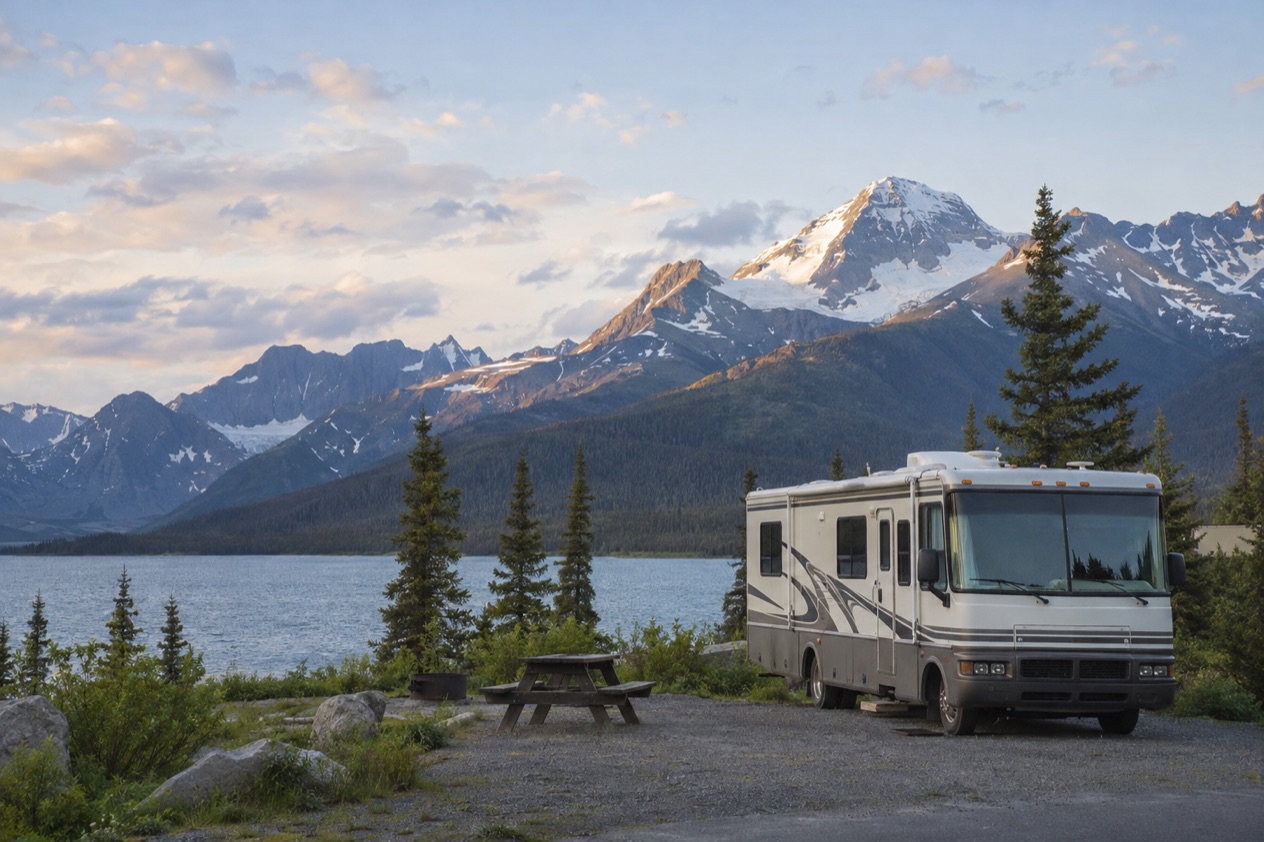
Can you rent a camper van in Alaska?
Yes, renting a motorhome and driving the highways is one of the independent ways to see Alaska, alongside arriving by train, taking the Marine Highway or flying into an Inside Passage town. The state’s travel guidance frames it as a choice for travelers who want to build their own route rather than follow a cruise or a packaged tour.
The appeal is easy to picture. You wake where you parked, make coffee with a view of spruce or a mountain wall, and decide the day’s route over breakfast. Alaska rewards that kind of slow travel, because the distances are large and the landscapes change from one valley to the next. A vehicle with a bed and a stove lets you stop when a place deserves it.
What a motorhome trip can and cannot reach
A cruise shows you coastal mountains, glaciers, marine wildlife and harbor towns, but it misses the highest mountains, the big land mammals and the wide interior. Driving fills in exactly that gap. You see the interior at ground level, with long stretches of forest, rivers beside the road and small towns that exist for the highway.
What a road trip does not do is reach everything. Alaska is mostly without roads, so a van keeps you to the roads that exist. Glacier cruises, boat tours and flightseeing are separate outings, and the state’s guidance suggests budgeting for one to two excursions a day, at a cost per excursion given in the table.
| Planning item | Figure |
|---|---|
| Excursions per day | One to two |
| Budget per excursion | $100 to $200 |
| Long days and comfortable temperatures | May to September |
| Shoulder seasons with lower hotel rates | Mid-May to mid-June and early September |
Choosing your months
Days are long and temperatures comfortable anytime from May to September. That window is the natural one for a trip with a bed on wheels, since you spend your evenings outside, cooking, walking and watching the light linger.
The edges of that window have their own character. In the shoulder seasons, from mid-May to mid-June and again in early September, hotel rates are lower. If you mix a few nights in lodging with nights in the van, those shoulder weeks can stretch a budget. Plan your campground dates around the openings and closures covered in the sections that follow.
Van, car or train?
The state’s guidance puts the independent options side by side: fly into Anchorage and travel by railroad, or rent a car or motorhome and drive the highways. The train hands the driving to someone else and keeps your attention on the window. The motorhome gives you the schedule.
Some travelers combine approaches. A cruise on a cross-Gulf itinerary followed by a land tour is one pairing the guidance mentions. Others take a small ship to reach smaller ports and bays where big ships cannot go. A camper van fits best in a trip that centers on the road system itself.
Where do you pick one up?
Anchorage is the starting point the state’s guidance names: you fly into Anchorage, then rent a car or motorhome and drive the highways. That makes the city the natural place to begin a van trip, the point where your flight ends and the road begins.
Picture the first hour. You land, collect your bags, meet the vehicle and then face the real work of any road trip: stocking the cupboards, finding your way around a rig that is larger than your car at home and pointing it toward the first campground. Keep that first leg light, and save the long drives for once you know how the vehicle handles.
Starting in Anchorage
Anchorage works as a base for a reason beyond the airport. It is where the Alaska Railroad route begins, and it is the end of the Seward Highway, which runs from Seward to Anchorage. A van trip that starts in the city can follow that highway out of town almost at once.
Before leaving the city, spend a little time on the practical side. Look at the road reports for the route you plan to drive, and decide how many nights you want in campgrounds with a reservation system and how many you leave open. A van in a big city is an ordinary vehicle, so use the city for errands while you have its stores around you.
The Seward Highway as a first drive
The Seward Highway extends 125 miles between Seward and Anchorage. It is designated a National Forest Scenic Byway, a State Scenic Byway and an All-American Road, and it runs through Turnagain Arm, Chugach National Forest, the Kenai Mountains and the Kenai Peninsula. That list reads like a summary of what people imagine when they think of Alaska.
The highway spends about 72 miles inside Chugach National Forest, so much of the drive is bordered by trees and mountain slopes. It is also part of the unsigned Interstate system as Interstate A-3, a small fact that makes a good story at the next campfire.
Traffic is part of the picture in summer. Up to 15,000 vehicles a day use the stretch from Girdwood past the Portage curve toward Turnagain Pass, ending at Ingram Creek. In a camper van you will want patience there, and a willingness to use pullouts rather than stopping on the shoulder.
Speed limits and cyclists
In July 2016, Alaska DOT&PF posted updated speed limits on a five-mile section south of Anchorage between Hope Junction and the top of Turnagain Pass. The limit is 55 mph in the right lane and 65 mph in the left lane. Drivers of larger vehicles will find the right lane the comfortable choice.
U.S. Bicycle Route 97 runs alongside the Seward Highway along its entire length and was created in 2011. You may share the road with cyclists, so give them room as you would on any road where bikes are part of the scene.
Other ways in
Not every trip starts at the Anchorage airport. The state’s guidance also describes the Marine Highway and flying into an Inside Passage town as options for an independent land tour. Those routes serve travelers who want to begin on the water or in the Southeast.
For a van trip, the pickup city is the one that matters, and the state’s guidance gives Anchorage for the car or motorhome option. Build your itinerary outward from there.
What do you need to know before you go?
You need to know where you will park each night, how the roads are behaving and what the campgrounds allow. The rules that apply to a van differ by campground, and the road reports change with the weather, so a little preparation pays off.
Camping in Denali
Denali’s campgrounds are among the best-documented places to park a rig in Alaska, and the rules are specific. No campground in Denali can accommodate an RV over 40 feet long, and none has electrical or water hookups. That means a self-contained van suits the park better than a vehicle that depends on a plug.
Reservations can be made as early as December 1 of the year before your visit. Wonder Lake Campground is closed through 2026 because of the Pretty Rocks Construction project, so look at the other campgrounds for any plan that touches the park. Senior Pass and Access Pass holders receive a discount on nightly fees.
| Denali campground detail | Figure |
|---|---|
| Nightly site fees | Around $25 to $50 |
| Senior Pass and Access Pass discount | 50% off nightly fees |
| Check in and check out | 11 am |
| Longest RV accommodated | 40 feet |
| Winter camping | Free, roughly late September to early May |
Staying in Alaska State Parks
State parks are another place to look for a night. Cabins and other reservable facilities can be booked through an online reservation system. The details of each park’s campground belong to that park, so read the listing for the one you choose before you drive there.
Reading the road with Alaska 511
Alaska 511 is the state’s road information site, and it is worth getting to know before the trip. It sorts conditions into categories: Good, Fair, Difficult, Very Difficult, Hazardous, Road Closure and No Winter Maintenance. In a vehicle with a high profile, those labels tell you whether to keep going or wait.
The Alaska Department of Transportation has partnered with Waze to publish Waze-reported incidents and closures on the site. The Waze for Cities program is a free data exchange between Waze and government entities, so the incident layer comes from drivers on the same roads you will use.
Cameras and saved routes
You can create an account to save routes and receive notifications, and you must log in to save a route for future viewing. Route notifications are sent by default on weekdays from 6 AM to 6 PM via SMS. Set the route you plan to drive once, and the alerts follow you.
Cameras help too. On the map page, click a camera icon, then the My Cameras button in the popup to add it. On the camera page, click the three dots icon below the image to reach the My Cameras option. A morning look at the pass you plan to cross can change your breakfast plans.
Good to know before you go
A camper van trip in Alaska is mostly a matter of timing and preparation: long days from May to September, a campground booked when the system opens, and a road report checked before each leg. Keep the vehicle’s size in mind when you choose campgrounds, and use the Alaska 511 notifications to stay ahead of closures. Outside the Denali area, the cost that follows applies to state park reservations made online.
| Fee | Amount | Who pays |
|---|---|---|
| Online reservation for Alaska State Parks cabins and reservable facilities | $4.50 per reservation | The person reserving online |
Sources
- Alaska 511 (https://511.alaska.gov/), checked October 11, 2026
- Alaska State Parks, unit fees (https://dnr.alaska.gov/parks/asp/unitfees.htm), checked October 11, 2026
- National Park Service, Denali National Park & Preserve, plan your visit: campgrounds (https://www.nps.gov/dena/planyourvisit/campgrounds.htm), checked October 11, 2026
- Alaska.org, best way (https://www.alaska.org/advice/best-way-to-see-alaska), checked October 11, 2026
- Wikipedia, Seward Highway (https://en.wikipedia.org/wiki/Seward_Highway), checked October 11, 2026