
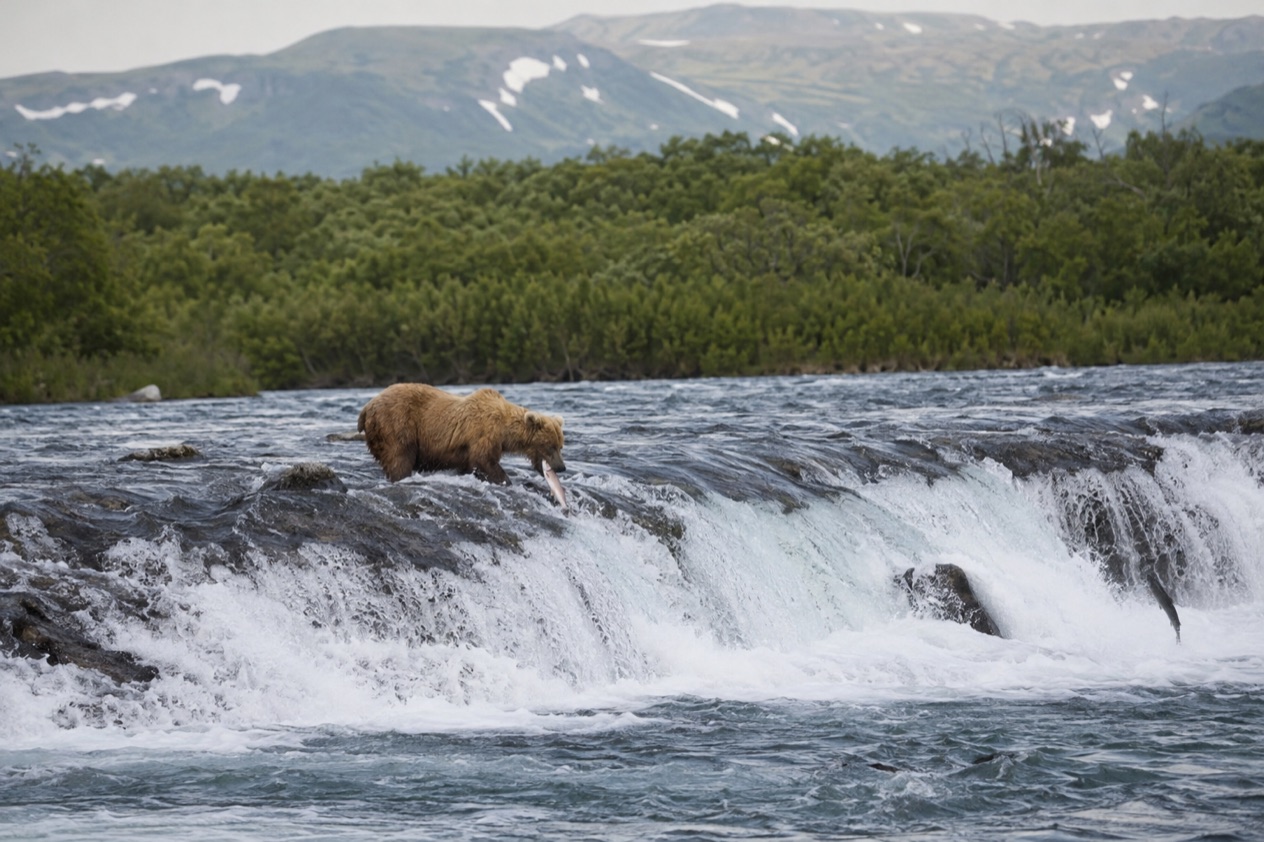
A brown bear stands at the lip of a low waterfall with its mouth open, waiting for a salmon to leap straight into it. Around the bend the river runs clear, and people watch quietly from a raised platform above the water. This is Brooks Falls in Katmai National Park and Preserve, and a visit here is about watching bears do what bears do at a river.
Is visiting Brooks Falls worth it?
Yes, if you want to watch brown bears at close range in a wild setting and are willing to plan around small planes, changeable weather and a short season. It suits wildlife watchers, photographers and anyone who would rather spend a day watching one river than ticking off many sights.
The falls themselves are modest, only about six feet high. What draws people is what happens at them. Salmon leap the falls on their way to spawning grounds in Brooks Lake, and bears gather to catch them.
Katmai has one of the highest densities of bears on earth, and the National Park Service says few other places offer comparable bear viewing. Brooks Camp, the base for the falls, is Katmai’s most popular destination, known for combining bear viewing, sport fishing, scenery, history and facilities in one spot.
What sets it apart from other wild places in Alaska is that the viewing is organized around the river and the camp. You arrive, hear a bear safety talk, and then walk to platforms built for watching.
There is a visitor center, ranger programs and a lodge, so the day has a shape. Here you are watching in company, with rangers close by.
What to see at Brooks Falls
The falls and the viewing platforms
The main event is the platform view of the falls on the Brooks River. The river drops over a low ledge, and salmon throw themselves upward to clear it. Bears take positions at the top or in the pool below, some patient and some splashing hard after a fish. The platforms let you watch the bears and the river from above, so you take in the whole scene rather than a single animal.
Bears usually gather here from July through early September. July has the greatest concentrations, with up to 25 bears seen at one time, and as many as 43 have been sighted in a single day. In September fewer bears show up, with a maximum of about 18 at once. Sightings are never guaranteed, but the numbers give you good reason for hope.
The Brooks River and its trails
The falls sit a mile and a half from Brooks Lake and an equal distance from Naknek Lake, so the river itself is a short stretch of water between two big lakes. Trails around Brooks Camp offer bear viewing, cultural history, quiet forests, alpine tundra and rugged mountain scenery, which means a day here can be more than one platform.
Walking toward the river gives you time to look at the forest and the lakeshore, and to notice how the camp sits at the mouth of the Brooks River on Naknek Lake. Bear country starts the moment you leave the plane, and every part of Katmai is treated that way.
The visitor center and ranger programs
The National Park Service runs a visitor center, ranger station, campground and auditorium at Brooks Camp, with daily ranger-led programs. Evening slide shows, walks and hikes fill the program, and they are a good way to learn about the area’s human history alongside its bears.
If rain pushes you indoors, the visitor center and the evening talks are the natural place to spend the hours. They also give context for what you saw at the falls.
The bus tour to the Valley of Ten Thousand Smokes
Daily bus tours leave from Brooks Camp for the Valley of Ten Thousand Smokes, the site of the largest volcanic eruption of the 20th century. It is a very different Katmai from the river, a landscape shaped by volcanic ash rather than salmon and bears.
It suits visitors who stay longer than a single day and want to see something beyond the falls. Brooks Camp also serves as the starting point for backcountry adventures across the park.
Hours, tickets and rules
Brooks Camp services run on a season, not all year. The National Park Service operates its facilities from June 1 to September 17, and meals and lodging at Brooks Lodge are available through the same date. After that, only very limited visitor services may continue through September 30.
| Site | Open |
|---|---|
| NPS visitor center, ranger station, campground and auditorium at Brooks Camp | June 1 to September 17 |
| Ranger-led programs at Brooks Camp | June 1 to September 17 |
| Brooks Lodge meals and lodging | Through September 17 |
| Visitor services at Brooks Camp | Very limited, may continue through September 30 |
Every visitor to Brooks Camp must begin their stay with a brief bear safety talk that outlines park regulations. A permit is needed for any activity within the Brooks River Corridor, except redfish fishery subsistence activities.
The corridor covers the river and 50 yards from the water’s edge along the banks, from the Lake Brooks inlet downstream to the elevated bridge and boardwalk. No permit is needed for travel to or from villages or homesites inside the corridor.
How to get to Brooks Falls
Most people reach Brooks Camp on small, float-equipped aircraft, which land on the water. The camp sits at the mouth of the Brooks River on the shore of Naknek Lake, and the falls are reached from there on foot.
King Salmon is the other place the park names in connection with Katmai visits, since a visitor center operates there alongside the one at Brooks Camp.
Weather matters for flying. Strong storms sweep through the Katmai area at any time of year, and weather may delay pickup from a chartered aircraft for days. That is why the park advises carrying waterproof rain gear and extra food, and why it suggests not making your schedule too tight. Allow extra time for delays and have a backup plan.
When to visit Brooks Falls
The bear season at the falls runs from July through early September. July brings the greatest concentrations, with up to 25 bears seen at one time, which makes it the month for the fullest view of the river. September has fewer bears, with a maximum of about 18 at once, so the platforms may feel quieter.
Timing also depends on services. The visitor center, ranger programs, campground and lodge operate from June 1 to September 17, so a visit within that window gives you the whole camp. After September 17, only very limited services may continue through September 30, and a trip then means fewer facilities around you.
As for the weather, expect windy, rainy and cold conditions, and pack for changing skies. Rain does not stop bears from fishing, and a wet day on the platform can be as memorable as a bright one. The evening ranger programs give you something to do once you are back at camp.
Tips for your visit
Dress and pack for diverse and changing weather. Waterproof rain gear is the clear priority, along with extra food in case a storm delays your flight out. The park says weather can hold up a chartered aircraft for days, so build slack into your plans.
Plan more than the platform. Walk the trails around the camp, attend the evening ranger programs and, if you have time, take the daily bus tour to the Valley of Ten Thousand Smokes. Brooks Camp also offers fishing, and Katmai’s streams hold numerous, ravenous and trophy-sized fish. The camp has a campground and a lodge for those staying overnight.
All of Katmai is bear country, so follow the bear safety guidelines from the talk you attend on arrival. Let a responsible person know where you are going and when you expect to return, since park staff do not track individual trips. Trip planners can be filled out at the King Salmon and Brooks Camp visitor centers, or emailed to Katmai’s dispatch office.
Good to know before you go
A visit to Katmai carries some inherent risk, and preparation makes the difference between an adventure and a tragedy. Backcountry travelers should consider a satellite phone or a satellite-based text messaging device. Services at Brooks Camp wind down in mid-September, with very limited ones possible through the end of that month, so a late-season trip needs the most planning.
Sources
- National Park Service, Katmai National Park & Preserve, plan your visit: brooks camp (https://www.nps.gov/katm/planyourvisit/brooks-camp.htm), checked October 11, 2026
- Wikipedia, Brooks Falls (https://en.wikipedia.org/wiki/Brooks_Falls), checked October 11, 2026
- National Park Service, Katmai National Park & Preserve, plan your visit: safety (https://www.nps.gov/katm/planyourvisit/safety.htm), checked October 11, 2026
- National Park Service, Katmai National Park & Preserve, plan your visit: things2do (https://www.nps.gov/katm/planyourvisit/things2do.htm), checked October 11, 2026
- Alaska Department of Fish and Game, Moose species profile (https://www.adfg.alaska.gov/index.cfm?adfg=moose.main), checked October 11, 2026
- National Park Service, Gates of the Arctic National Park & Preserve, plan your visit: basicinfo (https://www.nps.gov/gaar/planyourvisit/basicinfo.htm), checked October 11, 2026