
Along a river outside Haines, bare cottonwoods fill with dark shapes, each one a white-headed eagle waiting on a branch while others wheel overhead and squabble over salmon in the shallows. The scene is loud, a mix of thin chittering calls and wingbeats. Bald eagles live all over coastal Alaska, but one river valley in Southeast Alaska draws them in numbers that few places on earth can match, and the colder months are when it happens.
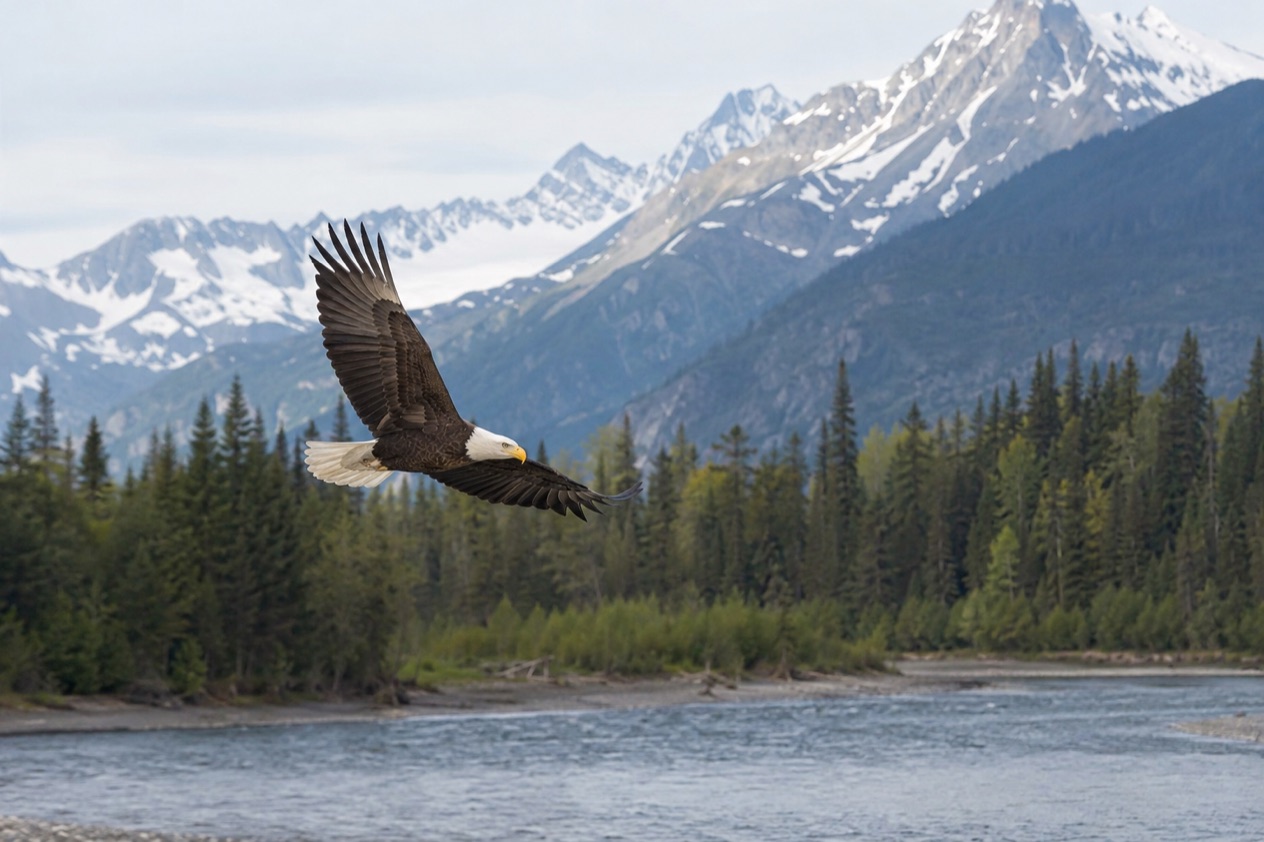
Where can you see bald eagles in Alaska?
Haines itself is a small port community on the shores of the Lynn Canal, the state’s longest fjord, and the preserve begins just outside town.
The Chilkat Bald Eagle Preserve
The preserve is a state park and wildlife refuge covering a large stretch of river country, mainly along the Chilkat River, with sections along the Klehini and Tsirku rivers. Between 200 and 400 eagles live here all year, so even outside the big gathering you have a chance of seeing birds perched over the water or soaring above the spruce.
A popular viewing stretch is the Haines Highway from miles 12 to 18. You pull off, step out and scan the cottonwoods and gravel bars. The experience is mostly one of patience: eagles sit motionless for long spells, then drop to the river or lift off together when something startles them. Those who enjoy simply standing and watching will be happiest here.
Haines and the Lynn Canal
Haines is the base for the preserve, and getting there shapes the trip. The only road link to the rest of the continent is Highway 3 from Haines Junction in the Yukon, 155 miles away. The only scheduled commercial flights to the airport, about 4 miles west of town, come from Juneau and Skagway, and the state ferry terminal sits about 4 miles north of town.
Once in town, Fort William H. Seward is worth an unhurried stroll between eagle outings. It was Alaska’s first U.S. army fort, built in the gold rush era, and it is a National Historic Landmark. For more wildlife, the Kroschel Wildlife Center, about 30 miles northwest of town on the Haines Highway, offers guided tours with grizzly bear, wolf, moose, lynx, snowy owl and wolverine among more than 15 species.
Sitka and the Alaska Raptor Center
In Sitka, the Alaska Raptor Center is a sanctuary set in the Tongass National Forest. It is a place to see raptors up close rather than in the wild, and it takes in injured birds and releases others back each year. Visitors can support its work by volunteering, donating, adopting a raptor or shopping.
The Tongass setting matters for eagles generally. In Southeast Alaska, Sitka spruce provides most of the nesting trees eagles use, with hemlocks next, so the old forest around Sitka and elsewhere in the region is the birds’ home even where no crowd of them gathers.
Ketchikan and other coastal towns
Ketchikan is an island community surrounded by rainforest and sea, shaped by Alaska Native culture and fishing traditions. Eagles are part of that setting of salmon, shoreline and spruce, so a day here pairs well with the Totem Heritage Center, Totem Bight State Historical Park, the Tongass Historical Museum and the Southeast Alaska Discovery Center. The tour center is in the Berth 2 Visitor Information Center.
In southern Alaska, eagles work the estuaries and shallow coastlines where herring, sand lance and eulachon run. A photo of an eagle taking flight at Kachemak Bay shows that the same bird turns up well beyond the Panhandle.
When do the eagles gather?
The eagles gather in the colder months, with more than 3,500 visiting the Haines area from October to February. That is why a page written in October sits right at the start of the season.
The Fall Congregation
The annual Fall Congregation in the Chilkat preserve has drawn up to 4,000 bald eagles at once. They come for the fish, and the river is the draw. Add the 200 to 400 residents and the valley holds a bird count that feels almost unreal when you see cottonwood after cottonwood loaded with eagles.
What you notice first is the sound and the sheer stillness of so many large birds. Then a fish surfaces, and the quiet breaks into a scramble of talons, wings and calls. Mornings and afternoons will each look different, since the eagles move about the river, but the chance of a crowded riverbank is greatest within that October to February window.
The Bald Eagle Festival in mid-November
The Bald Eagle Festival in Haines is a five-day celebration in mid-November, held mostly within the Eagle Council Grounds at 19 mile Haines Highway. It gathers people who share an interest in the birds, in the middle of the season when eagles are on the river.
For a traveler, the festival turns a quiet wildlife trip into a small community event in a town that is otherwise small and calm. It suits anyone who likes to combine watching with a bit of company and local activity.
Why the eagles are there
Fish is the key. In Southeast Alaska, fish make up roughly two thirds of the year-round diet of bald eagles and most of what parents bring to the nest. They largely take pink and coho salmon, with sockeye in places and some Chinook.
Eagles are not picky, though. In Alaska they also eat sea urchins, chitons, mussels and crabs, and they readily prey on sea otter pups. Along southern coasts, herring, sand lance and eulachon matter in the estuaries. So what you watch on the river is one example of a hunter with a broad menu.
How do you watch them?
You watch them mostly by stopping along the river road and looking, from pullouts on the Haines Highway between miles 12 and 18, with time and patience as your main tools. A day at the preserve is slow by design.
At the river
Start at the viewing stretch and walk the pullouts rather than hurrying to one spot. Scan the tops of the cottonwoods first, then the gravel bars and the open water. Eagles tend to look like white dots against bare branches, and a pair of binoculars lets you pick out a bird tearing at a fish.
Stand still and keep your voice low. Watching works best when you let the scene come to you, since the birds will often shift from perch to river without warning. The Eagle Council Grounds at 19 mile are the center of festival activity in mid-November.
Around Haines
Between river stops, use the town. Fort Seward gives you old buildings and a walk with a view of the Lynn Canal. The library in town has free computer workstations on a first-come, first-served basis, handy for a quick look at plans.
If a cruise ship is in port, a shuttle bus runs every 30 minutes from the Port Chilkoot Dock to several attractions and back during dockings. Haines sees only about 20 ship calls per season, mainly from the Holland-America Line, so the town keeps a small-port feel.
Beyond the eagles
A guided tour at Kroschel Wildlife Center, on the Haines Highway, lets you see animals such as grizzly bear, wolf, lynx and snowy owl in a managed setting. It makes a contrast with the wild eagles: the birds on the river are free and unpredictable, while the center offers a sure look at other species.
In Sitka, the Raptor Center gives a close view of birds that cannot be released, and in Ketchikan the totem parks and museums add a cultural layer to a wildlife trip.
Good to know before you go
Haines is reached by road from the Yukon, by ferry, or by scheduled flights from Juneau and Skagway, so allow for that when planning. Eagles are wild birds, so watch from the pullouts and let them keep their space. The gathering runs from October to February, and the festival falls in mid-November.
Sources
- Wikipedia, Bald eagle (https://en.wikipedia.org/wiki/Bald_eagle), checked October 11, 2026
- Wikipedia, Chilkat Bald Eagle Preserve (https://en.wikipedia.org/wiki/Chilkat_Bald_Eagle_Preserve), checked October 11, 2026
- Alaska Raptor Center, Sitka (https://www.alaskaraptor.org/), checked October 11, 2026
- Wikivoyage, Haines (https://en.wikivoyage.org/wiki/Haines), checked October 11, 2026
- Visit Ketchikan (https://www.visit-ketchikan.com/), checked October 11, 2026