
On the first Saturday of March, Fourth Avenue turns into a snow-packed runway lined with spectators in parkas, and the sound is a roar of barking from dog teams eager to run. March here is still a winter month, with snow on the ground and dark skies for the northern lights, but the days are stretching fast, which makes it a good time for travelers who want winter Alaska with a little more daylight to enjoy it.
What is the weather like in Anchorage in March?
March in Anchorage is cold and snowy but clearly turning toward spring, with afternoons that hover around freezing and a good deal of sun between the snowfalls.
| Month | Average high (°F) | Average low (°F) | Precipitation (in) | Days with precipitation | Daylight on the 15th |
|---|---|---|---|---|---|
| February | 27.3 | 15.2 | 0.86 | 3.0 | 8 h 58 min |
| March | 33.0 | 18.6 | 0.69 | 2.3 | 11 h 38 min |
| April | 45.1 | 29.9 | 0.43 | 1.4 | 14 h 36 min |
Mornings start well below freezing, so the snow squeaks underfoot and the air feels sharp until the sun climbs. By afternoon it can feel almost mild if the wind is quiet, and a jacket may come unzipped on a sunny day. Precipitation falls on only a couple of days, and it falls as snow, about 11.0 inches over the month. A storm tends to leave a fresh white layer, then the sky clears.
The light is the real change. Dusk comes late enough that the city is no longer lit mostly by streetlamps at the end of the afternoon, yet nights stay dark enough for the aurora.
Dress in layers: a warm base, an insulating middle and a windproof outer shell, plus insulated boots, a hat and gloves. Rain gear is not the issue this month. What matters is staying warm when you stand still, whether at a street parade of dog teams or outside after dark waiting for the sky to light up.
What to do in Anchorage in March
The big event of the month is the Iditarod Trail Sled Dog Race, one of Alaska’s iconic winter events, and its excitement traditionally starts in Anchorage on the first Saturday of March. Around it, the city offers winter sports, aurora watching and flights over the mountains. Anchorage is an urban enclave surrounded by wilderness, so a day often moves from a downtown café to a snowy trail in a matter of minutes.
The Iditarod ceremonial start downtown
The ceremonial start takes place in downtown Anchorage at Fourth Avenue and D Street, where spectators can watch the mushers depart. The route runs from there to Campbell Creek Science Center. Teams leave one after another, each driver waving to the crowd while the dogs lunge at their harnesses, and the whole street fills with the smell of wool, coffee and cold air.
The ceremonial start is a send-off, and the official restart happens the day after in Willow, 80 miles north of Anchorage. From there the trail crosses Rainy Pass in the Alaska Range, follows the Bering Sea shore and ends in Nome, passing towns such as Skwentna, McGrath and Unalakleet. The full race is 1,049 miles long. Those who cannot be in Anchorage can follow standings and free live broadcasts on the race website.
Northern lights from the city
From late September through the middle of April, the northern lights are active in the skies over Anchorage, so March sits inside the season. Anchorage is described as one of the best bases from which to chase the aurora, with many prime locations accessed from the city. Viewing is possible even after sundown, though the show is never guaranteed, and a cloudy night can hide it completely.
Research from Interior Alaska notes that auroral activity tends to be stronger around the spring equinox than at midwinter, which gives March a statistical edge. Dress for standing still in the cold, keep an eye on the sky after dark and be ready to go out on short notice if the clouds break.
Dog sledding and winter flightseeing
Dog sledding in Anchorage typically operates from October through March, so this is the end of the season. In Alaska, sled dogs traditionally pull side by side in pairs rather than in a fan shape, and the sleds are the built-up type with a high rail on each side. Seeing the teams at work is a good way to understand why the Iditarod matters so much here.
Clear winter skies keep pilots flying, which makes flightseeing over the Chugach Mountains and the Alaska Range a winter option. From the air the snowfields and ridgelines look sharp against the low sun.
Wildlife is part of the city’s character, and moose can turn up in town, so look before you cross a snowy parking lot or park trail. In March it is a pleasure of chance, not something to plan around. Winter Anchorage is also a good moment for a museum afternoon or a long lunch when the wind picks up.
A two-day itinerary for Anchorage in March
Day 1 belongs to downtown and the Iditarod if your trip falls on the first Saturday. Start in the morning on Fourth Avenue and find a spot near D Street before the teams leave. After the last sled disappears, warm up in a café nearby and eat a long lunch of salmon chowder or a reindeer sausage sandwich.
If it is not race weekend, spend the morning walking the downtown streets and the Anchorage Museum instead. In the afternoon, head to Ship Creek, where the city began as a tent camp when railroad construction started, and look at the frozen creek and the rail yards. As the evening light fades, have dinner at a local restaurant and then step out for an aurora watch if the sky is clear.
Day 2 is for the mountains and the winter outdoors. Spend the morning on a dog sled outing, since the season ends this month, and the afternoon on a flightseeing trip over the Chugach Mountains if the sky is clear. Skiing, skating or a snowshoe walk at a city park are good alternatives when you would rather stay on the ground.
If the weather turns gray and snowy, spend the day indoors at a museum, a brewery or a bakery. Evening is a good time for another look at the sky, since the aurora needs darkness and clear air, not good daytime weather.
Is Anchorage busy in March?
March is outside the main visitor season, since the best time to visit Anchorage is between May and early September, so the city feels quieter than in midsummer.
The exception is the Iditarod weekend, when the downtown streets around Fourth Avenue and D Street fill with spectators and the whole city has a festive mood. Outside that Saturday, the pace is calmer, with winter activities such as dog sledding, skiing and aurora watching drawing the visitors who do come. Cafés and restaurants have a local feel, and the evenings are for those out for northern lights.
What to pack for Anchorage in March
Pack for cold mornings, sunny afternoons and long stretches standing still outdoors, whether watching the mushers or waiting for the aurora.
- Insulated, waterproof boots, because the ground is snowy and you may stand for hours along the Iditarod route.
- Layers (base, fleece, windproof shell) for chilly mornings and milder afternoons.
- A warm hat and gloves, plus extra liner gloves for photos at night.
- Sunglasses, since March sun on fresh snow is bright.
- Hand and foot warmers for aurora watching after dark.
- A small daypack to carry shed layers.
Good to know before you go
March sits at the end of the winter season, which shapes what is open. Dog sledding in Anchorage typically operates from October through March, so a ride is possible now but not after this month. The aurora season runs into the middle of April.
Anchorage has the region’s main airport hub, Ted Stevens Anchorage International Airport, with non-stop flights from cities such as Seattle, Denver, Chicago, Minneapolis, Los Angeles and Phoenix.
Anchorage in March vs February and April
Moving the trip four weeks earlier means a colder, snowier Anchorage with much shorter days. February is deep winter, with the aurora and dog sledding both available but less daylight to enjoy the outdoors. The Iditarod start belongs to March, so a February trip misses it.
Four weeks later brings a very different feel. April is noticeably warmer, with much less snow and many more hours of light. Dog sledding in Anchorage has typically ended, and the aurora season is close to its end in the middle of the month. Spring begins to show in the city, though it is not yet the green of summer.
Choose February for deep winter and the longest nights. Stay with March if you want the Iditarod start, a last dog sledding window and a good balance of cold, daylight and aurora. Shift to April if you want milder days and long light, and do not mind losing the winter sports.
Is March a good time to visit Anchorage?
Yes, March is a good time for travelers who want winter Alaska with generous daylight, the Iditarod start and a chance of northern lights.
It suits people who like snow, crisp air and outdoor activities such as dog sledding, skiing and flightseeing. It is less suited to those who want summer’s long evenings, wildlife cruises or green landscapes, since the best time to visit Anchorage is between May and early September.
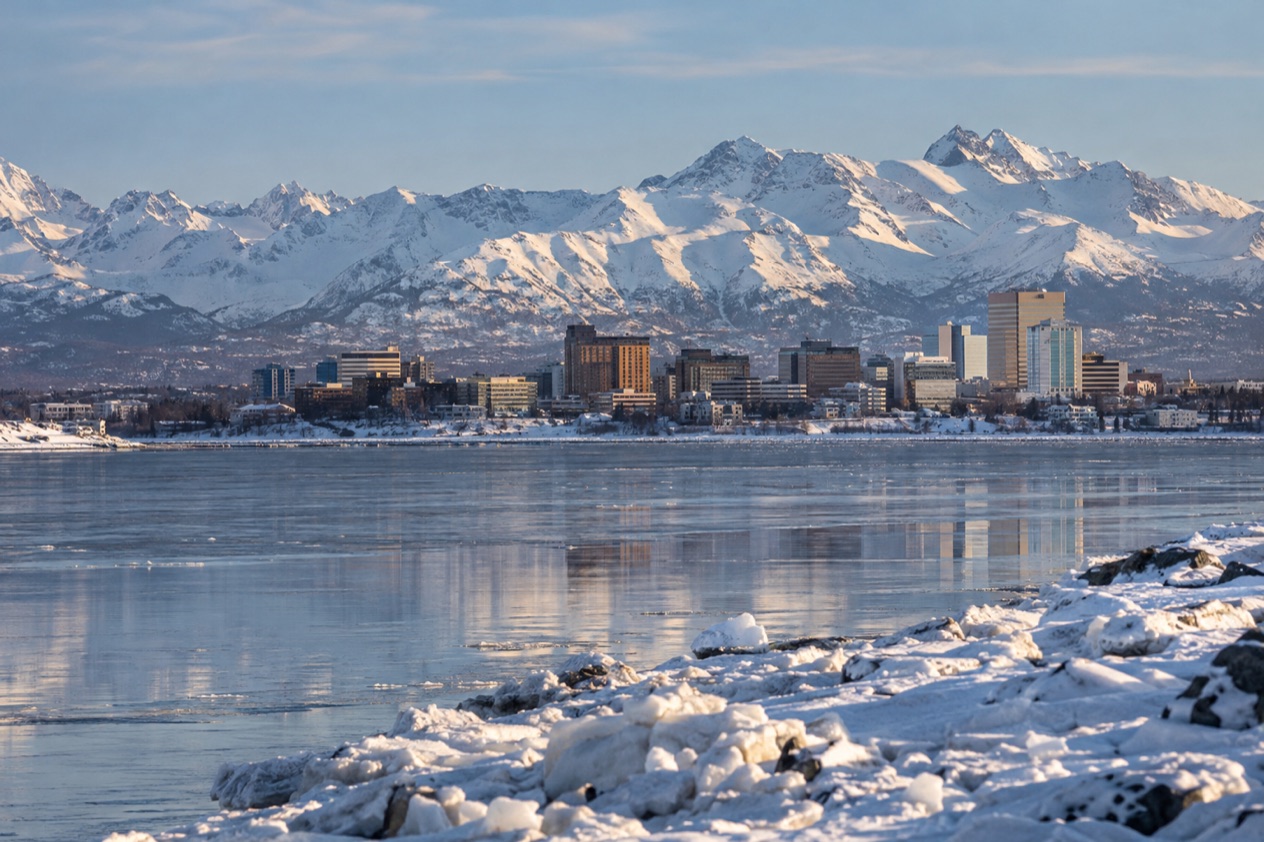
On arrival, find out when the Iditarod ceremonial start is, since it traditionally falls on the first Saturday of March, and then plan the rest of the trip around it. Keep at least one evening free for an aurora watch, because the sky needs to cooperate. What stays with you from March in Anchorage is the sight of dog teams lunging down a snow-lined Fourth Avenue, with the Chugach Mountains white behind the downtown buildings.
Sources
- NOAA NCEI, U.S. Climate Normals 1991-2020, monthly (https://www.ncei.noaa.gov/access/services/data/v1?dataset=normals-monthly-1991-2020&stations=USW00026451), station Anchorage Intl Ap, elevation 120 feet, checked October 11, 2026
- Computed from the date and the latitude of the place (sunrise equation, solar elevation -0.833 degrees), October 11, 2026
- University of Alaska Fairbanks Geophysical Institute, Aurora forecast (https://www.gi.alaska.edu/monitors/aurora-forecast), checked October 11, 2026
- Wikivoyage, Northern lights (https://en.wikivoyage.org/wiki/Northern_lights), checked October 11, 2026
- Wikipedia, Aurora (https://en.wikipedia.org/wiki/Aurora), checked October 11, 2026
- Visit Anchorage, northern lights viewing (https://www.anchorage.net/winter/things-to-do/northern-lights-viewing/), checked October 11, 2026
- Visit Anchorage, dog sledding (https://www.anchorage.net/winter/things-to-do/dog-sledding/), checked October 11, 2026
- Wikipedia, Dog sled (https://en.wikipedia.org/wiki/Dog_sled), checked October 11, 2026
- National Park Service, Denali National Park & Preserve, plan your visit: kennels (https://www.nps.gov/dena/planyourvisit/kennels.htm), checked October 11, 2026
- National Park Service, Denali National Park & Preserve, plan your visit: winter activities (https://www.nps.gov/dena/planyourvisit/winter-activities.htm), checked October 11, 2026
- Iditarod Trail Committee, the Iditarod (https://www.iditarod.com/), checked October 11, 2026
- Iditarod, about (https://www.iditarod.com/about/), checked October 11, 2026
- Visit Anchorage, Iditarod (https://www.anchorage.net/winter/events/iditarod-sled-dog-race/), checked October 11, 2026
- Wikipedia, Iditarod Trail Sled Dog Race (https://en.wikipedia.org/wiki/Iditarod_Trail_Sled_Dog_Race), checked October 11, 2026
- Visit Anchorage, wildlife viewing (https://www.anchorage.net/outdoors/wildlife-viewing/), checked October 11, 2026
- Visit Anchorage, winter things to do (https://www.anchorage.net/winter/things-to-do/), checked October 11, 2026
- Alaska.org, dest anchorage (https://www.alaska.org/destination/anchorage), checked October 11, 2026
- Wikivoyage, Anchorage (https://en.wikivoyage.org/wiki/Anchorage), checked October 11, 2026
- Wikipedia, Anchorage, Alaska (https://en.wikipedia.org/wiki/Anchorage,_Alaska), checked October 11, 2026
- Wikipedia, Climate of Alaska (https://en.wikipedia.org/wiki/Climate_of_Alaska), checked October 11, 2026
To plan your stay
- Things to Do in Anchorage: Museums, Alaska Native Heritage, Chugach Trails and Day Trips
- Where to Stay in Anchorage: Downtown, Eagle River, Girdwood and Lodging Types
- Anchorage from the Lower 48: Flights, Roads, Ferries and Trains Once You Arrive
- Know Before You Go to Anchorage: Weather, Wildlife, Getting Around and Local Habits