
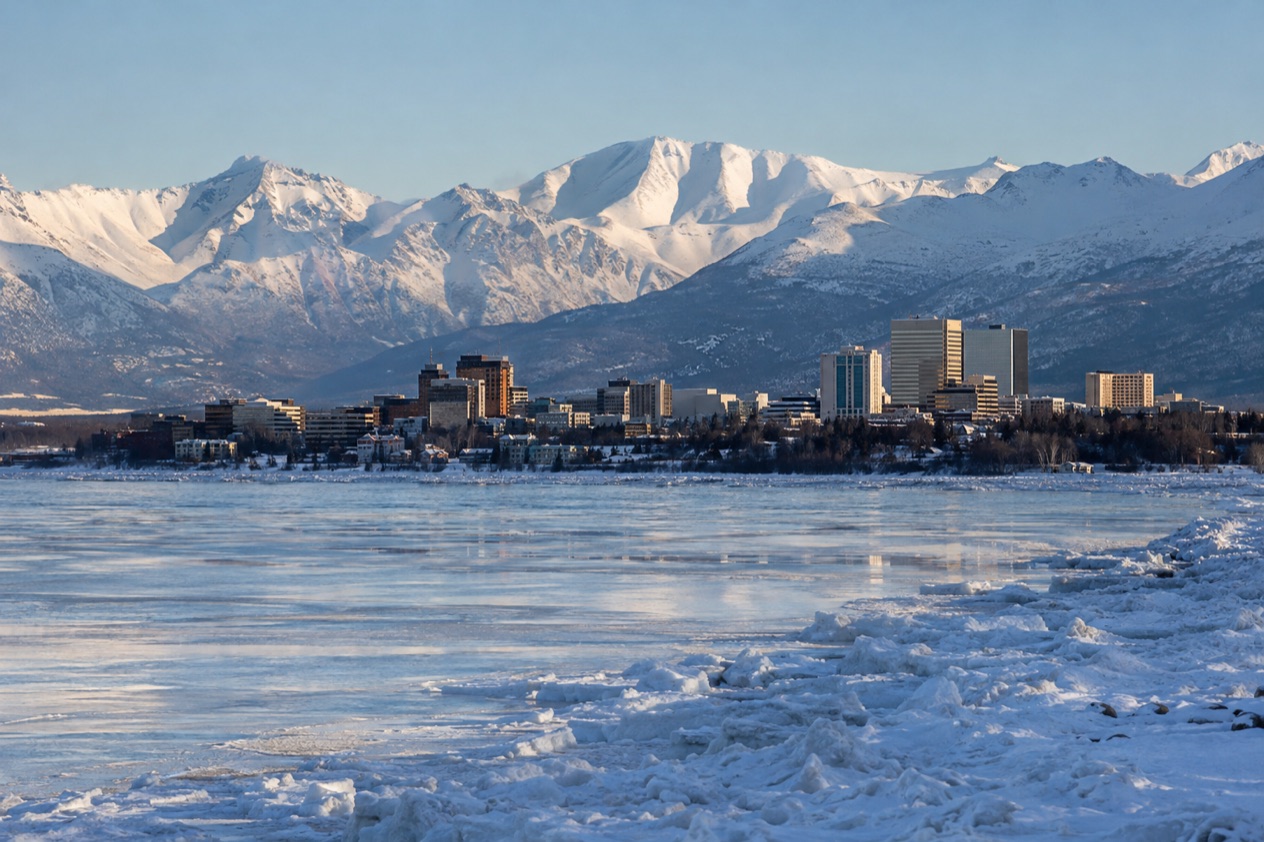
In January, Anchorage wakes up in the dark. Streetlights glow on fresh snow, exhaust hangs in the cold air outside the coffee shops, and the Chugach Mountains turn pink for a little while before the short day fades again.
It is a quiet, hushed month in Alaska’s biggest city, with dog teams, northern lights and warm restaurants. This is the page for travelers who want to see Anchorage in deep winter, when the town slows down and turns inward.
What is the weather like in Anchorage in January?
January in Anchorage is cold and mostly dry, with snow on the ground and short days that are slowly getting longer.
| Month | Average high (°F) | Average low (°F) | Precipitation (in) | Days with precipitation | Daylight on the 15th |
|---|---|---|---|---|---|
| December | 25.0 | 13.8 | 1.16 | 4.0 | 5 h 34 min |
| January | 22.7 | 11.0 | 0.75 | 2.7 | 6 h 20 min |
| February | 27.3 | 15.2 | 0.86 | 3.0 | 8 h 58 min |
What this means on the street: mornings are the coldest part of the day, and the afternoons barely lift above the teens or low 20s. That is cold enough that you will want real insulation, not just a stylish jacket. Because it is so dry, the cold tends to feel crisp rather than damp, and a clear day with sun on the snow can be surprisingly pleasant for a walk.
Expect plowed streets, packed snow on sidewalks and ice in shady spots, so shoes with grip matter as much as a warm coat.
The light is the character of the month. Daylight lasts a little over six hours in mid-January, and it keeps stretching as the weeks pass. The sun stays low, so the mountains and the snow take on a soft, golden-pink tone. Plan outdoor time in the middle of the day and keep the long evenings for indoor meals or for stepping out to watch the sky.
What to do in Anchorage in January
The big event of the winter here is Fur Rendezvous, known as Fur Rondy, which is Alaska’s largest and oldest winter festival. It began in 1936 as a three-day sporting event and has grown into a celebration of winter with events around downtown.
One of its best-loved oddities is the Outhouse Races, where teams steer outhouses on skis.
Anchorage also runs on the rhythm of its sled dogs. The Iditarod Trail Sled Dog Race is one of the state’s iconic winter events, and while the ceremonial start traditionally takes place on the first Saturday of March, the dog culture is part of the city’s winter all season. Dog sledding in Anchorage typically operates from October through March, so January falls squarely within the season.
Chasing the northern lights from Anchorage
From late September through the middle of April, the northern lights are active in the skies over Anchorage. January therefore sits right in the middle of the viewing season, and long dark evenings give you plenty of hours to look. The aurora is caused by charged particles from the sun colliding with gas molecules in the upper atmosphere, producing colors such as green, red and purple.
Anchorage is described as one of the best bases from which to chase the aurora, with many prime locations easily accessed from the city. The northern lights oval, where the chance of seeing the lights is highest, covers most of Alaska. Seeing them is a chance, not a promise. Clear skies matter most, so a cloudy night may call for patience and another try the next evening.
People head toward Fairbanks for a longer aurora stay. There, the viewing season runs roughly from August 21 to April 21, and with clear weather and at least three nights, seeing the aurora is described as highly likely. If you are staying in Anchorage, treat each clear night as an opportunity and dress for standing still in the cold.
Dog sledding and Denali’s kennels
In Alaska, sled dogs traditionally pull side by side in pairs rather than in a fan shape, and the sleds are typically the built-up type with a high rail on each side. A dog sledding outing in Anchorage is a way to see that tradition up close, with the dogs eager and loud before the run and suddenly quiet once they are moving.
The winter visitor center is the Murie Science and Learning Center at mile 1.3 on the Denali Park Road, and the park’s winter season runs from late September until early May.
| Site | Open |
|---|---|
| Denali National Park kennels (winter) | Saturdays and Sundays, 1 pm to 4 pm |
Flightseeing over the winter landscape
Flightseeing tours depart from Anchorage year-round, and personalized tours or charters are offered by floatplane, fixed wing and helicopter. Alaska has about six times as many pilots per capita as the rest of the United States, and flying is part of everyday life here.
In January, a flight offers a view of snowbound mountains and frozen country from above, with the low sun lighting the peaks for much of the short day. Which of the three aircraft suits you depends on what you want to see, and the operator can tell you what their trips cover.
Back in town, winter is the season for warm rooms: a bowl of something hot after a cold morning, a table by the window while the light fades, and live music when the evening comes. The city’s events range from concerts and live music to cultural celebrations, and the Anchorage Local E-newsletter is one way to keep up with what is happening.
A two-day itinerary for Anchorage in January
Day 1. Start late and slowly, since the sun comes up well after a normal breakfast. Have coffee and something warm in a downtown café while the sky lightens, then use the middle of the day, when the light is best, for a winter outing. A dog sledding session fits the season, as the dog sledding season runs through March. Wear every layer you packed.
Once the light fades in the afternoon, move indoors for a long lunch or an early dinner at a restaurant with a window onto the snow. After dark, if the sky is clear, head out of the brightest part of town to look for the aurora. The northern lights are active over Anchorage at this time of year, but they are never guaranteed.
Day 2. Give the second day to the sky and the city. A flightseeing tour departs from Anchorage year-round, and a morning flight puts the mountains beneath you while the low sun lights them. Pick floatplane, fixed wing or helicopter depending on what the operator offers.
In the afternoon, walk downtown streets in the last light and warm up in a museum or shop. If the weather turns, the rain card is simple: spend the day indoors with a long meal, a local brewery or live music, and try the sky again after dark. Evenings are long, so there is time for a second attempt.
Is Anchorage busy in January?
January is a quiet winter month in Anchorage, far from the busy summer season, and the pace of the town slows with the cold and the short days. The visitors who come are mostly there for winter itself: the aurora, dog sledding and snow.
The calendar of events leans toward the weeks ahead, with Fur Rondy and the Iditarod start building toward March. Winter activities such as dog sledding and flightseeing run in the meantime, and the town feels calm, with long evenings and plenty of room in the restaurants and cafés that stay lit and warm.
What to pack for Anchorage in January
Pack for steady cold and long stretches outside, especially if you plan to be out for the aurora or on a sled.
- A warm insulated parka, because afternoons stay well below freezing.
- Thermal base layers, for standing still on aurora nights.
- Insulated boots with good grip, for packed snow and ice.
- Warm hat, gloves or mittens and a scarf, since hands and ears feel the cold first.
- Sunglasses, because low sun on snow is bright.
- A headlamp, for the long dark hours.
Good to know before you go
The main thing to plan around in January is the light. With just over six hours of daylight in mid-month, put your outdoor activities in the middle of the day and save evenings for meals, music or the sky. Denali’s kennels keep weekend-only winter hours, so a trip there needs a Saturday or Sunday. Flightseeing tours depart from Anchorage year-round, so they remain an option when other plans change.
Anchorage in January vs December and February
Moving earlier to December brings even less light, with about five and a half hours of daylight in mid-month, and a bit more snow and precipitation. It is the darker, cozier side of winter, with the aurora still active and the holiday season shaping the mood downtown.
Moving later to February means a noticeably longer day, nearly nine hours of light in mid-month, and slightly milder temperatures. The aurora season continues, dog sledding still runs, and the town starts to feel the build toward Fur Rondy and the Iditarod start in March.
If you want the deepest winter and the longest nights, December or January suit you. If you want more daylight for outdoor time without leaving winter behind, February is the better choice. January sits between them, with cold, quiet streets and a day that is growing again.
Is January a good time to visit Anchorage?
Yes, for travelers who want real winter: cold, snow, long nights and a chance at the northern lights. It suits people happy to dress warmly, spend a few hours a day outside and enjoy a slow, indoor-leaning pace the rest of the time.
It is a poorer fit for anyone who wants long daylight, mild weather or a busy summer-style city. If cold is a dealbreaker, another month will be kinder.
On arrival, get your layers sorted, then plan the daylight hours around one outdoor highlight, such as a dog sledding session or a flight over the mountains, and keep a clear evening open for the sky. What makes January in Anchorage special is the contrast: a hushed, snowy city by day, and a dark sky that may light up green at night.
Sources
- NOAA NCEI, U.S. Climate Normals 1991-2020, monthly (https://www.ncei.noaa.gov/access/services/data/v1?dataset=normals-monthly-1991-2020&stations=USW00026451), station Anchorage Intl Ap, elevation 120 feet, checked October 11, 2026
- Computed from the date and the latitude of the place (sunrise equation, solar elevation -0.833 degrees), October 11, 2026
- University of Alaska Fairbanks Geophysical Institute, Aurora forecast (https://www.gi.alaska.edu/monitors/aurora-forecast), checked October 11, 2026
- Wikivoyage, Northern lights (https://en.wikivoyage.org/wiki/Northern_lights), checked October 11, 2026
- Wikipedia, Aurora (https://en.wikipedia.org/wiki/Aurora), checked October 11, 2026
- Visit Anchorage, northern lights viewing (https://www.anchorage.net/winter/things-to-do/northern-lights-viewing/), checked October 11, 2026
- Visit Anchorage, dog sledding (https://www.anchorage.net/winter/things-to-do/dog-sledding/), checked October 11, 2026
- Wikipedia, Dog sled (https://en.wikipedia.org/wiki/Dog_sled), checked October 11, 2026
- National Park Service, Denali National Park & Preserve, plan your visit: kennels (https://www.nps.gov/dena/planyourvisit/kennels.htm), checked October 11, 2026
- National Park Service, Denali National Park & Preserve, plan your visit: winter activities (https://www.nps.gov/dena/planyourvisit/winter-activities.htm), checked October 11, 2026
- Visit Anchorage, events (https://www.anchorage.net/events/), checked October 11, 2026
- Visit Anchorage, flightseeing (https://www.anchorage.net/things-to-do/flightseeing/), checked October 11, 2026
- Visit Anchorage, Fur Rondy (https://www.anchorage.net/winter/events/fur-rondy/), checked October 11, 2026
- Visit Anchorage, Iditarod (https://www.anchorage.net/winter/events/iditarod-sled-dog-race/), checked October 11, 2026
- Wikipedia, Climate of Alaska (https://en.wikipedia.org/wiki/Climate_of_Alaska), checked October 11, 2026
To plan your stay
- Things to Do in Anchorage: Museums, Alaska Native Heritage, Chugach Trails and Day Trips
- Where to Stay in Anchorage: Downtown, Eagle River, Girdwood and Lodging Types
- Anchorage from the Lower 48: Flights, Roads, Ferries and Trains Once You Arrive
- Know Before You Go to Anchorage: Weather, Wildlife, Getting Around and Local Habits