
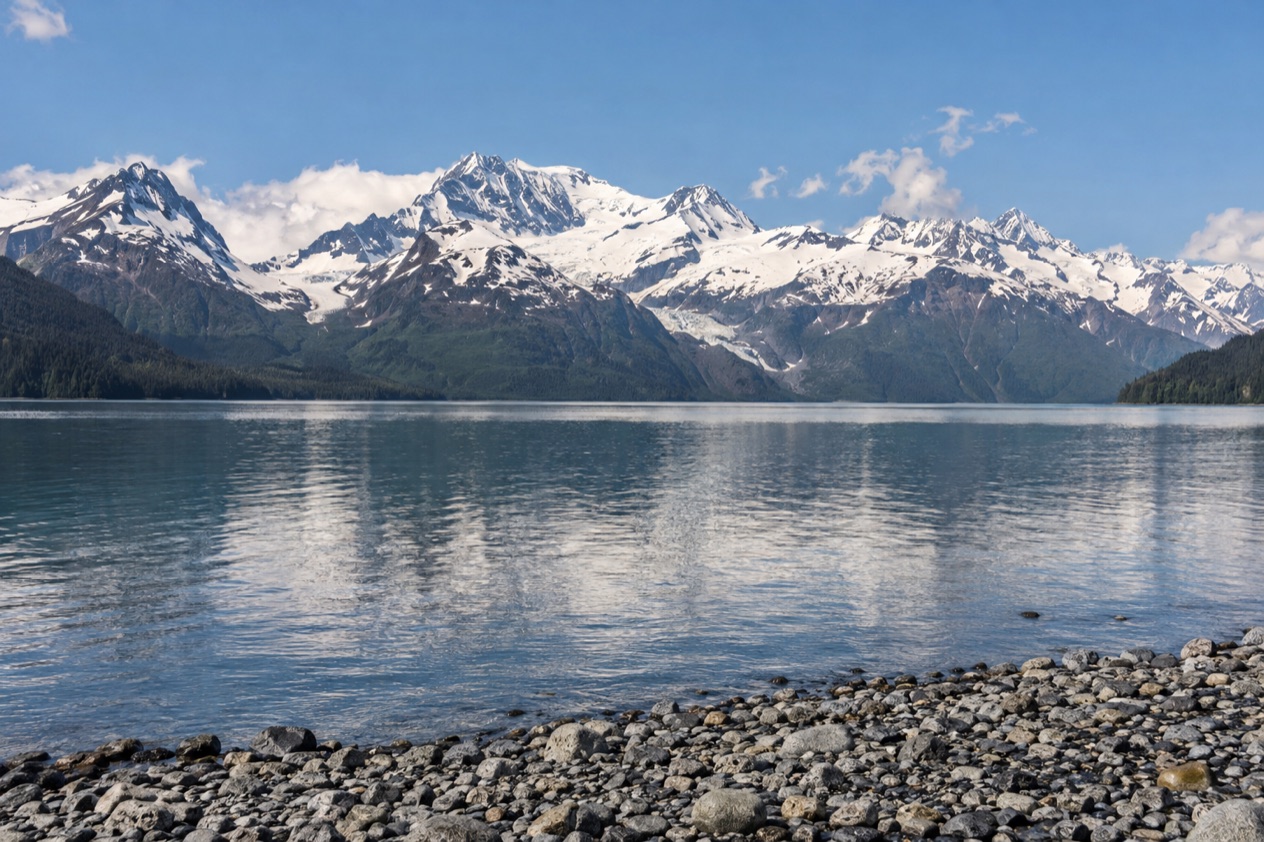
A trailhead above Anchorage, a lake with a glacier at the far end, a cabin on an island you reach only by boat or float plane: these are all state park land, and they often get lost between the national parks everyone has heard of. Alaska runs one of the largest state park systems in the country, from Fairbanks to the Inside Passage. It rewards travelers who want trails, lakes and cabins a little off the main tourist circuit.
What state parks does Alaska have?
Alaska has a very large system: the state parks division oversees more than 156 park units, from the far north to the tips of Southeast, and its land and water add up to three million acres, the most of any state park system in the country. The Alaska Department of Natural Resources, through its division of Parks and Outdoor Recreation, manages all of it.
Not every unit is a park in the strict sense. The division manages full state parks, state recreation areas, state recreation sites, and state historic sites. In practice, a recreation site may be a campground and a boat launch by a river, while a historical park tells you about a place and its people. The system began in 1970 with the creation of Denali State Park, Chugach State Park and Kachemak Bay State Park.
Wood-Tikchik State Park is the largest state park in the United States, holding some 15% of all state park land in the nation.
Southcentral: Anchorage, the Mat-Su and the Copper River Basin
Chugach State Park is the one travelers meet first, because it sits in the Anchorage area. Farther out, the Mat-Su region holds 24 parks and more than 650,000 acres. It covers the Matanuska-Susitna Valley and the Copper River Basin, and it includes Denali State Park and Independence Mine State Historical Park.
The region is a short drive from Anchorage, so it suits day trips exploring lakes. It also offers multi-day hiking in remote sub-alpine tundra, and wildlife is abundant. Some of the most popular destinations there have four-season access. In the Copper River Basin you find Lake Louise State Recreation Area and Liberty Falls State Recreation Site.
Kenai Peninsula and Prince William Sound
The Kenai Peninsula is home to Kachemak Bay, Resurrection Bay and the Kenai River, and its parks follow the same geography. Kachemak Bay State Park is near Homer, and Anchor River and Deep Creek State Recreation Areas are in the Homer area too. Captain Cook and Johnson Lake State Recreation Areas are in the Kenai and Soldotna area.
Near Seward you find Caine’s Head State Recreation Area and Thumb Cove State Marine Park. Shoup Bay State Marine Park is near Valdez, and Decision Point State Marine Park is near Whittier. In the Prince William Sound area, the list also includes Worthington Glacier State Recreation Site and Bettles Bay State Marine Park.
Interior, Kodiak and Southeast
The Northern Region has 16 state parks spanning 400 square miles. Chena River and Harding Lake State Recreation Areas are in the Fairbanks area, while Big Delta State Historical Park and Quartz Lake State Recreation Area are in the Delta Junction area.
On Kodiak Island you find Afognak Island State Park and Fort Abercrombie State Historical Park. In Southeast, every state park lies within the Tongass National Forest, which surrounds the Inside Passage. Eagle Beach near Juneau, Chilkat State Park near Haines, Halibut Point in Sitka and Totem Bight State Historical Park in Ketchikan are among them.
Which are the best known?
Chugach State Park is the one people reach first, and the three parks that founded the system, Chugach, Denali State Park and Kachemak Bay, are the names to start with. Beyond those, Independence Mine and the Kenai marine parks fill out the short list.
Chugach State Park
Chugach holds approximately 495,000 acres and is one of the four largest state parks in the United States. Its westernmost boundary is seven miles east of downtown Anchorage, and communities within minutes include Eagle River, Chugiak, Girdwood, Indian, Bird, Palmer and the village of Eklutna. Legislation signed on August 6, 1970, created it.
At Eklutna Lake, the Lakeside Trail follows the shore for 12.7 miles to the mile-long Eklutna Glacier Trail, which leads to the moraines at the foot of the glacier. In summer you can go on foot, by mountain bike, ATV or on horseback along the largely flat trail.
In winter it can be traveled by snowmobile, snowshoes or cross-country skis, as regulation and weather permit. Only non-motorized boats and boats with an electric motor are allowed on the lake.
Near Eagle River, the Eagle River Nature Center, run by a non-profit in association with the park, exhibits interpretive information on wildlife and geological features. The Albert Loop Trail is closed in the fall when bears are using the area for fishing.
The Historic Iditarod Trail, also called Crow Pass Trail, runs 28 miles through the park between Eagle River and Girdwood. McHugh Creek has hiking trails and picnic areas, and the privately run Flattop Mountain Shuttle links downtown Anchorage with the Glen Alps Trailhead.
Denali State Park and Independence Mine
Denali State Park is in the Matanuska-Susitna Valley and offers sweeping vistas. The K’esugi Ken Webcam shows current snow levels at K’esugi Ken Campground and what Denali looks like right now, which is handy before you plan a stop. Interpretive programming at the K’esugi Ken Interpretive Center is provided most summer days, from Memorial Day through Labor Day.
Independence Mine State Historical Park sits in Hatcher Pass near Palmer, surrounded by rugged peaks. Hatcher Pass also has the Gold Mint Trailhead and Government Peak Campground. Nancy Lake State Recreation Area, in the same region, is the place for relaxing by the water.
Kachemak Bay and the marine parks
Kachemak Bay State Park, near Homer, was one of the three original parks. Across the Kenai Peninsula, the marine parks around Resurrection Bay and Prince William Sound add more shoreline names to know: Thumb Cove and Caine’s Head near Seward, Shoup Bay near Valdez, and Decision Point near Whittier.
Wood-Tikchik is the giant of the system, and its camping permits can be reserved 180 days out. On Kodiak, Fort Abercrombie, Buskin River and Pasagshak River are on the road system, while Shuyak Island, Afognak Island and Woody Island are reachable only by boat or float plane.
How do you visit them?
You visit most state parks by driving to a trailhead, campground or picnic area, and you reserve cabins, shelters and group sites through the online reservation system. A few places in the system need a boat or float plane, so check the access before you plan.
Cabins and reservations
Most cabins can be reserved up to 90 days out, with the window opening at 12:00am that day. Cabins in Afognak Island State Park and Shuyak Island State Park, along with camping permits in Wood-Tikchik State Park, open 180 days out. Online reservations carry a $4.50 fee per reservation, and anyone with a Reserve America account will see it migrated to the new system.
Cancel within 2 days of arrival and there is no refund or credit. Kodiak region cabins have a stricter line: cancellations within 14 calendar days before arrival get no refund, so you must cancel at least 15 days ahead. Using a public use cabin without a permit is unlawful, and each day counts as a separate offense with a $50 fine.
Smoking in any form, including vaping, is forbidden in all public use cabins. You may not camp or stay overnight within 300 feet of a cabin, and sled dogs and horses should not be tied within 100 feet. Pets must be leashed around developed facilities, and no firearms may be discharged within a half mile of a developed facility.
Group sites, shelters and ice huts
Picnic shelters are the most common reservable item. Johnson Lake has six pavilions for up to 20 people each, and Clam Gulch has a shelter for up to 20. Ninilchik has two shelters for 30 each, and Scout Lake has one for up to 25. In Southeast, Chilkoot Lake and Chilkat State Park each have a shelter for up to 75, while Halibut Point in Sitka has four for up to 50 each.
Around Fairbanks, Chena River offers the Rosehip shelter for up to 75, two at Red Squirrel Campground, Twin Bears Camp and a shooting range reserved in two-hour blocks. Harding Lake has a group camping area and two shelters. Public-use ice huts in the Northern Region have no augers or wood for the stove, so bring your own, and their dates change with weather and ice.
| Chugach facility | Amount per night | Capacity or note |
|---|---|---|
| Eagle River Campground group camping area | $150 | Reservable online |
| Eagle River tent platforms | $35 | Tent-only group camping |
| Eagle River picnic pavilion | $35 | Reservable online |
| Eklutna Lake Group Camping Area A or B | $150 plus $4.50 transaction fee | 60 people and 20 vehicles each; 120 people and 40 vehicles together |
Annual passes
The 2026 Annual Boat Launch Pass costs $150, and the 2026 Annual Day Use Parking Pass costs $60. Passes are good for the calendar year and honored at most state parks, but not at the Pillars Boat Launch, Arctic Valley, Eagle Rock Boat Launch or the Eagle River Nature Center.
You can buy a pass in person or order it online. Passes are mailed the next business day, and the credit card receipt works as a temporary pass for up to thirty days. All sales are final. Disabled U.S. Veterans camping passes come through the Anchorage and Fairbanks DNR Public Information Centers, at (907) 269-8400 and (907) 451-2705.
Good to know before you go
A few rules apply in Chugach State Park: pets must be under control whether on or off leash, and drone takeoff and landing is illegal except at Bold Airstrip at the inlet of Eklutna Lake. Trapping is prohibited within a quarter mile of trailheads and within 50 yards of maintained trails.
The Vitus Lake cabin near Yakataga is closed because of foundation damage. For Southeast parks, the region office in Juneau answers questions at (907) 465-4563.
Sources
- Alaska State Parks, public use cabins (https://dnr.alaska.gov/parks/aspcabins/index.htm), checked October 11, 2026
- Alaska State Parks, Chugach region (https://dnr.alaska.gov/parks/aspunits/chugach/chugachindex.htm), checked October 11, 2026
- Alaska State Parks, unit fees (https://dnr.alaska.gov/parks/asp/unitfees.htm), checked October 11, 2026
- Alaska State Parks, Division of Parks and Outdoor Recreation (https://dnr.alaska.gov/parks/), checked October 11, 2026
- Alaska State Parks, Kenai Peninsula region (https://dnr.alaska.gov/parks/aspunits/kenai/kenaiindex.htm), checked October 11, 2026
- Alaska State Parks, Mat-Su region (https://dnr.alaska.gov/parks/aspunits/matsu/matsuindex.htm), checked October 11, 2026
- Alaska State Parks, Northern region (https://dnr.alaska.gov/parks/aspunits/northern/northindex.htm), checked October 11, 2026
- Alaska State Parks, passes (https://dnr.alaska.gov/parks/passes), checked October 11, 2026
- Alaska State Parks, Southeast region (https://dnr.alaska.gov/parks/aspunits/southeast/seindex.htm), checked October 11, 2026
- Wikipedia, List of Alaska state parks (https://en.wikipedia.org/wiki/List_of_Alaska_state_parks), checked October 11, 2026
- Wikipedia, Chugach State Park (https://en.wikipedia.org/wiki/Chugach_State_Park), checked October 11, 2026