
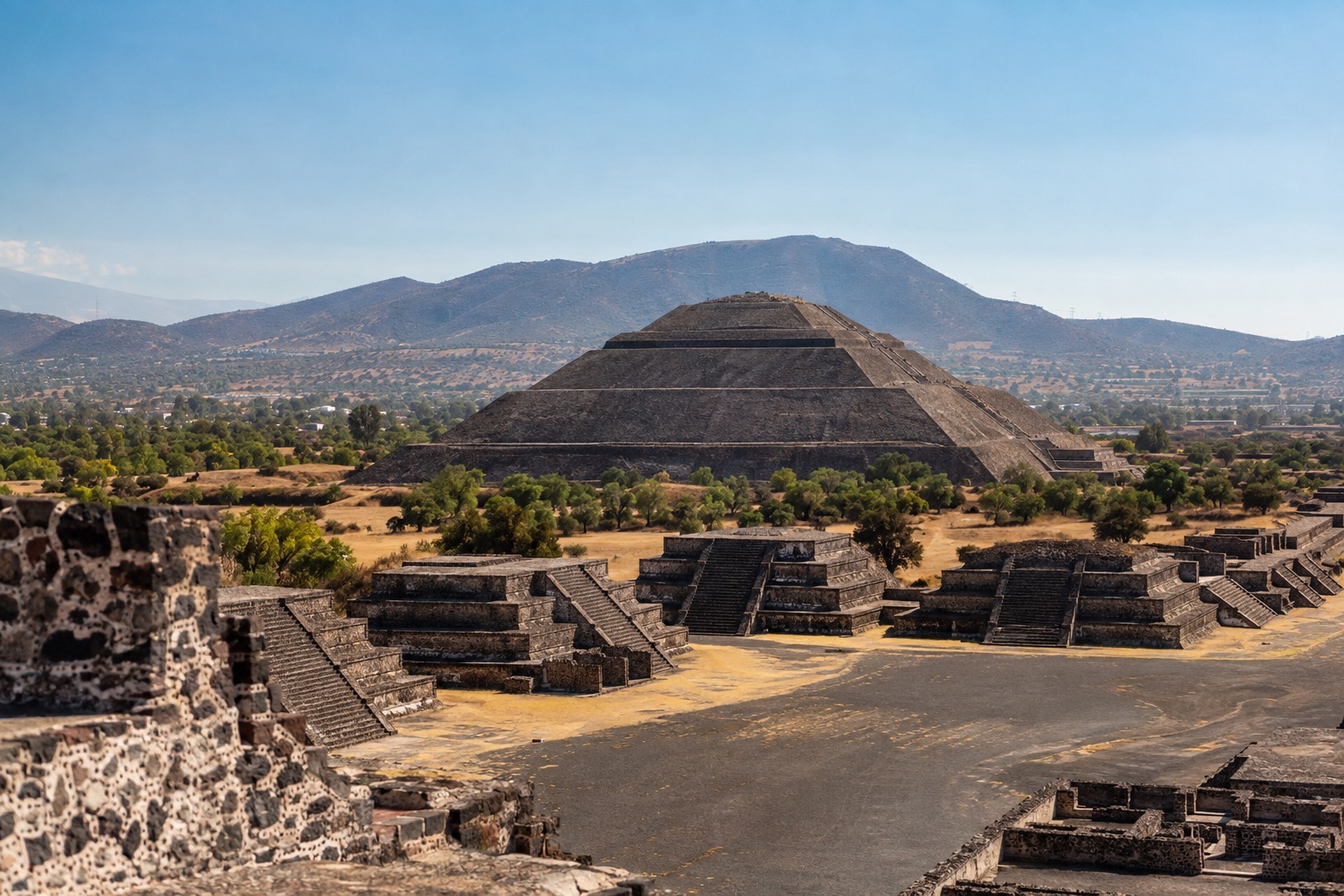
The day starts before the city has really woken up, with delivery trucks rolling through empty avenues and the first tamale vendors setting up on street corners. Mexico City thins out behind you, the highway gives way to dry hills and fields of maguey, and then the long line of the Avenue of the Dead appears with the Pyramid of the Sun at its side. Teotihuacan is an easy morning out of the capital, and how you get there shapes the rhythm of the whole day.
How do you get to Teotihuacan from Mexico City?
The ruins lie about 25 miles northeast of the city, so the trip is a half-day or full-day outing rather than an overnight stay, and the easiest way is either a tour that picks you up or a public bus from the northern terminal.
What decides is how much you want to organize yourself. A tour or a private driver removes every decision between your hotel and the gate, a bus costs you a little planning but gives you freedom to stay as long as you like. Traffic leaving the capital in the morning matters more than the distance, which is why an early start helps whatever you choose.
Ways to get to Teotihuacan from Mexico City
An organized tour
A tour is the simplest way to see Teotihuacan without thinking about it. A van or coach collects you at a central point or your hotel in the morning, drives you to the site and brings you back in the afternoon. Many tours bundle a guide at the pyramids and a stop for lunch, sometimes with a tequila or obsidian workshop on the way.
It suits first-time visitors, solo travelers and anyone who likes having the history explained as they walk the Avenue of the Dead. The trade-off is the clock: groups move on a fixed schedule, so you may have less time at the Temple of Quetzalcoatl or the Palace of Quetzalpapalotl than you would like. Ask what is included in the price, since entry is often charged separately at the gate.
The public bus
Buses to the pyramids leave from the Terminal Central del Norte, reached by Metro at the Autobuses del Norte station. The coaches run throughout the morning, and the ride takes you through the northern suburbs before the landscape opens up. The bus drops you near one of the gates, and from there you walk in.
This is the option for independent travelers who like to set their own pace and do not mind a little hustle at a big terminal. You can arrive right when the site opens, stay until the afternoon heat sends you back, and spend nothing on a guide. Choose a morning departure so that the return trip does not fall in the evening rush.
A private driver
A driver turns the outing into a door-to-door ride in your own car, usually waiting for you while you explore. You leave when you want, stop where you want and avoid the terminal altogether. It is the most comfortable way to go, and for a family or a small group, sharing the car can make it reasonable.
It also makes it easy to add a stop on the way back, a late lunch outside the city or a detour to another site, without watching a bus timetable. It suits travelers with limited time, young children, or anyone who would rather save their energy for walking the ruins.
Options compared
| Option | Time each way | Best for | What to know |
|---|---|---|---|
| Organized tour | Depends on pickups and stops, usually the longest | First visit, guided explanation | Fixed schedule, entry may be extra |
| Public bus | Direct ride from the northern terminal, traffic decides | Independent travelers, flexible hours | Start from the Autobuses del Norte Metro station |
| Private driver | Shortest door to door | Families, small groups, tight schedules | Easy to add a stop on the way back |
If you want the least effort, pick the tour or the driver. If you like moving at your own speed and arriving the moment the gates open, the bus is the natural choice. Whatever the option, leaving early gives you the cooler, quieter hours on the avenue.
Making a day of it
Teotihuacan itself fills a morning. You walk the Avenue of the Dead, stand beneath the Pyramid of the Sun and the Pyramid of the Moon, and step into the courtyards around the Temple of Quetzalcoatl and the Palace of Quetzalpapalotl. At its height more than 100,000 people lived here, and on a wide, open site with little shade you feel that scale in your legs.
| Site | Open | Admission |
|---|---|---|
| Teotihuacan | Daily, 8:00 a.m. to 5:00 p.m., last entry 4:30 p.m. | 210 pesos. Mexican nationals and foreign residents of Mexico pay 105 pesos, and enter free on Sundays |
Bring a hat, sunscreen and plenty of water, wear shoes for dusty paths and uneven stone, and remember that Mexico City sits high, so the sun is strong and the walking tires you faster than you expect. Plan on staying until the early afternoon, then have lunch in one of the restaurants near the gates before heading back.
Back in the city, the evening can go in a few directions. The Zócalo is lively as the light fades, Coyoacán has street food stalls and plazas, and on Tuesday, Friday or Sunday night you can catch lucha libre at Arena México. If you want context before or after the visit, the Museo Nacional de Antropología has halls devoted to ancient Mexico.
Good to know before you go
The U.S. State Department rates Mexico City Level 2, Exercise Increased Caution, the same baseline level as most of the country.
Carry some pesos for the entry gate, snacks and small purchases from vendors outside. Keep your phone and wallet out of sight on the Metro and at the bus terminal, as you would in any big city, and keep valuables close in the crowds at the site. The rainy afternoons of summer can arrive quickly, so an early start also helps you stay ahead of the weather.
Sources
- UNESCO World Heritage Centre, record 414 "Pre-Hispanic City of Teotihuacan" (whc.unesco.org/en/list/414), « Date of Inscription: 1987 », read via Chrome on September 29, 2026
- Wikipedia, "Teotihuacan", en.wikipedia.org, checked September 29, 2026
- common knowledge
- INAH, official for the Teotihuacan archaeological zone, inah.gob.mx/zonas/23-zona-arqueologica-de-teotihuacan, checked September 29, 2026
- INAH, inah.gob.mx/zonas-arqueologicas, checked September 29, 2026
- INAH, Zona Arqueologica Templo Mayor (inah.gob.mx/zonas/zona-arqueologica-templo-mayor), checked September 29, 2026
- Sistema de Informacion Cultural (sic.gob.mx), MNA sheet of 28/07/2026, checked October 3, 2026
- INAH, Museo Nacional de Antropologia, checked September 29, 2026
- INAH, Museo Nacional de Historia, Castillo de Chapultepec (inah.gob.mx/museos/museo-nacional-de-historia-castillo-de-chapultepec), checked September 29, 2026
- INAH, meme page, checked September 29, 2026
- INAH, Zona Arqueologica de Teotihuacan (inah.gob.mx/zonas/23-zona-arqueologica-de-teotihuacan), checked September 29, 2026
- Museo Frida Kahlo, museofridakahlo.org.mx (« NO CONTAMOS CON VENTA EN TAQUILLA », entrada general $320) et boletos.museofridakahlo.org.mx, checked October 3, 2026
- AICM, official site (aicm.com.mx), checked September 29, 2026
- U.S. Department of State, Mexico Travel Advisory (travel.state.gov, date issued May 29, 2026), checked October 3, 2026
- INAH lugares.inah.gob.mx
- Secretaría de Turismo de Puebla
- Secretaría de Turismo de Guerrero
- Frida Kahlo Museum
- Arena México