
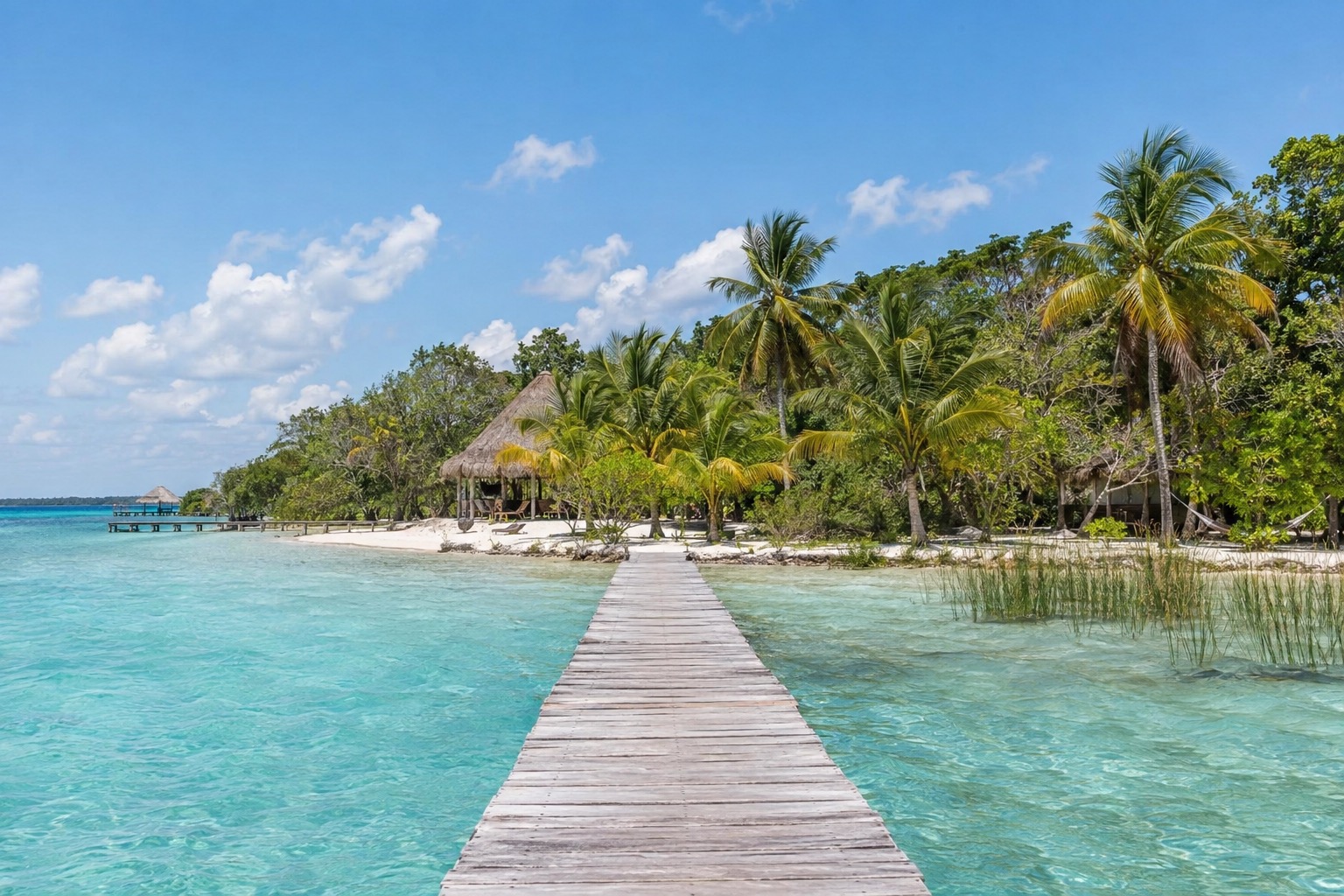
At first light in Bacalar, the lagoon goes quiet and glassy, and the bands of turquoise and deep blue seem to glow from underneath. Fishermen’s boats drift past the docks, the smell of coffee and fresh tortillas drifts from the lakeside kitchens, and the town square slowly wakes up. The year here moves between a dry, sunny stretch in winter and spring and a hot, stormy summer and fall, and the right month depends on what you want from the water.
When is the best time to visit Bacalar?
The best time to visit Bacalar is from about February through April, with late November to January a close second, when days are sunny, the air is warm without being punishing and the lagoon colors are most striking.
For the lagoon itself, the clear, bright days of late winter and spring are the ones people picture: strong sun lights up the pale limestone bottom and the famous bands of color stand out. Sailing, kayaking and paddleboarding are comfortable in the morning, and by afternoon you want shade and a cold drink on a dock.
For sightseeing, the same months suit a walk through the old fort and the lakeside streets without the soaking heat of summer. Spring brings the hottest afternoons, so plan outings early.
For a quieter, lower-key stay, the shoulder months of late fall and the weeks right after New Year are a good bet. Rooms are easier to find, the docks are calm and the town feels like itself. Summer and early fall are the wettest and most humid stretch, with heavy afternoon storms, though mornings are often clear.
Families should know that March is loud. Spring break fills the lakeside hotels and the beach clubs with groups, music and late nights. If your children do better with calm, aim for late January, February or the weeks after Easter instead.
Bacalar weather by month
Bacalar is hot all year, and what changes most from month to month is how much rain falls.
| Month | Average high (°F) | Average low (°F) | Rain (in) | Rain days |
|---|---|---|---|---|
| January | 85.8 | 66.6 | 2.61 | 10.6 |
| February | 87.6 | 68.9 | 1.16 | 7.2 |
| March | 89.6 | 71.4 | 1.10 | 5.1 |
| April | 91.9 | 75.6 | 1.88 | 4.9 |
| May | 93.0 | 77.4 | 4.87 | 9.6 |
| June | 92.3 | 77.9 | 7.70 | 15.8 |
| July | 93.2 | 77.4 | 4.89 | 14.1 |
| August | 94.1 | 77.2 | 6.46 | 14.4 |
| September | 93.6 | 76.1 | 7.07 | 17.8 |
| October | 91.2 | 73.6 | 8.26 | 16.3 |
| November | 88.3 | 69.6 | 4.88 | 13.1 |
| December | 86.5 | 67.6 | 2.48 | 12.3 |
The driest, brightest weeks run from February into April, while the wet season builds in late spring and peaks from June through October. Winter is not dry: January and December still see a fair number of rainy days, but those come as short showers or a gray, breezy day behind a winter cold front, and the sun returns quickly.
Summer and fall rain is different, with heavier downpours and stormy afternoons. Evenings in winter feel pleasantly cooler, while from May to October nights stay warm and sticky.
When is Bacalar cheapest and least crowded?
Bacalar is quietest in the wet months of September and October and again in the stretch between early November and the middle of December.
The busy weeks follow the calendar of American and Mexican vacations. Christmas and New Year fill the lakeside hotels, spring break in March brings groups, and Easter week draws Mexican families in large numbers. Mexican school vacation, from about early July to late August, is another busy stretch, with the docks and the public beaches crowded on weekends.
In the quiet months, rooms are easier to find and rates are often more flexible, restaurants have free tables at sunset and the lagoon feels like a shared secret. Trade-offs are the humidity and the rain, but mornings are often bright, which is when the water looks its best anyway.
Which months should you avoid in Bacalar?
Avoid September and October if you want reliable sun, since they are the wettest months and sit in the heart of the hurricane season.
The Atlantic hurricane season covers the Yucatan Peninsula, inland Bacalar included, and runs from June 1 to November 30. Inland, the lagoon is spared the open-sea surge, but a passing storm can still bring days of heavy rain, wind and canceled boat outings. Early June through October also means thick humidity and heat that can feel heavy by midday.
Sargassum is the other concern on the Caribbean coast. It is usually worst from spring into summer, and it is the first disappointment of many beach trips along the sea. Bacalar’s lagoon is a different setting, but if your plan combines the lagoon with a coastal stay, keep it in mind for those months.
Winter brings the occasional norte, a cold front with gray skies, wind and cooler evenings for a day or two. It is a nuisance rather than a reason to skip the season, and the sun usually returns quickly. The U.S. State Department rates Quintana Roo Level 2, “Exercise increased caution.”
Festivals and events in Bacalar through the year
Día de Muertos and the winter holidays
Día de Muertos, from October 31 to November 2, brings marigolds, candles and family altars to homes and the cemetery. In town you see ofrendas with photographs, bread and favorite foods, and the mood is tender rather than somber. It falls in the wet season, so expect warm, humid evenings and the chance of a shower.
Christmas and New Year, with December 25 and January 1 as the fixed dates, bring posadas, lights around the square and family dinners. The town fills with visitors, especially around New Year, and lakeside restaurants stay busy. It is a lively time for those who like company, and less so if you want solitude on the water.
Carnival and Easter week
Carnival usually lands in February or early March, with parades, costumes and music in the main square. It is more local than flashy, a good chance to see families out in force and to eat street snacks after dark.
Holy Week moves every year, usually falling in March or April. Mexican families pour into town for processions and long days by the water, so the lagoon is busy and the weekend atmosphere feels like a fair. Book early if you plan to come, and aim for weekday mornings if you prefer calm.
Local fiestas and the lagoon’s own seasons
The town celebrates its patron festivities with music, dances and food stalls near the square, usually in the spring. Dates shift, so treat it as a pleasant surprise if you happen to be in town rather than a reason to plan around.
The lagoon has its own quiet attractions at any time. Living stromatolites, rare survivors from one of Earth’s earliest life forms, line the shore, while local regulations cap motorized boat traffic and speed in some areas of the lagoon to safeguard them and the water’s clarity. Whale sharks and turtles belong to the nearby Caribbean coast, not to the lagoon, so add them to a coastal stay rather than expecting them in Bacalar.
Sources
- Servicio Meteorologico Nacional (CONAGUA), normales climatologicas 1991-2020, estacion 23032 (Chetumal (Dge), Othón P. Blanco), checked September 29, 2026
- sunrise-sunset.org, sunrise and sunset on the 15th of the month, checked September 8, 2026
- APIQROO, "Empresa" (apiqroo.com.mx), checked September 29, 2026
- Congreso del Estado de Quintana Roo, Ley del Impuesto al Hospedaje del Estado de Quintana Roo, art. 8, congresoqroo.gob.mx, checked September 29, 2026
- Ley de Derechos del Estado de Quintana Roo, art. 51-Octies, congresoqroo.gob.mx, checked September 29, 2026
- U.S. Department of State, travel.state.gov, checked September 29, 2026 (date issued May 29, 2026)
- NOAA National Hurricane Center, nhc.noaa.gov, checked September 29, 2026