
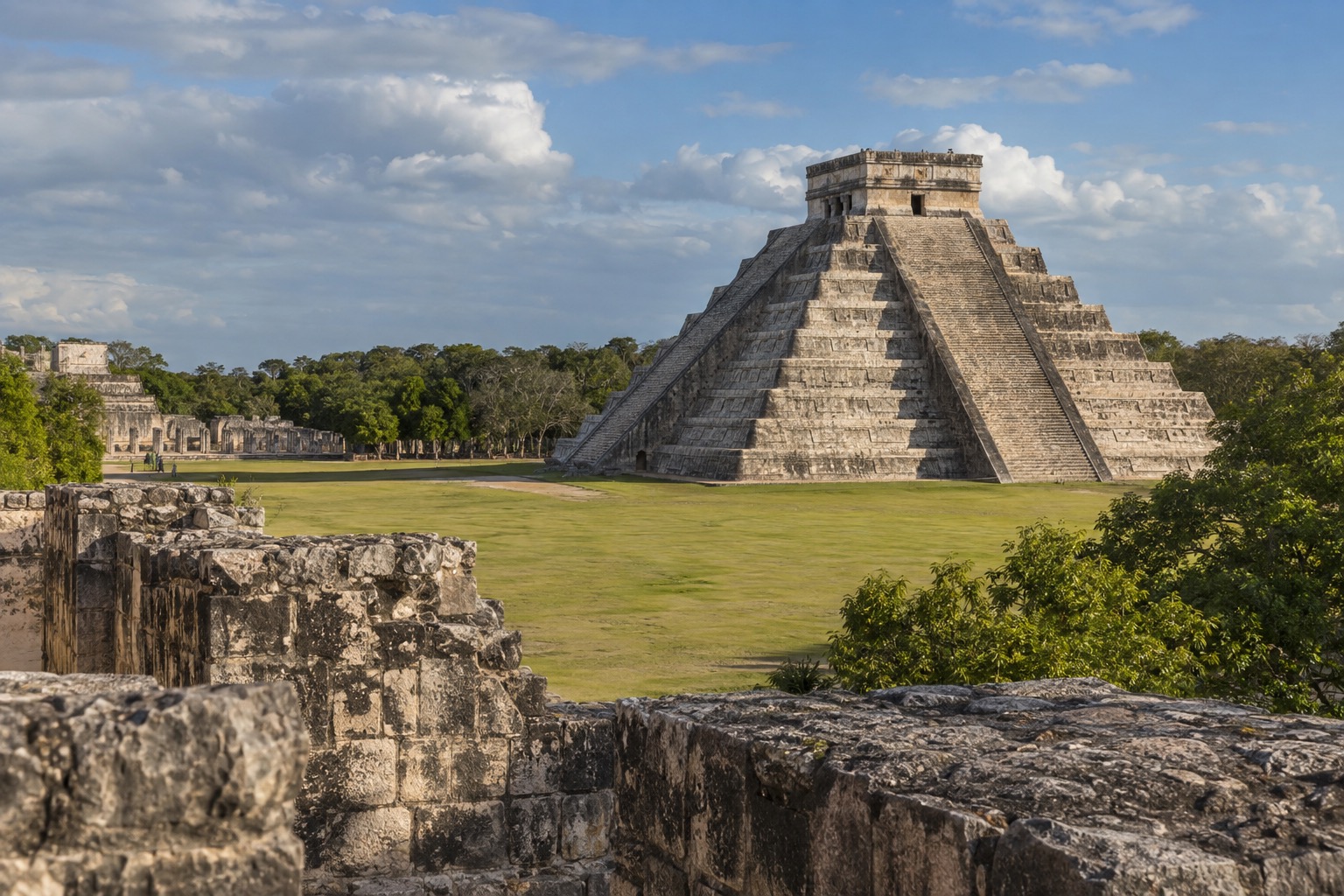
You come out of the entrance path into a wide, open clearing, and there it is: El Castillo, a stepped pyramid of pale stone rising above the grass, with the shade of the surrounding trees pooling at its base. Vendors are already calling out from the edges, and the first tour groups gather in the morning light. Chichen Itza is a full outing among the ruins of a great Maya city, one that rewards slow walking and a good hat.
Is visiting Chichen Itza worth it?
Yes, for almost anyone who likes history, architecture or simply standing in front of something astonishing, and especially for first-time visitors to the Yucatan who want one big ancient city on the list. Families with curious kids, photographers and travelers who want a clear “wow” moment all get it here.
What sets it apart from the other ruins in the region is the scale and the variety in a single walk: a monumental pyramid, a vast ball court, an observatory and carved halls, all within one open site. Smaller places such as Ek Balam feel more intimate and let you see carvings up close, while Chichen Itza gives you the grand picture. In 1988, it earned a spot on the UNESCO World Heritage List, and in 2007 a worldwide public vote put El Castillo among the New Seven Wonders of the World.
What to see at Chichen Itza
El Castillo (Temple of Kukulcan)
The great stepped pyramid is the heart of the site and the image everyone carries home. Its four sides are staircases, and the whole structure is tied to the Maya calendar and the feathered serpent god Kukulcan. Look at the base of the staircases, where serpent heads are carved in stone, and at the way the platform sits perfectly square to the plaza.
Visitors admire it from the ground, since climbing has been closed for years after a fatal fall. That is no loss for photographs: step back toward the middle of the clearing and the full proportions come into view. Try it in the early morning, when the light is soft and the crowds are still thin.
The Great Ball Court
Just a short walk from El Castillo lies the largest ball court of its kind in Mesoamerica, a long stone alley flanked by high walls with a ring set high on each side. Players used their hips and forearms to send a heavy rubber ball through those rings, and the game carried ritual weight as well as sporting thrill.
Look for the carved panels along the benches, which show scenes of players and sacrifice. Stand at one end and clap or speak: the acoustics of the court are famous, and guides love to demonstrate them. It suits anyone who likes stories of competition and ceremony.
The Observatory and the older buildings
South of the main plaza, the round tower known as El Caracol is the observatory, named for the spiral stair once found inside. The Maya tracked Venus and the movements of the sun and moon, and the tower’s slit-like windows are thought to line up with key celestial events.
The older section around it has a quieter feel, with finely cut stonework, long friezes and masks of the rain god Chaac. It is the part of the site where you can slow down, read the carvings and find shade. Come here after the pyramid, when the tour groups thin out and you can look closely.
Walking the wider site
Beyond the headline buildings, the paths lead past carved platforms, colonnaded halls and the great sinkhole that fed the city’s rituals. The Temple of the Warriors, with its rows of stone columns, is one of the most photogenic corners, and the walkways between structures give a sense of how big the city really was.
Wear comfortable shoes, because much of the visit is spent on foot over uneven ground. Carry water and a hat, and let yourself wander off the main line. The side paths are where you often find a bench in the shade and a moment without anyone in the frame.
Hours, tickets and rules
The site is open every day of the week, with a morning start and a late-afternoon close, and admission is made of two parts: a federal fee and a separate state fee charged on top. Foreign visitors pay the full combined amount, while Mexican nationals pay less. The zone is federally protected and managed by Mexico’s national institute for anthropology and history, and climbing the main pyramid is not permitted.
| Site | Open | Admission |
|---|---|---|
| Chichen Itza | Monday to Sunday, 8:00 a.m. to 4:00 p.m. | Foreign adults: 697 pesos in total (105 pesos federal plus 592 pesos State of Yucatan). Mexican nationals: 105 pesos federal plus 205 pesos state. Free on Sundays for Mexican nationals and foreign residents of Mexico. |
How to get to Chichen Itza
The ruins sit about 75 miles from Merida and 117 miles from Cancun, so most visitors come from one of those two bases. By road, the trip from Cancun takes about 2.5 to 3 hours each way, which makes it a long day out but a very doable one.
The town of Valladolid lies 25 miles east of the ruins, which makes it the closest base if you want to start early and avoid a long drive on the day itself. It also pairs well with an overnight stay in a colonial setting.
When to visit Chichen Itza
Go as soon as the gates open. The first hours are cooler, the light is gentle on the stone and the plaza has far fewer people. By midday the sun is strong and the open ground gives little shade, so the later part of the day belongs to those who like a slower, hotter walk.
For comfort, the cooler months from November to February are the easiest, with highs in the upper 80s and few rainy days. March to May turns very hot, with afternoon highs in the mid to upper 90s. From June to October the rain comes more often, usually as short, heavy showers or a stormy afternoon, so mornings are the safer bet. This period also falls within the Atlantic hurricane season.
Tips for your visit
- Bring water, a hat, sunglasses and comfortable walking shoes, since there is little cover across the plaza.
- Carry pesos for entry and for the craft stalls you will pass along the paths.
- Plan a good part of the day for the walk, and add a stop afterward so the trip is not only ruins.
- Families with young children get free entry for those under 13, and visitors with disabilities and those 60 and older have exemptions as well.
A natural pairing is Valladolid, where Cenote Zaci sits close to the center, a landscaped sinkhole open for swimming with a restaurant and artisan vendors on site. It is an easy cool-down after a hot morning among the ruins.
If you still want more ancient stone, Ek Balam lies between Valladolid and Tizimin. The site welcomes visitors daily, but the last entry is at 4:00 p.m., and standard admission runs 210 pesos, while Mexican nationals and foreign residents of Mexico pay 105 pesos. For something quieter and more colonial, the old convent in the Sisal neighborhood, reached along a tree-lined avenue, is a pleasant stroll in the cooler hours of the evening.
Good to know before you go
The U.S. State Department rates the state of Yucatan Level 1, ‘Exercise normal precautions’.
Pesos are the easiest currency for entry and for small purchases at the stalls. Keep the usual traveler habits, such as watching your belongings in crowds, and give yourself time to drink water throughout the visit, because the heat builds quickly in the open.
Sources
- Wikipedia, "Chichen Itza" infobox, en.wikipedia.org, checked September 29, 2026 (secondary source; official UNESCO whc.unesco.org not reached that day, 403)
- Wikipedia, "Chichen Itza", en.wikipedia.org, checked September 29, 2026
- common knowledge
- INAH, official for the Chichen Itza archaeological zone, inah.gob.mx/zonas/146-zona-arqueologica-de-chichen-itza, checked September 29, 2026
- INAH, inah.gob.mx/zonas-arqueologicas, checked September 29, 2026
- INAH, zonas-arqueologicas index listing, inah.gob.mx/zonas-arqueologicas, checked September 29, 2026
- sum of the two base fees (INAH 105 + AAFY 592)
- Wikipedia, "Valladolid, Yucatan", en.wikipedia.org, checked September 29, 2026 (source secondaire)
- INAH, official for the Ek Balam archaeological zone, inah.gob.mx/zonas/21-zona-arqueologica-ek-balam, checked September 29, 2026
- U.S. Department of State, Bureau of Consular Affairs, Mexico Travel Advisory, travel.state.gov, checked September 29, 2026 (date issued May 29, 2026) (date issued May 29, 2026)
- Servicio Meteorologico Nacional (CONAGUA), normales climatologicas 1991-2020, estacion 31046 (Valladolid (Obs), Valladolid), checked September 29, 2026