
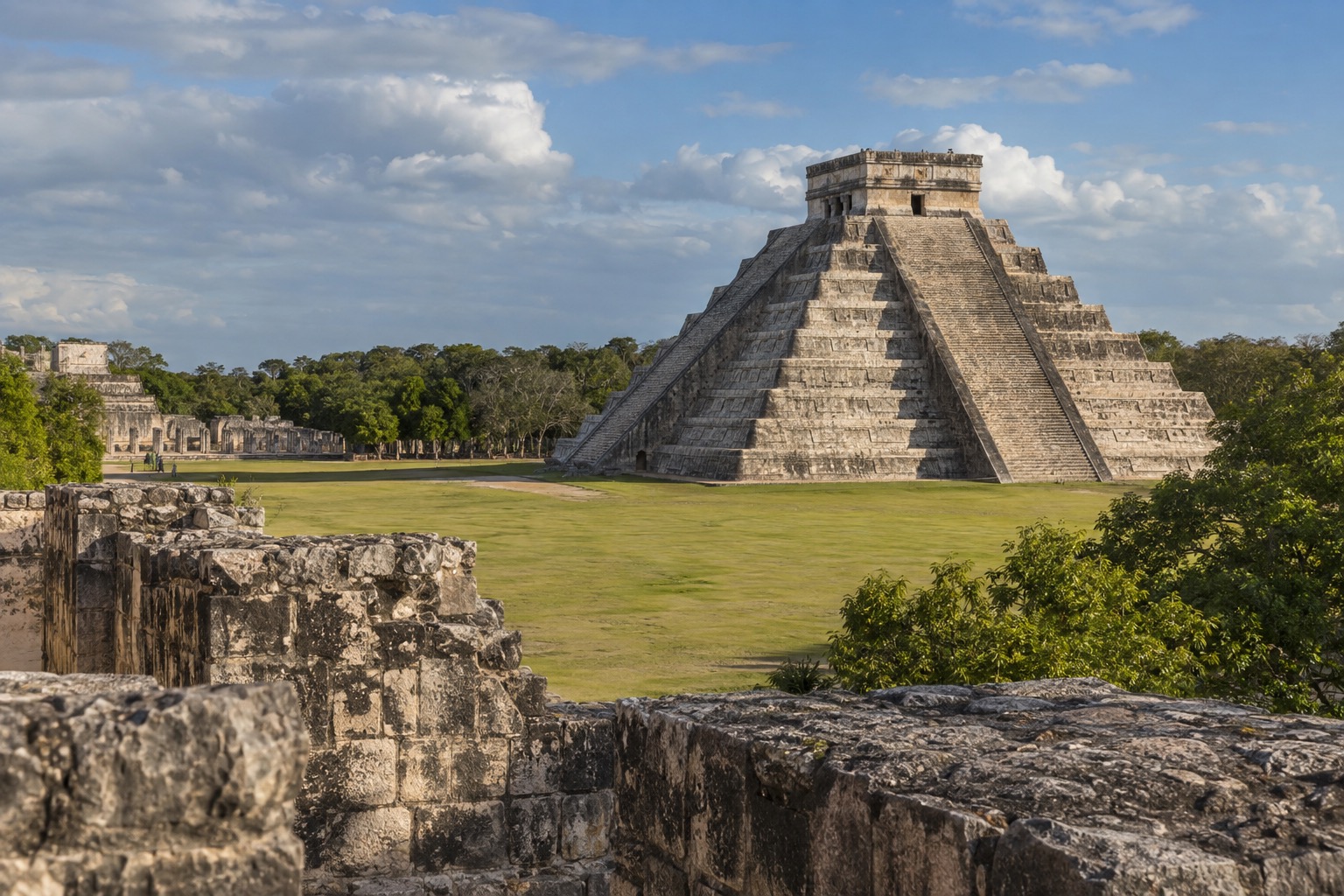
At Chichen Itza, the morning begins with the gates opening onto a wide lawn, the call of motmots in the trees and the great stepped pyramid catching the first sun. Through the dry winter the days are bright and comfortable, then spring turns the stone plaza into an oven, and summer brings towering afternoon clouds and sudden downpours over the jungle. The ruins in the middle of the Yucatan Peninsula reward almost any month, but each one asks something different of you.
When is the best time to visit Chichen Itza?
The best time to visit Chichen Itza is from November through February, when the days are warm rather than punishing and the rain mostly stays away, with March a good runner-up for anyone who can handle more heat.
For sightseeing, which is the whole point of coming here, those winter months are ideal. You walk the plaza, the ball court and the observatory in shirtsleeves, and the long shadows of early morning make the carved stone look sharp. The site is open from 8:00 a.m., and being at the gate first is a good habit in any month, because the middle of the day is when the sun and the tour buses arrive together.
If your trip also includes beach days, the same winter window works along the Caribbean coast, since Chichen Itza is a long day trip from Cancun and an easier one from Merida. Keep in mind that winter cold fronts can bring a gray, breezy day and rougher water now and then. For travelers on a budget who do not mind heat and showers, the wetter months from June to October mean thinner crowds at the pyramid and a lot of green around the ruins, but you will want a rain jacket in the bag and an early start.
Families should think twice about March, when U.S. spring break and Mexican school groups fill the plaza and the vendors’ stalls, and the heat is already climbing. The cooler winter mornings are kinder to children, and shade is scarce on the open grounds in the hotter months. Bring hats and water in any season.
Chichen Itza weather by month
The climate here is a simple story of a warm dry season and a hot wet one, and the table gives the month-by-month picture.
| Month | Average high (°F) | Average low (°F) | Rain days |
|---|---|---|---|
| January | 86.4 | 62.4 | 5.1 |
| February | 88.9 | 63.1 | 3.9 |
| March | 91.8 | 64.4 | 2.7 |
| April | 95.7 | 67.6 | 2.4 |
| May | 96.8 | 70.2 | 5.3 |
| June | 94.8 | 70.0 | 11.8 |
| July | 95.0 | 69.6 | 12.9 |
| August | 94.8 | 70.0 | 12.9 |
| September | 93.9 | 70.3 | 14.2 |
| October | 90.7 | 68.2 | 12.2 |
| November | 87.8 | 66.0 | 7.3 |
| December | 86.4 | 63.3 | 5.2 |
The year runs in two halves. From November to April the mornings are fresh and the rain is scarce, with an occasional cold front adding a cloudy, cooler day. April and May are the hottest stretch, with little rain to cool things down until the rains start in earnest in June.
Summer and early fall bring rain on more than a third of the days, usually a heavy shower or storm in the afternoon rather than a day of gray. The air stays humid even when the sun comes back, and September is the wettest month of the year.
When is Chichen Itza cheapest and least crowded?
The quietest stretches are September and October, plus the weeks in early November and again in late January, when neither school breaks nor holiday travel are pushing visitors toward the Yucatan.
The busy times are easy to predict. Christmas and New Year bring the biggest crowds of the winter, spring break fills March, and Easter week sends Mexican families to the ruins in numbers. Mexican school vacation, from about early July to late August, is another busy stretch, even though it is hot and rainy. On those days the plaza is full by mid-morning and the line at the main pyramid grows.
What this means for the rest of the trip: in the quiet months, hotel rooms in Merida, Valladolid and along the Caribbean coast are easier to find and the beaches are less packed. In the peak weeks, book early and plan to reach the ruins at opening time or late in the day, when the tour groups thin out.
Which months should you avoid in Chichen Itza?
Avoid April and May if heat bothers you, and think carefully about September and October if you do not want to deal with rain and the storm season.
The hottest months turn the open stone plaza into a place where you want to be done by late morning. There is little shade between the pyramid and the ball court, so the sun hits hard.
Wetter months offer greener scenery and fewer people, but afternoon storms are common, and the Atlantic hurricane season, which runs from June through November, peaks in late summer and early fall. A tropical system can bring days of heavy rain to the peninsula, and that can disrupt flights and day trips alike.
If your trip pairs the ruins with the Caribbean coast, sargassum is another thing to know. The seaweed usually piles up worst from spring into summer, and it is the first disappointment of many beach trips, though no stretch of sand is guaranteed to be clear or spoiled in any given week. Winter cold fronts, the nortes, are milder at the ruins, but they can bring a cloudy, breezy day, and they stir up the sea on the coast.
Festivals and events in Chichen Itza through the year
The equinox and Maya tradition
The best-known moment of the year here is the spring equinox in March, when the afternoon sun is said to create a play of light and shadow along the staircase of El Castillo, giving the impression of a serpent descending toward the ground. It draws a big crowd, which fills the plaza and makes this one of the busiest days of the year. The autumn equinox in September offers the same effect with a smaller crowd.
The pyramid was built to honor Kukulcan, the feathered serpent, and the illusion is one of the reasons it was named one of the New Seven Wonders of the World. Come early, expect a crowd, and enjoy it as an atmosphere as much as a spectacle. Other days of the year, you can see traces of the same design from the base of the staircase, where the carved serpent heads wait quietly at the bottom.
Winter holidays and Carnival
Christmas and New Year bring Mexican families on vacation, and the nearby towns of Valladolid and Merida fill with lights, posadas and plates of tamales and hot ponche. Merida stages a lively Carnival in the weeks before Lent, with parades, costumes and dancing in the streets, and it is easy to add to a ruins trip because the city is the usual base for the site.
Easter week, which moves every year, is a time of processions in the towns and a rush of domestic travelers to the ruins. If your dates match, you will see the plaza busy and the region in a festive mood. Book rooms early, and plan on a morning visit before the heat and the crowds take over.
Día de Muertos and the fall season
Día de Muertos runs from October 31 to November 2, and in the Yucatan it takes a Maya form called Hanal Pixán, the meal of the souls. Families build altars with food, candles and flowers, and bakeries sell mucbipollo, a large tamale baked in a pit. Towns near the ruins hold vigils and small processions, and Merida adds cultural events around the dates.
It is a good moment to visit, because the rainy season is fading, the countryside is still green and the heat eases. Come for the food and the atmosphere in town, then visit the ruins early the next morning, when the air is fresh and the crowds are lighter than in winter.
Sources
- Wikipedia, "Chichen Itza" infobox, en.wikipedia.org, checked September 29, 2026 (secondary source; official UNESCO whc.unesco.org not reached that day, 403)
- Wikipedia, "Chichen Itza", en.wikipedia.org, checked September 29, 2026
- common knowledge
- INAH, official for the Chichen Itza archaeological zone, inah.gob.mx/zonas/146-zona-arqueologica-de-chichen-itza, checked September 29, 2026
- INAH, inah.gob.mx/zonas-arqueologicas, checked September 29, 2026
- INAH, zonas-arqueologicas index listing, inah.gob.mx/zonas-arqueologicas, checked September 29, 2026
- Servicio Meteorologico Nacional (CONAGUA), normales climatologicas 1991-2020, estacion 31097 (Merida (Conagua), Mérida), checked September 29, 2026
- sunrise-sunset.org, sunrise and sunset on the 15th of the month, checked September 8, 2026