
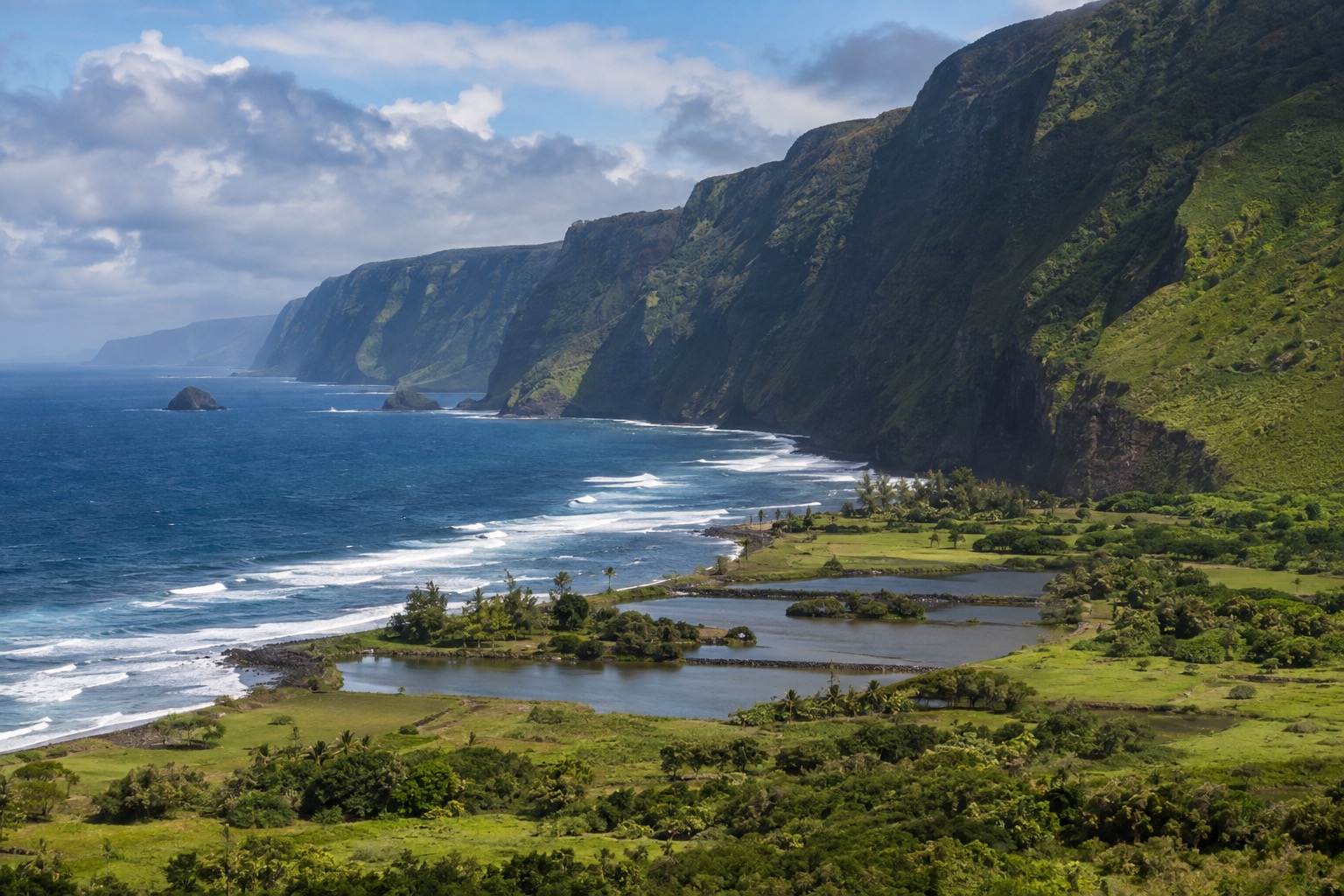
On a March morning the red dirt roads of Molokai are still damp from the night, roosters call from the kiawe trees, and the pastures of the central plain turn a bright, almost startling green. Out past the reef, a humpback whale tail slaps the water now and then as the last of the winter whales head north. This is a small, slow island with no resort strip and no traffic lights, and March suits it well.
What is the weather like in Molokai in March?
In March, expect warm, mostly sunny days and a light breeze, along with a few scattered showers and an ocean that remains cool when you first get in.
| Month | Average high (°F) | Average low (°F) | Rain (in) | Rain days | Sea (°F) | Daylight on the 15th |
|---|---|---|---|---|---|---|
| February | 78.8 | 64.6 | 2.31 | 4.6 | 76.4 | 11 hours 30 minutes |
| March | 79.2 | 65.8 | 3.02 | 5.2 | 76.2 | 12 hours 4 minutes |
| April | 81.0 | 67.1 | 1.54 | 3.4 | 76.9 | 12 hours 42 minutes |
Days are comfortable for walking, cycling the country roads or sitting on a beach with a light shirt. Showers tend to be brief and drift through on the trade winds, often leaving a rainbow over the pastures. Evenings cool off just enough to want a thin layer on the lanai.
The sea is pleasant for wading and snorkeling in the sheltered spots, though winter swells can still reach the north and west shores. Look at the beach signs and ask a local before getting in, because conditions change from one stretch of coast to the next.
What to do in Molokai in March
March on Molokai is about whales fading out of the season, green hillsides, long empty beaches and the unhurried rhythm of a place where people still stop to talk on the road. Nothing here is staged for visitors, and that is the appeal.
Watching the last humpback whales
The humpbacks that wintered in Hawaiian waters begin to leave as March goes on, so sightings are still possible but thinner than in the heart of winter. The south shore, sheltered from the big swells, is the usual place to scan the horizon, whether from a boat or from a pullout along the coast road.
Early morning is best, when the wind is light and a spout shows clearly against the dark water. Binoculars help a lot. Keep a respectful distance, since the whales are protected and the island prefers that they be left in peace.
Beaches and the west end
Papohaku, a broad ribbon of pale sand on the west side, makes a fine long walk in late afternoon, with Oahu faintly visible across the channel at sunset. Winter swell often lingers into March, so it is more a place for strolling than for swimming. Most Molokai beaches have no lifeguard on duty, so check the signs along with that day’s surf and currents before entering the water, and swim near a lifeguard only at beaches where one is stationed.
For gentler water, the south shore near the old fishponds is calmer on most days. Walkers see egrets and turtles near the shallows, and you can wade along the edge where the reef begins. Keep off the reef itself, which is alive and easily damaged.
Green country, small towns and local food
Kaunakakai is the island’s main town, a few blocks of wooden storefronts leading to a long wharf. Stop at the bakery for warm sweet bread, pick up fruit at a roadside stand, and order a plate lunch of kalua pork or fresh fish. Evenings are quiet, and many places keep short hours.
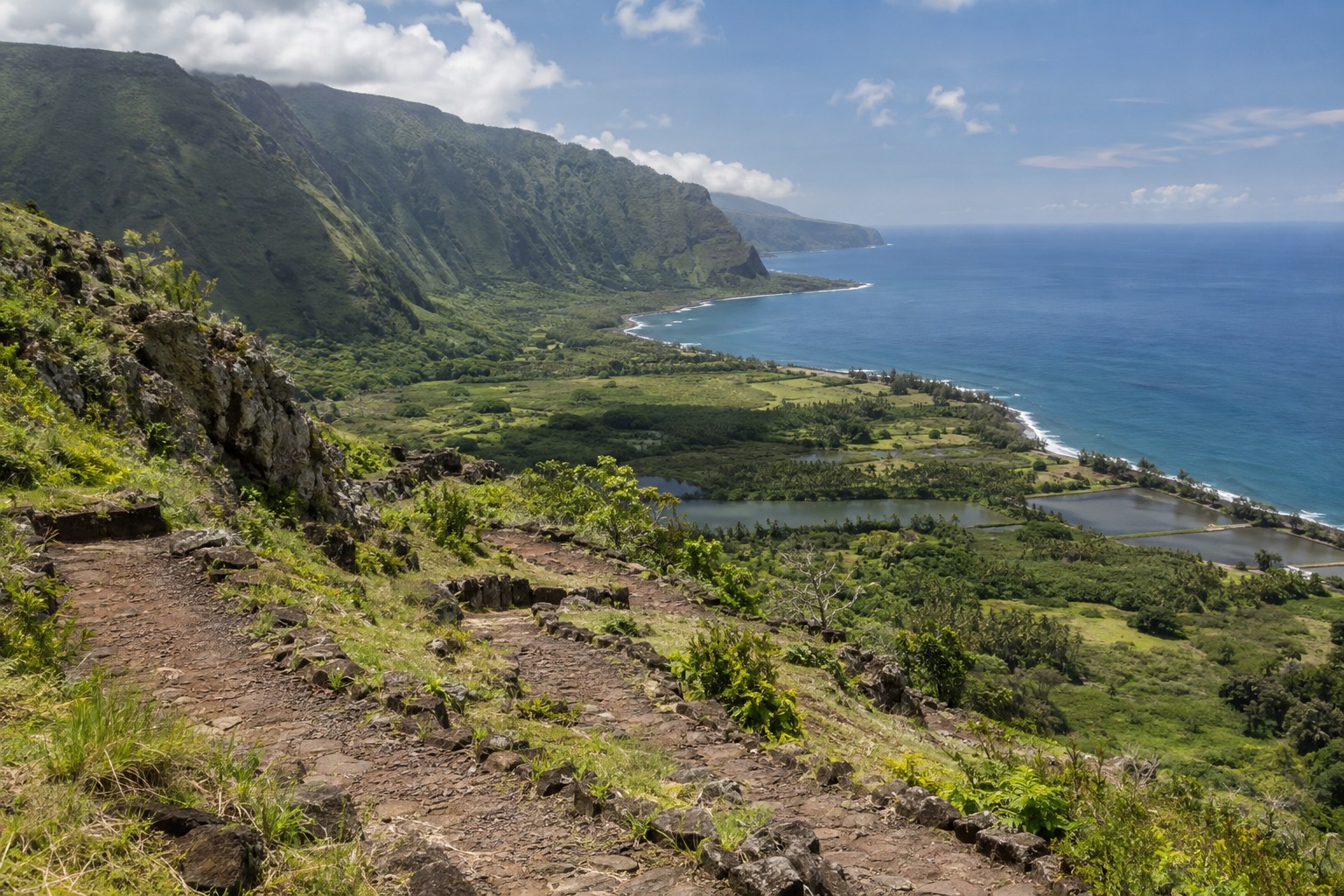
The cooler, damper weather of March makes the uplands pleasant for a drive toward the forested hills, where the air smells of wet earth and ginger. Molokai is a place where much of the land is sacred and still lived on, so stay on public roads, ask before stepping onto private property and leave stones and offerings as you find them.
Is Molokai busy in March?
No, Molokai stays quiet in March, even when spring break fills the bigger islands.
A few mainland families arrive during school breaks, but the island has few rooms and no big resorts, so crowds never really form. Restaurants are small and some close early, so a table is rarely hard to find yet it pays to plan dinner before the kitchen shuts. Rental cars are limited, which matters more than the number of visitors.
What to pack for Molokai in March
Pack for warm days, a breeze and the occasional shower.
- A light rain jacket for passing showers on the trade winds
- A thin sweater or long-sleeved shirt for evenings
- Sturdy sandals or walking shoes for red dirt roads
- Reef-safe sunscreen, a hat and sunglasses
- Binoculars for the last whales of the season
Good to know before you go
March falls well outside the official hurricane season, which runs from June 1 to November 30. Services on Molokai are limited and stores keep modest hours, so fill the gas tank and buy supplies when you pass through town. For lodging, the nightly rate has state and county taxes added on top.
| Tax | Rate | Who pays |
|---|---|---|
| State Transient Accommodations Tax | 11.00% | Guests, on lodging |
| Maui County surcharge on the General Excise Tax | 0.5% | Added to taxable sales in the county |
Is March a good time to visit Molokai?
Yes, for travelers who like their islands slow, green and uncrowded, March works nicely.
Compared with February, the days are a touch warmer and showers a bit less frequent, though the rain is still enough to keep the hills lush. April turns drier and warmer again, so the island is greener now and brighter then. The sea hardly changes across the three months. What sets March apart on Molokai is the overlap of seasons: a last whale spout offshore, fresh green pastures behind the beach, and an island that seems to belong to its own people and to you for a few quiet days.
Sources
- NOAA NCEI, monthly normals 1991-2020, station USW00022534, checked September 8, 2026
- Open-Meteo Marine API, average 2015-2024, checked September 8, 2026
- sunrise-sunset.org, sunrise and sunset calculated for the 15th of the month, checked September 8, 2026
- Hawaii Department of Taxation, Tax Announcement No. 2025-03 (Transient Accommodations Tax Law Changes from 2025 Legislative Session), files.hawaii.gov/tax/news/announce/ann25-03.pdf, checked September 24, 2026
- Hawaii Department of Taxation, County Surcharge on General Excise and Use Tax page, tax.hawaii.gov/geninfo/countysurcharge/, checked September 25, 2026
- NOAA NCEI, monthly normals 1991-2020, station USW00021504
- NWS Honolulu / Central Pacific Hurricane Center, « 2026 Central Pacific Hurricane Season Outlook », weather.gov/hfo/hurricaneOutlook2026, checked September 24, 2026