
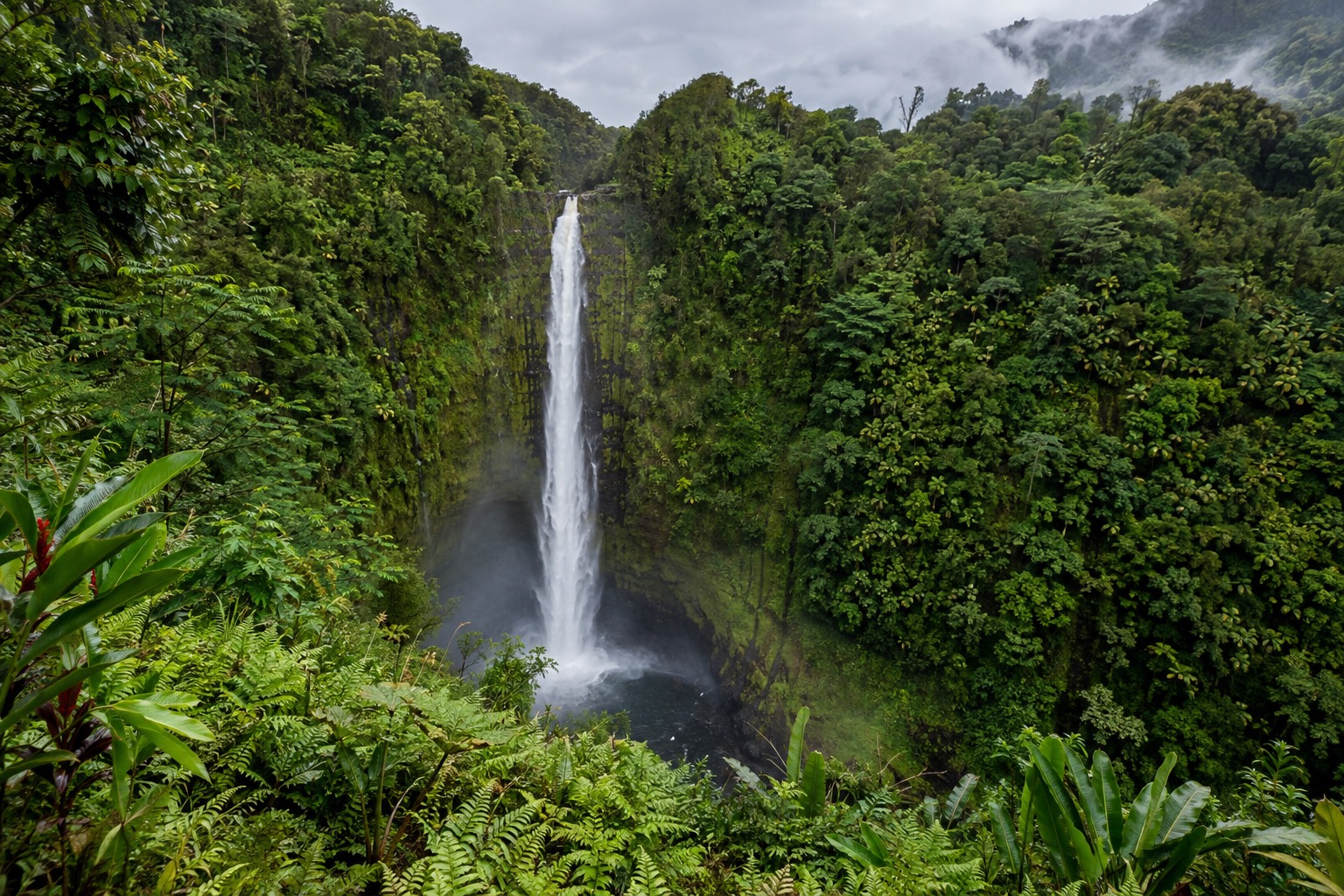
The path drops into a tunnel of giant ferns, wild ginger and bamboo, and the sound of falling water grows long before anything comes into view. Then the trees open and a thin ribbon of water plunges from a high green lip into a gorge. Akaka Falls State Park is a short, easy stroll on the rainy Hamakua side of the Big Island, built for travelers who want a big waterfall without a big hike.
Is visiting Akaka Falls State Park worth it?
Yes, especially for families, first-time visitors and anyone who likes rainforest scenery without a long walk. The park suits a stop on a drive north of Hilo, and it rewards even a quick visit.
What sets it apart from other waterfalls nearby is how much you see from a single paved loop. Many Big Island falls need a steep descent or a long drive to reach, while here the walk passes lush jungle, a smaller cascade and then the main drop. The water is tall and slender rather than wide and thundering, and the surrounding greenery is as much the show as the fall itself.
What to see at Akaka Falls State Park
The loop through the rainforest
The footpath is a short loop that winds beneath a dense canopy of tree ferns, banana plants, orchids and bamboo. The ground is damp and the air smells of wet earth and flowers. It includes multiple steps and is not wheelchair accessible, so expect a bit of climbing up and down.
Go slowly. Birdsong, dripping leaves and the distant roar of water fill the walk, and the lush plant life gives plenty of reasons to stop for photos. Rain showers are common here, so a damp stroll is part of the experience.
Kahuna Falls
Along the loop you pass Kahuna Falls, a cascading fall that tumbles down a rocky face in stages. It is seen from a viewpoint across a ravine, partly screened by thick vegetation, so it feels like a glimpse of something wild rather than a grand set piece.
It makes a good warm-up for the main event. Look for the way the water splits and re-gathers over the dark rock, and for the ferns clinging to the walls of the gorge, which stay bright green all year.
Akaka Falls itself
The star of the park drops 442 feet in a single plunge into a deep, jungle-choked gorge. The viewing platform looks across at the fall, so you see its full height, framed by tropical foliage on both sides. After heavy rain it runs strong, and mist often drifts up from the pool below.
Light matters. When the sun breaks through, rainbows can form in the spray, and the cliff walls glow a deep emerald. On gray days the fall looks silvery and moody against the clouds. Either way, it is the kind of view that makes people stand quietly for a few minutes.
Hours, tickets and rules
The park is open every day, and visitors from outside Hawaii pay a small fee per person plus a parking fee for each private vehicle.
| Site | Open | Admission |
|---|---|---|
| Akaka Falls State Park | Daily, 8:30 a.m. to 5:00 p.m. | Non-residents: $5.00 per person to enter, $10 per non-commercial vehicle to park |
The state park page lists entry and parking fees but no advance reservation system for Akaka Falls. That sets it apart from Diamond Head, Haena and Waianapanapa, where booking ahead is part of the plan. You can simply arrive during opening hours and pay at the park.
How to get to Akaka Falls State Park
The park sits north of Hilo on the Hamakua side of the Big Island, reached by Highway 220. The turnoff leads to the village of Honomu, and the park entrance is 3.6 miles from there. The park covers 65.4 acres, most of it the forest that surrounds the loop. Honomu itself is a small plantation-era town with a short main street of old wooden storefronts, a handy place to stop before or after the falls.
When to visit Akaka Falls State Park
Arriving soon after the park opens in the morning usually means fewer people on the narrow viewing platforms and a cooler, quieter walk. Late in the day the light gets low under the canopy, and the gates close at 5:00 p.m.
This is a rainforest, so rain can come in any month. Afternoons are warm all year, with highs from the high 70s to low 80s, and the wetter stretch from November through April tends to feed the falls well.
October is warm and showery, with rain on more days than not. The Central Pacific hurricane season runs from June 1 to November 30, so the fall is a good place to carry a light rain jacket.
Tips for your visit
- Wear shoes with good grip, since the steps and paths stay wet.
- Bring a light rain jacket and a camera protected from mist.
- The loop is short, so it combines easily with a stop in Honomu or a day around Hilo.
- Families with small children can manage the walk, but strollers and wheelchairs will struggle with the steps.
- Part of the trail was listed as closed due to fallen trees in late September 2026, so the state parks notices page is the place to see the current status of the loop.
Good to know before you go
Cards are the easy way to pay for most things on the island, though it helps to keep a few small bills for park fees. Stay on the marked path, take care on wet steps and railings, and keep an eye on your belongings in the parking area, as at any popular stop.
Sources
- Hawaii DLNR Division of State Parks, dlnr.hawaii.gov/dsp/parks/hawaii/akaka-falls-state-park, checked September 25, 2026
- Hawaii DLNR Division of State Parks, akaka-falls-state-park, checked September 25, 2026
- Hawaii DLNR Division of State Parks, announcements, dlnr.hawaii.gov/dsp/announcements, checked September 25, 2026
- NOAA NCEI, monthly normals 1991-2020, station USW00021504, checked September 8, 2026
- NWS Honolulu / Central Pacific Hurricane Center, « 2026 Central Pacific Hurricane Season Outlook », weather.gov/hfo/hurricaneOutlook2026, checked September 24, 2026
To plan your stay
- Best Time to Visit Hawaii: Seasons, Weather by Island, Whales and Crowds
- Where to Stay in Hawaii: Choosing an Island, Oahu to Kauai Bases and the Hotel Tax
- Getting Around Hawaii: Interisland Flights, TheBus and Skyline, Rental Cars and Taxi Fares
- Know Before You Go to Hawaii: Agriculture Form, Sunscreen Law, Reservations and Taxes