
Early in the morning, the air in Lanai City smells of Norfolk pines, and the only traffic on Dole Park is a pickup truck rolling past the old plantation cottages. Down at the coast, spinner dolphins sometimes cruise into Hulopoe Bay while the first swimmers wade in. Lanai is a quiet island of one small town, two luxury resorts and dirt tracks that lead to empty shores, made for travelers who want stillness, a few good beaches and a rented Jeep.
Where is Lanai and what is it like?
Lanai sits in the channel just southwest of Maui, within sight of Molokai and the West Maui mountains, and it is the smallest of Hawaii’s inhabited islands that visitors can easily reach. Its land area is about 141 square miles, yet it feels far more remote than the map suggests, with a single town on a high plateau and a handful of paved roads.
The island was once a pineapple plantation, and Lanai City still has that look: tin-roofed cottages, a grassy central park, a few cafés, a general store and a small grid of streets lined with tall pines. The pace is slow. Shops close early, nightlife means dinner and the stars, and strangers wave from their trucks.
Two resorts anchor the visitor side, one on the coast at Manele and one up in the highlands. People who love Lanai come for solitude, hiking and rough-road exploring. Those who want boardwalks, surf shops and a long list of restaurants will find it too still, and might be happier on Maui across the channel.
What is there to do in Lanai?
Lanai gives you beaches without crowds, backcountry driving and a small town to wander, and that is the point: unlike Maui or Oahu, there are no big attractions to line up for, so the island itself is the activity.
Hulopoe Bay and the marine reserve
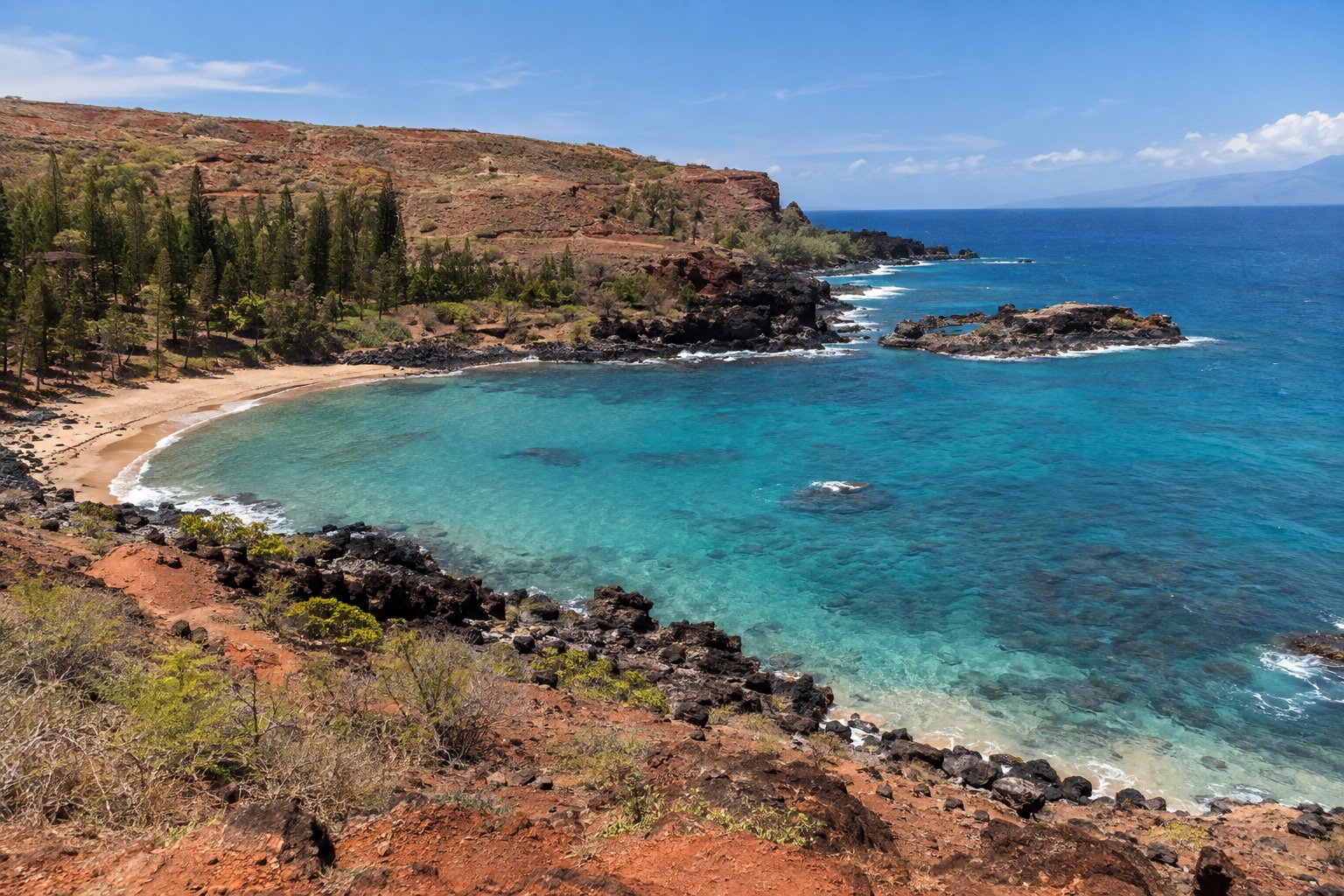
Hulopoe is the island’s showpiece beach, a crescent of pale sand next to Manele Harbor, on the sunny south coast. It lies inside the Manele-Hulopoe Marine Life Conservation District, which covers 309 acres and has protected the reef since 1976. That protection shows underwater, where schools of reef fish are easy to spot just off the rocks at the edge of the bay.
Fishing here is limited to pole-and-line from the shoreline, and boats may not anchor or moor in the protected inner zone. Spinner dolphins often appear in the morning, and green sea turtles come to rest near shore.
Stay at least 10 feet away from any turtle, in the water or on the sand. Tide pools at the south end are fun for children to peer into, and the beach flags and signs tell you how the water is that day.
Backcountry drives and the empty north and east shores
The island’s real character lies on its dirt roads, which cross red-earth plateaus and drop to shores where you may be the only visitor. Shipwreck Beach on the windward side is lined with driftwood and the rusting hull of a ship stranded on the reef, and it is a place for beachcombing and long walks, not swimming, since the wind and currents are strong.
Higher up, the Garden of the Gods is a landscape of boulders and rust-colored rock that glows at sunset, and the Munro Trail climbs through the pines for wide views toward neighboring islands. A four-wheel-drive vehicle suits these tracks, and the red dust gets on everything, so leave white clothes behind.
Lanai City and the highlands
A walk around Dole Park takes in the whole town: a small local art gallery, a bakery, plate-lunch counters and the old theater. The cool highland air, a good deal fresher than at the coast, makes a stroll pleasant even in summer, and the evening mood is closer to a country village than a resort.
Two things round out a day here: a horseback ride or a round of golf at one of the resort courses, and a slow dinner under the pines. The town suits anyone who likes to get to know a place by walking, and it pairs well with a morning on the beach.
How many days do you need in Lanai?
Two nights is enough to taste Lanai, and three or four let you settle into its rhythm. A short stay fits Hulopoe Bay, an evening in Lanai City and one good drive across the plateau or out to Shipwreck Beach.
With more time, you can tackle the Munro Trail, spend a full day on the rough roads to the far shores, and linger on the beach without a schedule. Many visitors treat Lanai as a quiet stretch added to a Maui trip, and the island rewards that approach, since the ferry makes it simple to hop across and back.
A day trip from Maui is possible, but it leaves little time beyond the beach and a quick look around town. Staying the night means you see the island once the day visitors have gone, which is when it feels most like itself.
Where to stay in Lanai
There are two main bases. The coast at Manele puts you beside Hulopoe Bay, with a resort setting, sea views and easy access to the water, which suits couples, families and anyone whose main goal is the beach.
Lanai City, up on the plateau, offers a small historic inn, a highland resort and a few rentals among the pines. It is cooler, quieter and closer to the café, the shops and the dirt-road adventures, and it fits travelers who like a village feel over a beachfront setting.
How do you get to Lanai and get around?
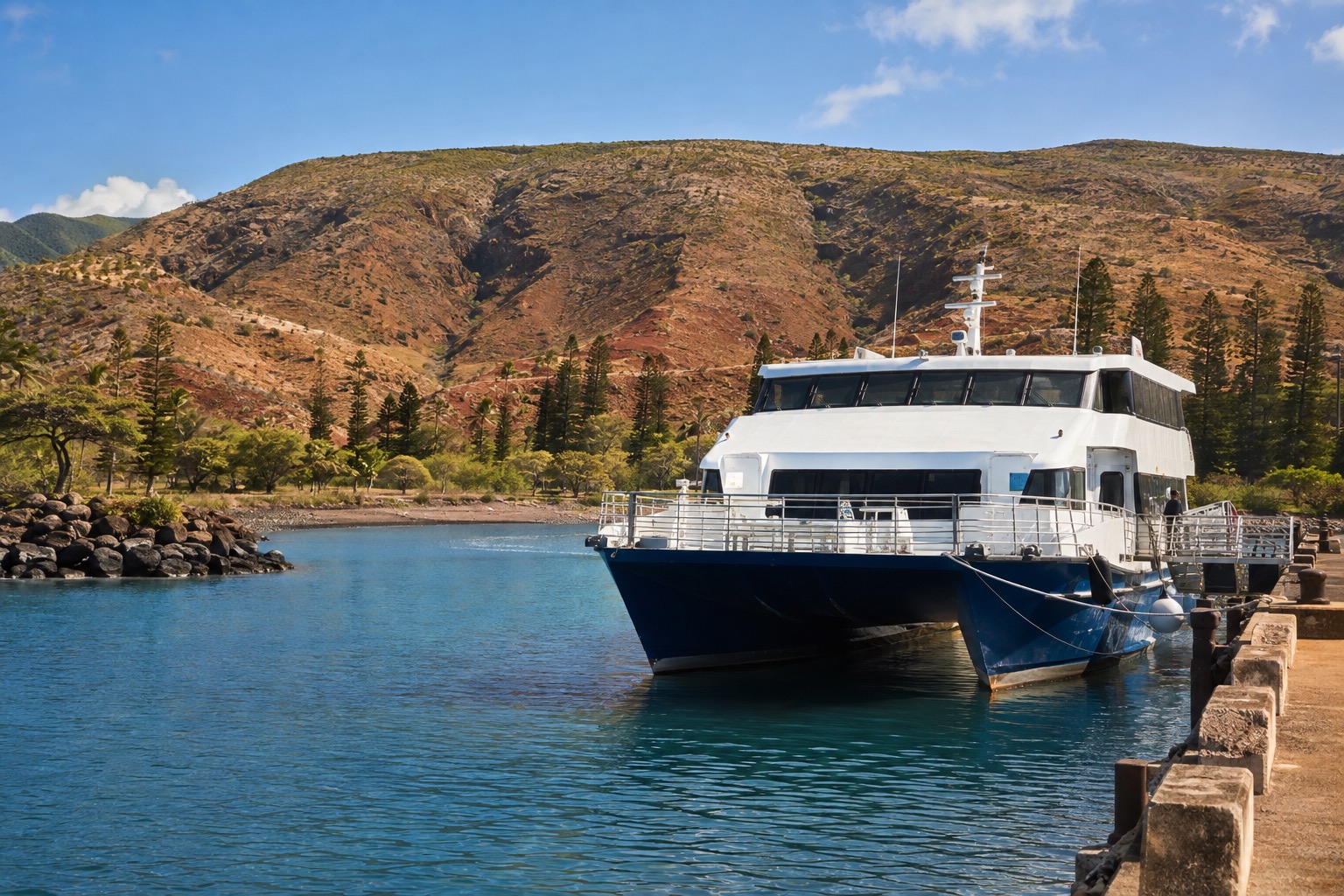
Most visitors arrive by ferry from Maui. The Expeditions boat runs three round trips a day between Maalaea Harbor and Manele Harbor, and the crossing takes about an hour and ten minutes. The crossing is often breezy, and in winter you may spot humpback whales from the deck.
| Route | Departures from Maui | Crossing |
|---|---|---|
| Maalaea Harbor to Manele Harbor | 6:30 a.m., 11:00 a.m., 3:30 p.m. | About 1 hour 10 minutes |
Lanai Airport sits on the central plateau and handles a small number of commercial flights, so it is a quiet, uncrowded gateway. Once on the island, you will want a vehicle to reach the beaches and the highlands, since the paved roads are few and the best places lie at the end of dirt tracks. Lanai City itself is easy to explore on foot.
When is the best time to visit Lanai?
April through June and September through October are the sweet spots: highs run from the upper 70s to low 80s, and rain days are rare, usually just two a month. August is the driest month and the warmest, with highs in the low 80s, so it suits beach days, though the highlands stay cooler than the coast.
Winter is the wetter season. January is the rainiest month, with showers on a handful of days, and the air turns fresher, especially up in Lanai City, where an extra layer is welcome in the evening. Even then, the island is much drier than Maui’s windward side, and plenty of sunny hours remain.
The Central Pacific hurricane season runs from June 1 to November 30, so the summer and fall months fall inside it. Crowds follow the mainland calendar, with busier weeks around spring break, the summer family weeks and the winter holidays, but Lanai stays small and calm even then.
Good to know before you go
Lanai is a U.S. island, so there is no passport or visa to think about, and dollars are all you need. The island is very quiet, with few places to eat and shop, so plan meals and supplies ahead, and treat the reef, the turtles and the old stone sites with respect. Lodging carries state and county taxes on top of the room rate.
| Tax | Rate | Who pays |
|---|---|---|
| Hawaii Transient Accommodations Tax | 11.00% | Guests, on lodging |
| Maui County surcharge on the General Excise Tax | 0.5% | Added to taxable sales and services |
Sources
- Hawaii Department of Taxation, Tax Announcement No. 2025-03 (Transient Accommodations Tax Law Changes from 2025 Legislative Session), files.hawaii.gov/tax/news/announce/ann25-03.pdf, checked September 24, 2026
- Hawaii Department of Taxation, County Surcharge on General Excise and Use Tax page, tax.hawaii.gov/geninfo/countysurcharge/, checked September 25, 2026
- Federal Aviation Administration, CY2024 Commercial Service Enplanements (xlsx), faa.gov/airports/planning_capacity/passenger_allcargo_stats/passenger/arp-cy2024-commercial-service-enplanements.xlsx, checked September 24, 2026
- DLNR Division of Aquatic Resources, "Lanai Manele-Hulopoe", dlnr.hawaii.gov/dar/marine-managed-areas/hawaii-marine-life-conservation-districts/lanai-manele-hulopoe/, read September 25, 2026
- State of Hawaii Data Book 2024, Table 5.10 "Land Area, By Island: 2010" (source: U.S. Census Bureau 2010 Census Redistricting Data), files.hawaii.gov/dbedt/economic/databook/2024-individual/05/051024.pdf, read September 25, 2026
- Expeditions (Lanai to Maui Ferry, operated by Hone Heke Corporation), official schedule page, go-lanai.com/maui-lanai-ferry/, read September 25, 2026
- Hawaii Public Utilities Commission, "Water Carriers", puc.hawaii.gov/water-carriers/, read September 25, 2026
- NOAA Fisheries, "Viewing Marine Wildlife in Hawaiʻi", fisheries.noaa.gov/pacific-islands/marine-life-viewing-guidelines/viewing-marine-wildlife-hawaii, read September 25, 2026
- NOAA NCEI, monthly normals 1991-2020, station USC00515275
- NWS Honolulu / Central Pacific Hurricane Center, « 2026 Central Pacific Hurricane Season Outlook », weather.gov/hfo/hurricaneOutlook2026, checked September 24, 2026
All our pages
When to go
- Best Time to Visit Lanai: Weather by Month, Crowds, Swimming and Events
- Lanai in January: Weather, Winter Whales, Swimming and Things to Do
- Lanai in February: Weather, Whale Season, Beaches and a Two-Day Plan
- Lanai in March: Weather, Hulopoe Beach, Garden of the Gods and a Two-Day Plan
- Lanai in April: Weather, Beaches and What to Do
- Lanai in May: Weather, Swimming, Things to Do and a Two-Day Plan
- Lanai in June: Weather, Hulopoe Beach and What to Do
- Lanai in July: Warm Sea, Dry Plateau Days and Things to Do
- Lanai in August: Weather, Beaches, Things to Do and a Two-Day Plan
- Lanai in September: Weather, Swimming, Things to Do and a Two-Day Plan
- Lanai in October: Weather, Swimming, Things to Do and a Two-Day Plan
- Lanai in November: Weather, Hulopoe Bay, Lanai City and What to Do
- Lanai in December: Weather, Calm Beaches and Things to Do