
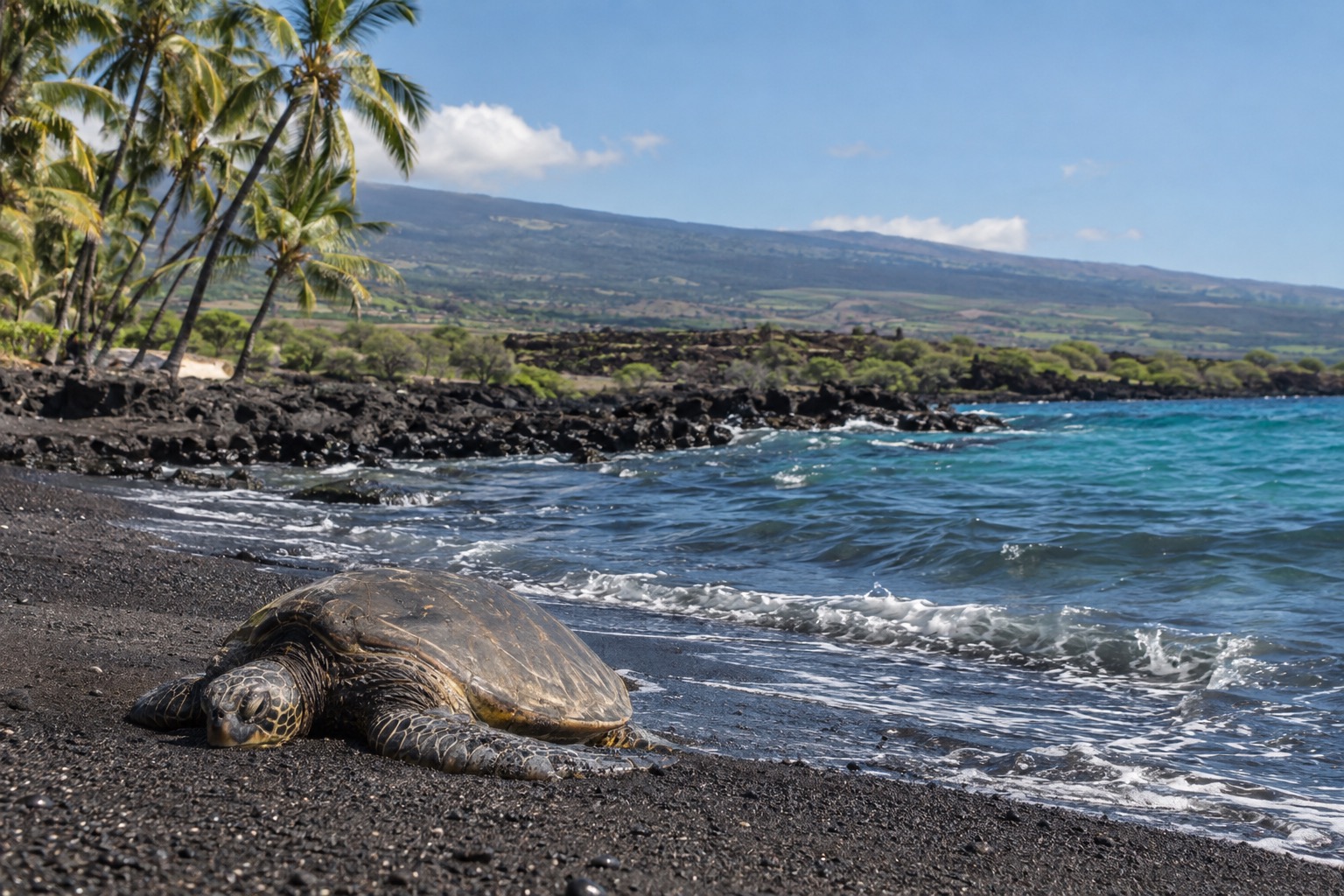
Early in the morning at Punaluu, honu haul themselves out of the surf and settle on the black sand like smooth gray boulders, while waves hiss over the dark grains and coconut palms rattle in the trade wind. This is a quiet corner of the Big Island’s southeast side, a place to slow down on the way between Kona, Hilo and the volcano. It suits travelers who want a beach to watch rather than a beach to lounge on.
Where is Punaluu and what is it like?
Punaluu sits on the Kau coast in the southeast of the Big Island, a short stretch of shoreline between the old sugar town of Naalehu to the southwest and the slopes of Kilauea inland to the northeast. It is a tiny place, a black sand beach with a small park, a few houses and open lava and pasture country all around.
The pace is slow and the setting is wild. There is no resort strip, no row of shops and no nightlife, just a bay, a lava shoreline and the sound of surf. Travelers who like wide skies, quiet roads and wildlife will love it. Those who want restaurants, shopping and a lively beach scene will find more in Kona or Hilo.
The coast also gets more weather than the resort side of the island. Clouds drift in off the mountain, showers pass through, and the light changes by the hour, which gives the black sand a deep, wet shine.
What is there to do in Punaluu?
The black sand beach and its sea turtles
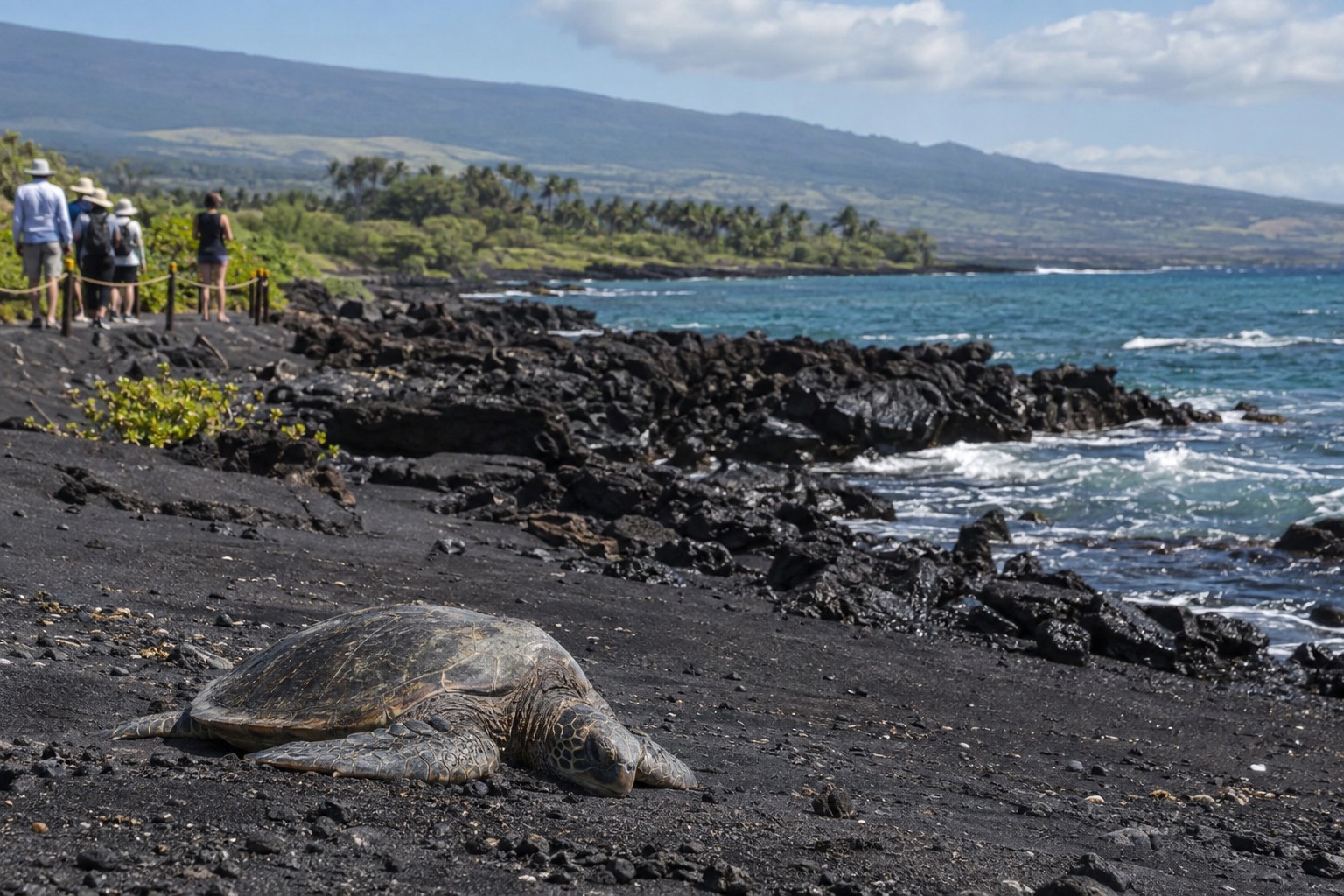
The main reason to come is the beach itself. The sand is dark because it is made of finely ground basalt from lava that met the sea, and it feels almost like coarse pepper underfoot. Green sea turtles, the honu, feed on the algae along the rocks and often rest on the sand, so the shore is as much a wildlife stop as a beach.
The turtles are listed as Threatened under the Endangered Species Act, and NOAA Fisheries recommends staying at least 10 feet away, on land and in the water. Watch from a distance, never touch one, and leave the sand where it is. State law already prohibits removing beach sand from public shorelines like this one, so a pocketful of black sand as a souvenir can bring real penalties.
Early morning and late afternoon are the gentlest hours, with softer light and fewer tour vans. Bring a camera with a zoom and plan on a slow hour or two rather than a quick photo stop. The surf here is often lively, so read the posted warnings and the day’s surf and currents before you get in the water, and swim near a lifeguard only where one is on duty.
A day to the volcano
Punaluu is one of the closest beach stops to Hawaii Volcanoes National Park, which lies up the highway toward Kilauea. Many visitors pair the two: crater rim views, steam vents and lava landscapes in the cool, often rainy air of the high country, then a descent to the warm coast for a late afternoon on the sand.
Kilauea is currently at Volcano Alert Level WATCH, with glow and spatter reported from its vents, so the night sky over the crater can be a highlight. A private vehicle entrance pass costs $30 and covers the passholder and up to 14 passengers. Bring a rain jacket and a warm layer, because the rim is far cooler than the shore.
Coast drives and small-town stops
The highway along the south coast is a pleasure in itself, with pastures, wind-bent trees and glimpses of the ocean. Naalehu has bakeries and roadside stands that make an easy lunch break, and the long, empty stretches invite unhurried stops for photos.
What sets Punaluu apart from its neighbors is its wildness and its wildlife. Kona offers resorts and snorkeling, Hilo offers rain forest, waterfalls and farmers markets, and Punaluu offers a place where you simply sit and watch turtles on dark sand.
How many days do you need in Punaluu?
A half day is enough for Punaluu itself, and a night or two works well if you are using it as a base for the volcano side of the island. The beach rewards patience more than hours, so a morning with the turtles and a picnic is a full visit.
With two or three days on this side of the island, add a long day in Hawaii Volcanoes National Park, a drive through Naalehu and the south coast, and a stay near the park. With more time, Hilo and its waterfalls lie on the other side of the volcano, and Kona’s coffee farms and snorkeling bays are a long scenic drive in the opposite direction.
Where to stay in Punaluu
Punaluu itself has very little lodging, so most travelers sleep elsewhere and visit for the day. Naalehu and the nearby Kau villages offer small, quiet stays for those who want to be close to the black sand and far from crowds.
The village of Volcano, near the national park entrance, suits travelers who want to be near the crater and its night glow. Hilo works for those who want restaurants and markets, and Kona suits beach vacations with resort comforts. Hotel and vacation rental stays carry the state’s Transient Accommodations Tax, now 11 percent, plus a 3 percent county tax in the County of Hawaii.
How do you get to Punaluu and get around?
Most visitors fly to Kona International Airport on the west side or Hilo International Airport on the east side, then drive. Both are in the FAA’s small hub category, and Kona is the busier of the two. The beach sits along the main south coast highway, so the drive is straightforward from either side, passing through open country and small towns.
A rental car is the practical way to get around, since Punaluu has no town center, no shuttles and long gaps between services. Fill the tank and pack snacks and water before heading onto the south coast, because stops are few. Walking is for the beach park itself, where paths lead along the shore and to the pond area.
When is the best time to visit Punaluu?
May through October is the drier, warmer stretch, and June is the driest month with only a couple of rain days. Highs reach the mid-80s from July through October, which makes the shore pleasant for long beach stops, and the light is bright for photographing the black sand.
November to April is cooler and wetter, with a few more showers, though even January stays near 79°F in the afternoon. Punaluu is a rainier coast than Kona, with about 35 inches a year compared with roughly 10 in Kona, so a shower can pass over the beach while the west side stays sunny. Winter surf can also be bigger, so look at the signs before getting in.
The Central Pacific hurricane season runs from June 1 to November 30, so summer and fall travel falls inside it. The beach is busiest around school vacations and holiday weeks, when tour groups come through more often. Early mornings are calm at any time of year.
Good to know before you go
Bring cash or a card for roadside food stands and fill the gas tank before heading down the coast. The turtles, the sand and the shoreline are protected, so keep your distance and take only photos. Sun is strong even on cloudy days, so reef-safe sunscreen and a hat help.
| Fee | Amount | Who pays |
|---|---|---|
| Hawaii state Transient Accommodations Tax | 11.00% | Guests in hotels and short-term rentals |
| County of Hawaii Transient Accommodations Tax | 3% | Guests in hotels and short-term rentals on the Big Island |
Sources
- Hawaii Department of Taxation, Tax Announcement No. 2025-03 (Transient Accommodations Tax Law Changes from 2025 Legislative Session), files.hawaii.gov/tax/news/announce/ann25-03.pdf, checked September 24, 2026
- County of Hawaii, Department of Finance, Transient Accommodations Tax (TAT) page, hawaiicounty.gov/departments/finance/transient-accommodations-tax-tat (live returned HTTP 403 on request, read via Internet Archive Wayback Machine snapshot dated August 14, 2026, same official content), checked September 25, 2026
- Hawaii Department of Taxation, County Surcharge on General Excise and Use Tax page, tax.hawaii.gov/geninfo/countysurcharge/, checked September 25, 2026
- Federal Aviation Administration, CY2024 Commercial Service Enplanements (xlsx), faa.gov/airports/planning_capacity/passenger_allcargo_stats/passenger/arp-cy2024-commercial-service-enplanements.xlsx, checked September 24, 2026
- NOAA Fisheries, "Green Turtle", fisheries.noaa.gov/species/green-turtle, read September 25, 2026
- NOAA Fisheries, "Viewing Marine Wildlife in Hawaiʻi", fisheries.noaa.gov/pacific-islands/marine-life-viewing-guidelines/viewing-marine-wildlife-hawaii, read September 25, 2026
- Hawaiʻi State Legislature, S.B. No. 3032, S.D. 1, H.D. 2 (2026), Section 1, data.capitol.hawaii.gov/sessions/session2026/bills/SB3032_HD2_.pdf, read September 25, 2026
- National Park Service, "Fees & Passes", nps.gov/havo/planyourvisit/fees.htm, read September 25, 2026
- U.S. Geological Survey, Hawaiian Volcano Observatory, "Kīlauea Volcano Updates", usgs.gov/volcanoes/kilauea/volcano-updates, read September 24, 2026
- NOAA NCEI, monthly normals 1991-2020, station USC00518600
- NOAA NCEI, monthly normals 1991-2020, station USW00021510
- NOAA NCEI, monthly normals 1991-2020, station USW00021504
- NWS Honolulu / Central Pacific Hurricane Center, « 2026 Central Pacific Hurricane Season Outlook », weather.gov/hfo/hurricaneOutlook2026, checked September 24, 2026
All our pages
When to go
- Best Time to Visit Punaluu: Weather by Month, Crowds, Swimming and Festivals
- Punaluu in January: Weather, Sea Conditions, Black Sand Beach and What to Do
- Punaluu in February: Weather, Sea Conditions and What to Do on the Ka'u Coast
- Punaluu in March: Black Sand, Sea Turtles, Weather and What to Do
- Punaluu in April: Weather, Black Sand Beach, Honu and Merrie Monarch Season
- Punaluu in May: Black Sand Beach, Weather, Sea Conditions and a Two-Day Plan
- Punaluu in June: Black Sand Beach, Warm Water and Sea Turtles
- Punaluu in July: Black Sand Beach, Weather, Sea Conditions and a Two-Day Plan
- Punaluu in August: Weather, Black Sand Beach Swimming and What to Do
- Punaluu in September: Black Sand Beach, Weather, Sea Conditions and a Two-Day Plan
- Punaluu in October: Black Sand Beach, Weather, Sea Turtles and a Two-Day Plan
- Punaluu in November: Black Sand Beach, Winter Seas, Weather and a Two-Day Plan
- Punaluu in December: Weather, Black Sand Beach Swimming and What to Do