
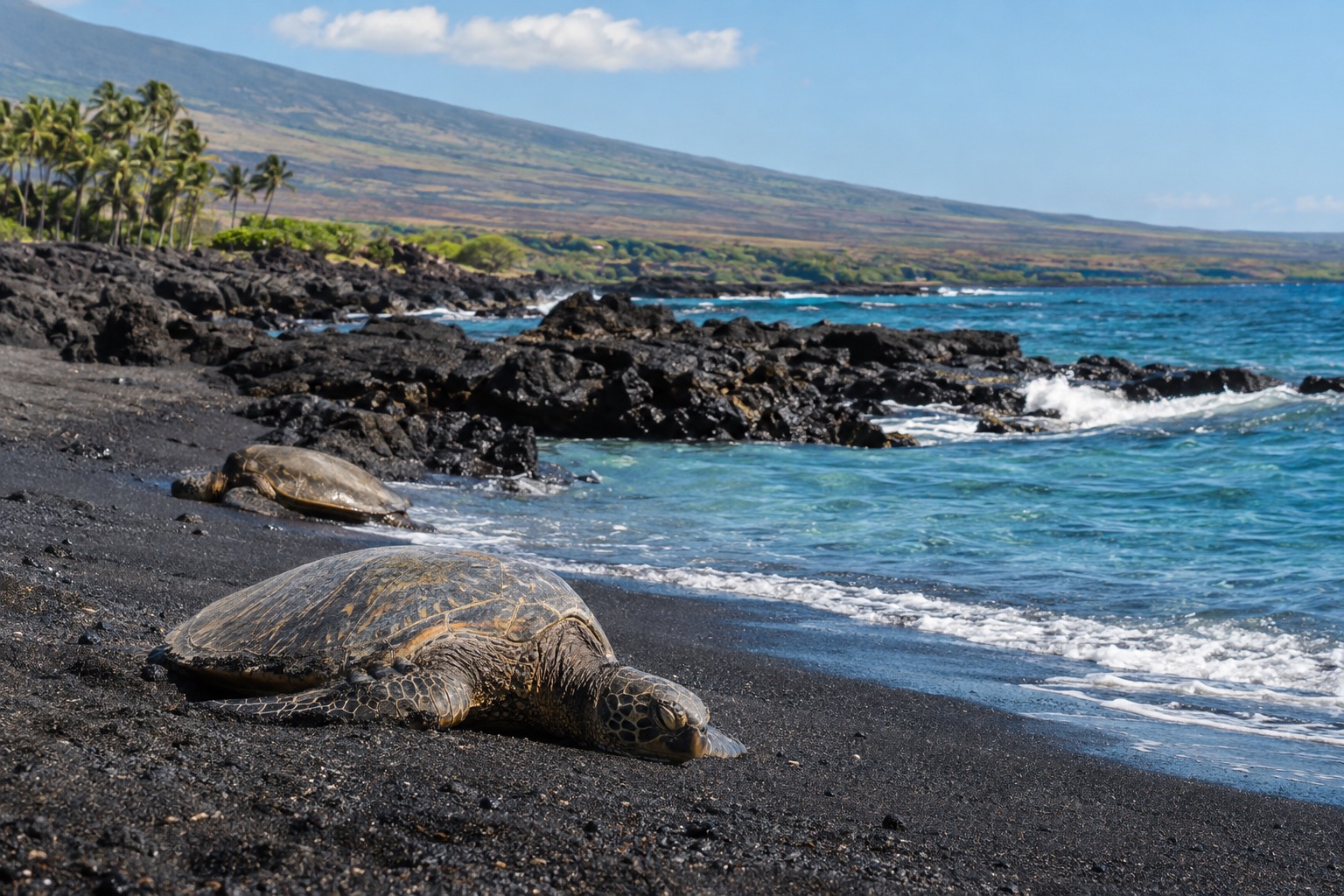
Trade winds rustle the coconut palms along Punaluu’s shore, and on the days when a shower sweeps down from the slopes of Mauna Loa, the rainbow arrives before the umbrella is out. The year here has two moods: a warm, green, somewhat wetter winter and a hotter, brighter summer that turns the shoreline golden. This stretch of the Big Island’s Kau coast sits on the windward side, so it is lusher than Kona and far drier than Hilo.
When is the best time to visit Punaluu?
The best months are April through June for most travelers, with September and October a close second if you like heat and don’t mind a shower or two. These are the stretches when the days run bright, the rain thins out and the road down from the volcano feels easy.
For the beach and the water, late spring and summer are the kindest. The air is warm, the ocean has lost its winter chill, and the black sand is hot enough underfoot that you will want sandals between the shade and the shore. Punaluu is better known for its black sand and its turtles than as a place for long, easy swims, so think of it as a beach for strolling, picnicking and watching the surf.
For sightseeing, the picture is wider. Punaluu is a natural stop on a loop that takes in Hawaii Volcanoes National Park, and the dry-ish months make that drive more pleasant. Winter has its own charm, with greener hills and fewer people at the shore, but expect more gray mornings and a passing downpour.
Budget travelers and anyone who wants space will like the shoulder months, especially late April, May and the weeks after Labor Day. Families should know that spring break in March and the long summer weeks bring more cars to the parking lot and more voices to the shore. The shoreline is small, so a busy day feels busy.
Punaluu weather by month
Punaluu stays warm all year, with a clear drier stretch in late spring and early summer.
| Month | Average high (°F) | Average low (°F) | Rain (in) | Rain days | Sea (°F) |
|---|---|---|---|---|---|
| January | 79.4 | 65.0 | 3.52 | 4.3 | 77.4 |
| February | 79.9 | 64.9 | 3.94 | 4.2 | 76.4 |
| March | 79.6 | 65.8 | 4.03 | 4.6 | 75.9 |
| April | 80.4 | 67.1 | 1.89 | 3.6 | 76.2 |
| May | 81.6 | 68.2 | 1.41 | 3.2 | 77.4 |
| June | 82.5 | 69.7 | 0.80 | 1.9 | 78.0 |
| July | 84.0 | 69.9 | 1.87 | 3.0 | 78.5 |
| August | 84.5 | 70.6 | 2.89 | 2.6 | 79.1 |
| September | 84.0 | 70.3 | 2.77 | 3.6 | 79.8 |
| October | 83.9 | 70.1 | 4.14 | 4.5 | 79.7 |
| November | 82.0 | 68.8 | 3.96 | 4.8 | 79.2 |
| December | 80.5 | 67.1 | 4.00 | 4.4 | 78.4 |
The year runs from a cooler, wetter winter to a hotter, drier summer. From November to March the showers come more often, usually short and heavy, with gray stretches that can settle over the coast for a day. June is the driest month by a wide margin, while October and November bring the rain back even though the air stays hot. Evenings are mild all year, and a light layer is plenty.
When is Punaluu cheapest and least crowded?
The quietest weeks fall in late April, May, early June and again from September to mid-November, once school is back in session across the mainland. On those days the black sand beach can feel almost empty in the early morning, and rooms in the Kau district and nearby towns are easier to find.
The busy times follow the U.S. calendar. Spring break in March, the summer vacation weeks, Easter week, Thanksgiving and the stretch from Christmas to New Year all fill the island’s lodging and the parking lot at the beach. Because Punaluu is a stop on the drive between Kona, Hilo and the volcano, tour traffic peaks around midday, so the early and late hours are the calm ones in any season.
Which months should you avoid in Punaluu?
No month is off limits, but the ones to think about are the wettest and the ones inside the official storm window. The Central Pacific hurricane season runs from June 1 to November 30, which covers the hottest half of the year. Hawaii is rarely hit, yet it is wise to follow forecasts if you travel in those months.
Rain is the other consideration. November and the winter months bring the most frequent showers, and on a bad day the coast turns misty and gray. October is hot and a bit damp. If you want a sure sunny beach day, June is the strongest bet.
Heat matters too. From July to October the sun on the black sand is strong, so go early or late and carry water. On exposed shores, winter waves may also get large, so before entering the water, look at the signs that are posted and review that day’s surf and currents, and swim only near a lifeguard where one is on duty.
When can you swim in Punaluu?
The ocean is warm enough for a dip in every month, though the surf and the currents matter more than the temperature. The water is coolest from February to April and warmest from August through October, when it feels almost like a bath.
The shoreline is open to the ocean, with lava rock, and waves can arrive with little warning. Summer is usually the gentler season, while winter swells make the entry rougher and the shore break stronger. Check the beach signs before you step in, and do not count on any day being calm.
Honu, also known as green sea turtles, often swim in the shallows, and the same wildlife rules that govern land apply in the water, with NOAA Fisheries recommending at least 10 feet of distance from them. Many visitors find that watching from the sand is the best part of the beach anyway.
Festivals and events in Punaluu through the year
Winter holidays and the Merrie Monarch week
The year starts with Christmas lights in the small towns of the Kau and Volcano districts and family gatherings on the beach on New Year’s Day. It is a gentle season, with fire-lit evenings in the uplands and the green of the rainy months at its fullest.
The week after Easter belongs to the Merrie Monarch hula festival in Hilo, a drive up the coast. Hula halau from across the islands compete, and the whole town fills with dancers, lei and crowds. If you are in Punaluu then, plan the trip to Hilo early in the day and expect hotel rooms across the island to be in demand.
Lei Day, Kamehameha Day and summer
May 1 is Lei Day, celebrated across Hawaii with flower garlands, music and school pageants. On the Big Island you will see lei in shop windows and on the shoulders of people heading to community events, a pleasant moment to stop at a small-town market for flowers.
Kamehameha Day on June 11 brings parades, floral floats and pa’u riders on horseback, with the biggest festivities up at the north end of the island. Summer after that is for family reunions, picnics under the palms and barbecue smoke drifting along the Kau coast. Weekends are livelier at the beach, so weekday mornings are the way to go.
Nature seasons: honu and the volcano
Honu are here all year, grazing on algae along the rocks and resting on the sand once the sun warms it. Because the Endangered Species Act lists them as Threatened, visitors stay back and follow the animals’ lead.
The volcano is the other draw. At night, Kilauea’s vents have been glowing and spattering, and the volcano remains at Volcano Alert Level WATCH, so an evening in Hawaii Volcanoes National Park pairs easily with a stop at Punaluu. A private vehicle pass costs $30 and covers everyone in the car. Winter also brings humpback whales offshore, a good reason to scan the horizon between January and March.
Sources
- NOAA NCEI, monthly normals 1991-2020, station USC00518600, checked September 8, 2026
- Open-Meteo Marine API, average 2015-2024, checked September 8, 2026
- sunrise-sunset.org, sunrise and sunset calculated for the 15th of the month, checked September 8, 2026
- Hawaii Department of Taxation, Tax Announcement No. 2025-03 (Transient Accommodations Tax Law Changes from 2025 Legislative Session), files.hawaii.gov/tax/news/announce/ann25-03.pdf, checked September 24, 2026
- County of Hawaii, Department of Finance, Transient Accommodations Tax (TAT) page, hawaiicounty.gov/departments/finance/transient-accommodations-tax-tat (live returned HTTP 403 on request, read via Internet Archive Wayback Machine snapshot dated August 14, 2026, same official content), checked September 25, 2026
- Hawaii Department of Taxation, County Surcharge on General Excise and Use Tax page, tax.hawaii.gov/geninfo/countysurcharge/, checked September 25, 2026
- Federal Aviation Administration, CY2024 Commercial Service Enplanements (xlsx), faa.gov/airports/planning_capacity/passenger_allcargo_stats/passenger/arp-cy2024-commercial-service-enplanements.xlsx, checked September 24, 2026
- NOAA Fisheries, "Green Turtle", fisheries.noaa.gov/species/green-turtle, read September 25, 2026
- NOAA Fisheries, "Viewing Marine Wildlife in Hawaiʻi", fisheries.noaa.gov/pacific-islands/marine-life-viewing-guidelines/viewing-marine-wildlife-hawaii, read September 25, 2026
- Hawaiʻi State Legislature, S.B. No. 3032, S.D. 1, H.D. 2 (2026), Section 1, data.capitol.hawaii.gov/sessions/session2026/bills/SB3032_HD2_.pdf, read September 25, 2026
- National Park Service, "Fees & Passes", nps.gov/havo/planyourvisit/fees.htm, read September 25, 2026
- U.S. Geological Survey, Hawaiian Volcano Observatory, "Kīlauea Volcano Updates", usgs.gov/volcanoes/kilauea/volcano-updates, read September 24, 2026
- NOAA NCEI, monthly normals 1991-2020, station USW00021510
- NOAA NCEI, monthly normals 1991-2020, station USW00021504
- NWS Honolulu / Central Pacific Hurricane Center, « 2026 Central Pacific Hurricane Season Outlook », weather.gov/hfo/hurricaneOutlook2026, checked September 24, 2026