
NAZARÉ · WEST COAST · THE CLIFF AND THE CANYON
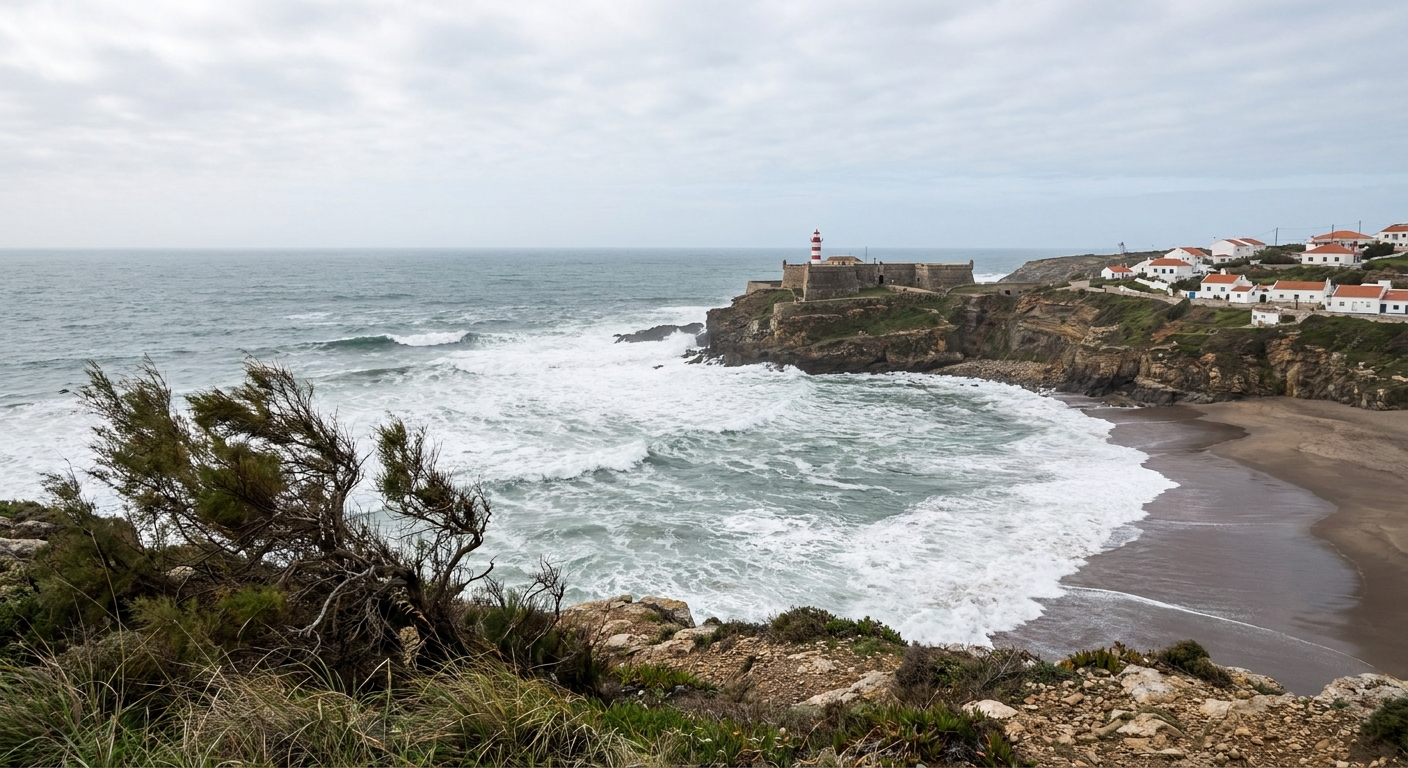
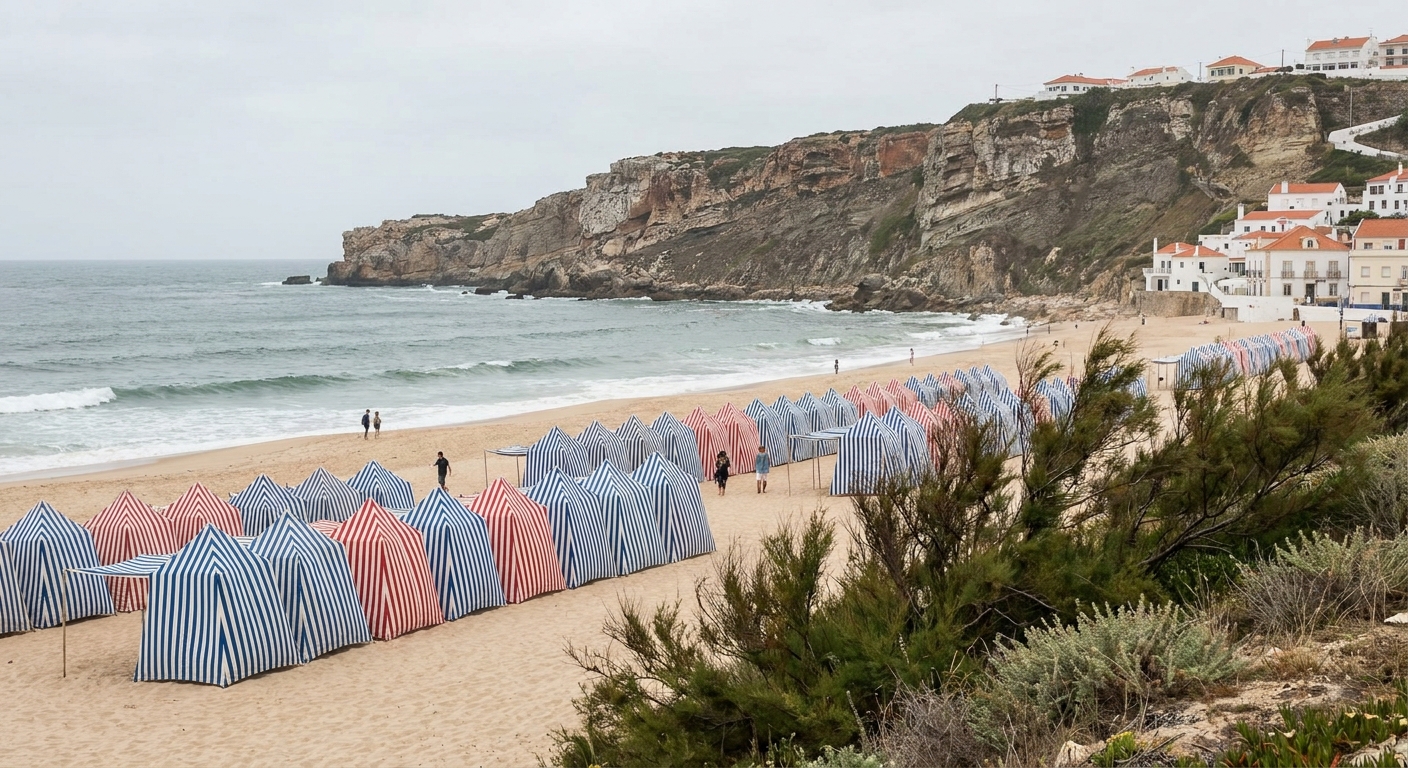
The wave that made this town famous does not break on the beach you see from the promenade. It breaks on the far side of the headland, at Praia do Norte, where a submarine canyon runs almost to the shore and stands the Atlantic swell up into something people watch from the clifftop with their hands in their pockets. The sand below the town is a different animal: sheltered, wide, ruled in summer by rows of striped tents. Same town, opposite temperaments, and the calendar decides which one you get.
NAZARÉ AT A GLANCE
One promontory carries two shorelines: the swell circus at Praia do Norte, watched from the fort, and the sheltered town sand under the funicular. Pick the one your dates can deliver.
WEST COAST · BIG-WAVE SEASON · TOWN BEACH IN SUMMER
Go for: the terrace at the Forte de São Miguel Arcanjo on a swell morning, the Miradouro do Suberco at the top of the funicular, and the racks of split fish drying at the edge of the town beach.
Think twice before: booking a date for the giants, or planning a swim at Praia do Norte: the town’s own beach information advises against bathing there because of the shore break and the currents.
Beach status and funicular hours change with the season · full sources at the end of this guide
On this page
- Praia do Norte or Praia da Nazaré?Two shores of one promontory
- Where to watch the big waves in NazaréThe funicular, Sítio and the lighthouse fort
- Things to do in NazaréDrying racks, the seven skirts, the market
- Best time to visit NazaréSwell season or summer
- Where to stay in NazaréLower town or the Sítio clifftop
- Getting to Nazaré from LisbonNo station in town, and the Óbidos pairing
Praia do Norte and Praia da Nazaré: how the two beaches differ
The headland does the sorting. North of it, Praia do Norte faces the open Atlantic and the Nazaré canyon, the deep trench that reaches in toward the shore and steepens the swell before it lands. South of it, in the lee of the same rock, Praia da Nazaré lies wide and flat in front of the town. These are two sides of a cliff, not two ends of one beach. There is no short walk along the sand between them: from the lower town you climb to Sítio and continue on foot to the northern access, or you go round by road.
Praia do Norte is a surf beach first. The town’s own beach information lists it as guarded during the bathing season, with surf, bodyboard, kitesurf and windsurf practised there, while advising against swimming because of the shore break and the currents. That advice stands on ordinary days. On the big-swell days that reach the news, the water is no place to be at all, closures and lifeguard instructions apply, and the useful position is the cliff above. Praia da Nazaré, sheltered by that same rock, is where the striped tents go up and where families spend July.
Watching the big waves at Nazaré: the funicular to Sítio and the Forte de São Miguel Arcanjo
The way up is the Ascensor da Nazaré, the funicular that climbs from the lower town to Sítio, the old quarter on top of the cliff. Step out at the top and the Miradouro do Suberco drops the whole lower town and its beach directly beneath you. Behind the viewpoint stand the Santuário de Nossa Senhora da Nazaré and the small Ermida da Memória on the cliff edge, the chapel attached to the local legend of the rider who stopped at the brink. From there the road runs out along the point to the Forte de São Miguel Arcanjo.
The fort holds the lighthouse, and its terrace is the watching platform: the surf breaks below and slightly north, so you look down onto it rather than across at it. On a working swell day the terrace is cold, loud and full, wind comes over the wall carrying sand, and the doorway queue moves slowly. Dress as you would for a boat, not for a beach. Ground beyond the fort is unfenced in places, so stay well back from the edge and off any path that has been closed.
No swell is guaranteed. The season for the giants runs roughly from autumn into early spring, and inside that window the ocean keeps its own schedule, which is why people who see one book flexibly and read forecasts. Out of season the promontory still repays the climb, since the viewpoint, the sanctuary and the walk to the fort all work on a grey afternoon with a flat sea. Climate belongs to the calendar: our month-by-month guide and the November page carry the temperatures and the rain.
The fishing town of Nazaré: drying racks, the seven skirts and the municipal market
Racks of split fish still stand on the sand at the edge of the town beach, drying in sun and wind the way they have been dried here for generations. Sardines, horse mackerel and octopus go out on the wooden frames, salted, and finish on stalls and in kitchens along the seafront. This is a working practice rather than a display, which is why the racks appear and disappear with the weather and the catch.
The costume around them, the sete saias, seven skirts worn one over the other with a headscarf and slippers, belongs to women who wear it as their own clothes and not as a uniform. Some are selling dried fish. Some are sitting on a bench watching the water. Photograph the beach freely, ask before you photograph the person, and buy something if you have just spent five minutes with a lens near her stall.
The Mercado Municipal in the lower town is the other half of the same economy, busiest in the morning and stocked for households. Pederneira, the third old quarter, sits on its own hill inland with a church square and a view over the valley, and it is not on the funicular route. Grilled fish is the standard dinner down by the promenade, and our food guide covers what to order and how it is served.
When to visit Nazaré: swell season or the summer beach
| Season or moment | Where | Why then | The trap |
|---|---|---|---|
| Autumn to early spring | Forte de São Miguel Arcanjo, above Praia do Norte | The swell window for the canyon waves, and the days the tow-in crews go out | Booking a fixed date instead of following the forecast |
| A big-swell morning | The fort terrace and the cliff road | The whole spectacle, jet skis included, seen from solid ground | Drifting toward an unfenced edge in a strong wind |
| An out-of-season afternoon | Sítio | Suberco viewpoint, the sanctuary, the Ermida da Memória, empty lanes | Expecting surf on demand |
| Summer | Praia da Nazaré | Sheltered sand, striped tents, the promenade at full volume | Assuming Praia do Norte offers the same swim |
| Morning, year round | Mercado Municipal and the drying racks | Fish landed, split and salted, the town at work | Arriving once the market has wound down |
| Evening | Lower town streets behind the seafront | Grilled fish after the day coaches have gone | Assuming the funicular still runs when dinner ends |
Where to stay in Nazaré: the lower town or the Sítio clifftop
The lower town is the grid of streets behind the promenade, and it suits anyone who intends to walk everywhere: beach, market, restaurants and the coach stop sit on the flat. In summer the blocks nearest the seafront stay awake late and fill with day visitors between lunch and dusk. A room one or two streets inland trades the sea view for a quieter window, and usually costs less.
Sítio, on top of the cliff, is the other address: long views down the coast, quieter evenings, and the shortest approach to the fort when a swell arrives overnight. What you accept in exchange is wind, a colder terrace and reliance on the funicular or the road every time you want dinner by the beach. Check the last departure of the day against your dinner plans before you book. Zone thinking for the rest of the country sits in our where-to-stay guide.
Getting to Nazaré from Lisbon or Óbidos, and how many nights to give it
There is no railway station in Nazaré itself. The nearest stop on the line, Valado dos Frades, sits outside town and needs a bus or a taxi for the last leg, so most visitors arrive by long-distance coach from Lisbon or by car. Parking in the lower town is street-side and tightens on summer afternoons and on big-swell weekends. Our getting-around guide covers coaches and regional trains, and the car guide handles tolls and rentals.
For a first look, the town attaches neatly to a day out of the capital: Óbidos in the morning and the cliff terrace in the afternoon is the pairing our day-trip guide already sets out. Sleep here a night, or two, when watching the ocean is the point of the trip and you want room to move your plan the morning a forecast changes. On a tight itinerary with locked dates, treat the waves as a bonus and the town as the reason.
Surfing rather than watching belongs elsewhere on this coast: Ericeira has the schools and the everyday beach breaks, with Peniche between the two. If this stop is one link in a longer loop, the 10-day route shows where the west coast falls between Lisbon and the north. Families weighing sheltered sand against a windy cliff-edge outing will find that argued in our Portugal with kids guide.
When to go. The month-by-month case for Nazare — what the normals say, when the sea is warm enough to swim and which weeks fill up — sits on the best time to visit Nazare.
The last word
The fame arrived from offshore, out of a canyon nobody can see, and the town took it on without turning into a theme park about it. Tow-in photographs hang in the fort, surf shops line the promenade, and a few streets away a woman turns split fish on a wooden rack because that is the morning’s work. Both belong to the same town on the same day, and the dinner plate is the shortest route between them.
Come in the swell months and give the ocean several days of your calendar instead of one afternoon, or come in July and take the sheltered sand for exactly what it is. The striped tents stand on a beach that empties into wind by December. Ask at a fish stall in August what the sea does in February, and the answer arrives with a hand raised above the head.
Sources & data for this guide
- Sítio, the Ascensor da Nazaré, the Santuário de Nossa Senhora da Nazaré and the Ermida da Memória · visitportugal.com (Turismo de Portugal) plus ground observation · checked Sep 6, 2026
- Praia do Norte · municipal beach information lists it as guarded during the bathing season, with surf, bodyboard, kitesurf and windsurf, and advises against swimming because of the shore break and currents · Câmara Municipal da Nazaré · checked Sep 6, 2026
- Big-wave season over the Nazaré canyon · a long-established seasonal pattern running roughly from autumn to early spring. No date can be booked, so we publish none; live forecasts sit with the usual surf services · checked Sep 6, 2026
- Walking between Praia da Nazaré and Praia do Norte · the promontory separates the two beaches and the published pedestrian route climbs through Sítio rather than following the sand · checked Sep 6, 2026
- Funicular, market and beach-service hours change with the season and we publish none here: the boards in town are the only current version · checked Sep 6, 2026
- Access · Nazaré has no station in town; the nearest railway stop is Valado dos Frades, with bus or taxi onward, and long-distance coaches serve the town from Lisbon · operator timetables · checked Sep 6, 2026
- Editorial note: clifftop wind, terrace crowding on swell days and neighborhood atmosphere are our own observations, not published data