
NAZARÉ · PORTUGAL · JANUARY
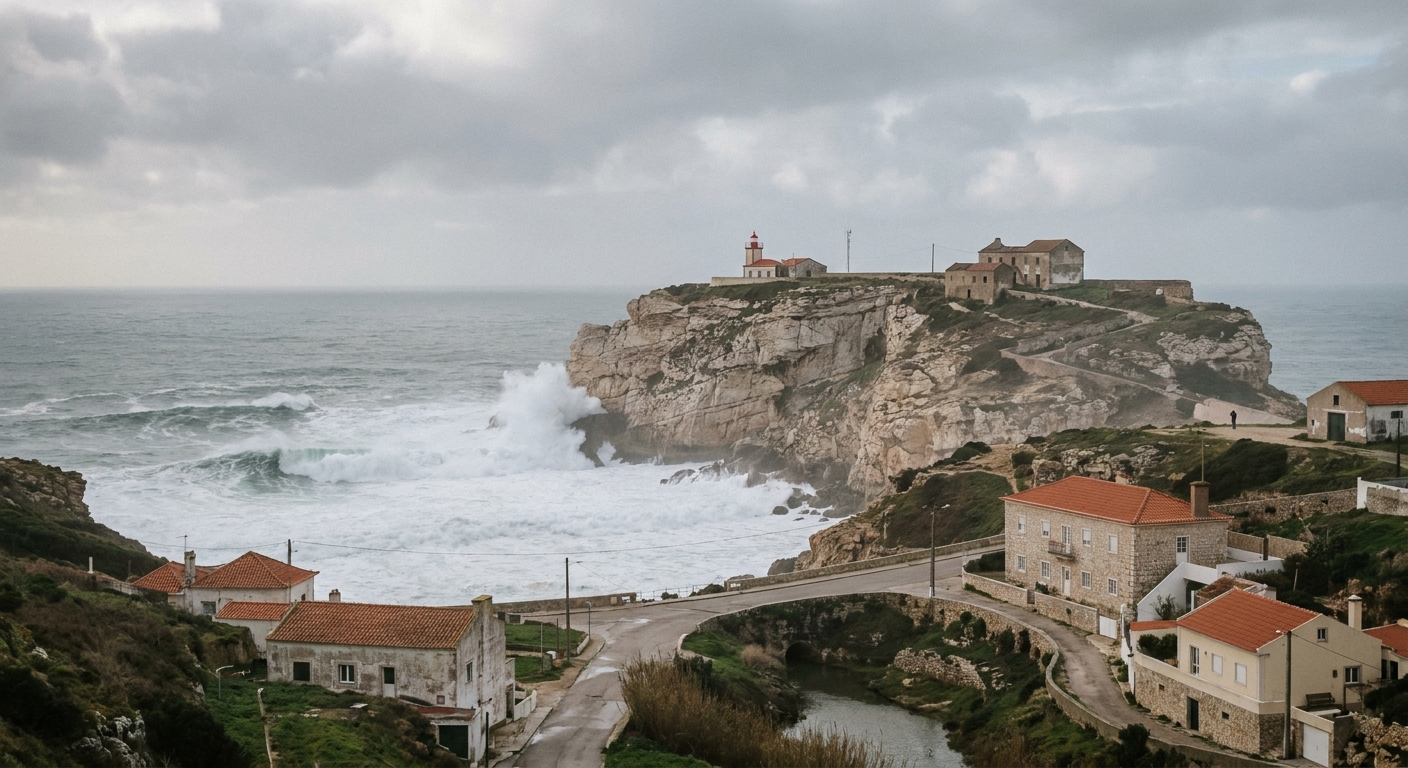
January is a coat month in Nazaré. Afternoons average 58.1°F, nights 49.8°F, and the wide crescent of sand that holds umbrella rows in August holds dog-walkers, fishermen and swell-watchers instead. The winter big-wave season at Praia do Norte runs straight through these weeks, which is the single reason most visitors book now.
You have already chosen the town, so the live question is the date. Shifting four weeks moves the rain far more than the thermometer: December, January and February all sit within 1.4°F of each other on average highs, while February’s rainfall drops to 2.17 inches against January’s 2.98.
THE MONTH AT A GLANCE · NAZARÉ
January gives you a 58.1°F coast, a 60.1°F sea and rain on roughly one day in three: a swell-watching, coat-wearing month rather than a beach one.
AVG HIGH 58.1°F · SEA 60.1°F · 10.4 WET DAYS · 9H45 OF DAYLIGHT
Go for: the winter swell window at Praia do Norte, a promenade with room on it at noon, and a coast you can walk all day in a rain shell.
Think twice before: building the trip around swimming or a beach day: 10.4 January days record measurable rain and the sea averages 60.1°F.
Air: IPMA station 531, Cabo Carvoeiro · Sea: Open-Meteo Marine · full sources at the end
On this page
- Nazaré weather in January58.1°F days, 2.98 inches, 10.4 wet days
- Can you swim in January?A 60.1°F sea, wetsuit by wetsuit
- Crowds, prices and booking in low seasonWhat we verified and what we could not
- Things to do in JanuaryPraia do Norte, Sítio and the funicular
- A two-day plan around 9h45 of daylightHour by hour, with a wet-day swap
- January vs December and FebruaryHow the three winter months compare
- Is January a good time to visit Nazaré?Our verdict, and who should shift
The short version before the detail: January is the wettest of Nazaré’s three winter months at 2.98 inches, the nights bottom out around 49.8°F, and the water holds at 60.1°F.
Nazaré weather in January: average highs, lows and rain days
| January in Nazaré | Figure | Source |
|---|---|---|
| Average high | 58.1°F (14.5°C) | IPMA normals 1991–2020 |
| Average low | 49.8°F (9.9°C) | IPMA normals 1991–2020 |
| Rainfall | 2.98 in | IPMA normals 1991–2020 |
| Days with 0.04 in or more | 10.4 | IPMA normals 1991–2020 |
| Sea surface | 60.1°F | Open-Meteo Marine, 2015–2024 |
| Daylight on Jan 15 | 9h 45m | sunrise-sunset.org |
Every figure here comes from IPMA, Portugal’s national weather service, and from one real thermometer rather than a model grid cell: station 531 at Cabo Carvoeiro, Peniche, 105 feet (32.0 m) above the sea, 1991–2020 normals. That station sits on the same exposed stretch of Atlantic coast as Nazaré, so the reading travels well along the shore and badly inland. High ground behind the coast runs colder and a great deal wetter, and a hiking day deserves its own forecast.
An average January records at least 0.04 inch of rain on 10.4 days. That is roughly one day in three. IPMA counts on its own thresholds rather than the 0.10-inch line American tables use, so the two counts are not interchangeable. In practice the wet comes through on Atlantic fronts and then clears: a walk between showers is the normal shape of a January day in Nazaré, and a washed-out week is not what the normals describe.
Day and night sit only 8.3°F apart, and the narrowness cuts both ways. Afternoons rarely feel warm, evenings rarely bite. Pack for wind and water rather than for cold: a waterproof shell, one warm mid-layer, shoes that cope with a wet cobbled ramp up to Sítio, and trousers you do not mind soaking. Our Portugal packing guide has the rest of the list.
On January 15 the sun rises at 7:54 am and sets at 5:39 pm local time, for 9 hours and 45 minutes of daylight. Mainland Portugal runs on UTC in winter, so those are the times your phone will show. Put the clifftop in the middle of the day and treat 5 pm as the last useful hour of outdoor light.
Can you swim in Nazaré in January? Sea temperature and what it feels like
The sea off Nazaré averages 60.1°F in January in the Open-Meteo Marine record for 2015–2024. One caveat belongs with that number: it is built from daily maximum readings, so it runs a shade warmer than a true 24-hour mean. Read 60.1°F as the friendly end of what the water does, not the figure at 7 am.
Sixty degrees is full-wetsuit water for anything longer than a plunge. Surfers go out in hoods and boots and stay out for hours. An unprotected swimmer gets a bracing three or four minutes before the cold ends the swim, and children last less. Plan on no lifeguard cover at Praia da Nazaré in January and treat any entry as unsupervised.
We found no wave-height or wind series for the month, so we quote no numbers on either. What stands without them: the winter swell window is the reason January bookings exist here, and the watching is done from the headland above Praia do Norte rather than from the sand. Surf forecasts swing day to day, so check one the morning you go and keep the afternoon loose.
How busy is Nazaré in January? Crowds, prices and booking
By the calendar, January is deep off-season on this coast. The New Year week closes, the school holidays end, and the summer demand that fills a Portuguese beach town is five months out. We found no occupancy series and no monthly room-rate data for Nazaré, so we crown no month the cheapest and give no percentage. Some seafront businesses take a winter break, so calling ahead beats walking up.
We could not verify a booking-lead figure either, and we will not invent one. The January pattern is unusual anyway: the crowd follows the swell forecast, and a promising weekend can absorb a small town’s stock of rooms within days. Book refundable, watch the forecast, and treat a locked non-refundable weekend as the real risk to your trip cost. Most US travelers fly into Lisbon first, as our flights guide sets out.
We could not verify a municipal lodging tax for Nazaré, so we quote no rate and no per-night amount. Portuguese municipalities set their own arrangements, and where one applies it usually lands as a separate line at checkout rather than inside the room price you booked. Ask when you reserve, then read the confirmation.
One upgrade genuinely changes January here, and it is the car. With 9 hours 45 minutes of daylight and rain on roughly one day in three, mobility converts a soaked morning into Óbidos inside its walls and a clear afternoon into the coast road south toward Ericeira. Our car rental guide covers the tolls and the insurance trap.
Things to do in Nazaré in January: Praia do Norte, Sítio and the funicular
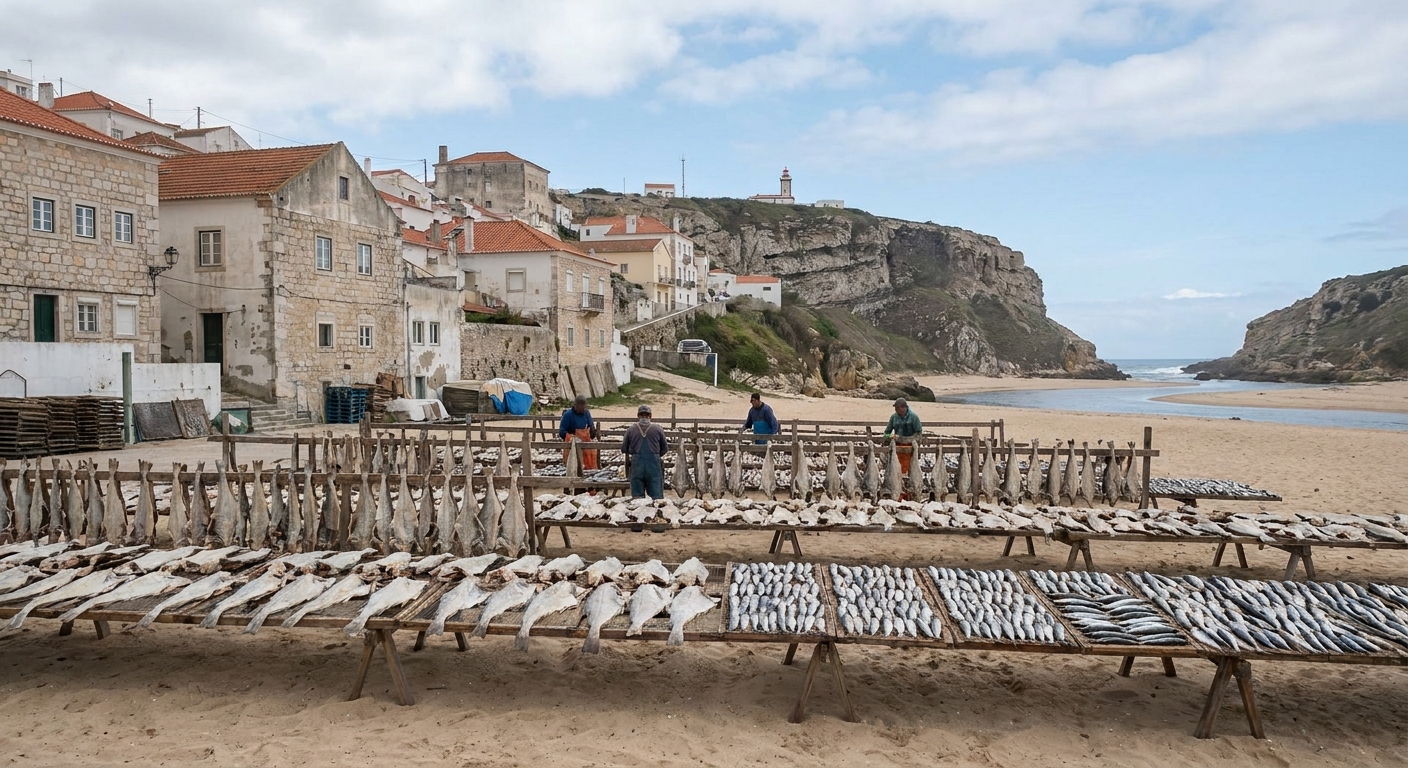
Winter is when Praia do Norte does the thing it is famous for, and January sits in the middle of that season. Nobody books this month for a tan. The second thing the date hands over is space: the promenade, the drying racks on the sand and the clifftop at Sítio all have room in them at noon on a Tuesday, in a town that spends its summer shoulder to shoulder.
The geography is simple enough to walk. Praia sits at sea level, Sítio sits on the cliff above it, and the funicular, the Ascensor da Nazaré, connects the two. Up top are the Suberco viewpoint over the bay, the sanctuary of Nossa Senhora da Nazaré, and the path out to the Forte de São Miguel Arcanjo, the lighthouse fort overlooking the north beach. Check on the day for winter hours and fares for the funicular, the sanctuary and the fort.
What January changes at those places is the air, not the water. The sea reads 61.3°F in December, 60.1°F in January and 59.7°F in February, a spread of 1.6°F across the whole winter, so the wetsuit decision is identical in all three months. On a January night at 49.8°F the sea is more than ten degrees warmer than the air standing over it, and the coat decision is the one that actually moves.
The parts with no ticket desk carry the month well: the Suberco terrace, the seafront walk from the harbor end to the cliff, the beach itself and the headland path toward the fort.
Nazaré in January: a two-day itinerary
Day one runs on daylight. Breakfast at 8:30, with the sun up since 7:54. Take the funicular to Sítio around 10 and give the Suberco viewpoint and the sanctuary the late morning. Lunch in Sítio at 1. Walk the headland path toward the Forte de São Miguel Arcanjo at 2:30, which is when the north beach shows what the swell is doing. Be back down in Praia by 5, ahead of the 5:39 pm sunset, and eat early.
Day two starts on the sand at Praia da Nazaré, with the harbor end and the drying racks, then turns inland after lunch for Óbidos and its walls. If the front parks over the coast for the whole day, invert the order: drive inland in the morning, keep Nazaré for whatever break the afternoon gives, and use our getting-around guide for the road logic.
Nazaré in January vs December and February
| Measure | December | January | February |
|---|---|---|---|
| Average high | 59.5°F | 58.1°F | 58.5°F |
| Average low | 51.4°F | 49.8°F | 50.5°F |
| Rainfall | 2.70 in | 2.98 in | 2.17 in |
| Days with 0.04 in or more | 9.4 | 10.4 | 7.6 |
| Sea surface (daily maxima) | 61.3°F | 60.1°F | 59.7°F |
On air temperature the three months are near-identical: 1.4°F separates December’s 59.5°F high from January’s 58.1°F, and February lands in between at 58.5°F. Rain is where they part. January takes 2.98 inches over 10.4 wet days, the wettest and the greyest of the three, while February drops to 2.17 inches over 7.6 days. The sea cools steadily through the winter, from 61.3°F in December to 59.7°F in February.
Shift four weeks forward and you gain 2.8 fewer wet days, 0.81 inch less rain and longer afternoons, at a cost of 0.4°F of sea temperature, which almost nobody can feel through neoprene. Shift back to December and you buy the warmest water of the winter and milder nights at 51.4°F, alongside the holiday pricing nobody enjoys. Both cases are laid out in our February guide and our December guide.
Is January a good time to visit Nazaré?
Yes if you are coming for the Atlantic in winter, for a quiet coastal town, for long walks in a shell jacket and for a headland with room to stand on it. No if the trip is built on beach hours or on swimming with children: 10.4 wet days, 9 hours 45 minutes of daylight and a 60.1°F sea make a poor foundation for that holiday, whatever the brochure photo shows.
If the answer came out no, February is the shift to make, and it wins on paper twice over: warmer afternoons by 0.4°F, and nearly three fewer wet days per month. The only thing it takes away is the half-degree of sea warmth. For a broader read across the whole calendar, our best time to visit Portugal page ranks the twelve months nationally.
January’s own argument is narrow and real: the swell season is wide open, the New Year visitors have gone home, Easter is months away, and the clifftop belongs to whoever climbed up for it.
The last word
Book it refundable and watch the forecast rather than the calendar, because in January a Nazaré weekend is made or unmade by what the ocean is doing on the Friday. One figure we have kept back: 2.4 days in an average January bring 0.39 inch of rain or more, so two or three days of a week here will be genuinely, properly wet. Those are the days for the road to Óbidos and a bowl of caldeirada. The rest, at 58.1°F, are walking days, and the town is yours.
Sources & data for this guide
- January air normals (58.1°F / 49.8°F, 2.98 in, 10.4 days at 0.04 in or more, 2.4 days at 0.39 in or more) · IPMA, normals 1991–2020, station 531 Cabo Carvoeiro, 32.0 m · checked Sep 23, 2026
- December and February normals (59.5/51.4°F, 2.70 in, 9.4 days · 58.5/50.5°F, 2.17 in, 7.6 days) · same IPMA station and period · checked Sep 23, 2026
- Sea surface 60.1°F in January, 61.3°F in December, 59.7°F in February · Open-Meteo Marine API, 2015–2024 mean of daily maxima · checked Sep 23, 2026
- Daylight 9h 45m, sunrise 7:54 am and sunset 5:39 pm on January 15 · sunrise-sunset.org · checked Sep 23, 2026
- Editorial admission: we found no occupancy or room-rate series for Nazaré, could not verify a municipal lodging tax, and could not verify winter hours or fares for the funicular, the sanctuary or the Forte de São Miguel Arcanjo. We also found no wave, wind or verified January event dates, so none appear above.
- The IPMA station stands at Cabo Carvoeiro, Peniche, on the same exposed coast · inland and high ground run colder and wetter · check a local forecast before a hiking day.