
DRY TORTUGAS · APRIL · 70 MILES WEST OF KEY WEST
At 82.6°F, the average April afternoon at the Key West weather station runs 3.0°F above March and 3.3°F below May, and the sea off Dry Tortugas reaches 79.8°F at its daily peak. You have already picked the fort in the Gulf. The question left is the date, and April answers with warm air, water a fraction under 80°F, and measurable rain on fewer than three days of the thirty.
April is also the final month of Florida’s November-to-April dry season, as our Florida guide lays out. The park’s geography stays fixed all year: no road reaches it, and every trip starts in Key West on a boat or a seaplane. The date decides the weather at both ends of that crossing and the warmth of the water when you step off onto Garden Key.
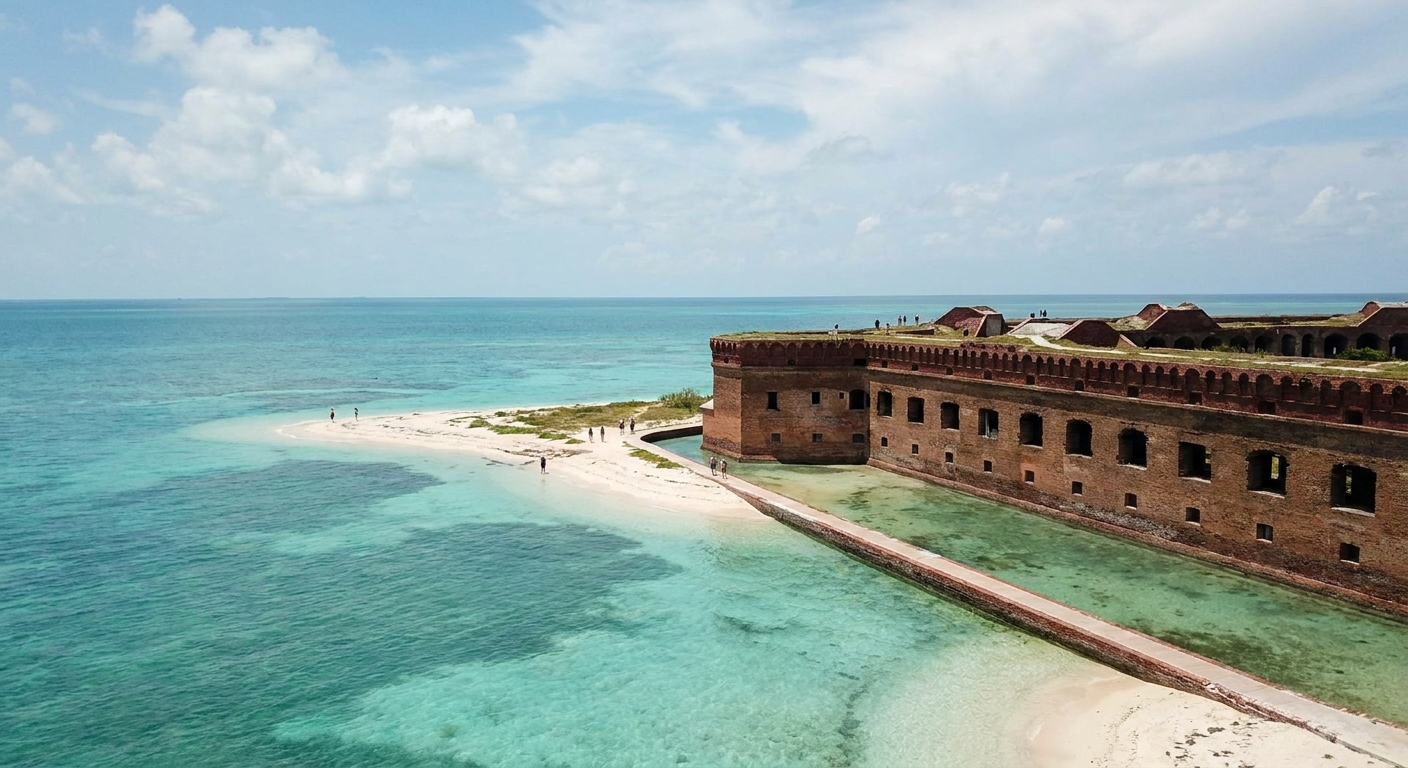
THE MONTH AT A GLANCE · DRY TORTUGAS · APRIL
April gives Dry Tortugas warm, mostly dry days and a sea just under 80°F, a strong month for snorkeling and the fort, with May the better pick only if water warmth outranks everything else.
LAST MONTH OF THE DRY SEASON · SEA 79.8°F AT DAILY PEAK · 2.8 WET DAYS · BOOK THE CROSSING FIRST
Go for: snorkeling off Garden Key in water near 80°F, long walks around Fort Jefferson under mostly dry skies, and an overnight with almost 13 hours of daylight.
Think twice before: booking April if you chill easily in water under 80°F. May’s sea runs 84.6°F on the same marine series.
Air: NOAA NCEI 1991-2020, Key West station · Sea: Open-Meteo Marine 2015-2024 · Light: sunrise-sunset.org · full sources at the end
On this page
- Dry Tortugas weather in April82.6°F highs, 73.1°F lows and 2.8 wet days
- Can you swim in Dry Tortugas in April?A 79.8°F sea at the daily peak, and how it feels
- How busy is Dry Tortugas in April?Crowds, booking the crossing and lodging tax
- Things to do in Dry Tortugas in AprilFort Jefferson, the Garden Key beach and Loggerhead Key
- Two-day Dry Tortugas itineraryA night on Garden Key, from sunset to sunrise
- Dry Tortugas in April vs March and MayHow the three months compare on heat, rain and sea
- Is April a good time to visit Dry Tortugas?Who should go in April, and who should wait for May
For the ferry, the seaplane and the history of the fort, start with our Dry Tortugas guide. Where to sleep the night before the boat is covered in our Key West guide, and the airports that serve the Keys are in our Florida flights guide. If you are still weighing April against the rest of the year, Florida’s best time to visit sets the months side by side.
Dry Tortugas weather in April: average highs, lows and rain days
| April measure | Value | Source |
|---|---|---|
| Average high | 82.6°F | NOAA NCEI, Key West station |
| Average low | 73.1°F | NOAA NCEI, Key West station |
| Precipitation | 2.07 in | NOAA NCEI, Key West station |
| Days with 0.10 in or more | 2.8 | NOAA NCEI, Key West station |
| Days with 1 in or more | 0.7 | NOAA NCEI, Key West station |
| Sea surface (mean of daily maxima) | 79.8°F | Open-Meteo Marine, 2015-2024 |
| Daylight, April 15 | 12 h 47 min | sunrise-sunset.org |
The air normals below are official 1991-2020 figures from NOAA’s National Centers for Environmental Information, read at station USW00012836 in Key West: an average April high of 82.6°F, a low of 73.1°F and 2.07 inches of rain. That thermometer stands seventy miles east of Fort Jefferson. Dry Tortugas sits alone in open Gulf water, windier than Key West and with nothing between it and an incoming front, so treat every figure here as the nearest real measurement, not a reading taken on Garden Key.
The Key West record averages 2.8 April days with at least a tenth of an inch of rain, about one day in eleven. Days with an inch or more average 0.7, so a typical April brings one soaking day or none at all. For a day trip, a wet crossing is possible but unlikely. Pack a light rain shell in the day bag and keep your phone and camera in a dry pouch for the boat ride.
From the 73.1°F dawn to the 82.6°F afternoon, the gap is 9.5°F, narrow by mainland standards. Campers on Garden Key need little more than a light blanket at night. The open-water crossing and the breeze on the moat wall still make a long-sleeve layer worth carrying at noon, along with a brimmed hat and reef-safe sunscreen for a day spent mostly in the open.
On April 15 the sun rises at 7:03 am and sets at 7:50 pm Eastern Daylight Time, converted from the UTC times in sunrise-sunset.org’s calculation, for 12 hours 47 minutes of light. Overnight visitors get the fort’s western brick in low sun from roughly 7 pm (est.), and the first light at 7:03 am reaches the same walls from the east.
Can you swim in Dry Tortugas in April? Sea temperature and what it feels like
Open-Meteo’s Marine API puts the April sea surface off Dry Tortugas at 79.8°F, averaged over 2015-2024. That figure is a mean of daily maxima, the warmest reading of each day, so it runs a shade warmer than a 24-hour average would, and an early-morning snorkel meets water slightly below it. It also comes from a separate source and period: a marine model series, independent of the Key West thermometer behind the air normals.
Water just under 80°F feels cool for the first minute and comfortable afterward for most swimmers on a half-hour snorkel. If you chill easily, or plan back-to-back sessions off the Garden Key beach, a rash guard or a thin wetsuit top keeps you in longer, which also protects a back that faces the sun for an hour.
We could not read wind speed or swell data for the park, so we give no figure. NOAA’s station location does tell you the direction of the error: the islands are more exposed than Key West, and a breezy April day there chops up the water over the reef flats and along the crossing. On a gusty morning, snorkel close to the beach and leave the outer stretches of the moat wall for a calmer hour.
How busy is Dry Tortugas in April? Crowds and prices
April closes Florida’s November-to-April dry season, and our Florida guide places the loudest spring-break crowds in March, one month earlier. We found no monthly visitor or occupancy series for the park or for Key West hotels, so we crown no month the busiest and none the cheapest.
Every visitor reaches Dry Tortugas by boat or seaplane from Key West, so the first booking to lock in is the crossing, then the Key West bed for the night before. We found no data on how far ahead April crossings sell out, so we give no number of weeks. Book the two together, on refundable terms where the operator offers them, and plan the drive or flight down the Keys with our getting-around guide.
We could not verify the lodging-tax rate on a Key West hotel room, so we give no percentage. Ask for the all-in nightly total, taxes and any resort fee included, before you commit; resort fees and parking are both lines in our Florida trip-cost guide.
If you spend extra anywhere, spend it on a night on the island. Camping on Garden Key puts you at the fort for both ends of April’s daylight, the hours a round-trip visit misses, and lets you snorkel the beach before the first boat of the day ties up. We could not verify the campsite fee or the gear allowance on the crossing, so confirm both with the park and the operator before you plan around them.
Things to do in Dry Tortugas in April
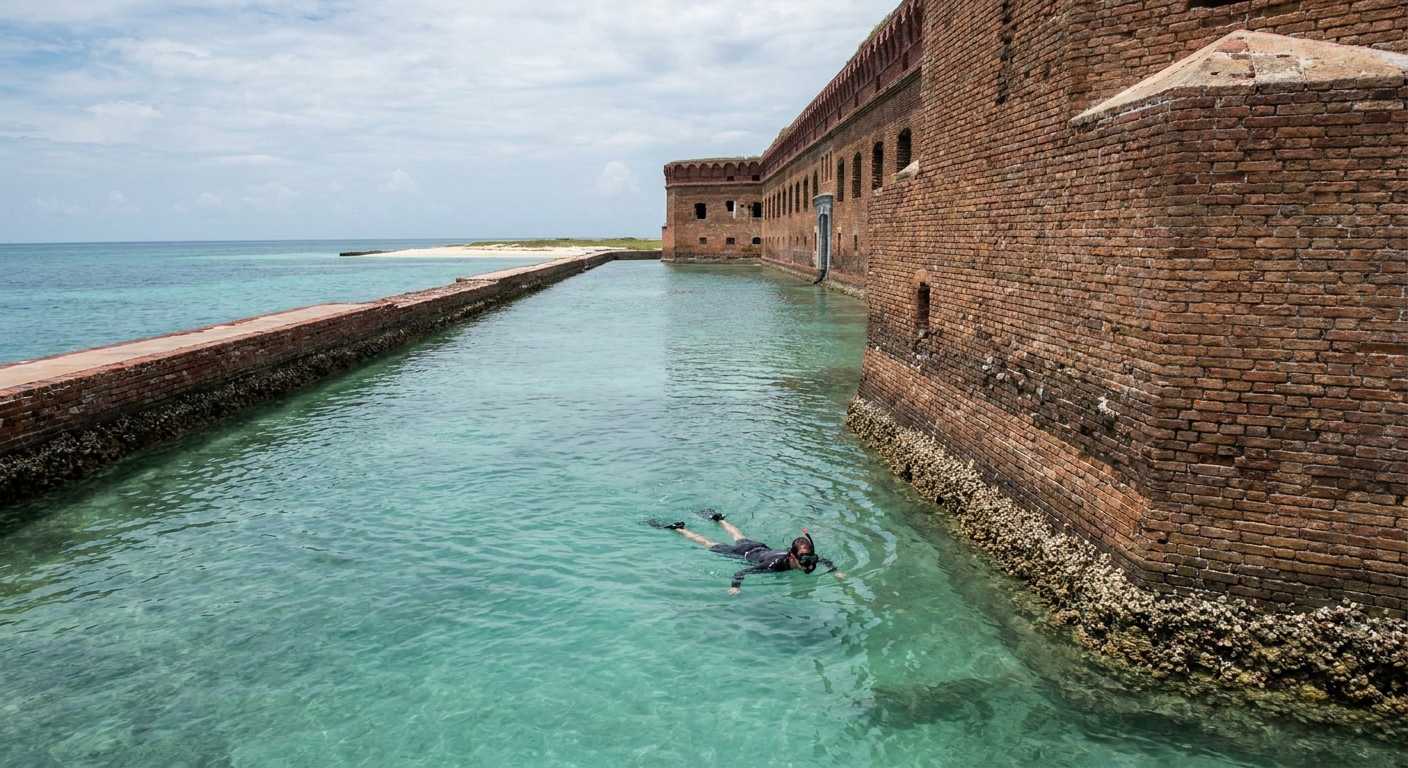
April hands a snorkeler a pairing neither neighbor matches at once: a sea at 79.8°F in daily maxima, 1.2°F warmer than March, alongside 2.8 days of measurable rain against May’s 4.1. A beach snorkel and a slow circuit of the fort in 82.6°F afternoons fit comfortably into the same day, without the 85.9°F highs of the month that follows.
Fort Jefferson fills most of Garden Key, and the walk along its moat wall loops the brick with open water on one side. The swimming beach on the same island is where most snorkelers start, working along the outer edge of the moat wall in water the marine series puts at 79.8°F at the April daily peak. Loggerhead Key, the larger island to the west with its lighthouse, sits across open water from the fort.
Between March and April the average high climbs 3.0°F while the sea gains 1.2°F. Into May the order flips: the sea jumps 4.8°F and the air 3.3°F. In April the water therefore stays cooler than the afternoon air, so plan the long snorkel for early afternoon, when both reach their daily peak, and keep the fort walk for the morning.
We could not verify the park entrance fee or any fee-free day in April, so we name none. Once you are on Garden Key, the moat wall walk costs nothing, nor does the view across to Loggerhead Key’s lighthouse or the night sky seventy miles out from the lights of Key West.
Dry Tortugas in April: a two-day itinerary
Day one. Take the morning boat or seaplane out of Key West, and check the departure time with the operator, since we did not verify it. On arrival, walk Fort Jefferson before the day warms toward its 82.6°F average high, then circle the moat wall. Snorkel the beach in early afternoon, with the water at its daily peak near 79.8°F. Campers set up once the day visitors have gone, eat early and walk out to the moat wall for the 7:50 pm sunset.
Day two. Be on the east side of the fort for the 7:03 am sunrise, then take a second snorkel before breakfast in water a little cooler than the previous afternoon, rash guard on. If a shower rolls through, the fort’s brick casemates give cover until it passes. Ask the operator the evening before about sea conditions for the return, and have your gear packed in dry bags before the boat is due.
Dry Tortugas in April vs March and May
| Measure | March | April | May |
|---|---|---|---|
| Average high (Key West, NOAA) | 79.6°F | 82.6°F | 85.9°F |
| Average low (Key West, NOAA) | 69.3°F | 73.1°F | 76.4°F |
| Precipitation (Key West, NOAA) | 1.53 in | 2.07 in | 3.12 in |
| Days with 0.10 in or more | 2.9 | 2.8 | 4.1 |
| Sea, mean of daily maxima (Open-Meteo Marine, 2015-2024) | 78.6°F | 79.8°F | 84.6°F |
On the Key West normals, March runs 79.6°F by day and 69.3°F by night, April 82.6°F and 73.1°F, May 85.9°F and 76.4°F. Rain totals climb from 1.53 inches to 2.07 to 3.12, yet April logs 2.8 days of measurable rain against 2.9 in March and 4.1 in May, so its extra water falls on fewer, heavier days. At sea the marine series goes 78.6°F, 79.8°F, then 84.6°F.
Move to March and you give up 1.2°F of sea and 3.0°F of afternoon warmth for a month with 0.54 inch less rain, and you land in the spring-break month our Florida guide flags. Move to May and you gain 4.8°F of water, the change most swimmers would notice on entry, but you add 1.3 wet days and walk the fort in 85.9°F afternoons.
Is April a good time to visit Dry Tortugas?
Yes, for snorkelers and fort walkers who want good odds of a dry day and water within a fraction of 80°F, and for campers happy with 73.1°F nights. It suits less well anyone who gets cold in water under 80°F, and travelers who need a calm crossing guaranteed, since we found no wind or swell data for the park.
If the water is your sticking point, pick May: its sea reaches 84.6°F on the marine series, at the cost of 4.1 wet days and warmer afternoons. If cooler air matters more than the swim, read Dry Tortugas in March first.
Of March, April and May, April is the one that pairs the fewest days of measurable rain, 2.8, with a sea within a fraction of 80°F.
The last word
Book the crossing first and build the rest of the trip around it. In April the sea’s daily peak off the islands sits 2.8°F below Key West’s 82.6°F average afternoon high, so the water is at its most welcoming exactly when the sun is highest. Pack the rash guard, swim after lunch, and keep the moat wall for the sunset.
Sources & data for this guide
- April, March and May air normals, precipitation and rain days · NOAA NCEI monthly normals 1991-2020, station USW00012836 (Key West, seventy miles east of the park) · checked Sep 24, 2026
- Sea surface temperature, mean of daily maxima, March to May · Open-Meteo Marine API, 2015-2024 average · checked Sep 24, 2026
- Daylight, sunrise and sunset on April 15 · sunrise-sunset.org, converted from UTC to Eastern Daylight Time · checked Sep 24, 2026
- Dry season and spring-break timing · our Florida guide · checked Sep 24, 2026
- What we could not verify: ferry and seaplane fares and schedules, park entrance fee, campsite fee, lodging-tax rate, wind and swell data. The twilight timing is our estimate. Check the park and the operators when you book.