
PORTO · WHERE TO STAY · BY NEIGHBORHOOD
Porto is built on the side of a gorge. The Douro cuts through granite, the city climbs the north wall in terraces of tiled houses, and Vila Nova de Gaia climbs the south wall facing back. That geometry decides more about a stay than any star rating. The quarter you book sets how far you walk, how much of that walk is vertical, and whether the sound outside your window at one in the morning is a river-cruise loudspeaker or nothing at all. Seven areas below, what each gives, and what each costs you.
THE SHORT ANSWER · PORTO
First visit: sleep in the upper Baixa around Aliados and Trindade, which keeps you out of the biggest climb back from the Ribeira. Want the view of Porto rather than Porto itself: cross to Gaia.
FIRST-TIMERS: BAIXA · POSTCARD: RIBEIRA · CREATIVE CALM: CEDOFEITA · VALUE: BONFIM · THE VIEW: GAIA
The rule of thumb: choose your bank of the river first, then your altitude. In Porto the walk home matters more than the walk out.
Think twice about: a Ribeira lane if you arrive with a full-size suitcase, and Foz or Boavista if you want to walk back from dinner in the old town.
Neighborhood character and the slope notes: editorial · Transit: Metro do Porto and STCP network maps · full sources at the end
Baixa, Aliados and Clérigos: Porto’s central place to stay
The commercial heart: the wide slope of Avenida dos Aliados, the Clérigos tower on its high point, São Bento station with its tiled hall, the Bolhão market, and Rua de Santa Catarina running north for shopping. Metro and buses converge here, so no day needs planning. Two costs come attached. The bar streets around Galerias de Paris run loud on Friday and Saturday nights, and this is the slice of town every visitor crosses at some point. Ask for a room off the street.
The Ribeira: the postcard, and the climb back up from it
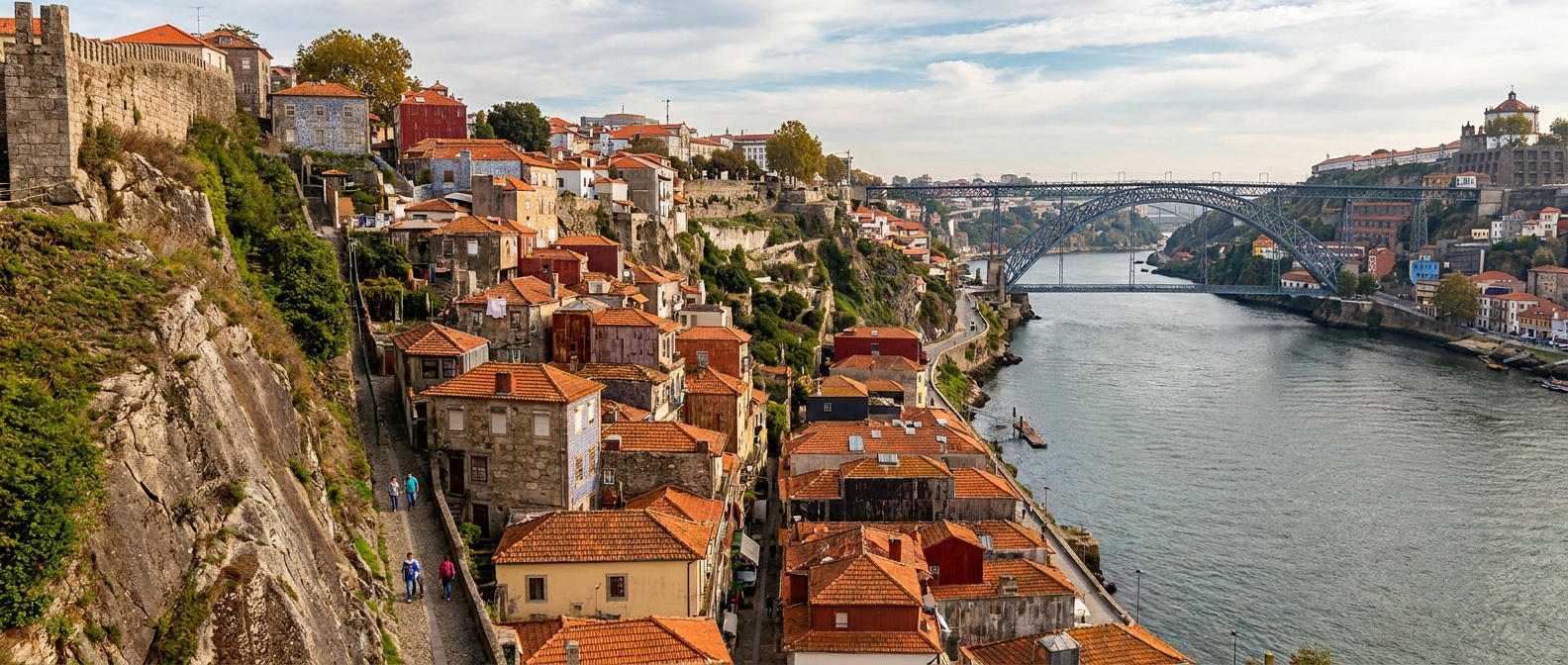
The riverside strip under the bridge is the image people book Porto for: houses stacked in six colors, arcades, terraces along the quay. It is also the hardest address in the city to reach with luggage. Lanes turn into steps, taxis stop where the cobbles start, and rooms inside old granite walls can hold the damp through winter. Nights run loud until the last terrace shuts. Book here if the view is the point of the trip.
Cedofeita and Rua Miguel Bombarda: galleries, shops and residential streets
West of Aliados, Cedofeita is the city off duty. Rua Miguel Bombarda gathers contemporary galleries and the small design shops around them, with coordinated openings a few times a year (worth checking the dates directly). Around that: bookshops, coffee counters, apartment blocks, a hall of independent stalls. This is our editorial pick for a second visit or a stay of a week. The trade is distance, roughly fifteen minutes on foot (est.) down to the river, and the same back up.
Where to stay in Bonfim, Porto: the local quarter
East of the center, Bonfim runs on workshops, tascas with paper tablecloths and, increasingly, renovated buildings with studios inside them. It hands you the everyday city, and by our reading you get more room for the money here than at a river-view address (est.); the budget picture is laid out in what a Portugal trip costs. Instant charm is not part of the deal. Streets run plain for long stretches, and the walk in from Campanhã is functional rather than scenic.
Vila Nova de Gaia: the view of Porto, with the port lodges below
The south bank is where you look at Porto instead of standing in it, and the terrace beside the Serra do Pilar monastery pays for the room by itself. The port lodges line the streets under it, because Gaia has aged and shipped the wine for generations, though estates upriver keep cellars of their own. Tour and tasting arrangements change, so book and confirm hours with the lodge. The cost of the view: every dinner in the old town starts with a bridge.
Foz do Douro: the ocean end, well out of the center
Where the river meets the Atlantic: a seafront promenade, a lighthouse, gardens, fish grilled near the water, and a residential calm with no relation to the tourist city. The metro does not reach it. You arrive by bus or on the heritage tram along the riverbank to Passeio Alegre, a pleasure the first time and a commute after that. The ocean stays cool even in August, and the seafront is exposed when the wind gets up. Good for a slow week, poor for two nights (est.).
Boavista: offices, Casa da Música and a metro hub
The business district around the Rotunda da Boavista: corporate towers, hotels with real desks in the rooms, and Casa da Música anchoring the square. It is flat, well connected by metro, and about as atmospheric as business districts get anywhere. A room here makes sense for a concert night or a work trip with meetings attached. Nothing on the street tells you which city you are in, and the old town is a ride away rather than a stroll.
Is Porto hilly? The climb from the river and the lifts that shorten it
Porto has one dominant gradient, not a set of separate hills: the ground rises from the quay to the upper town in a single wall, and does it again on the Gaia side. The question is not which hill you pick, it is how often you go down to the water. The Guindais funicular, the top deck of the Dom Luís I as a level crossing, and the Gaia cable car each remove a climb. Hours change by season, so check before relying on them.
The seven Porto neighborhoods: slope, night noise and the walk to the river
| Neighborhood | Slope with a bag | Night noise | Nearest transit | To the Ribeira on foot | Best for | The catch |
|---|---|---|---|---|---|---|
| Baixa / Aliados / Clérigos | Moderate, paved streets | High Fri–Sat near the bar streets | Metro at Aliados and Trindade, rail at São Bento | Downhill out, uphill back (est. 10 min) | First visits | Shared with every other visitor |
| Ribeira | Steep, steps and cobbles | High and late, along the quay | Buses and the Guindais funicular at the edges | You are in it | Atmosphere, river traffic | Damp rooms, hard arrivals |
| Cedofeita / Miguel Bombarda | Gentle, mostly even streets | Low to moderate | Metro on the Boavista corridor | Around 15 min down (est.) | Galleries, longer stays | Fewer sights at the door |
| Bonfim | Rolling but walkable | Low, residential | Heroísmo metro, Campanhã rail | Around 20 min (est.) | Value, local streets | Charm arrives in patches |
| Vila Nova de Gaia (riverside) | Steep between bridge and quay | Moderate, quieter after dark | Jardim do Morro metro, cable car | Cross the bridge | Port lodges, the skyline | Everything else is a crossing |
| Foz do Douro | Flat along the seafront | Low | Bus, heritage tram to Passeio Alegre | Not on foot | Sea air, slow days | Far from the old town |
| Boavista | Flat plateau | Low | Casa da Música metro interchange | Not on foot | Concerts, work trips | No old town of its own |
North bank or south bank: Porto or Gaia for the nights
Booking Gaia puts the postcard in your window and the port lodges at the bottom of your street. It also puts the bridge into every day, in both directions. The upper deck of the Dom Luís I walks level from Jardim do Morro into the old town and the metro runs across it, so the crossing is short. Short is not the same as nothing, and a late dinner in the Ribeira becomes a decision rather than a stroll.
Two to three nights (est.) covers the city, more if you are taking the train upriver or working through the day trips out of Campanhã. Our call: north bank for a first stay, and cross for an afternoon among the lodges. Whatever the address, ask for a room off the street, because granite reflects sound and the lanes funnel it upward. If the choice of city itself is still open, that argument sits in Lisbon vs Porto.
On this page
- First stay, everything within a walkBaixa, Aliados and Clérigos
- The riverfront postcard, steps includedThe Ribeira
- Galleries, coffee and quiet blocksCedofeita and Miguel Bombarda
- Local streets and more room for the moneyBonfim
- Port lodges and the skyline of PortoVila Nova de Gaia
- Ocean air, promenade, no old townFoz do Douro
- Which streets you climb with a suitcaseThe slope, and the funicular and cable car
Nothing on that list is more than a bus, a heritage-tram ride, a short metro hop or one bridge crossing from the rest, and the old town itself is small enough to cross on foot.
The last word
Run the address through three tests before you pay. Can a taxi stop within sight of the door, or does the last stretch turn into steps. Is the window on the party side of the building or the back. And picture the return at eleven at night, uphill, after a long dinner, because in Porto that is the walk you will remember from the trip.
Then choose the version of the city you want to wake up in: river traffic and granite in the Ribeira, gallery shutters going up on Miguel Bombarda, lodge signs across the water in Gaia. Once the room is settled, the pleasant reading is left: what to do in the city, where the trains go from Campanhã, and the region beyond it if the trip keeps heading north.
Sources & data for this guide
- Neighborhood character, the slope column and the night-noise column · editorial, from our own visits · checked Sep 3, 2026
- Metro lines, stations, the airport link and the Guindais funicular · Metro do Porto network map · checked Sep 3, 2026
- City buses and the historic tram line along the river to Foz · STCP, Porto public transport · checked Sep 3, 2026
- Districts, quarters and visitor information · Visit Porto (official city tourism) · checked Sep 3, 2026
- Editorial note: this page names no hotels and quotes no room rates, opening hours or tasting fees on purpose. Prices are handled in the trip cost guide, and lodge, funicular and cable-car hours move with the season, so confirm them with the operator. Night counts and walking times marked (est.) are our recommendations, not measurements.