
BIG CYPRESS NATIONAL PRESERVE · FEBRUARY · THE TAMIAMI TRAIL
February on the Tamiami Trail brings dry-season light over the cypress strands, cool mornings and a sunset at 6:14 p.m. Big Cypress National Preserve lies inland between Miami and Naples. Its sawgrass prairie, pinelands and cypress domes line US 41, and most drivers only see them through the windshield. In February it is worth pulling over.
Highs near 78°F, about three and a half rain days and a little over 11 hours of daylight put February among the easy months to spend whole days outside here. The main catch is a cool start, and the official normals understate it for an inland swamp. Everything that does not depend on the date, from the drive in to the layout of the preserve, is in our Big Cypress guide.
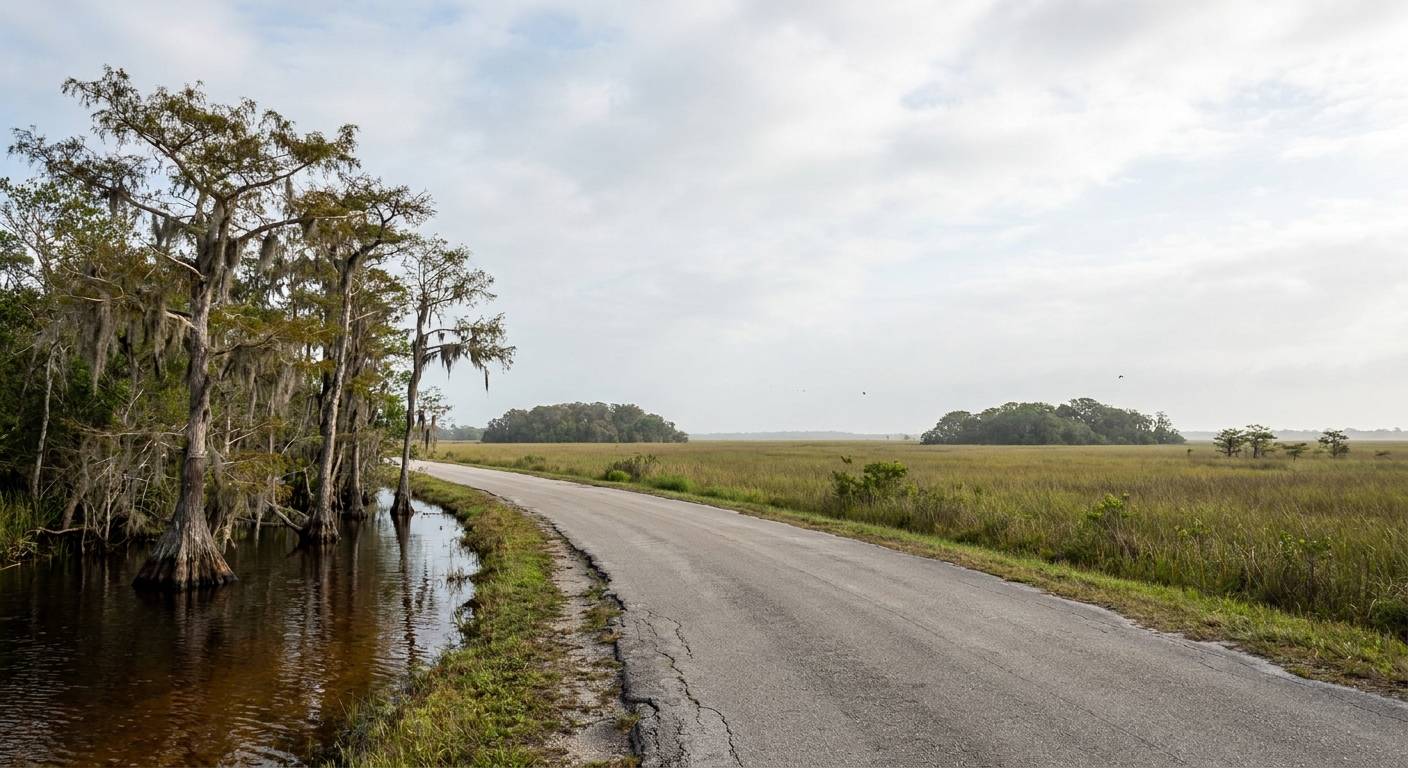
THE MONTH AT A GLANCE · BIG CYPRESS · FEBRUARY
February is a strong month for Big Cypress, with 78.2°F afternoons and 3.6 rain days at the Miami station, plus inland mornings cool enough to call for a layer.
DRY SEASON · 3.6 RAIN DAYS · SUNSET 6:14 PM EST
Go for: cool-morning boardwalks, gravel scenic drives and trail miles in dry-season weather, on a two-day trip based near US 41.
Think twice before: counting on warm dawns. The Miami normals show 63.2°F lows, and inland nights run colder than the coast.
Climate: NOAA NCEI 1991-2020, Miami station USW00012839 · Daylight: sunrise-sunset.org · full sources at the end
On this page
- Big Cypress weather in February78.2°F highs, 63.2°F lows, 3.6 rain days
- What to wear in Big Cypress in FebruaryA 15-degree swing from dawn to afternoon
- Crowds, booking and lodging tax in FebruaryDry-season demand and beds near US 41
- Things to do in Big Cypress in FebruaryOasis Visitor Center, Kirby Storter, Loop Road
- A two-day Big Cypress itinerarySunrise at 6:54 a.m. to sunset at 6:14 p.m.
- February vs January or MarchJanuary 2°F cooler, March 2.4°F warmer
- Is February a good time to visit?Who should go and who should wait for March
Every figure here comes from NOAA’s National Centers for Environmental Information: the official 1991-2020 monthly normals for station USW00012839, in Miami, on the coast. That is a real thermometer rather than a reanalysis grid cell, but it stands well east of the preserve. Big Cypress lies inland along the Tamiami Trail, where winter nights run colder than the city’s and summer afternoons hotter. Read the lows below as an upper bound for the swamp at dawn.
Big Cypress National Preserve weather in February: average highs, lows and rain days
| February normal (Miami station) | Value |
|---|---|
| Average high | 78.2°F |
| Average low | 63.2°F |
| Precipitation | 2.15 in |
| Days with 0.10 in or more | 3.6 |
| Days with 1 in or more | 0.5 |
| Daylight on February 15 | 11 h 20 min |
| Sunrise / sunset on February 15 | 6:54 a.m. / 6:14 p.m. EST |
NOAA’s 1991-2020 normals put the average February high at 78.2°F and the average low at 63.2°F, with 2.15 inches of precipitation across the month. They are thirty-year averages from a physical station in Miami. Inland, expect mornings to open cooler than 63.2°F. We found no preserve station reading to put a number on the difference.
Measurable rain, a tenth of an inch or more, falls on 3.6 days in an average February, roughly one day in eight. A soaking day of an inch or more averages half a day per February. Of those 3.6 wet days, most stay light, so a two-day trip has good odds of dry boardwalks and firm gravel.
From the average low to the average high, February spans 15.0°F. Pack for both ends in one daypack: a fleece or light jacket that folds small, a refillable water bottle, a sun hat, sunscreen and insect repellent. A thin rain shell covers the 3.6 wet days without taking much room. Add closed shoes with a grippy sole for the gravel of Loop Road and Turner River Road.
February 15 brings about 11 hours 20 minutes of daylight. The sun rises at 6:54 a.m. and sets at 6:14 p.m. Eastern Standard Time, converted from sunrise-sunset.org’s UTC times. Plan the last walk to end by six. Under the cypress canopy the light fades before the official sunset, and US 41 through the preserve is a two-lane road with long unlit stretches.
How warm is Big Cypress National Preserve in February?
Average highs of 78.2°F and lows of 63.2°F leave 15.0°F between dawn and mid-afternoon at the Miami station. Both ends sit about two degrees above January (76.2°F and 61.0°F) and 2.4°F below March (80.6°F and 65.6°F). The coastal thermometer runs warm at night compared with the preserve, so the low is the figure to read with caution.
For a 7 a.m. start, long pants and a fleece over a T-shirt make sense. By late morning the fleece goes in the pack. Afternoons near 78°F feel like early summer in much of the country, so a brimmed hat and sunscreen matter more than a jacket on the open prairie along Turner River Road.
Our sources give no count of nights at or below 32°F, so we cannot say how often February freezes in the preserve. Cold fronts do reach South Florida in winter, and inland lows fall below the coast’s. If a front appears in the forecast for your travel week, add a warm hat and a second layer for the dawn walks.
How busy is Big Cypress National Preserve in February? Crowds and prices
February falls inside Florida’s dry season, which the National Weather Service places from November through April, and our Florida best-time guide maps it month by month. It sits squarely in the December-to-April window our Florida guides recommend for Naples and the southwest. We found no room-rate or occupancy series for the towns around the preserve, so we rank no month cheaper or dearer than another.
We could not verify booking lead times, so we give no number of weeks. Book a refundable room once your dates firm up, then recheck the price closer to the trip. For flights, RSW in Fort Myers serves the Naples side and MIA or FLL the Miami side. Our Florida flights guide compares the three airports.
We could not verify the lodging-tax rate in the counties around the preserve, so we give no percentage. When you compare hotels in Everglades City, Naples or Miami, ask for the total with taxes and any resort fee included before you book.
If you spend more on one item, make it proximity. A bed in Everglades City or on the Naples side puts you on a boardwalk soon after the 6:54 a.m. sunrise, while the air is still near its overnight low. A room in Miami adds a morning drive across the state. Our getting-around guide covers the roads, and our trip-cost guide sets out the budget tiers.
Things to do in Big Cypress National Preserve in February
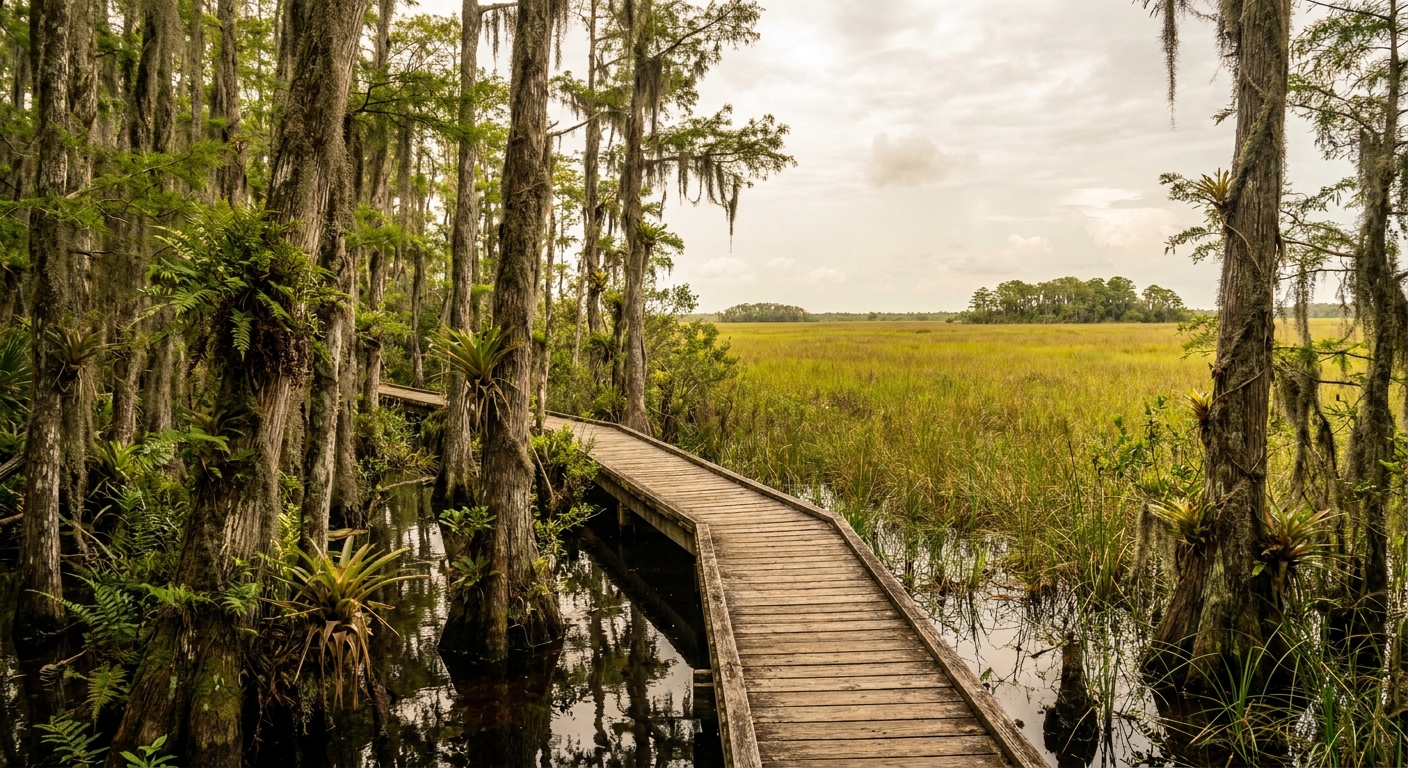
Cool dawns and 3.6 rain days make February a month for long walks in the open. The Florida National Scenic Trail begins in the preserve, and the pinelands and prairie along it offer little shade. Summer turns the same ground over to the wet season’s afternoon storms, as our Florida overview describes, and March already adds 2.4°F to the average high.
Start at Oasis Visitor Center on US 41 for maps, road conditions and any ranger programs. The Kirby Storter Roadside Park boardwalk leads into a cypress strand from a pullout on the Tamiami Trail. H.P. Williams Roadside Park marks the start of Turner River Road, a gravel drive north through prairie and cypress. South of the highway, Loop Road is a gravel scenic drive through the swamp. We could not verify boardwalk lengths, parking counts or opening hours, so we quote none. The preserve posts current details at nps.gov/bicy.
None of these places changes shape with the calendar. The air around them does: at the Miami station a February dawn averages 63.2°F against 61.0°F in January, and the afternoon reaches 78.2°F against 76.2°F. That step of about two degrees makes a sunrise walk at Kirby Storter a little milder than in January, with rain days almost unchanged (3.6 against 3.8).
We could not verify an entrance fee, a campground rate or the price of any guided program for February, so we quote none. Check the fees at nps.gov/bicy before you go. The daylight costs nothing: 11 hours 20 minutes on February 15.
Big Cypress National Preserve in February: a two-day itinerary
Day one. Reach Kirby Storter Roadside Park around 7:30 a.m., about half an hour after the 6:54 a.m. sunrise, while the air sits close to the overnight low. Walk the boardwalk, then drive to Oasis Visitor Center for maps and conditions. By late morning, with the fleece off, take Turner River Road north from H.P. Williams Roadside Park at an easy speed. Pack lunch or eat in Everglades City. Around 4 p.m., return to the Tamiami Trail pullouts for the late light and start the drive back before the 6:14 p.m. sunset.
Day two. Drive Loop Road in the morning, slowly, with frequent stops. In the afternoon, walk a stretch of the Florida Trail near Oasis, or continue east on US 41 to Shark Valley in Everglades National Park. If rain arrives, skip the gravel roads while they are wet and keep to the paved Tamiami Trail stops, then move Loop Road to the next dry morning. With 3.6 rain days in an average February, a two-day trip usually finds one.
Big Cypress National Preserve in February vs January and March
| Miami station normal | January | February | March |
|---|---|---|---|
| Average high | 76.2°F | 78.2°F | 80.6°F |
| Average low | 61.0°F | 63.2°F | 65.6°F |
| Dawn-to-afternoon spread | 15.2°F | 15.0°F | 15.0°F |
| Precipitation | 1.83 in | 2.15 in | 2.46 in |
| Days with 0.10 in or more | 3.8 | 3.6 | 3.5 |
Across the three months at the Miami station, the average high climbs from 76.2°F in January to 78.2°F in February and 80.6°F in March. The low follows, from 61.0°F to 63.2°F to 65.6°F. Precipitation rises from 1.83 to 2.15 to 2.46 inches, while rain days barely move: 3.8, 3.6 and 3.5. We could not verify a sea temperature for any of the three months, so we give none. If we add a Gulf reading later, it will be a mean of daily maxima, a little warmer than a 24-hour average.
Going four weeks earlier, to January, takes 2.0°F off the afternoon and 2.2°F off the dawn, with 0.32 inch less rain over the month. Going four weeks later, to March, adds 2.4°F at both ends and 0.31 inch of rain. Our Big Cypress in January guide covers the cooler option.
Is February a good time to visit Big Cypress National Preserve?
Yes, for walkers, drivers and anyone planning long hours outside without summer heat: February averages 78.2°F afternoons and 3.6 rain days at the Miami station. It suits a two-day trip based near the Tamiami Trail. It suits less well a traveler who dislikes cold starts, since inland dawns begin below the 63.2°F coastal average.
If cool mornings rule February out, pick March. Its normals run 65.6°F at dawn and 80.6°F in the afternoon, with 3.5 rain days, the fewest of the three months. You accept 0.31 inch more rain over the month than in February.
Among its two neighbors, February combines fewer rain days than January with less total rain than March.
The last word
Book the bed near the preserve, set an alarm for the 6:54 a.m. sunrise, and take February as the Miami station records it: 78.2°F afternoons after a fleece-cool start. Keep one calendar detail in mind. The whole month runs on Eastern Standard Time, and clocks move forward on the second Sunday of March, so a March trip gets its sunsets an hour later on the clock.
Sources & data for this guide
- February, January and March normals (highs, lows, precipitation, rain days) · NOAA NCEI 1991-2020 monthly normals, station USW00012839, Miami · checked Sep 24, 2026
- Station scope: the thermometer stands on the coast in Miami, not in the preserve, and inland winter nights run colder · NOAA NCEI · checked Sep 24, 2026
- Daylight and sunrise/sunset on February 15, converted from UTC to Eastern Standard Time · sunrise-sunset.org · checked Sep 24, 2026
- Florida dry and wet seasons · National Weather Service, via our Florida overview · checked Sep 24, 2026
- What we could not verify: sea temperature, freeze-night counts, room rates, booking lead times, the lodging-tax rate, entrance fees, boardwalk lengths and visitor-center hours. We quote none of them · check nps.gov/bicy when you book.
To plan your stay
- Best Time to Visit Big Cypress National Preserve: Dry Season Months, Summer Heat and Rainfall
- Big Cypress National Preserve in January: Weather, Daylight, Crowds and a Two-Day Itinerary
- Big Cypress National Preserve in March: Weather, Rain Days, Crowds and a Two-Day Plan
- Big Cypress National Preserve in April: Weather, Rain Days, Daylight and Things to Do